PRECISION AEROBATICS XR-61 ARF
Mike Hurley
A well-designed and capable aerobat

It’s been a while since I’ve had the chance to fly anything smaller than a 30% model, but lately I’ve gotten the bug for a small airplane. I have been looking hard at available offerings.
I’ve been building models for many years, and I love the design and sophistication of built-up wood aircraft. Done right, they can be so beautiful. I had already decided to try one of the products from Precision Aerobatics, so when I received the offer to review the company’s XR-61, I was thrilled.
Precision Aerobatics’ designs fit my style and sense of aesthetics. The company’s aircraft are designed much like a Giant Scale aerobatic airplane with slightly more delicate construction and more attention to keeping the structure lightweight.
The engineering and attention to detail of the XR-61’s construction are not only beautiful, but fascinating. It’s like lace made from wood. The computer-designed structures are so fine that if cut and built from only wood, they might have been too sparse, but with the use of Precision Aerobatics’ FiberFusion technology—a combination of thin carbon-fiber lamination and carefully placed carbon-rod reinforcements and crossmembers—this seemingly delicate structure is not only lightweight, but rigid and strong enough to endure the abuse of 3-D hucking (freestyle flying).
When the XR-61 arrived, I was anxious to check it out and happy to see that it was built just like my big airplanes—beautiful carbon-fiber landing gear bolted on from the bottom, wheel pants and cuffs just like my big airplanes, a carbon-fiber wing tube, a carbon-reinforced fiberglass cowl, and even a pull-pull rudder system with Kevlar cables.
There’s a carbon-fiber battery tray and the hatch lifts off with a single pin-style latch. The wings slide onto a carbon-fiber tube and bolt to the fuselage from the inside. All of the servo mounting positions and linkages are assembled as I would do it on a bigger aircraft (but appropriately lighter). It’s a miniature

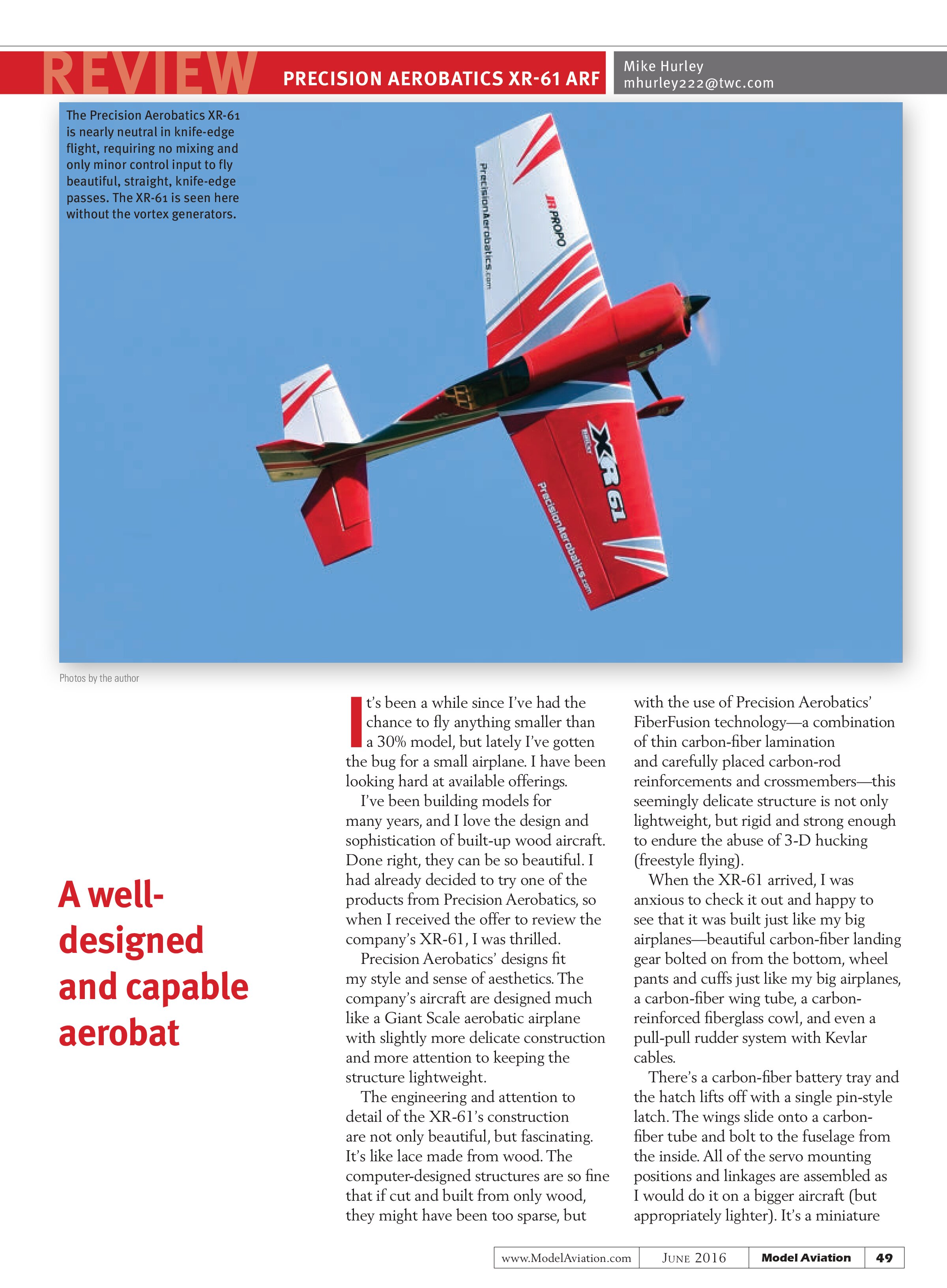
version of an International Miniature Aerobatic Club (IMAC)-style airplane. The XR-61 is not a scale aircraft and my first impression was that the design seems meant to cross the boundary between precision flight and 3-D. The oversize wing and tail surfaces have a wide chord and large control surfaces for 3-D, but the long fuselage indicates the designer wanted smooth, stable lines. These two features are usually not found on one model when the intent is something such as a fun-fly 3-D aircraft or inversely, a mini aerobatic airplane.
The XR-61’s scalelike look could be mistaken for a scale aircraft that has been optimized for an extreme flight envelope, but the steep canopy angle, long front deck, and stylized cowl give it a sleek, racy feeling, almost like a cross between an Extra and a 1930s-era Thompson Trophy racer.
I’ve built electric-powered airplanes before and used drive systems based on advice from other modelers or recommendations from manufacturers. Precision Aerobatics’ optional integrated Performance Airframe-Drive System (iPAs) made me smile by taking out the guesswork.
The company has done all of the work for you. Precision Aerobatics spent a great deal of time developing the perfect combination of motor, battery, speed control, and propeller so that you don’t have to worry. This isn’t a conservative, underpowered, off-the-shelf offering; it’s a well-designed, no-compromises package optimized to work with the airframe.
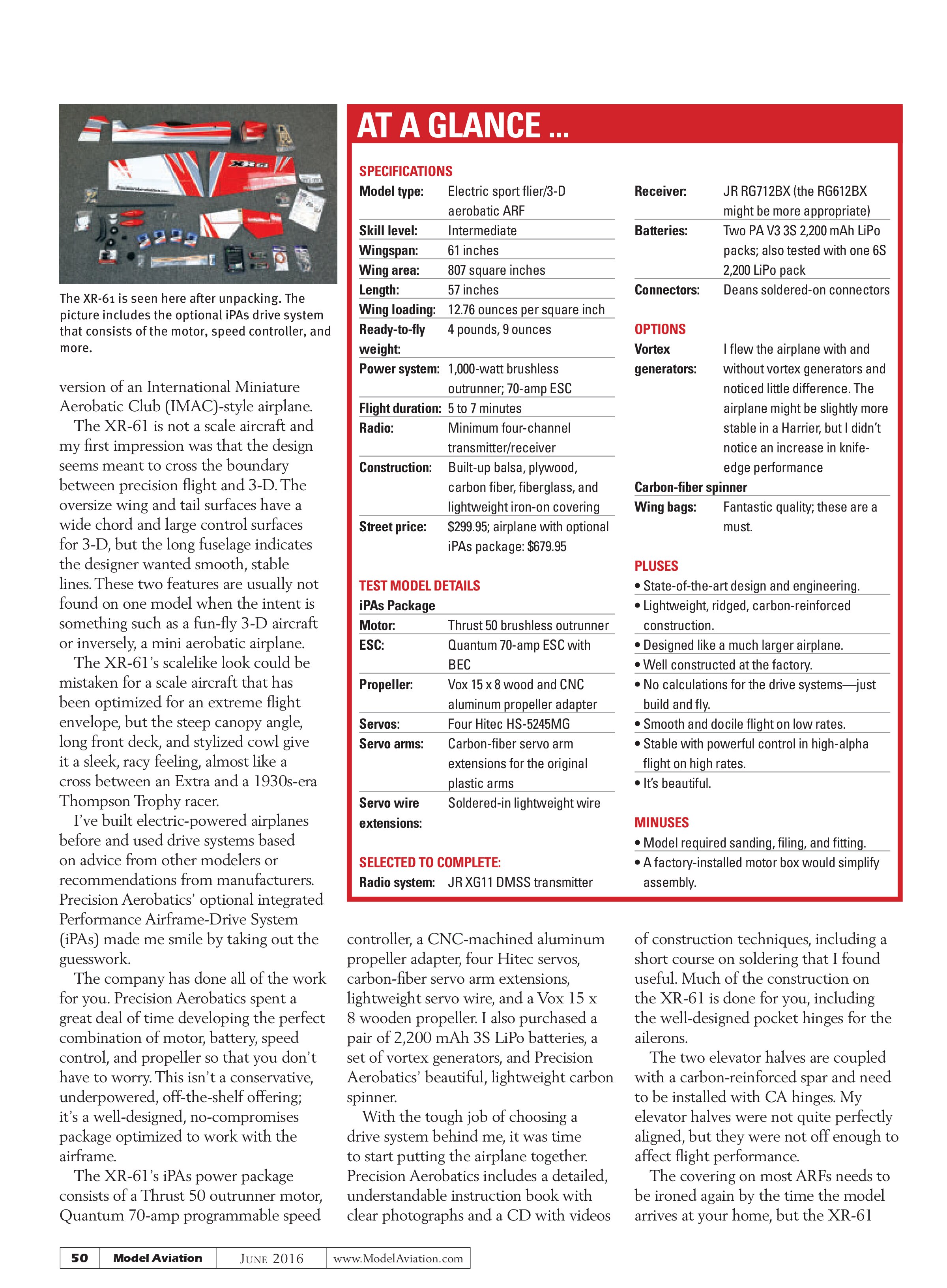
The XR-61’s iPAs power package consists of a Thrust 50 outrunner motor, Quantum 70-amp programmable speed controller, a CNC-machined aluminum propeller adapter, four Hitec servos, carbon-fiber servo arm extensions, lightweight servo wire, and a Vox 15 x 8 wooden propeller. I also purchased a pair of 2,200 mAh 3S LiPo batteries, a set of vortex generators, and Precision Aerobatics’ beautiful, lightweight carbon spinner.
With the tough job of choosing a drive system behind me, it was time to start putting the airplane together. Precision Aerobatics includes a detailed, understandable instruction book with clear photographs and a CD with videos of construction techniques, including a short course on soldering that I found useful. Much of the construction on the XR-61 is done for you, including the well-designed pocket hinges for the ailerons.
The two elevator halves are coupled with a carbon-reinforced spar and need to be installed with CA hinges. My elevator halves were not quite perfectly aligned, but they were not off enough to affect flight performance.
The covering on most ARFs needs to be ironed again by the time the model arrives at your home, but the XR-61
AT A GLANCE ...
SPECIFICATIONS
Model type: Electric sport flier/3-D aerobatic ARF
Skill level: Intermediate
Wingspan: 61 inches
Wing area: 807 square inches
Length: 57 inches
Wing loading: 12.76 ounces per square inch
Ready-to-fly weight: 4 pounds, 9 ounces
Power system: 1,000-watt brushless outrunner; 70-amp ESC
Flight duration: 5 to 7 minutes
Radio: Minimum four-channel transmitter/receiver
Construction: Built-up balsa, plywood, carbon fiber, fiberglass, and lightweight iron-on covering
Street price: $299.95; airplane with optional iPAs package: $679.95
TEST MODEL DETAILS
iPAs Package
Motor: Thrust 50 brushless outrunner
ESC: Quantum 70-amp ESC with BEC
Propeller: Vox 15 x 8 wood and CNC aluminum propeller adapter
Servos: Four Hitec HS-5245MG
Servo arms: Carbon-fiber servo arm extensions for the original plastic arms
Servo wire extensions: Soldered-in lightweight wire
SELECTED TO COMPLETE:
Radio system: JR XG11 DMSS transmitter
Receiver: JR RG712BX (the RG612BX might be more appropriate)
Batteries: Two PA V3 3S 2,200 mAh LiPo packs; also tested with one 6S 2,200 LiPo pack
Connectors: Deans soldered-on connectors
OPTIONS
Vortex generators: I flew the airplane with and without vortex generators and noticed little difference. The airplane might be slightly more stable in a Harrier, but I didn’t notice an increase in knife-edge performance
Carbon-fiber spinner
Wing bags: Fantastic quality; these are a must.
PLUSES
- State-of-the-art design and engineering.
- Lightweight, ridged, carbon-reinforced construction.
- Designed like a much larger airplane.
- Well constructed at the factory.
- No calculations for the drive systems—just build and fly.
- Smooth and docile flight on low rates.
- Stable with powerful control in high-alpha flight on high rates.
- It’s beautiful.
MINUSES
- Model required sanding, filing, and fitting.
- A factory-installed motor box would simplify assembly.
and if the speed was up or there was a little headwind, it would balloon before settling in. Moving the CG forward slightly took care of this issue.
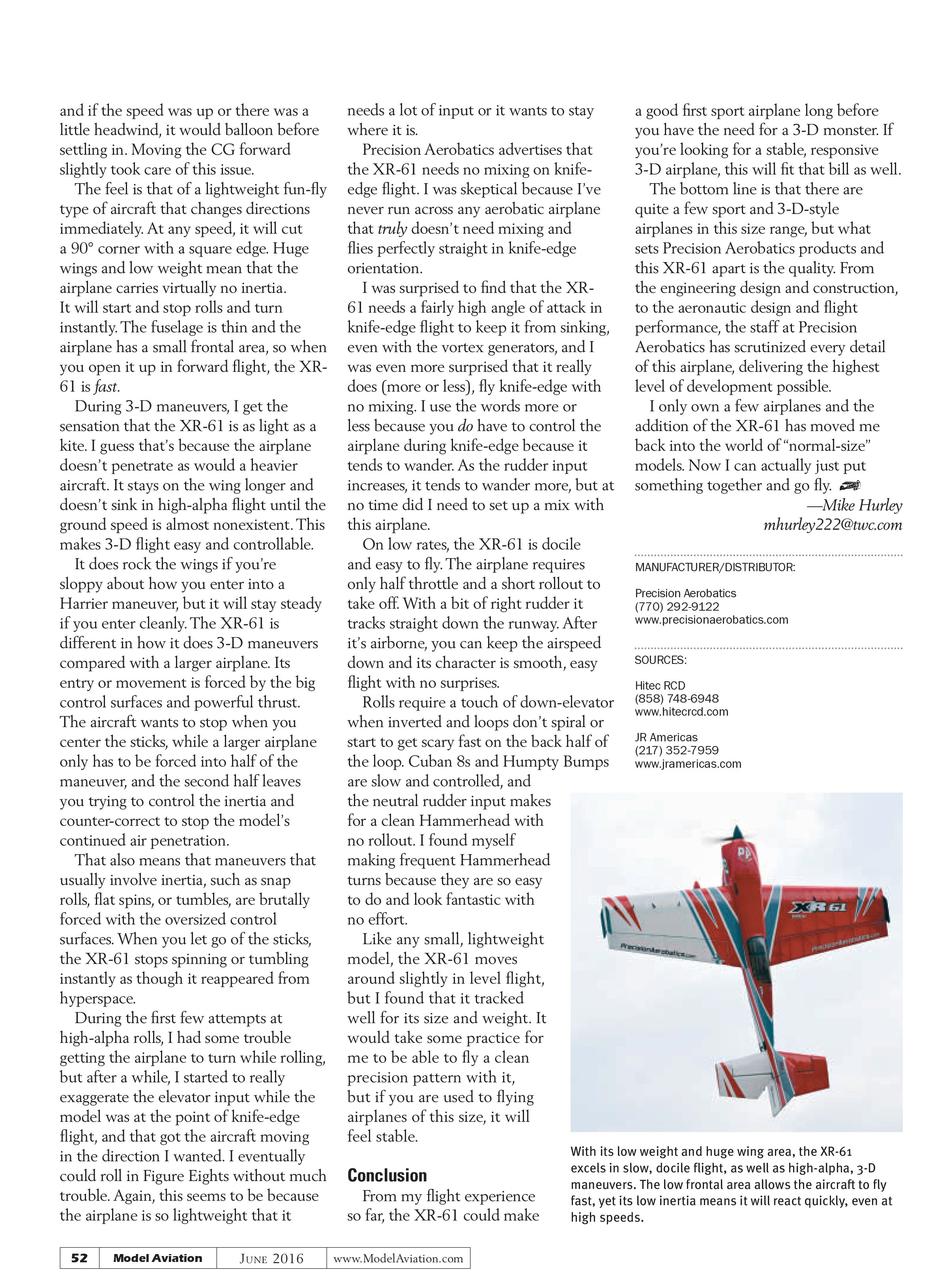
The feel is that of a lightweight fun-fly type of aircraft that changes directions immediately. At any speed, it will cut a 90° corner with a square edge. Huge wings and low weight mean that the airplane carries virtually no inertia. It will start and stop rolls and turn instantly. The fuselage is thin and the airplane has a small frontal area, so when you open it up in forward flight, the XR-61 is fast.
During 3-D maneuvers, I get the sensation that the XR-61 is as light as a kite. I guess that’s because the airplane doesn’t penetrate as would a heavier aircraft. It stays on the wing longer and doesn’t sink in high-alpha flight until the ground speed is almost nonexistent. This makes 3-D flight easy and controllable.
It does rock the wings if you’re sloppy about how you enter into a Harrier maneuver, but it will stay steady if you enter cleanly. The XR-61 is different in how it does 3-D maneuvers compared with a larger airplane. Its entry or movement is forced by the big control surfaces and powerful thrust. The aircraft wants to stop when you center the sticks, while a larger airplane only has to be forced into half of the maneuver, and the second half leaves you trying to control the inertia and counter-correct to stop the model’s continued air penetration.
That also means that maneuvers that usually involve inertia, such as snap rolls, flat spins, or tumbles, are brutally forced with the oversized control surfaces. When you let go of the sticks, the XR-61 stops spinning or tumbling instantly as though it reappeared from hyperspace.
During the first few attempts at high-alpha rolls, I had some trouble getting the airplane to turn while rolling, but after a while, I started to really exaggerate the elevator input while the model was at the point of knife-edge flight, and that got the aircraft moving in the direction I wanted. I eventually could roll in Figure Eights without much trouble. Again, this seems to be because the airplane is so lightweight that it needs a lot of input or it wants to stay where it is.
Precision Aerobatics advertises that the XR-61 needs no mixing on knife-edge flight. I was skeptical because I’ve never run across any aerobatic airplane that truly doesn’t need mixing and flies perfectly straight in knife-edge orientation.
I was surprised to find that the XR-61 needs a fairly high angle of attack in knife-edge flight to keep it from sinking, even with the vortex generators, and I was even more surprised that it really does (more or less), fly knife-edge with no mixing. I use the words more or less because you do have to control the airplane during knife-edge because it tends to wander. As the rudder input increases, it tends to wander more, but at no time did I need to set up a mix with this airplane.
On low rates, the XR-61 is docile and easy to fly. The airplane requires only half throttle and a short rollout to take off. With a bit of right rudder it tracks straight down the runway. After it’s airborne, you can keep the airspeed down and its character is smooth, easy flight with no surprises.
Rolls require a touch of down-elevator when inverted and loops don’t spiral or start to get scary fast on the back half of the loop. Cuban 8s and Humpty Bumps are slow and controlled, and the neutral rudder input makes for a clean Hammerhead with no rollout. I found myself making frequent Hammerhead turns because they are so easy to do and look fantastic with no effort.
Like any small, lightweight model, the XR-61 moves around slightly in level flight, but I found that it tracked well for its size and weight. It would take some practice for me to be able to fly a clean precision pattern with it, but if you are used to flying airplanes of this size, it will feel stable.
Conclusion
From my flight experience so far, the XR-61 could make a good first sport airplane long before you have the need for a 3-D monster. If you’re looking for a stable, responsive 3-D airplane, this will fit that bill as well. The bottom line is that there are quite a few sport and 3-D-style airplanes in this size range, but what sets Precision Aerobatics products and this XR-61 apart is the quality. From the engineering design and construction, to the aeronautic design and flight performance, the staff at Precision Aerobatics has scrutinized every detail of this airplane, delivering the highest level of development possible.
I only own a few airplanes and the addition of the XR-61 has moved me back into the world of “normal-size” models. Now I can actually just put something together and go fly.
—Mike Hurley
mhurley222@twc.com
MANUFACTURER/DISTRIBUTOR:
Precision Aerobatics
(770) 292-9122
www.precisionaerobatics.com
SOURCES:
Hitec RCD
(858) 748-6948
www.hitecrcd.com
JR Americas
(217) 352-7959
www.jramericas.com