JR Americas XBus
Troy Hamm
funflyr@juno.com

Simplify your setup with this serial data system
The JR Americas XBus system is a plug-and-play serial data system that allows a modeler to use multiple servos without the need for servo-matching devices or servo programmers. The XBus system is compatible with all brands of servos and can be used on fixed-wing as well as rotary-wing aircraft, making it very versatile. Because the servo programming is done through the JR DMSS transmitter, installing multiple servos on a single control surface is simple and takes little time.
Over long distances, standard wire and connector resistance can multiply, removing needed power and current from servos. One of the big advantages of the XBus system is its ability to provide high current with low voltage drop to the servos, regardless of where they are located in the aircraft. By utilizing power cables that feature heavy-gauge wire and Deans Ultra connectors, modelers will get the maximum torque and speed from their servos.
JR has many XBus accessories available, including power-distribution hubs, servo harnesses, servo extensions, and servo converters. These allow the XBus system to be installed in every type and size of RC aircraft.
JR Americas has four separate packages available called XBus XPacks. The XPacks include the accessories needed to convert your aircraft to XBus. Packages are available for standard-current airplanes, high-current airplanes, as well as standard and advanced sailplanes.
Installation
Before starting the installation, I read through the included manual and I watched the tutorial video available on the JR Americas website. Both did a great job of explaining the operation and installation of the XBus system.
The first step in the XBus installation is selecting the correct XBus mode for the type of aircraft that you will be programming. When the System Menu has been entered on the JR transmitter,
select Mode A for airplane mode or Mode B for helicopters.
The next step in programming the transmitter requires entering the Settings Menu. This menu is where all of the basic settings are input, such as servo direction, travel limit, and servo-neutral position.
The XBus components use Main ID and Sub ID numbers; the Main ID number identifies the function of that component. For example, #2 is the aileron channel. The Sub ID number indicates the location of the component in that particular XBus converter; this allows independent adjustment of up to four servos on one channel.
Each component is factory labeled, so programming the servos is simple and straightforward. A couple of things to remember is that only one component can be programmed at a time and the changes made are saved in the transmitter only after the set command is issued.
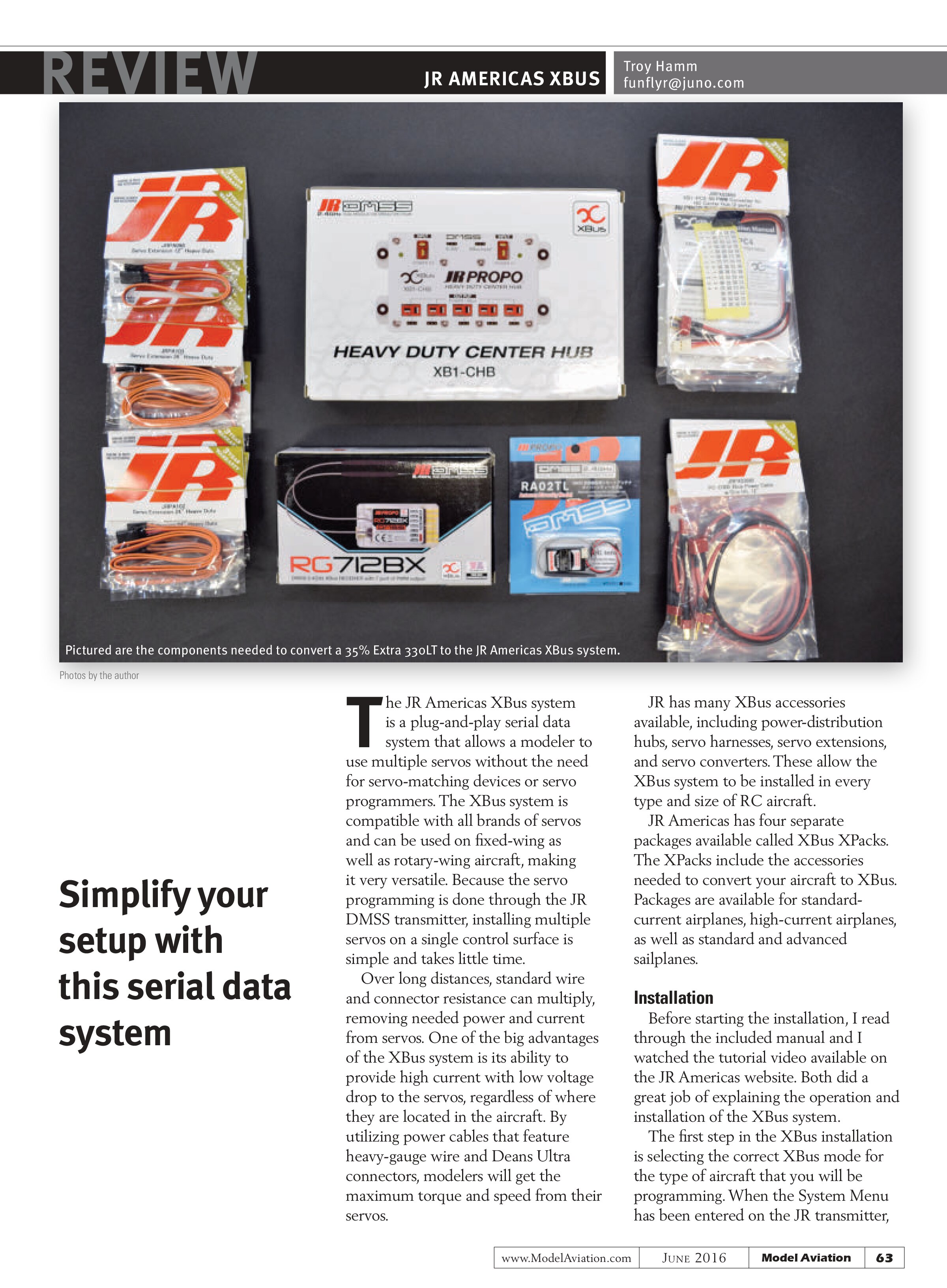
The aircraft that I installed the XBus system into is a 3D Hobby Shop 108-inch wingspan Extra 330LT. The aircraft was outfitted with MKS HV-777 high-voltage digital servos on the control surfaces. The components used for the installation included the XB1 center hub, RG712BX receiver, RA02TL remote receiver, four XB1-PC2 heavy-duty servo converters, JR heavy-duty servo extensions, and XBus power cables with Deans Ultra connectors.
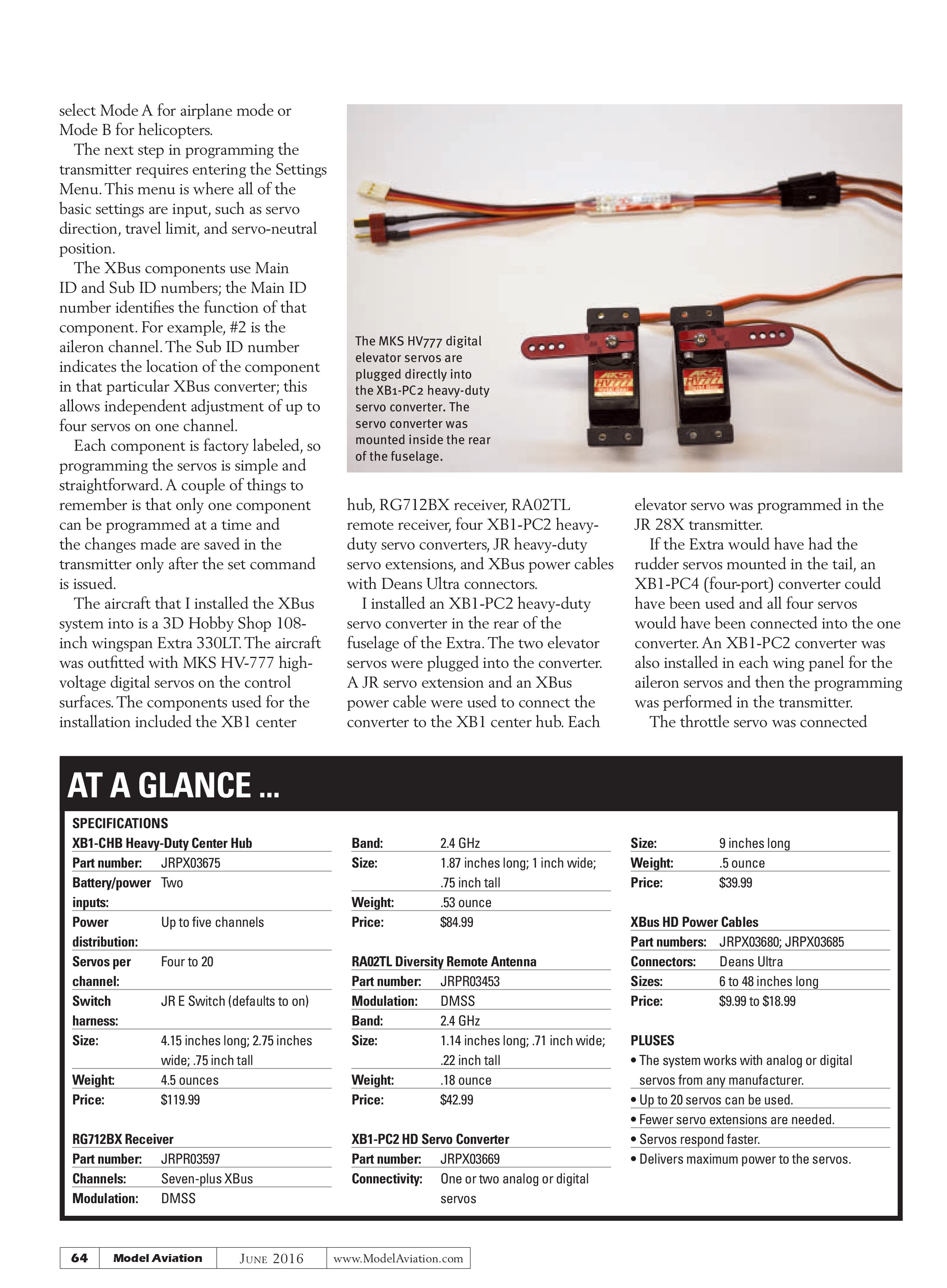
I installed an XB1-PC2 heavy-duty servo converter in the rear of the fuselage of the Extra. The two elevator servos were plugged into the converter. A JR servo extension and an XBus power cable were used to connect the converter to the XB1 center hub. Each elevator servo was programmed in the JR 28X transmitter.
If the Extra would have had the rudder servos mounted in the tail, an XB1-PC4 (four-port) converter could have been used and all four servos would have been connected into the one converter. An XB1-PC2 converter was also installed in each wing panel for the aileron servos and then the programming was performed in the transmitter.
The throttle servo was connected directly into the RG712BX receiver. The XB1 center hub is designed to use batteries that are equipped with Deans Ultra connectors and have output voltage ranging from 4.5 to 8.5 volts.
To power the system, I used two 6.6-volt, 2S 2,300 mAh A123 batteries that were plugged directly into the input power ports on the XB1 center hub. The two batteries should be the same type and capacity.
One word of caution: The input batteries must be removed when the aircraft is not in use because the XB1 center hub’s slight amount of current draw will drain the batteries over time. The batteries also should be unplugged from the XB1 center hub while being charged.
A nice feature of the XB1 center hub is the included electronic switch. It comes ready to mount on the side of the airplane’s fuselage and is designed to default to the on position when the switch plug is removed.
Flying
The system performed flawlessly. It provided smooth, instantaneous servo response. Having previously flown my aircraft without the XBus system, I found that the servos provided a noticeable increase in control surface authority and quicker response time with the XBus system installed.
Before installing the XBus system, the aircraft would roll slower as the airspeed was increased. With the XBus system providing additional power to the servos, more torque can be provided to the control surface and blowback is a thing of the past. The roll rate is no longer affected by the airspeed. I also found that the rudder and elevators have more authority than before and their response time is faster.
With the XBus system installed, snap rolls stop instantly when the control surface pressure is released. I had previously found it challenging to perform half snap rolls because the aircraft would over-rotate. Now, with the quicker response time, half snap rolls are easier to fly.
With the addition of the XBus system, the servos provide their designed power and speed to the control surfaces. Overall, I feel more connected to the airplane than before.
Conclusion
The XBus system greatly simplified the electronic equipment installation in my 35% Extra 330. XBus requires fewer servo extensions, making for a clean installation inside the airframe. The programming of the direction of movement, the neutral point, and the servo travel are all easy to adjust from one screen on the transmitter.
I like the fact that servos manufactured by companies other than JR will work with the XBus system. If an existing airplane were to be converted to XBus, the servos wouldn’t necessarily have to be replaced. I highly recommend the XBus system for any airplane or helicopter, especially if the aircraft has multiple servos on each control surface.
—Troy Hamm
funflyr@juno.com
MANUFACTURER/DISTRIBUTOR:
JR Americas
(217) 352-7959
www.jramericas.com
SOURCES:
Tutorial video
www.jramericas.com/xbus
AT A GLANCE ...
SPECIFICATIONS
XB1-CHB Heavy-Duty Center Hub
Part number: JRPX03675
Battery/power inputs: Two
Power distribution: Up to five channels
Servos per channel: Four to 20
Switch harness: JR E Switch (defaults to on)
Size: 4.15 inches long; 2.75 inches wide; .75 inch tall
Weight: 4.5 ounces
Price: $119.99
RG712BX Receiver
Part number: JRPR03597
Channels: Seven-plus XBus
Modulation: DMSS
Band: 2.4 GHz
Size: 1.87 inches long; 1 inch wide; .75 inch tall
Weight: .53 ounce
Price: $84.99
RA02TL Diversity Remote Antenna
Part number: JRPR03453
Modulation: DMSS
Band: 2.4 GHz
Size: 1.14 inches long; .71 inch wide; .22 inch tall
Weight: .18 ounce
Price: $42.99
XB1-PC2 HD Servo Converter
Part number: JRPX03669
Connectivity: One or two analog or digital servos
Size: 9 inches long
Weight: .5 ounce
Price: $39.99
XBus HD Power Cables
Part numbers: JRPX03680; JRPX03685
Connectors: Deans Ultra
Sizes: 6 to 48 inches long
Price: $9.99 to $18.99
PLUSES
• The system works with analog or digital servos from any manufacturer.
• Up to 20 servos can be used.
• Fewer servo extensions are needed.
• Servos respond faster.
• Delivers maximum power to the servos.

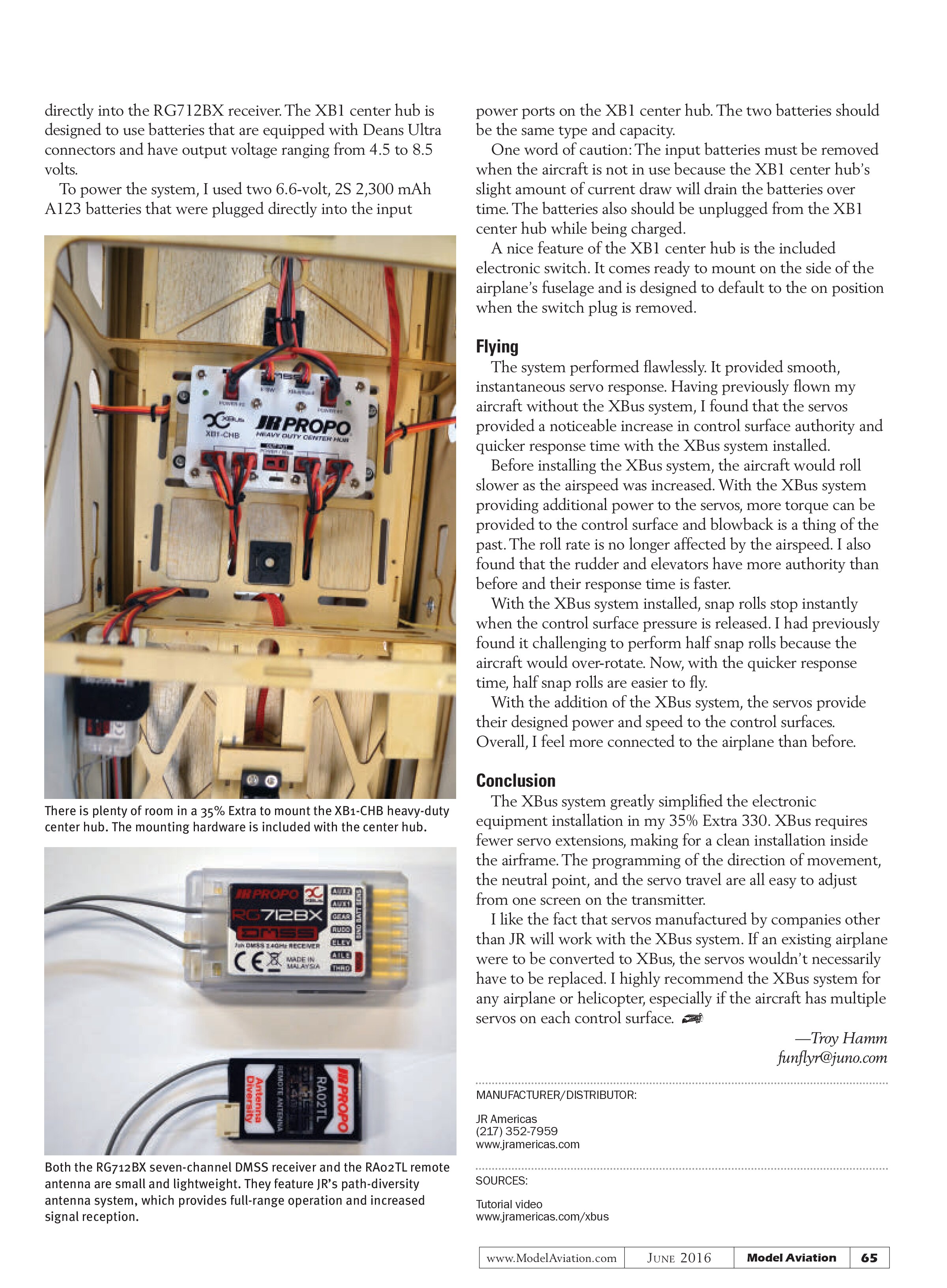
There is plenty of room in a 35% Extra to mount the XB1-CHB heavy-duty center hub. The mounting hardware is included with the center hub.

Both the RG712BX seven-channel DMSS receiver and the RA02TL remote antenna are small and lightweight. They feature JR’s path-diversity antenna system, which provides full-range operation and increased signal reception.