E-20 Electric FF
Q628: I’ve heard a lot lately about a new electric-powered Free Flight (FF) contest that is slated for competition in the 2016 flying season. Are there any rules established for this event? Where will the contest or contests be held? It sounds interesting.
A628: This event had its beginning approximately a year ago. It’s called E-20 Electric FF. The 20 indicates its 20-inch maximum wingspan. A set of provisional rules has been prepared by a group of pilots who actively fly micro-size aircraft—pilots such as Bob Selman from BSD Micro RC and Model Aviation columnist, Paul Bradley. I might add that there are many others—including me—who are participating in this new effort. I’ve provided a link in “Sources” to a website that contains the full set of rules as they currently apply.
As you read these rules, you will realize that there are several requirements that must be met. The motor is stipulated to be an 8.5mm brushed direct-drive motor that is similar to the ParkZone Ultra Micro P-51 PKZ3616 motor. No gear drives are allowed. The propeller cannot exceed 2.7 inches in diameter. The battery is not to exceed a 160 mAh capacity and must be a single-cell LiPo.
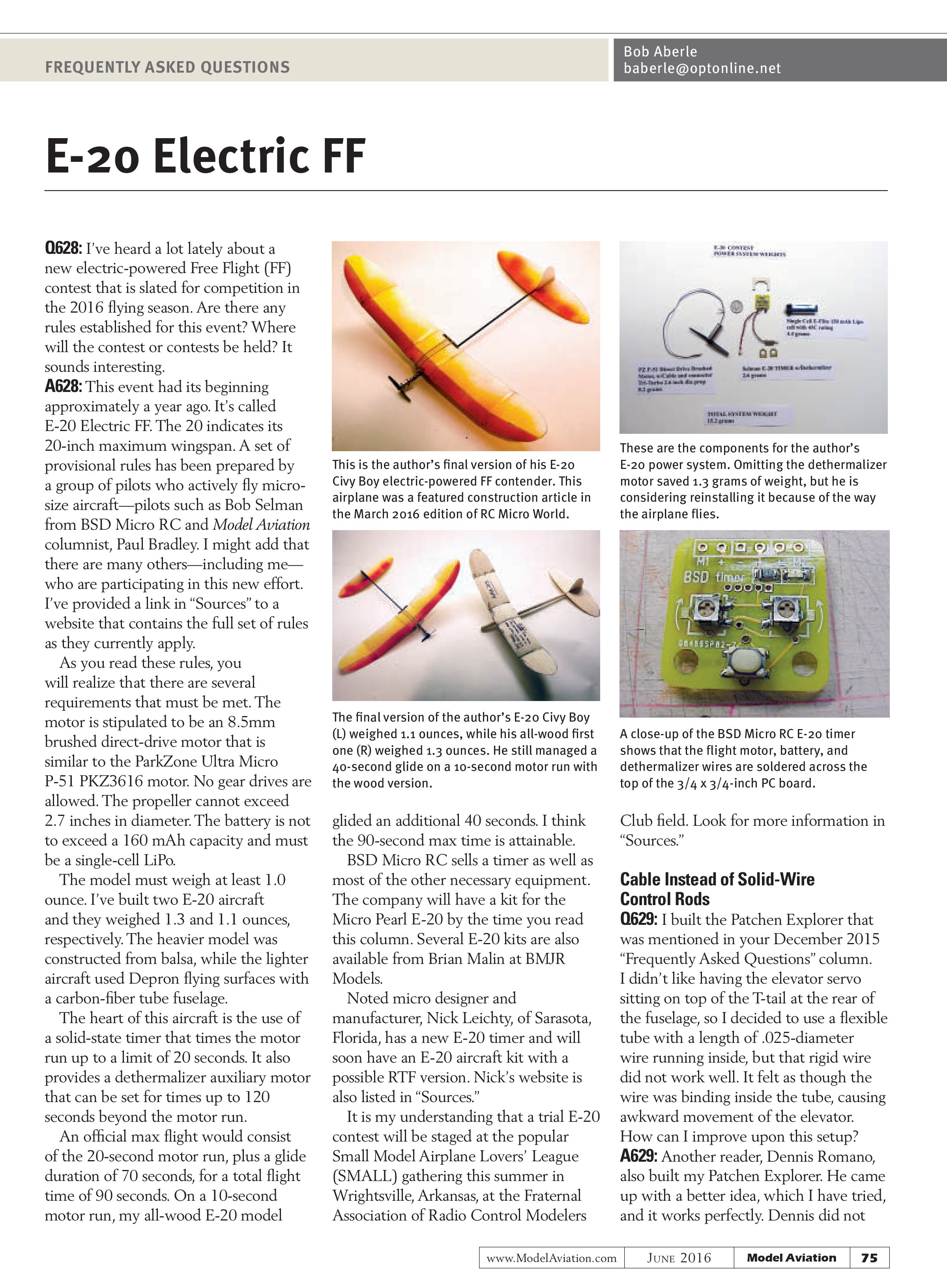
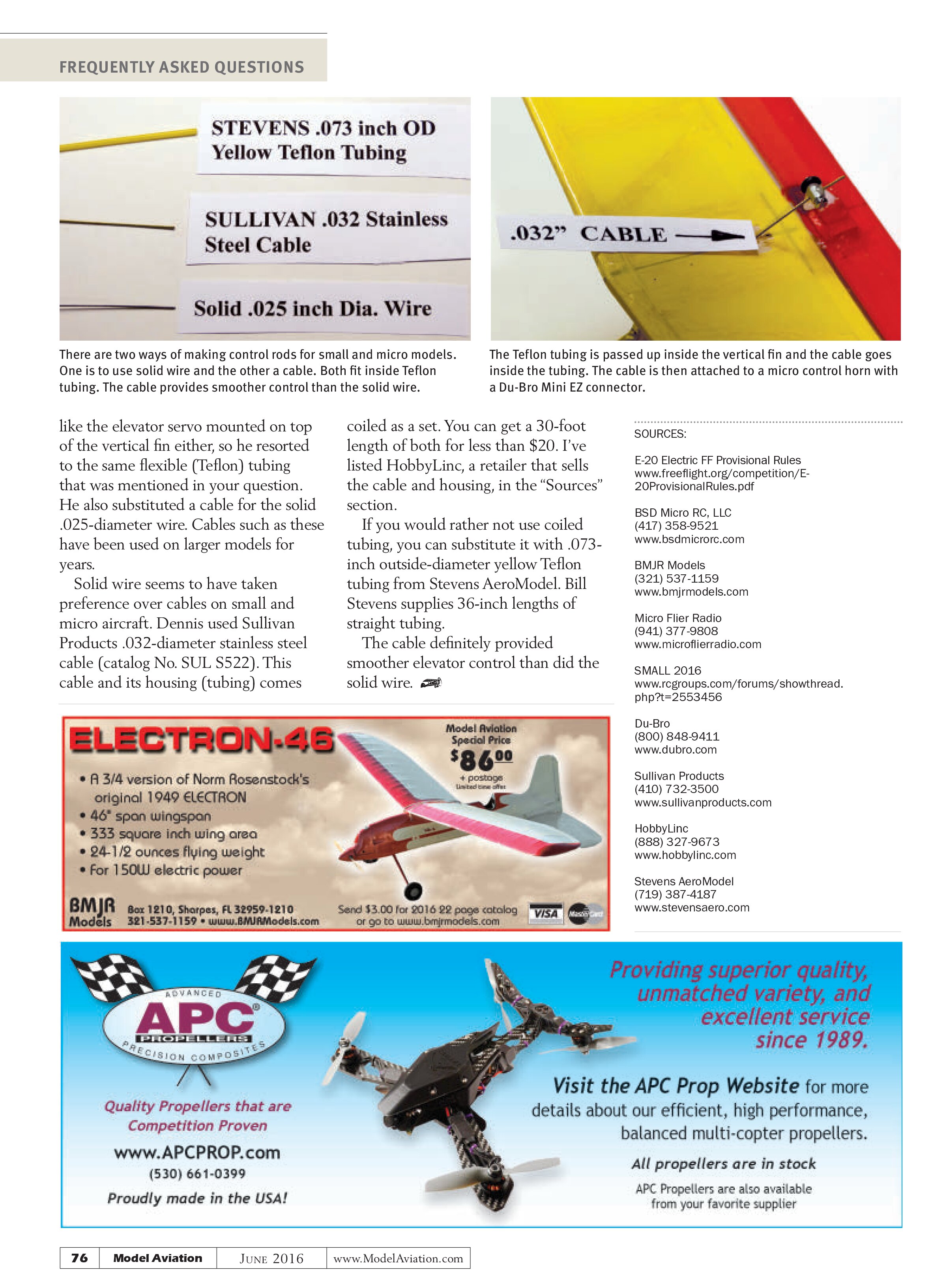
The model must weigh at least 1.0 ounce. I’ve built two E-20 aircraft and they weighed 1.3 and 1.1 ounces, respectively. The heavier model was constructed from balsa, while the lighter aircraft used Depron flying surfaces with a carbon-fiber tube fuselage.
The heart of this aircraft is the use of a solid-state timer that times the motor run up to a limit of 20 seconds. It also provides a dethermalizer auxiliary motor that can be set for times up to 120 seconds beyond the motor run.
An official max flight would consist of the 20-second motor run, plus a glide duration of 70 seconds, for a total flight time of 90 seconds. On a 10-second motor run, my all-wood E-20 model


glided an additional 40 seconds. I think the 90-second max time is attainable.
BSD Micro RC sells a timer as well as most of the other necessary equipment. The company will have a kit for the Micro Pearl E-20 by the time you read this column. Several E-20 kits are also available from Brian Malin at BMJR Models.
Noted micro designer and manufacturer, Nick Leichty, of Sarasota, Florida, has a new E-20 timer and will soon have an E-20 aircraft kit with a possible RTF version. Nick’s website is also listed in “Sources.”
It is my understanding that a trial E-20 contest will be staged at the popular Small Model Airplane Lovers’ League (SMALL) gathering this summer in Wrightsville, Arkansas, at the Fraternal Association of Radio Control Modelers Club field. Look for more information in “Sources.”


Cable Instead of Solid-Wire Control Rods
Q629: I built the Patchen Explorer that was mentioned in your December 2015 “Frequently Asked Questions” column. I didn’t like having the elevator servo sitting on top of the T-tail at the rear of the fuselage, so I decided to use a flexible tube with a length of .025-diameter wire running inside, but that rigid wire did not work well. It felt as though the wire was binding inside the tube, causing awkward movement of the elevator. How can I improve upon this setup?
A629: Another reader, Dennis Romano, also built my Patchen Explorer. He came up with a better idea, which I have tried, and it works perfectly. Dennis did not


like the elevator servo mounted on top of the vertical fin either, so he resorted to the same flexible (Teflon) tubing that was mentioned in your question. He also substituted a cable for the solid .025-diameter wire. Cables such as these have been used on larger models for years.
Solid wire seems to have taken preference over cables on small and micro aircraft. Dennis used Sullivan Products .032-diameter stainless steel cable (catalog No. SUL S522). This cable and its housing (tubing) comes coiled as a set. You can get a 30-foot length of both for less than $20. I’ve listed HobbyLinc, a retailer that sells the cable and housing, in the “Sources” section.
If you would rather not use coiled tubing, you can substitute it with .073-inch outside-diameter yellow Teflon tubing from Stevens AeroModel. Bill Stevens supplies 36-inch lengths of straight tubing.
The cable definitely provided smoother elevator control than did the solid wire.
Sources:
E-20 Electric FF Provisional Rules
www.freeflight.org/competition/E-20ProvisionalRules.pdf
BSD Micro RC, LLC
(417) 358-9521
www.bsdmicrorc.com
BMJR Models
(321) 537-1159
www.bmjrmodels.com
Micro Flier Radio
(941) 377-9808
www.microflierradio.com
SMALL 2016
www.rcgroups.com/forums/showthread.php?t=2553456
Du-Bro
(800) 848-9411
www.dubro.com
Sullivan Products
(410) 732-3500
www.sullivanproducts.com
HobbyLinc
(888) 327-9673
www.hobbylinc.com
Stevens AeroModel
(719) 387-4187
www.stevensaero.com