District XI—Alaska, Idaho, Montana, Oregon, Washington

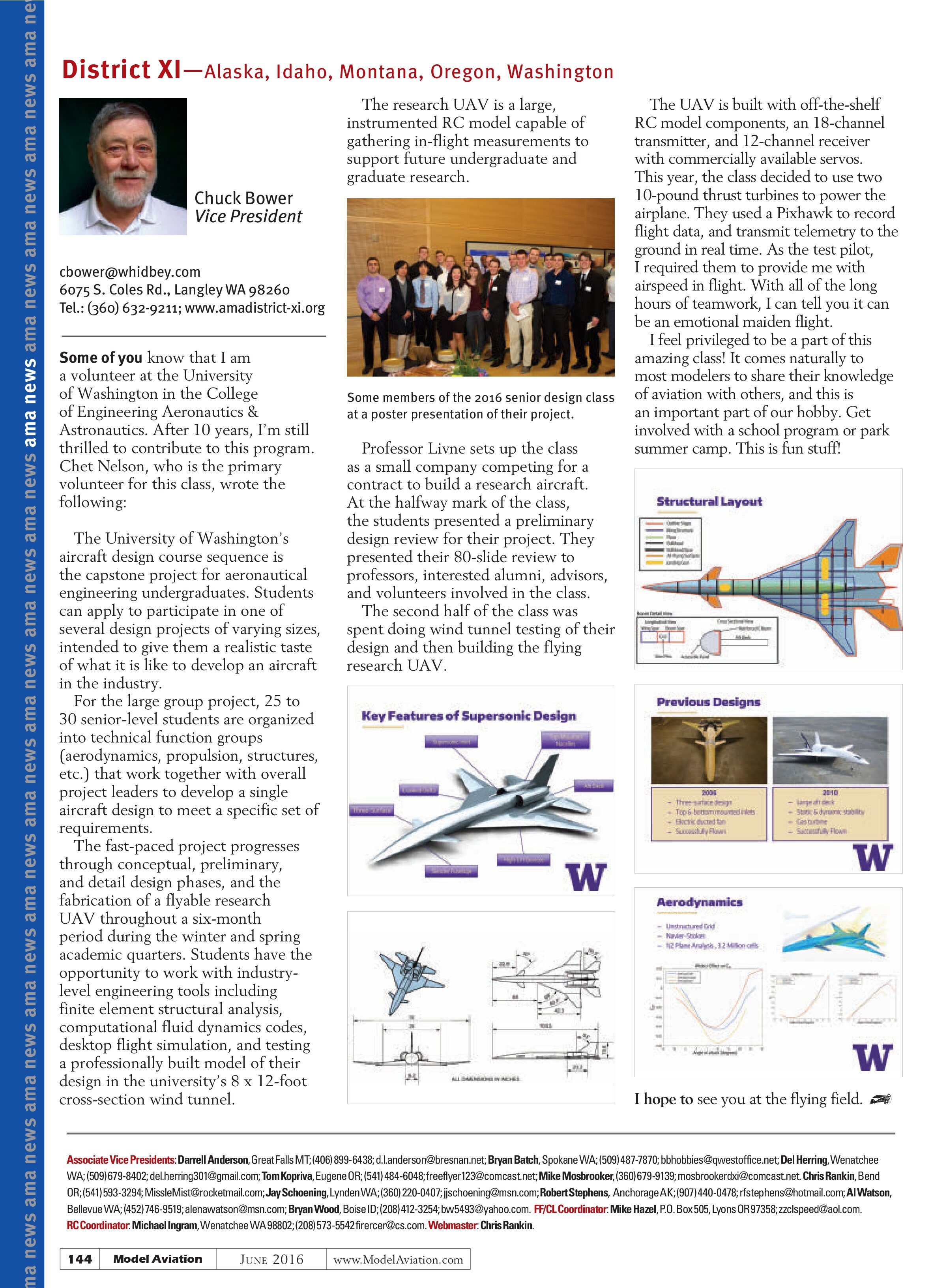
Chuck Bower
Vice President
cbower@whidbey.com
6075 S. Coles Rd., Langley WA 98260
Tel.: (360) 632-9211; www.amadistrict-xi.org
Some of you know that I am a volunteer at the University of Washington in the College of Engineering Aeronautics & Astronautics. After 10 years, I’m still thrilled to contribute to this program. Chet Nelson, who is the primary volunteer for this class, wrote the following:
The University of Washington’s aircraft design course sequence is the capstone project for aeronautical engineering undergraduates. Students can apply to participate in one of several design projects of varying sizes, intended to give them a realistic taste of what it is like to develop an aircraft in the industry.
For the large group project, 25 to 30 senior-level students are organized into technical function groups (aerodynamics, propulsion, structures, etc.) that work together with overall project leaders to develop a single aircraft design to meet a specific set of requirements.
The fast-paced project progresses through conceptual, preliminary, and detail design phases, and the fabrication of a flyable research UAV throughout a six-month period during the winter and spring academic quarters. Students have the opportunity to work with industry-level engineering tools including finite element structural analysis, computational fluid dynamics codes, desktop flight simulation, and testing a professionally built model of their design in the university’s 8 x 12-foot cross-section wind tunnel.
The research UAV is a large, instrumented RC model capable of gathering in-flight measurements to support future undergraduate and graduate research.

Professor Livne sets up the class as a small company competing for a contract to build a research aircraft. At the halfway mark of the class, the students presented a preliminary design review for their project. They presented their 80-slide review to professors, interested alumni, advisors, and volunteers involved in the class.
The second half of the class was spent doing wind tunnel testing of their design and then building the flying research UAV.


The UAV is built with off-the-shelf RC model components, an 18-channel transmitter, and 12-channel receiver with commercially available servos. This year, the class decided to use two 10-pound thrust turbines to power the airplane. They used a Pixhawk to record flight data, and transmit telemetry to the ground in real time. As the test pilot, I required them to provide me with airspeed in flight. With all of the long hours of teamwork, I can tell you it can be an emotional maiden flight.
I feel privileged to be a part of this amazing class! It comes naturally to most modelers to share their knowledge of aviation with others, and this is an important part of our hobby. Get involved with a school program or park summer camp. This is fun stuff!


I hope to see you at the flying field.