District VII—Iowa, Michigan, Minnesota, Wisconsin

Tim Jesky
Vice President
timjesky@charter.net
2886 E. Country Ln., Monroe MI 48162
Tel.: (734) 384-6085;
www.amadistrict-vii.org
Hello again. Here’s hoping your flying season is shaping up well. I’m writing this column in April, and the April showers phrase is living up to its billing. Just for good measure, let’s throw in some snow too.
My neighbors in Toledo, Ohio, caught seven inches of the white stuff this past Sunday. I may have mentioned before that the Toledo Weak Signals club is my home club. You might ask why the District VII vice president would call a District III club home. Well, it’s a little complicated.
The short answer is the Weak Signals club is sanctioned out of Ohio and its flying field is in Michigan. Because our original club was in danger of losing its field, my sons and I signed on with the Weak Signals roughly 15 or so years ago. It was nearly an hour’s drive to get there, but well worth it.
Not long after that, my wife had a job transfer to Toledo and we decided to move to Monroe, Michigan, to shorten her commute. So, by sheer coincidence, the home we bought just happened to be only 15 minutes away from the Weak Signals field. That’s my story and I’m sticking to it.
I’m going to hand it off to Wisconsin Associate Vice President Bob Johnson to share a club success story in which an AMA Flying Site Improvement Grant played a role. It’s never too early for clubs that are considering field improvements to look into the program for 2017 grant awards.
From its humble beginning in 1943 until the 1950s, the members of the Valley Aero Modelers Club of Appleton, Wisconsin, participated in various forms of U-Control [Control Line or CL] and Free Flight activities. As radios became more reliable and the price of an RC system became less expensive, more and more members began flying RC models. Today, nearly all of the club’s activity is in various aspects of RC.
Although CL models can be flown from an area the size of a baseball diamond, RC requires a much larger flying area. Throughout the years, the club established and lost several flying sites primarily because of the encroachment of housing developments and noise complaints.
In 2005, the club located a closed landfill and began exploring it as a possible flying site. Upon completion of negotiations with the City of Appleton, which owns the site, a long-term lease agreement was signed in December of 2005 and the club had a nearly permanent flying site.
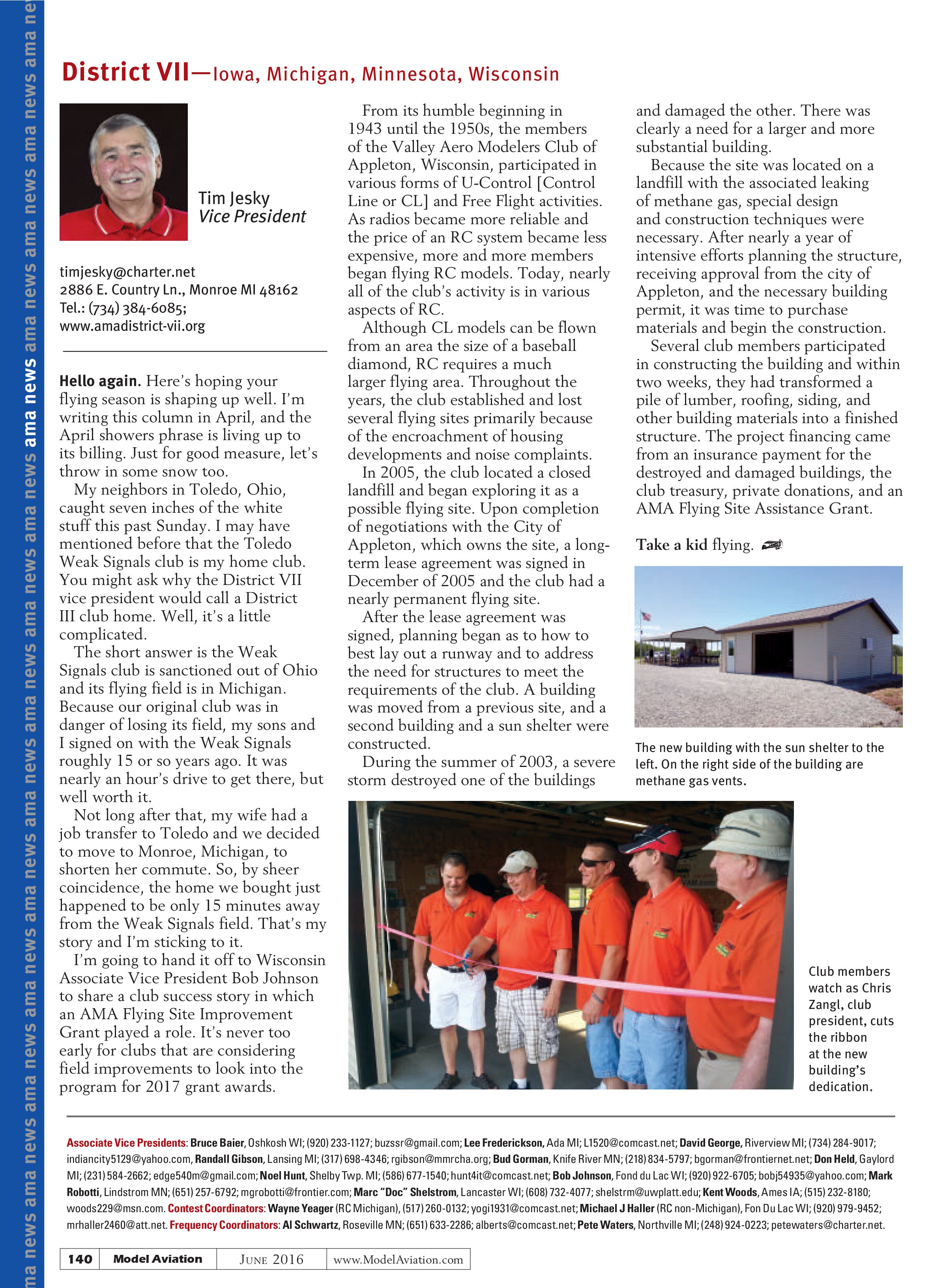
After the lease agreement was signed, planning began as to how to best lay out a runway and to address the need for structures to meet the requirements of the club. A building was moved from a previous site, and a second building and a sun shelter were constructed.
During the summer of 2003, a severe storm destroyed one of the buildings and damaged the other. There was clearly a need for a larger and more substantial building.
Because the site was located on a landfill with the associated leaking of methane gas, special design and construction techniques were necessary. After nearly a year of intensive efforts planning the structure, receiving approval from the city of Appleton, and the necessary building permit, it was time to purchase materials and begin the construction.
Several club members participated in constructing the building and within two weeks, they had transformed a pile of lumber, roofing, siding, and other building materials into a finished structure. The project financing came from an insurance payment for the destroyed and damaged buildings, the club treasury, private donations, and an AMA Flying Site Assistance Grant.
Take a kid flying.


Associate Vice Presidents: Bruce Baier, Oshkosh WI; (920) 233-1127; buzssr@gmail.com; Lee Frederickson, Ada MI; L1520@comcast.net; David George, Riverview MI; (734) 284-9017; indiancity5129@yahoo.com, Randall Gibson, Lansing MI; (317) 698-4346; rgibson@mmrcha.org; Bud Gorman, Knife River MN; (218) 834-5797; bgorman@frontiernet.net; Don Held, Gaylord MI; (231) 584-2662; edge540m@gmail.com; Noel Hunt, Shelby Twp. MI; (586) 677-1540; hunt4it@comcast.net; Bob Johnson, Fond du Lac WI; (920) 922-6705; bobj54935@yahoo.com; Mark Robotti, Lindstrom MN; (651) 257-6792; mgrobotti@frontier.com; Marc “Doc” Shelstrom, Lancaster WI; (608) 732-4077; shelstrm@uwplatt.edu; Kent Woods, Ames IA; (515) 232-8180; woods229@msn.com. Contest Coordinators: Wayne Yeager (RC Michigan), (517) 260-0132; yogi1931@comcast.net; Michael J Haller (RC non-Michigan), Fon Du Lac WI; (920) 979-9452; mrhaller2460@att.net. Frequency Coordinators: Al Schwartz, Roseville MN; (651) 633-2286; alberts@comcast.net; Pete Waters, Northville MI; (248) 924-0223; petewaters@charter.net.