Down memory lane
Bob Noll
bobrc@aol.com
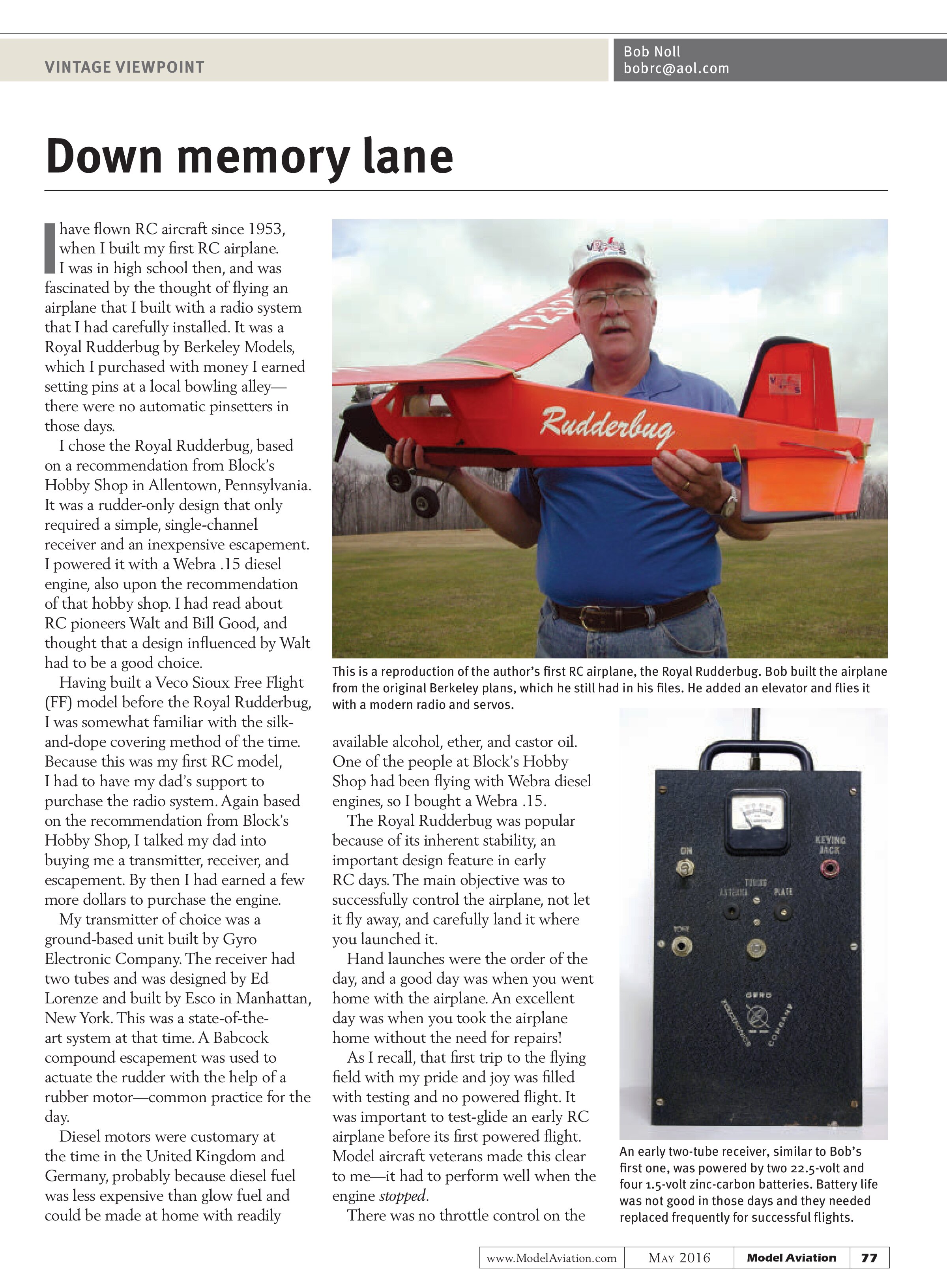
I have flown RC aircraft since 1953, when I built my first RC airplane. I was in high school then, and was fascinated by the thought of flying an airplane that I built with a radio system that I had carefully installed. It was a Royal Rudderbug by Berkeley Models, which I purchased with money I earned setting pins at a local bowling alley—there were no automatic pinsetters in those days.
I chose the Royal Rudderbug, based on a recommendation from Block’s Hobby Shop in Allentown, Pennsylvania. It was a rudder-only design that only required a simple, single-channel receiver and an inexpensive escapement. I powered it with a Webra .15 diesel engine, also upon the recommendation of that hobby shop. I had read about RC pioneers Walt and Bill Good, and thought that a design influenced by Walt had to be a good choice.
Having built a Veco Sioux Free Flight (FF) model before the Royal Rudderbug, I was somewhat familiar with the silk-and-dope covering method of the time. Because this was my first RC model, I had to have my dad’s support to purchase the radio system. Again based on the recommendation from Block’s Hobby Shop, I talked my dad into buying me a transmitter, receiver, and escapement. By then I had earned a few more dollars to purchase the engine.
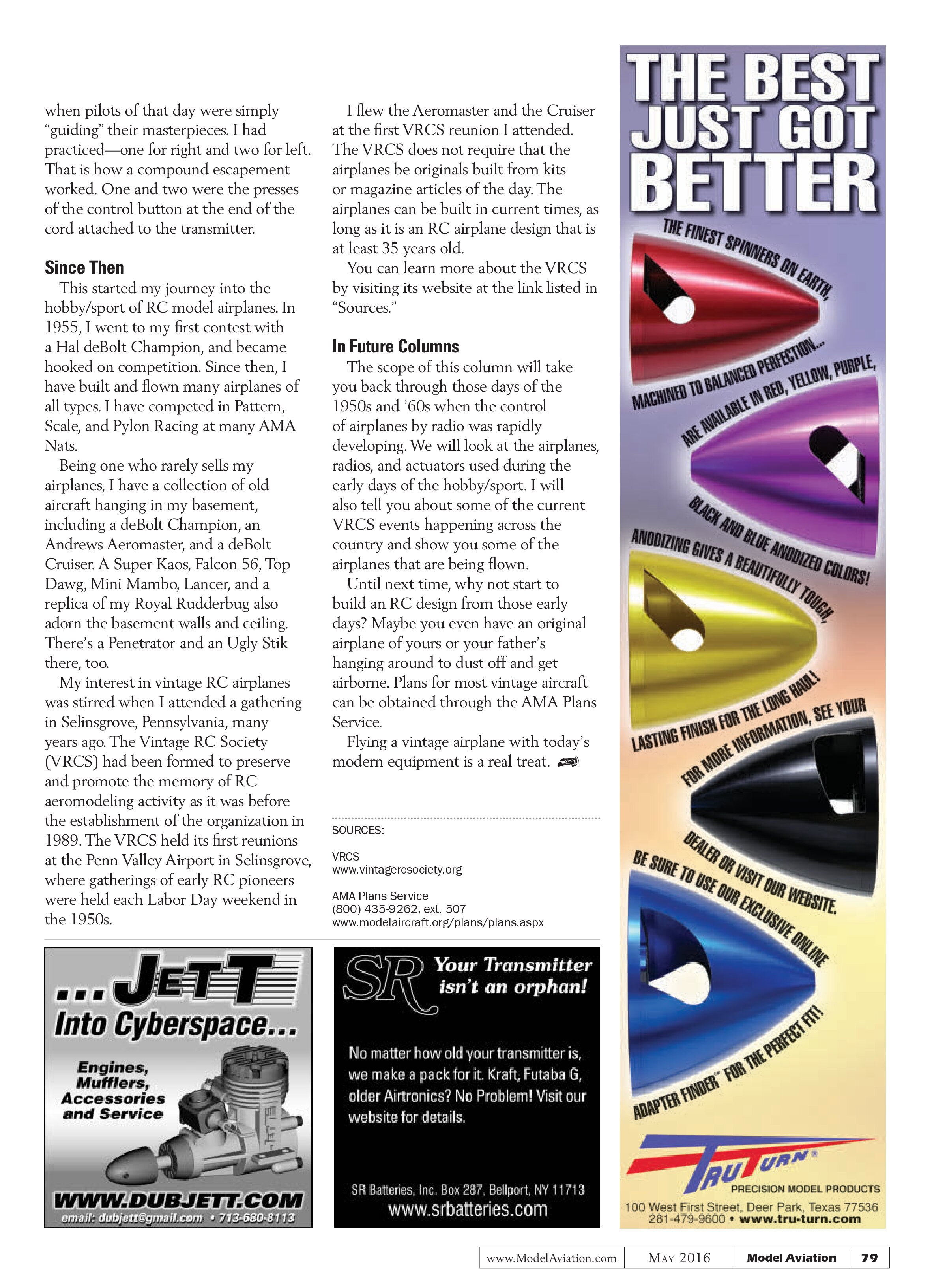
My transmitter of choice was a ground-based unit built by Gyro Electronic Company. The receiver had two tubes and was designed by Ed Lorenze and built by Esco in Manhattan, New York. This was a state-of-the-art system at that time. A Babcock compound escapement was used to actuate the rudder with the help of a rubber motor—common practice for the day.
Diesel motors were customary at the time in the United Kingdom and Germany, probably because diesel fuel was less expensive than glow fuel and could be made at home with readily

available alcohol, ether, and castor oil. One of the people at Block’s Hobby Shop had been flying with Webra diesel engines, so I bought a Webra .15.
The Royal Rudderbug was popular because of its inherent stability, an important design feature in early RC days. The main objective was to successfully control the airplane, not let it fly away, and carefully land it where you launched it.
Hand launches were the order of the day, and a good day was when you went home with the airplane. An excellent day was when you took the airplane home without the need for repairs!
As I recall, that first trip to the flying field with my pride and joy was filled with testing and no powered flight. It was important to test-glide an early RC airplane before its first powered flight. Model aircraft veterans made this clear to me—it had to perform well when the engine stopped.
There was no throttle control on the

when pilots of that day were simply “guiding” their masterpieces. I had practiced—one for right and two for left. That is how a compound escapement worked. One and two were the presses of the control button at the end of the cord attached to the transmitter.
Since Then
This started my journey into the hobby/sport of RC model airplanes. In 1955, I went to my first contest with a Hal deBolt Champion, and became hooked on competition. Since then, I have built and flown many airplanes of all types. I have competed in Pattern, Scale, and Pylon Racing at many AMA Nats.
Being one who rarely sells my airplanes, I have a collection of old aircraft hanging in my basement, including a deBolt Champion, an Andrews Aeromaster, and a deBolt Cruiser. A Super Kaos, Falcon 56, Top Dawg, Mini Mambo, Lancer, and a replica of my Royal Rudderbug also adorn the basement walls and ceiling. There’s a Penetrator and an Ugly Stik there, too.
My interest in vintage RC airplanes was stirred when I attended a gathering in Selinsgrove, Pennsylvania, many years ago. The Vintage RC Society (VRCS) had been formed to preserve and promote the memory of RC aeromodeling activity as it was before the establishment of the organization in 1989. The VRCS held its first reunions at the Penn Valley Airport in Selinsgrove, where gatherings of early RC pioneers were held each Labor Day weekend in the 1950s.
I flew the Aeromaster and the Cruiser at the first VRCS reunion I attended. The VRCS does not require that the airplanes be originals built from kits or magazine articles of the day. The airplanes can be built in current times, as long as it is an RC airplane design that is at least 35 years old.
You can learn more about the VRCS by visiting its website at the link listed in “Sources.”
In Future Columns
The scope of this column will take you back through those days of the 1950s and ’60s when the control of airplanes by radio was rapidly developing. We will look at the airplanes, radios, and actuators used during the early days of the hobby/sport. I will also tell you about some of the current VRCS events happening across the country and show you some of the airplanes that are being flown.
Until next time, why not start to build an RC design from those early days? Maybe you even have an original airplane of yours or your father’s hanging around to dust off and get airborne. Plans for most vintage aircraft can be obtained through the AMA Plans Service.
Flying a vintage airplane with today’s modern equipment is a real treat.
SOURCES:
AMA Plans Service
(800) 435-9262, ext. 507
www.modelaircraft.org/plans/plans.aspx