The history of AMA
View from HQ by Dave Mathewson, AMA Executive Director

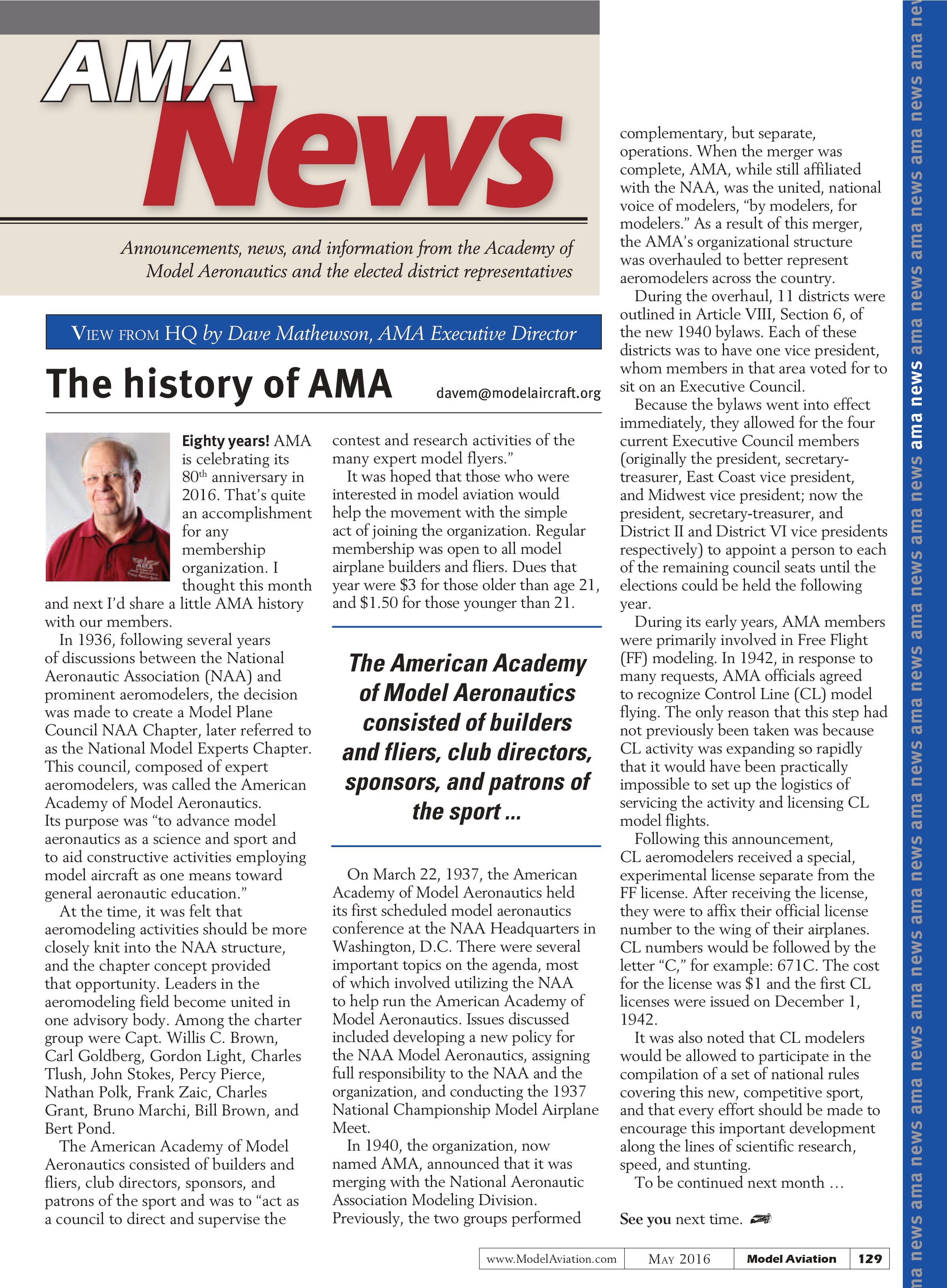
Eighty years! AMA is celebrating its 80th anniversary in 2016. That’s quite an accomplishment for any membership organization. I thought this month and next I’d share a little AMA history with our members.
In 1936, following several years of discussions between the National Aeronautic Association (NAA) and prominent aeromodelers, the decision was made to create a Model Plane Council NAA Chapter, later referred to as the National Model Experts Chapter. This council, composed of expert aeromodelers, was called the American Academy of Model Aeronautics. Its purpose was “to advance model aeronautics as a science and sport and to aid constructive activities employing model aircraft as one means toward general aeronautic education.”
At the time, it was felt that aeromodeling activities should be more closely knit into the NAA structure, and the chapter concept provided that opportunity. Leaders in the aeromodeling field become united in one advisory body. Among the charter group were Capt. Willis C. Brown, Carl Goldberg, Gordon Light, Charles Tlush, John Stokes, Percy Pierce, Nathan Polk, Frank Zaic, Charles Grant, Bruno Marchi, Bill Brown, and Bert Pond.
The American Academy of Model Aeronautics consisted of builders and fliers, club directors, sponsors, and patrons of the sport and was to “act as a council to direct and supervise the contest and research activities of the many expert model flyers.”
It was hoped that those who were interested in model aviation would help the movement with the simple act of joining the organization. Regular membership was open to all model airplane builders and fliers. Dues that year were $3 for those older than age 21, and $1.50 for those younger than 21.
The American Academy of Model Aeronautics consisted of builders and fliers, club directors, sponsors, and patrons of the sport ...
On March 22, 1937, the American Academy of Model Aeronautics held its first scheduled model aeronautics conference at the NAA Headquarters in Washington, D.C. There were several important topics on the agenda, most of which involved utilizing the NAA to help run the American Academy of Model Aeronautics. Issues discussed included developing a new policy for the NAA Model Aeronautics, assigning full responsibility to the NAA and the organization, and conducting the 1937 National Championship Model Airplane Meet.
In 1940, the organization, now named AMA, announced that it was merging with the National Aeronautic Association Modeling Division. Previously, the two groups performed complementary, but separate, operations. When the merger was complete, AMA, while still affiliated with the NAA, was the united, national voice of modelers, “by modelers, for modelers.” As a result of this merger, the AMA’s organizational structure was overhauled to better represent aeromodelers across the country.
During the overhaul, 11 districts were outlined in Article VIII, Section 6, of the new 1940 bylaws. Each of these districts was to have one vice president, whom members in that area voted for to sit on an Executive Council.
Because the bylaws went into effect immediately, they allowed for the four current Executive Council members (originally the president, secretary-treasurer, East Coast vice president, and Midwest vice president; now the president, secretary-treasurer, and District II and District VI vice presidents respectively) to appoint a person to each of the remaining council seats until the elections could be held the following year.
During its early years, AMA members were primarily involved in Free Flight (FF) modeling. In 1942, in response to many requests, AMA officials agreed to recognize Control Line (CL) model flying. The only reason that this step had not previously been taken was because CL activity was expanding so rapidly that it would have been practically impossible to set up the logistics of servicing the activity and licensing CL model flights.
Following this announcement, CL aeromodelers received a special, experimental license separate from the FF license. After receiving the license, they were to affix their official license number to the wing of their airplanes. CL numbers would be followed by the letter “C,” for example: 671C. The cost for the license was $1 and the first CL licenses were issued on December 1, 1942.
It was also noted that CL modelers would be allowed to participate in the compilation of a set of national rules covering this new, competitive sport, and that every effort should be made to encourage this important development along the lines of scientific research, speed, and stunting.
To be continued next month ...
See you next time.