Table-saw situation
Dave Gee
safetycolumn@cs.com
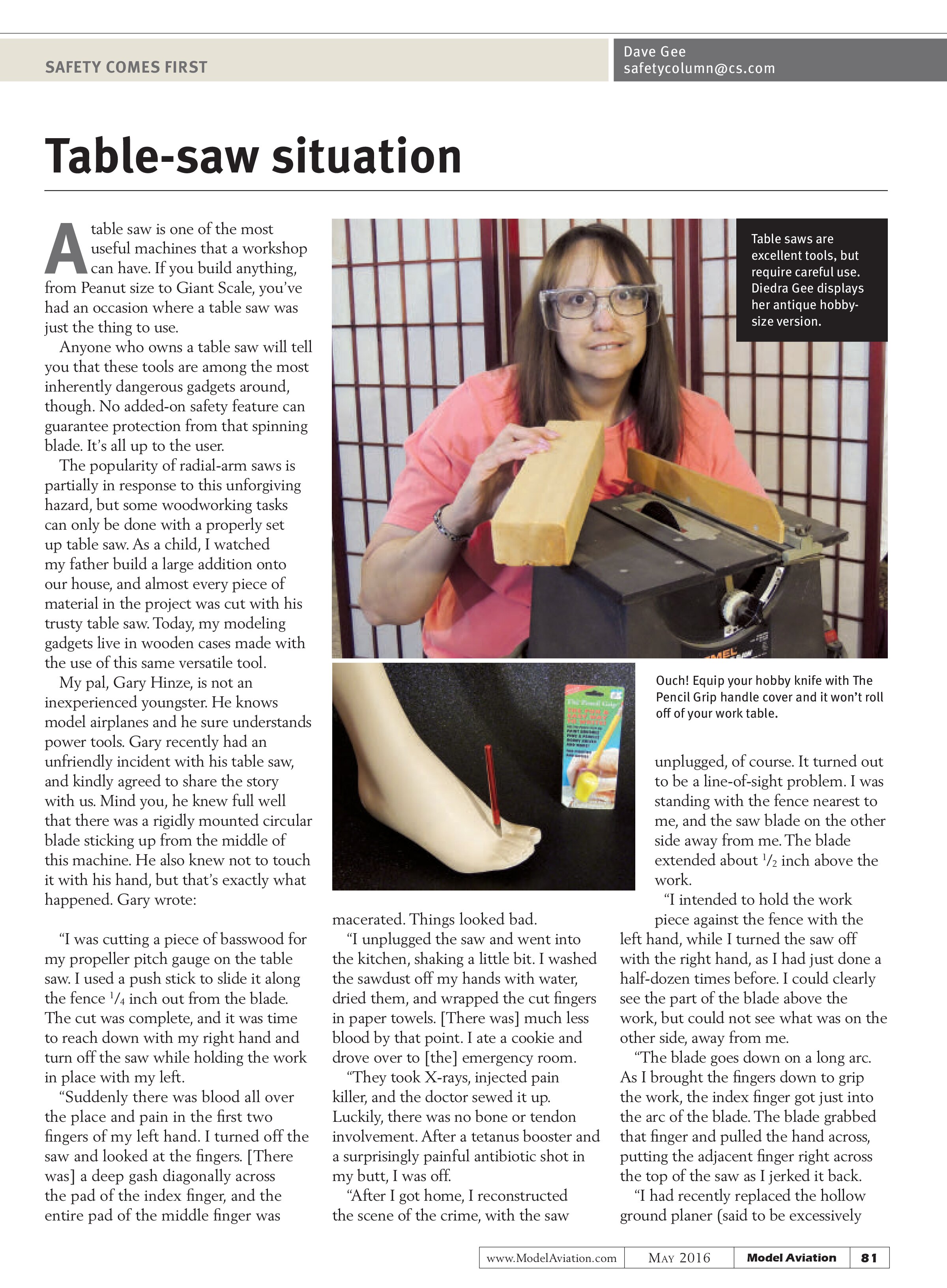
A table saw is one of the most useful machines that a workshop can have. If you build anything, from Peanut size to Giant Scale, you’ve had an occasion where a table saw was just the thing to use.
Anyone who owns a table saw will tell you that these tools are among the most inherently dangerous gadgets around, though. No added-on safety feature can guarantee protection from that spinning blade. It’s all up to the user.
The popularity of radial-arm saws is partially in response to this unforgiving hazard, but some woodworking tasks can only be done with a properly set up table saw. As a child, I watched my father build a large addition onto our house, and almost every piece of material in the project was cut with his trusty table saw. Today, my modeling gadgets live in wooden cases made with the use of this same versatile tool.
My pal, Gary Hinze, is not an inexperienced youngster. He knows model airplanes and he sure understands power tools. Gary recently had an unfriendly incident with his table saw, and kindly agreed to share the story with us. Mind you, he knew full well that there was a rigidly mounted circular blade sticking up from the middle of this machine. He also knew not to touch it with his hand, but that’s exactly what happened. Gary wrote:
“I was cutting a piece of basswood for my propeller pitch gauge on the table saw. I used a push stick to slide it along the fence ¼ inch out from the blade. The cut was complete, and it was time to reach down with my right hand and turn off the saw while holding the work in place with my left.
“Suddenly there was blood all over the place and pain in the first two fingers of my left hand. I turned off the saw and looked at the fingers. [There was] a deep gash diagonally across the pad of the index finger, and the entire pad of the middle finger was

macerated. Things looked bad.
“I unplugged the saw and went into the kitchen, shaking a little bit. I washed the sawdust off my hands with water, dried them, and wrapped the cut fingers in paper towels. [There was] much less blood by that point. I ate a cookie and drove over to [the] emergency room.
“They took X-rays, injected pain killer, and the doctor sewed it up. Luckily, there was no bone or tendon involvement. After a tetanus booster and a surprisingly painful antibiotic shot in my butt, I was off.
“After I got home, I reconstructed the scene of the crime, with the saw

unplugged, of course. It turned out to be a line-of-sight problem. I was standing with the fence nearest to me, and the saw blade on the other side away from me. The blade extended about ½ inch above the work.
“I intended to hold the work piece against the fence with the left hand, while I turned the saw off with the right hand, as I had just done a half-dozen times before. I could clearly see the part of the blade above the work, but could not see what was on the other side, away from me.
“The blade goes down on a long arc. As I brought the fingers down to grip the work, the index finger got just into the arc of the blade. The blade grabbed that finger and pulled the hand across, putting the adjacent finger right across the top of the saw as I jerked it back.
“I had recently replaced the hollow ground planer (said to be excessively
dangerous) with a carbide-tipped blade. Guess what? All table-saw blades are dangerous when you put body parts in them!
“Lesson learned: when working with a table saw, always be able to see all [of] your fingers and [the entire] exposed blade. Do one movement at a time and pay attention.”
Some people use an accessory called a featherboard on woodworking tasks such as Gary’s. This tool holds the work against the saw fence while your fingers stay clear. Anytime you can get a tool to take the risk instead of your fingers, do it.
Another point stood out: it is always a good idea to have someone else around when we use power tools, just as we should have a buddy with us at the flying field whenever possible. You never know when help might be needed.
Gary was able to stay calm enough to take care of himself, but I’ll bet he would have welcomed some assistance during the crisis. Of course, I wondered how eating a cookie got into the first-aid process. Gary is my kind of modeler.
Roll and Drop?
World War I was a time of innovation, when some awful weapons were invented and used. One was the fléchette, a pencil-size metal dart that was dropped from airplanes by the thousands. The idea was to skewer the enemy’s ground troops.
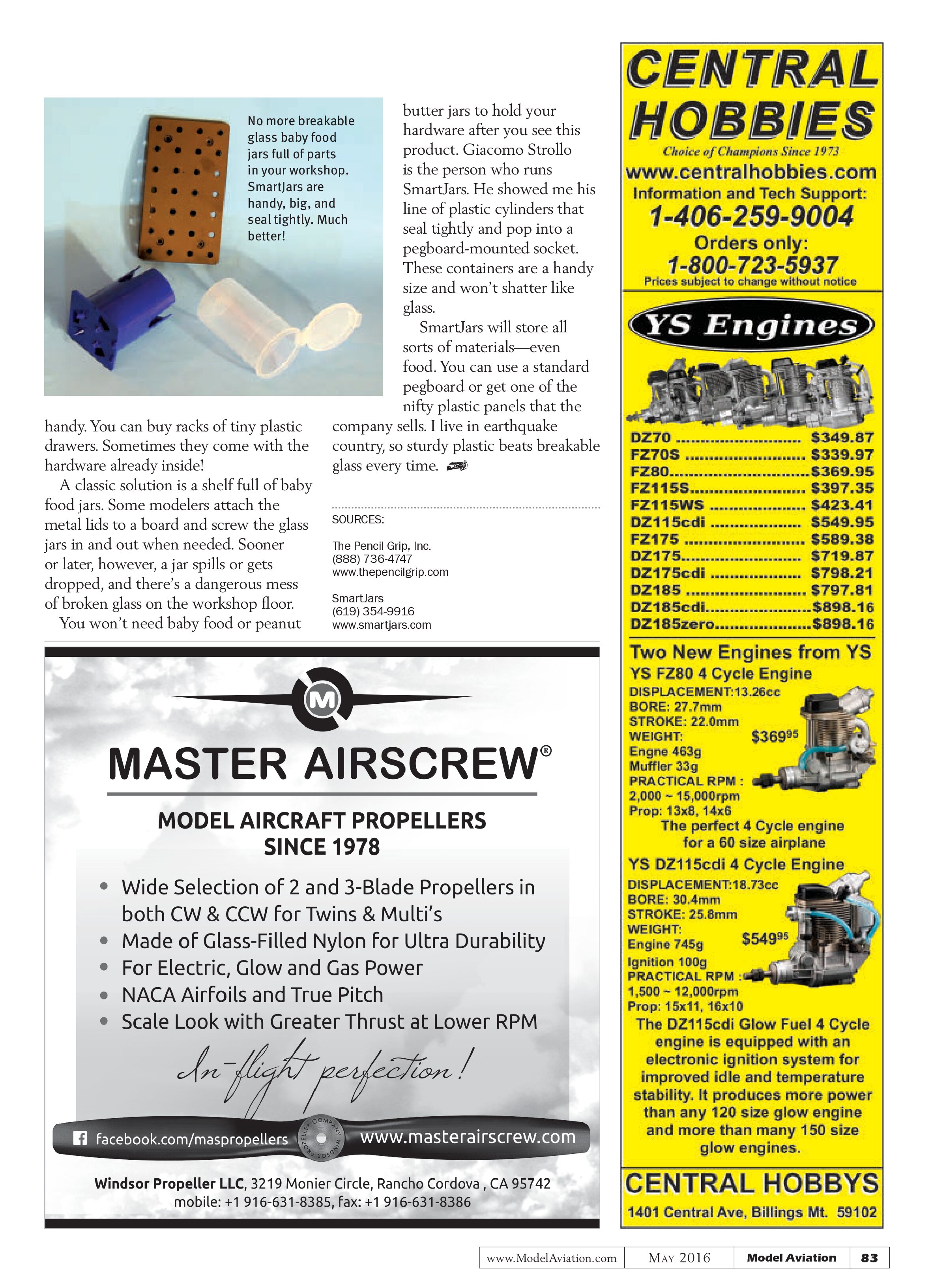
You don’t have to be a historical reenactor to bring back those bad old days. Almost all modelers have an old-fashioned hobby knife in their tool stash. Install a classic #11 blade and when that thing rolls off of the table, presto! It’s 1917 all over again!
After hearing about several recent hobby-knife-falling-off-the-workbench reports, I did some careful testing. Sure enough, there is a tendency for a hobby knife to turn blade downward in freefall. The hollow-handled ones are the worst. Unless you’re wearing chainmail socks, it could get ugly.
The best defense is to not let a hobby knife roll off of the table. I have a handy pencil holder for mine, but I sometimes forget and set the knife down on the table—dumb and risky.
Plan B is to modify the knife so it won’t roll. You can alter the shaft in various ways, or buy a commercial item such as those rubber triangles that slip over the handle, but they can be hard to find.
I was pleased to see an ergonomically designed version at a big craft store chain. It’s called The Pencil Grip, and not only does it keep your knife from becoming an airborne weapon, it improves your grip on the handle. I would have paid $2.49 for mine, but some craft places often have 40% off coupons or accept offers from competing stores. Buy it for a $1.45? Yeah, baby!
A Jar of Nuts?
How do you store nuts and bolts on your workbench? Model aircraft seem to require a thousand little pieces, and we need to keep spare hardware handy. You can buy racks of tiny plastic drawers. Sometimes they come with the hardware already inside!
A classic solution is a shelf full of baby food jars. Some modelers attach the metal lids to a board and screw the glass jars in and out when needed. Sooner or later, however, a jar spills or gets dropped, and there’s a dangerous mess of broken glass on the workshop floor.
You won’t need baby food or peanut butter jars to hold your hardware after you see this product. Giacomo Strollo is the person who runs SmartJars. He showed me his line of plastic cylinders that seal tightly and pop into a pegboard-mounted socket. These containers are a handy size and won’t shatter like glass.
SmartJars will store all sorts of materials—even food. You can use a standard pegboard or get one of the nifty plastic panels that the company sells. I live in earthquake country, so sturdy plastic beats breakable glass every time.

SOURCES:
The Pencil Grip, Inc.
(888) 736-4747
www.thepencilgrip.com
SmartJars
(619) 354-9916
www.smartjars.com