How small can I go?
Joe Malinchak
joemal@echoes.net
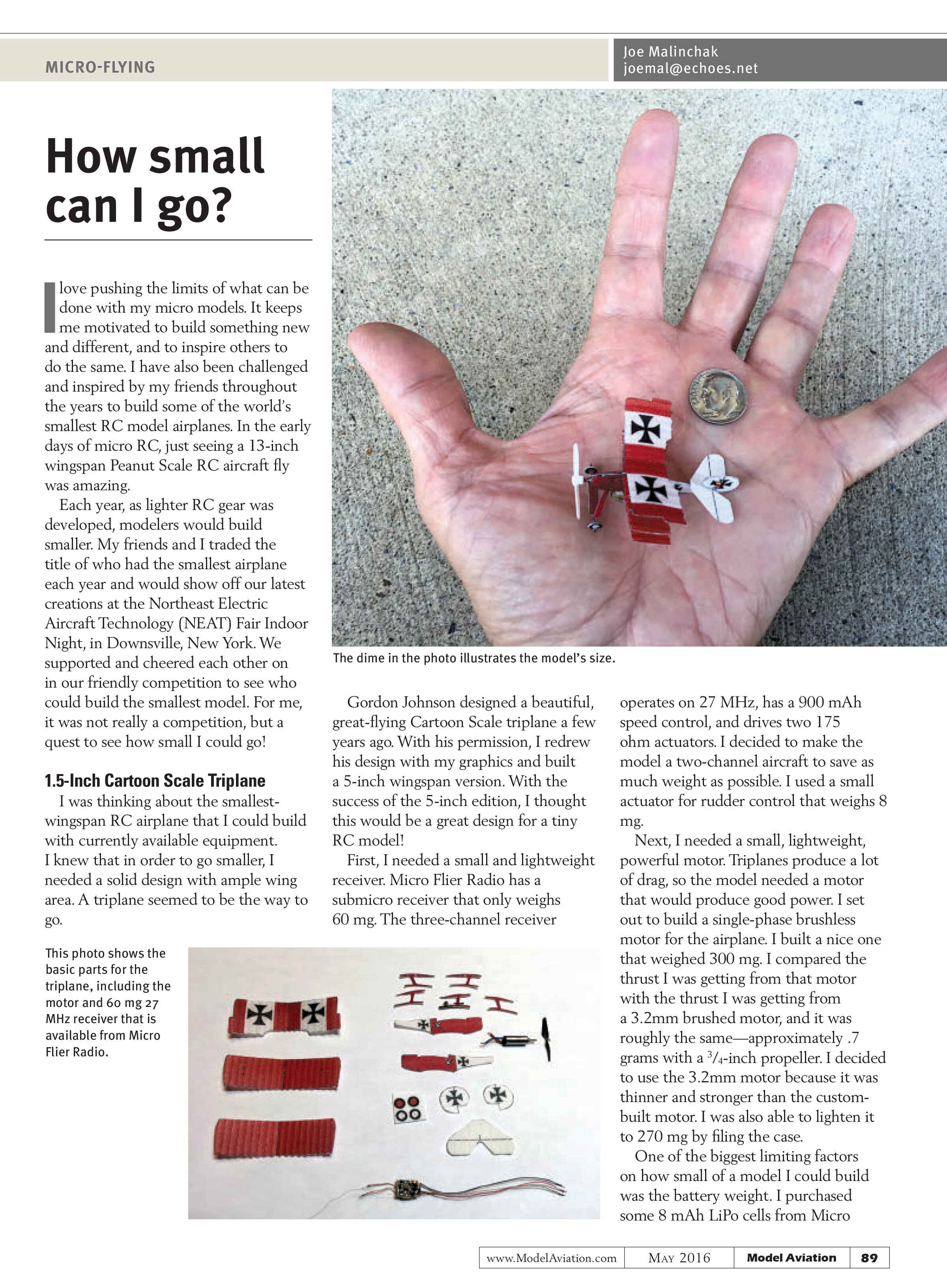
I love pushing the limits of what can be done with my micro models. It keeps me motivated to build something new and different, and to inspire others to do the same. I have also been challenged and inspired by my friends throughout the years to build some of the world’s smallest RC model airplanes. In the early days of micro RC, just seeing a 13-inch wingspan Peanut Scale RC aircraft fly was amazing.
Each year, as lighter RC gear was developed, modelers would build smaller. My friends and I traded the title of who had the smallest airplane each year and would show off our latest creations at the Northeast Electric Aircraft Technology (NEAT) Fair Indoor Night, in Downsville, New York. We supported and cheered each other on in our friendly competition to see who could build the smallest model. For me, it was not really a competition, but a quest to see how small I could go!
1.5-Inch Cartoon Scale Triplane
I was thinking about the smallest-wingspan RC airplane that I could build with currently available equipment. I knew that in order to go smaller, I needed a solid design with ample wing area. A triplane seemed to be the way to go.
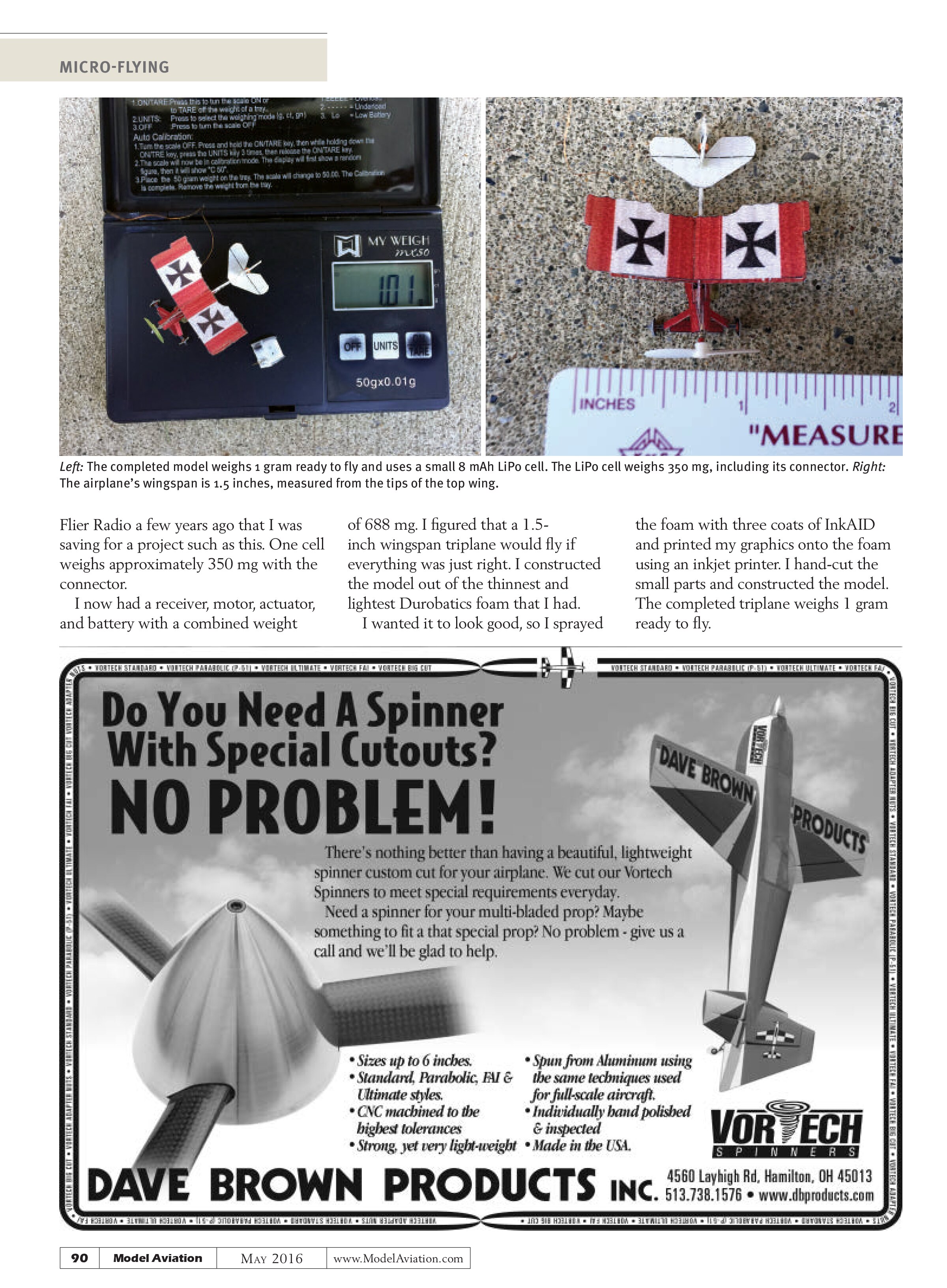
This photo shows the basic parts for the triplane, including the motor and 60 mg 27 MHz receiver that is available from Micro Flier Radio.

Gordon Johnson designed a beautiful, great-flying Cartoon Scale triplane a few years ago. With his permission, I redrew his design with my graphics and built a 5-inch wingspan version. With the success of the 5-inch edition, I thought this would be a great design for a tiny RC model!
First, I needed a small and lightweight receiver. Micro Flier Radio has a submicro receiver that only weighs 60 mg. The three-channel receiver operates on 27 MHz, has a 900 mAh speed control, and drives two 175 ohm actuators. I decided to make the model a two-channel aircraft to save as much weight as possible. I used a small actuator for rudder control that weighs 8 mg.
Next, I needed a small, lightweight, powerful motor. Triplanes produce a lot of drag, so the model needed a motor that would produce good power. I set out to build a single-phase brushless motor for the airplane. I built a nice one that weighed 300 mg. I compared the thrust I was getting from that motor with the thrust I was getting from a 3.2mm brushed motor, and it was roughly the same—approximately .7 grams with a ¾-inch propeller. I decided to use the 3.2mm motor because it was thinner and stronger than the custom-built motor. I was also able to lighten it to 270 mg by filing the case.
One of the biggest limiting factors on how small of a model I could build was the battery weight. I purchased some 8 mAh LiPo cells from Micro

Flier Radio a few years ago that I was saving for a project such as this. One cell weighs approximately 350 mg with the connector.
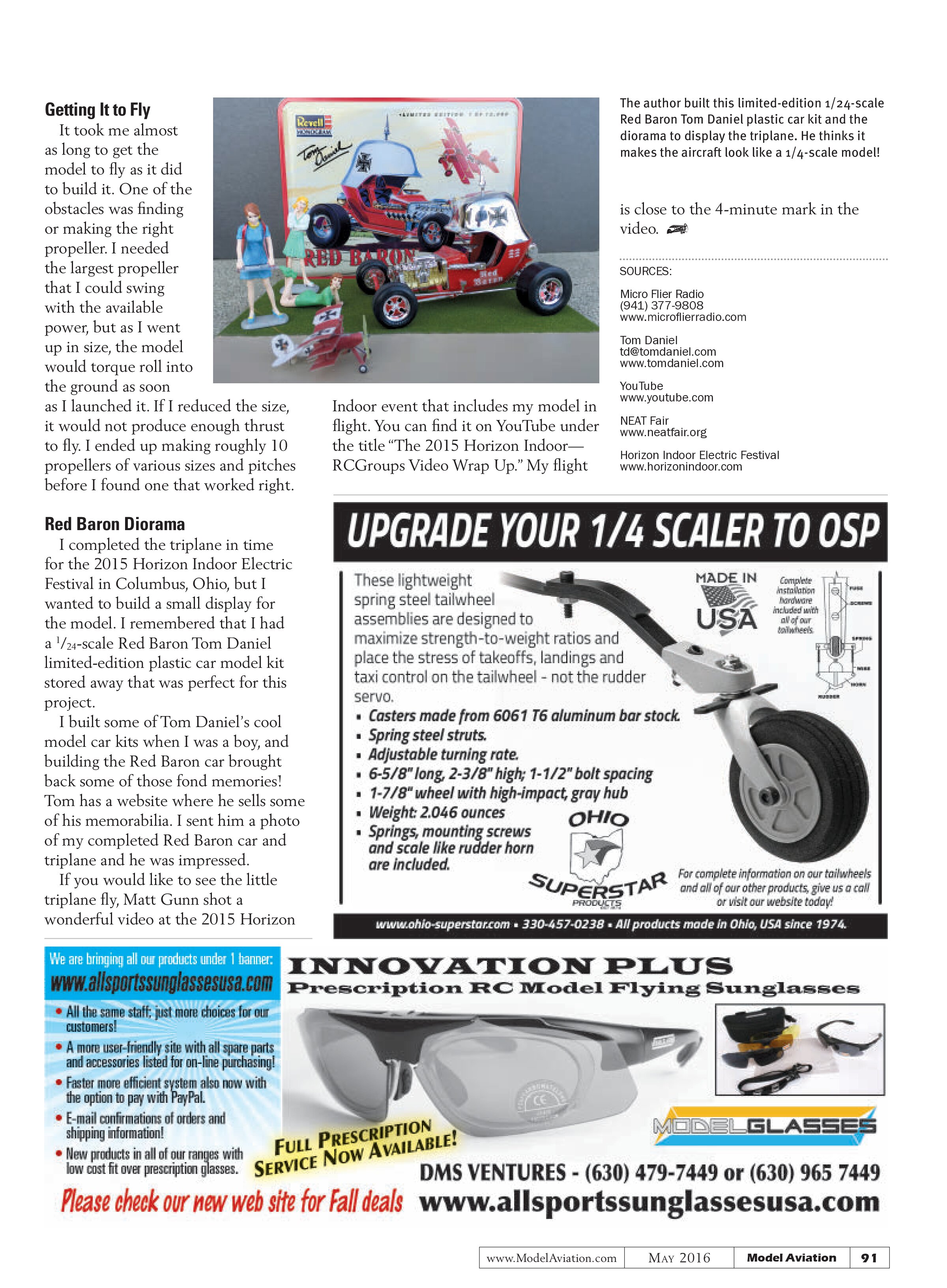
I now had a receiver, motor, actuator, and battery with a combined weight of 688 mg. I figured that a 1.5-inch wingspan triplane would fly if everything was just right. I constructed the model out of the thinnest and lightest Durobatics foam that I had.
I wanted it to look good, so I sprayed the foam with three coats of InkAID and printed my graphics onto the foam using an inkjet printer. I hand-cut the small parts and constructed the model. The completed triplane weighs 1 gram ready to fly.

Getting It to Fly
It took me almost as long to get the model to fly as it did to build it. One of the obstacles was finding or making the right propeller. I needed the largest propeller that I could swing with the available power, but as I went up in size, the model would torque roll into the ground as soon as I launched it. If I reduced the size, it would not produce enough thrust to fly. I ended up making roughly 10 propellers of various sizes and pitches before I found one that worked right.
Red Baron Diorama
I completed the triplane in time for the 2015 Horizon Indoor Electric Festival in Columbus, Ohio, but I wanted to build a small display for the model. I remembered that I had a 1/24-scale Red Baron Tom Daniel limited-edition plastic car model kit stored away that was perfect for this project.
I built some of Tom Daniel’s cool model car kits when I was a boy, and building the Red Baron car brought back some of those fond memories! Tom has a website where he sells some of his memorabilia. I sent him a photo of my completed Red Baron car and triplane and he was impressed.
If you would like to see the little triplane fly, Matt Gunn shot a wonderful video at the 2015 Horizon Indoor event that includes my model in flight. You can find it on YouTube under the title “The 2015 Horizon Indoor—RCGroups Video Wrap Up.” My flight is close to the 4-minute mark in the video.

Sources:
Micro Flier Radio
(941) 377-9808
www.microflierradio.com
Tom Daniel
td@tomdaniel.com
www.tomdaniel.com
YouTube
www.youtube.com
NEAT Fair
www.neatfair.org
Horizon Indoor Electric Festival
www.horizonindoor.com