I AM THE AMA
Tony Stillman
AMA Flying Site Assistance Coordinator/Technical Director
by Jay Smith

Jay Smith: How did you get involved with model aviation?
Tony Stillman: I have always been fascinated with flight. My dad would take me to the Blue Angels air show every year at Naval Air Station Pensacola [Florida] where we lived. He worked on the base and would tell me all kinds of stories about repair and maintenance on the A-4 Skyhawks.
I remember watching the Red Devils, Byrd Mapoles (the “Flying Mayor of Milton” [Florida]) and Leo Loudenslager fly aerobatic routines at the show. I had many dime-store rubber models that I flew off the street in front of my house.
I got into Estes Model rockets when I was in 5th grade, and then Control Line (CL) with a Cox PT-19 trainer. I spent many a summer Saturday morning cutting grass to earn money to go to the local Kmart and buy a quart of Testors glow fuel to fly my CL airplanes!
In 1971, my mom told me about a local RC Pattern [Aerobatics] event in town. My dad took me out to the event and I met another kid my age and we hit it off. Before I knew it, my dad had signed us up as new members of the local club, the Northwest Florida Modelers. We bought a Carl Goldberg Skylane 62, built the kit together, and learned to fly from instructors at the club.
JS: How has model aviation impacted your life and/or career?
TS: I was taking woodshop in high school when I was asked by a member of my club if I would like to have a summer job working at a model kit company. I jumped at the chance!
The company was Southern R/C Products, a Pattern kit company run by Ron Chidgey. The company kitted the Tiger Tail, a Ron Chidgey design that won at the 1971 AMA Nats. The summer job turned full time and a few years later, Steve Helms purchased the company. He started a radio repair shop there and I went to work for Steve at a new company called Radio South, transitioning from cutting balsa for airplane kits, to learning electronic repair of RC systems.
In the 1980s, I purchased Radio South from Steve, and have been operating it ever since. Between the late 1970s until 2006, I was involved in RC Pattern. I became the president of the National Society of Radio Controlled Aerobatics (NSRCA). I was also an AMA contest director (CD), and I was co-CD for the 1983 Pattern World Championship in Pensacola and co-CD with Ron Van Putte at the 1999 Pattern World Championship, also in Pensacola.
I was a four-time manager of the US FAI F3A team, winning the Team World Championship in Poland in 2003. Flying Pattern allowed me to make many modeling friends in the US and worldwide. This modeling family has enriched my life in ways I could never dream of.
JS: What disciplines of modeling do you currently participate in?
TS: I still love Pattern, but have not competed since 2006. I moved to Georgia and I got more involved with small electrics.
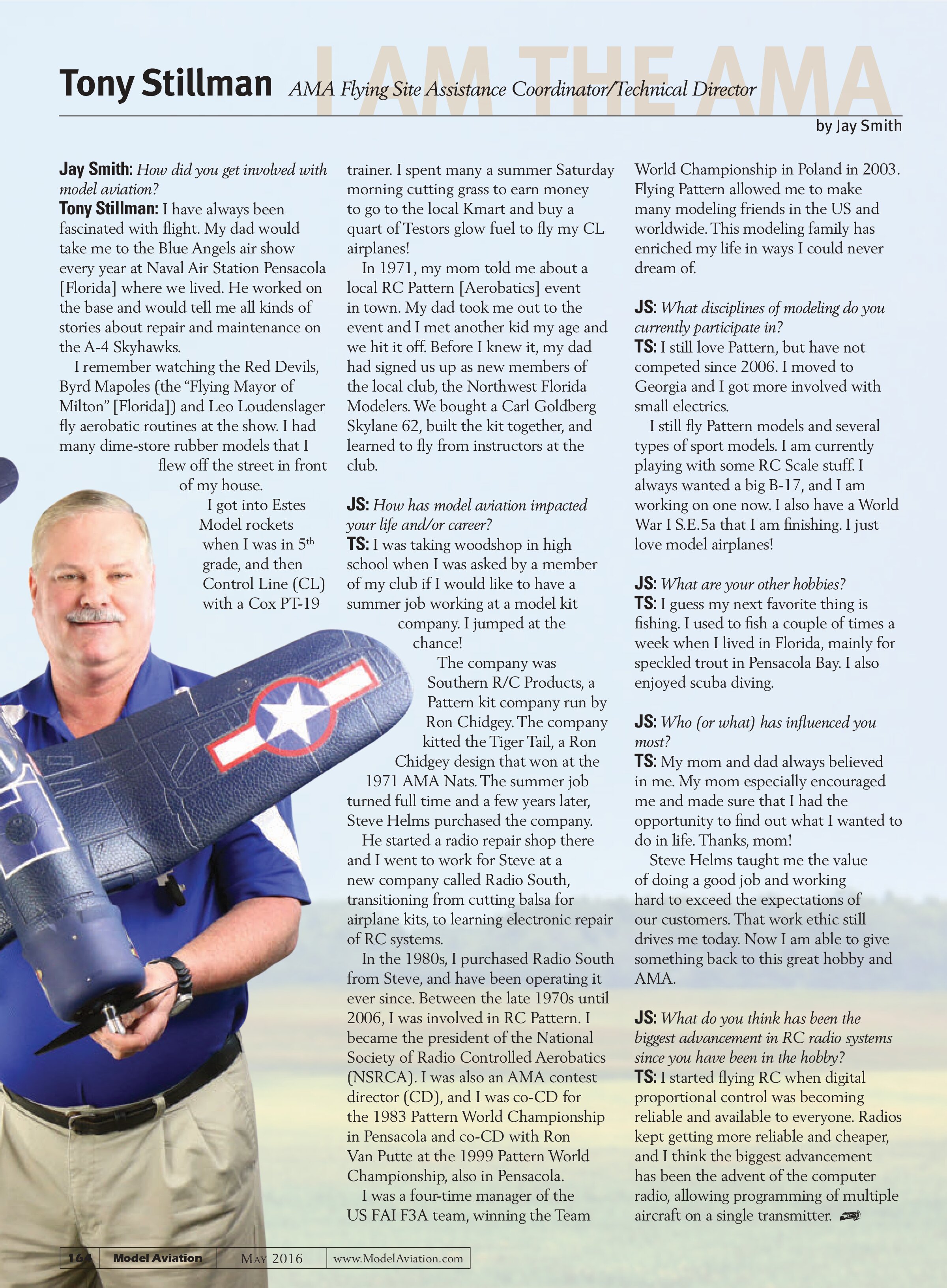
I still fly Pattern models and several types of sport models. I am currently playing with some RC Scale stuff. I always wanted a big B-17, and I am working on one now. I also have a World War I S.E.5a that I am finishing. I just love model airplanes!
JS: What are your other hobbies?
TS: I guess my next favorite thing is fishing. I used to fish a couple of times a week when I lived in Florida, mainly for speckled trout in Pensacola Bay. I also enjoyed scuba diving.
JS: Who (or what) has influenced you most?
TS: My mom and dad always believed in me. My mom especially encouraged me and made sure that I had the opportunity to find out what I wanted to do in life. Thanks, mom!
Steve Helms taught me the value of doing a good job and working hard to exceed the expectations of our customers. That work ethic still drives me today. Now I am able to give something back to this great hobby and AMA.
JS: What do you think has been the biggest advancement in RC radio systems since you have been in the hobby?
TS: I started flying RC when digital proportional control was becoming reliable and available to everyone. Radios kept getting more reliable and cheaper, and I think the biggest advancement has been the advent of the computer radio, allowing programming of multiple aircraft on a single transmitter.