One-Design at the 2016 Nats
by Gene Smith
grwhiskey@brightok.net


The One-Design event at this year’s AMA Free Flight (FF) Nats will be for the same models as last year: the Jays Bird with a .049 or .051 Nostalgia-legal engine and the Tornado by Reid Simpson with a .049 or .051 Tee Dee. Check the National Free Flight Society (NFFS) website for plans.
Kansas Wakefield
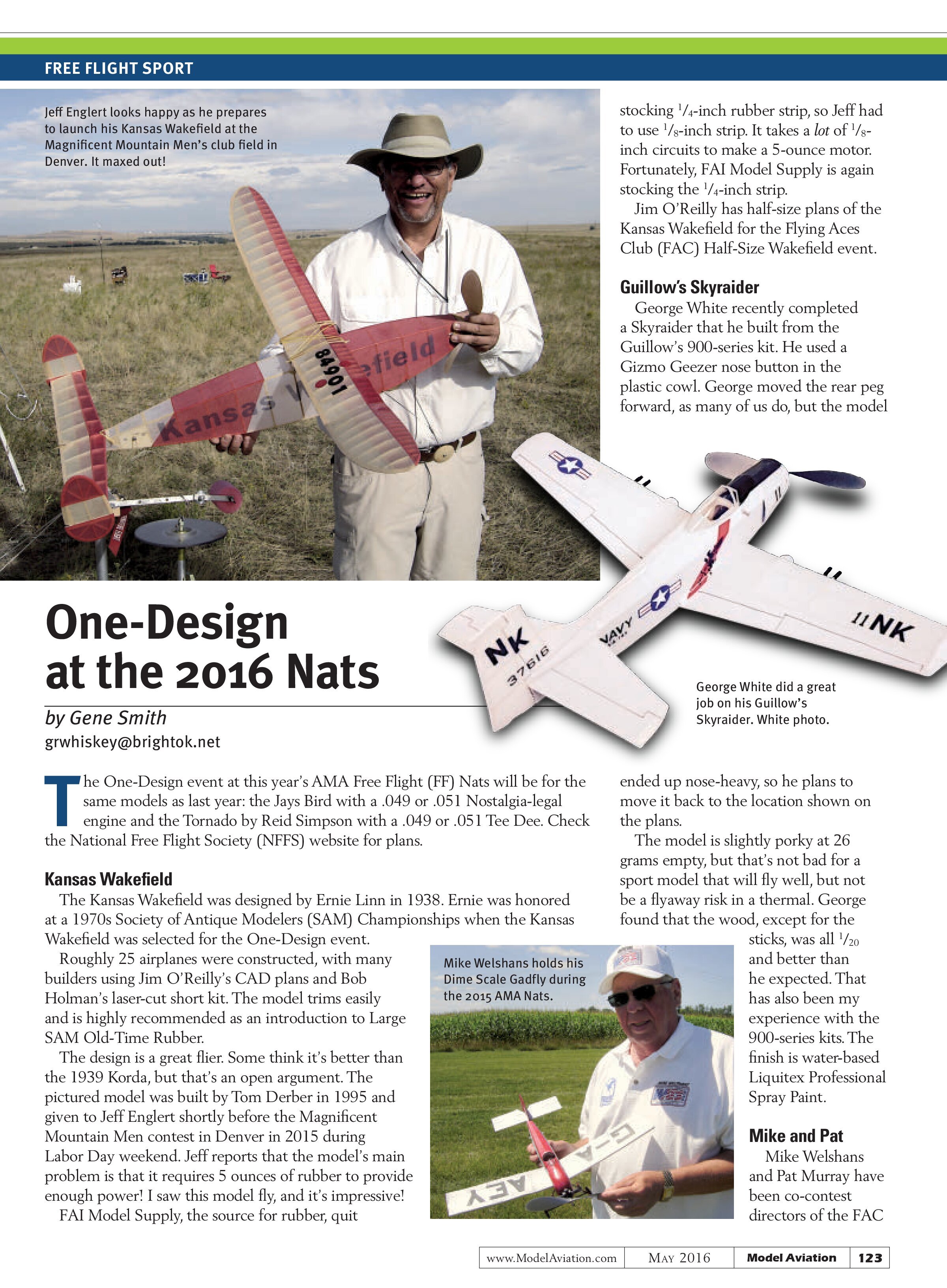
The Kansas Wakefield was designed by Ernie Linn in 1938. Ernie was honored at a 1970s Society of Antique Modelers (SAM) Championships when the Kansas Wakefield was selected for the One-Design event.
Roughly 25 airplanes were constructed, with many builders using Jim O’Reilly’s CAD plans and Bob Holman’s laser-cut short kit. The model trims easily and is highly recommended as an introduction to Large SAM Old-Time Rubber.
The design is a great flier. Some think it’s better than the 1939 Korda, but that’s an open argument. The pictured model was built by Tom Derber in 1995 and given to Jeff Englert shortly before the Magnificent Mountain Men contest in Denver in 2015 during Labor Day weekend. Jeff reports that the model’s main problem is that it requires 5 ounces of rubber to provide enough power! I saw this model fly, and it’s impressive!
FAI Model Supply, the source for rubber, quit stocking ¼-inch rubber strip, so Jeff had to use ⅛-inch strip. It takes a lot of ⅛-inch circuits to make a 5-ounce motor. Fortunately, FAI Model Supply is again stocking the ¼-inch strip.
Jim O’Reilly has half-size plans of the Kansas Wakefield for the Flying Aces Club (FAC) Half-Size Wakefield event.
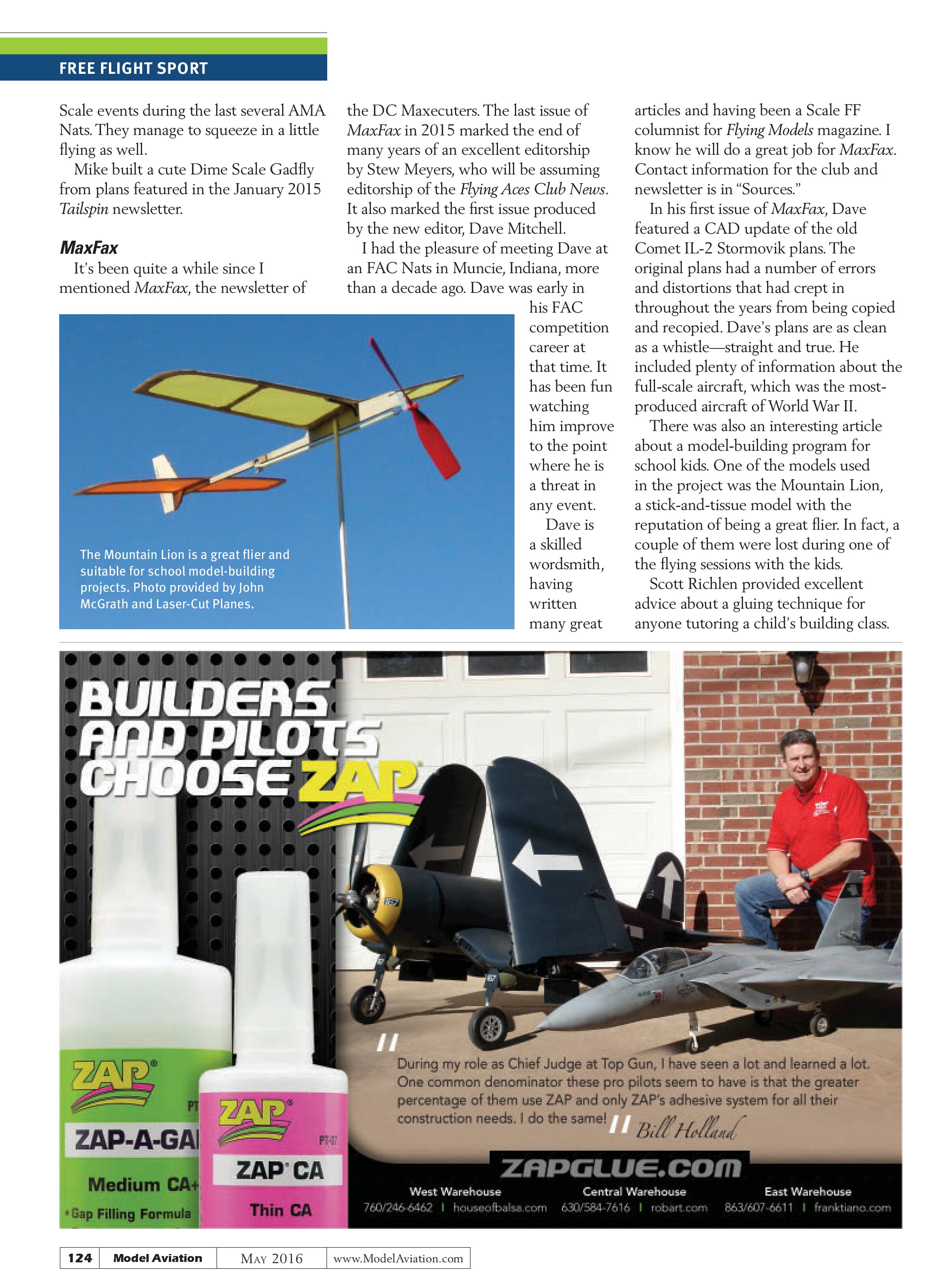
Guillow’s Skyraider
George White recently completed a Skyraider that he built from the Guillow’s 900-series kit. He used a Gizmo Geezer nose button in the plastic cowl. George moved the rear peg forward, as many of us do, but the model ended up nose-heavy, so he plans to move it back to the location shown on the plans.
The model is slightly porky at 26 grams empty, but that’s not bad for a sport model that will fly well, but not be a flyaway risk in a thermal. George found that the wood, except for the sticks, was all 1/20 and better than he expected. That has also been my experience with the 900-series kits. The finish is water-based Liquitex Professional Spray Paint.
Mike and Pat
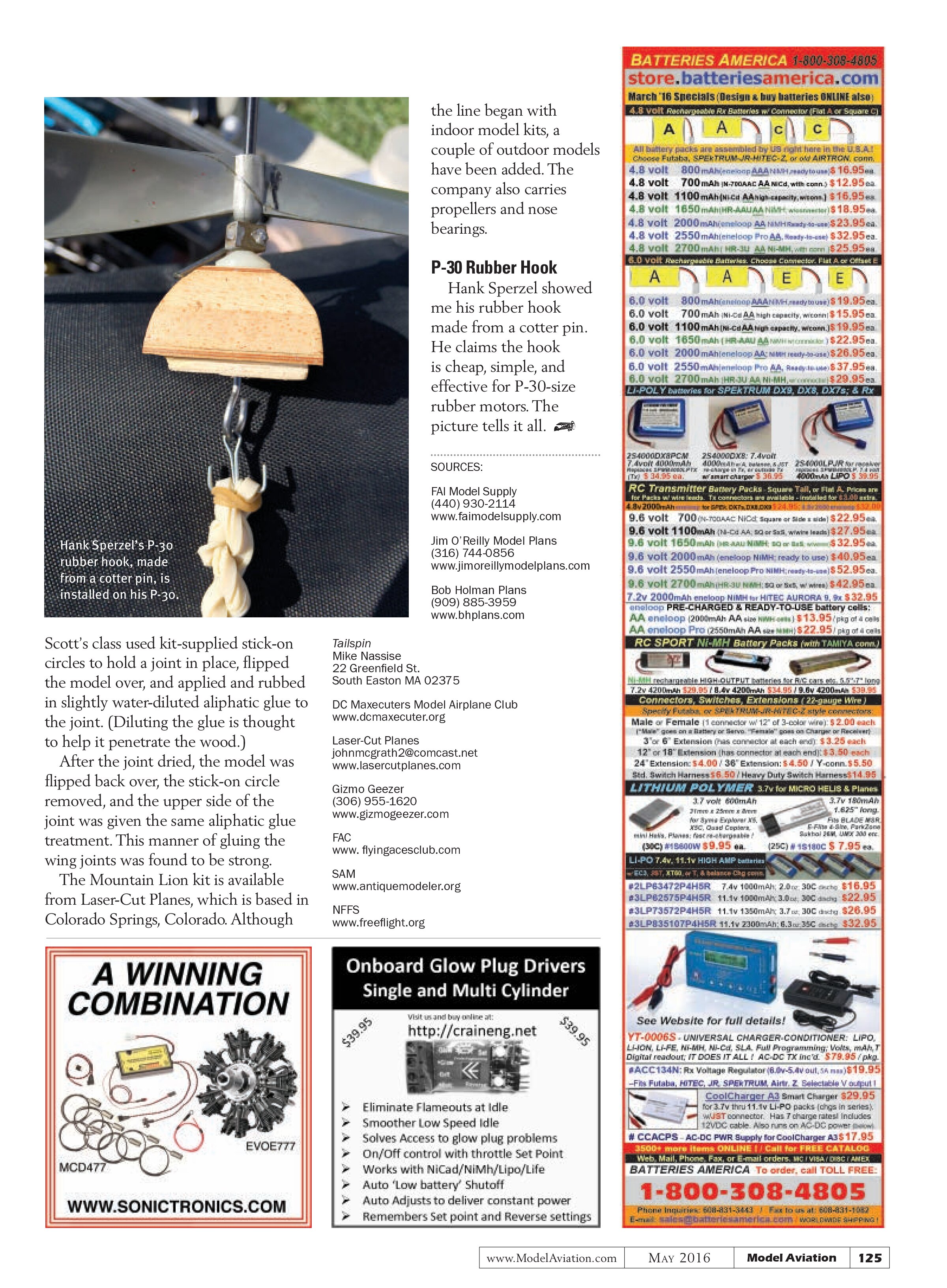
Mike Welshans and Pat Murray have been co-contest directors of the FAC

Scale events during the last several AMA Nats. They manage to squeeze in a little flying as well.
Mike built a cute Dime Scale Gadfly from plans featured in the January 2015 Tailspin newsletter.
MaxFax
It’s been quite a while since I mentioned MaxFax, the newsletter of the DC Maxecuters. The last issue of MaxFax in 2015 marked the end of many years of an excellent editorship by Stew Meyers, who will be assuming editorship of the Flying Aces Club News. It also marked the first issue produced by the new editor, Dave Mitchell.
I had the pleasure of meeting Dave at an FAC Nats in Muncie, Indiana, more than a decade ago. Dave was early in his FAC competition career at that time. It has been fun watching him improve to the point where he is a threat in any event.
Dave is a skilled wordsmith, having written many great articles and having been a Scale FF columnist for Flying Models magazine. I know he will do a great job for MaxFax. Contact information for the club and newsletter is in “Sources.”
In his first issue of MaxFax, Dave featured a CAD update of the old Comet IL-2 Stormovik plans. The original plans had a number of errors and distortions that had crept in throughout the years from being copied and recopied. Dave’s plans are as clean as a whistle—straight and true. He included plenty of information about the full-scale aircraft, which was the most-produced aircraft of World War II.
There was also an interesting article about a model-building program for school kids. One of the models used in the project was the Mountain Lion, a stick-and-tissue model with the reputation of being a great flier. In fact, a couple of them were lost during one of the flying sessions with the kids.
Scott Richlen provided excellent advice about a gluing technique for anyone tutoring a child’s building class.

Scott’s class used kit-supplied stick-on circles to hold a joint in place, flipped the model over, and applied and rubbed in slightly water-diluted aliphatic glue to the joint. (Diluting the glue is thought to help it penetrate the wood.)
After the joint dried, the model was flipped back over, the stick-on circle removed, and the upper side of the joint was given the same aliphatic glue treatment. This manner of gluing the wing joints was found to be strong.
The Mountain Lion kit is available from Laser-Cut Planes, which is based in Colorado Springs, Colorado. Although the line began with indoor model kits, a couple of outdoor models have been added. The company also carries propellers and nose bearings.
P-30 Rubber Hook
Hank Sperzel showed me his rubber hook made from a cotter pin. He claims the hook is cheap, simple, and effective for P-30-size rubber motors. The picture tells it all.
Sources:
FAI Model Supply
(440) 930-2114
www.faimodelsupply.com
Jim O’Reilly Model Plans
(316) 744-0856
www.jimoreillymodelplans.com
Bob Holman Plans
(909) 885-3959
www.bhplans.com
Tailspin
Mike Nassise
22 Greenfield St.
South Easton MA 02375
DC Maxecuters Model Airplane Club
www.dcmaxecuter.org
Laser-Cut Planes
johnmcgrath2@comcast.net
www.lasercutplanes.com
Gizmo Geezer
(306) 955-1620
www.gizmogeezer.com