Side projects for the “off-peak” season
by Mark Rudner
rudner@mit.edu
This is the last column that I’ll write this year during the “off-peak” season (it’s now early February), so it seemed appropriate to dedicate some space to Combat-related side projects. I refer to this time as “off peak” because “off season” would imply that flying has stopped. I hope that many of you still manage to fly throughout the winter months.
It’s been a long time since I last wrote about developments in the world of electric-powered Control Line (CL) Combat. This is not because of a lack of activity, but rather because of the large volume of other topics to cover. I’ll now give an update on some developments coming from Denmark and the US.
When I first started seriously experimenting with electric power for CL Combat, I retrofitted an old-style, 2008 vintage F2D model to hold a LiPo battery, ESC, and radio receiver. For the front end, I modified a set of F2D engine mounts to allow the electric motor to be fitted onto the existing mount block.
This was my first attempt, so I had little idea what would be the most efficient and lightest way to get all components onboard and in position. My most important goal was to get the model in the air and to start collecting data. One of my key targets, however, was to put together a setup that could match the performance of a top-of-the-line F2D model—even if only for a minute.
For a first attempt, that setup worked well and taught me many valuable lessons. However, the model was heavy. Throughout the variety of battery and motor combinations that I tried, the total takeoff weight ranged from 550 to 610 grams. For comparison, a decent ready-to-fly F2D model—including a full tank of fuel—generally weighs between 500 and 520 grams. Although some of the combinations that I tried had great power, there was a huge weight penalty that hurt maneuverability.
After toying with the original electric model for some time, it eventually became clear that I would need to start over and build a new airplane to make significant progress.
With many things going on and an intense F2D schedule to follow, I lacked the motivation to start anew. One day I let one of my club members take a turn flying the model, and after a wild ride, he planted it solidly in the mud. The aircraft was badly damaged and it was the best thing that ever happened to it.
The broken model lay dormant in my shop for some time, until my dad came to visit before the Danish World Cup in May 2015. In anticipation of the electric Combat event to be held there, we took one of my relatively modern Riga F2D models (built by Vasilijs Prokofev) and retrofitted it for the battery and ESC in an entirely new way.
When preparing the new model, I aimed to minimize weight as much as possible. We tailored the modifications directly toward the lightest of the high-powered motors that I had on hand (a high-revving NTM Prop Drive 28-36 3,000 Kv motor from HobbyKing). This motor weighs approximately 87 grams and can turn a standard F2D


propeller at 33,000-plus rpm in the air. This is a quite favorable power-to-weight ratio that I think should allow it to keep up with the Foras.
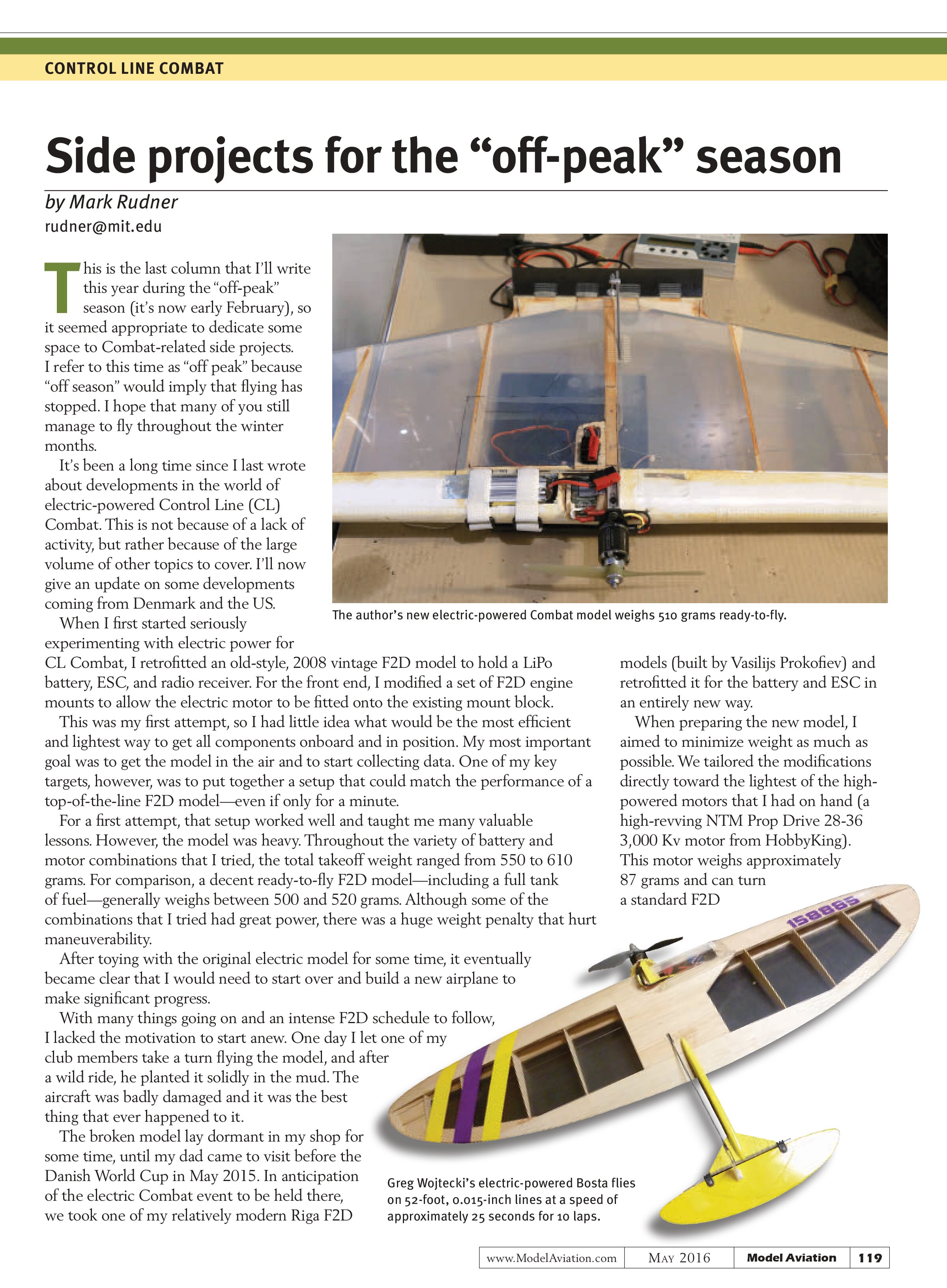
As shown in the photo, we mounted the battery directly in the foam leading edge (secured with Velcro straps) and the ESC was mounted where the muffler trench used to be (after a few minutes of careful work with the Dremel tool).
With a 4S 850 mAh LiPo battery, we achieved a takeoff weight of 510 grams—finally within the acceptable range for an F2D model! Because this model was exactly the type that I normally fly, and the center of gravity (CG) was positioned in the same location, I had no doubt that this model would turn and burn with the best of them.
Then I tested it. The airplane felt terrible. It made wide turns, and was extremely inconsistent between inside and outside loops. I tried adding tail weight to bring the CG back and help it turn tighter, but eventually the airplane became totally unstable.
What a huge and mysterious disappointment! How could this be? In basically every respect, the model is identical to my standard F2D setup. I finally realized one key difference: the electric motor is an outrunner. This means that the entire body of the motor rotates, along with the magnets.
As compared with the rotating mass in a standard internal-combustion engine (mostly the crankshaft), the electric motor carried a huge angular momentum that must have created large gyroscopic forces that killed the model’s performance. It’s an effect that I had never expected to be so significant, but it appeared to be rather devastating. At least that’s my hypothesis.
To test it, I purchased an inrunner motor with similar specifications to the outrunner that I had used before. If I’m right, the electric Combat model should indeed be able to run with the pack powered by this new motor.
Greg Wojtecki’s Bosta
In other news, during the World Air Games in Dubai, I met Dan Kane, an RC Pylon Racing pilot from Chicago who has been building and flying electric Combat models with Greg Wojtecki for some time.
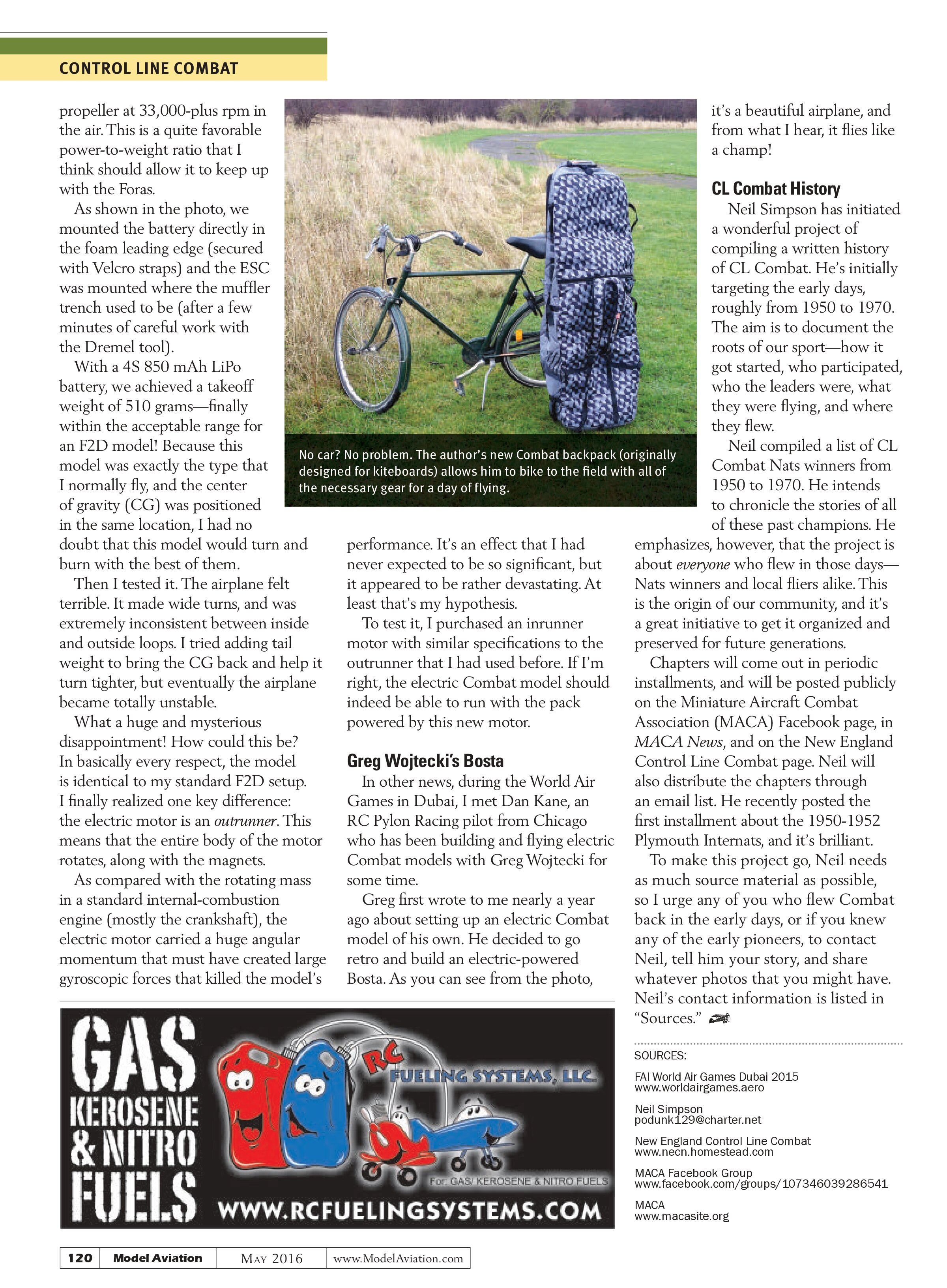
Greg first wrote to me nearly a year ago about setting up an electric Combat model of his own. He decided to go retro and build an electric-powered Bosta. As you can see from the photo,

it’s a beautiful airplane, and from what I hear, it flies like a champ!
CL Combat History
Neil Simpson has initiated a wonderful project of compiling a written history of CL Combat. He’s initially targeting the early days, roughly from 1950 to 1970. The aim is to document the roots of our sport—how it got started, who participated, who the leaders were, what they were flying, and where they flew.
Neil compiled a list of CL Combat Nats winners from 1950 to 1970. He intends to chronicle the stories of all of these past champions. He emphasizes, however, that the project is about everyone who flew in those days—Nats winners and local fliers alike. This is the origin of our community, and it’s a great initiative to get it organized and preserved for future generations.
Chapters will come out in periodic installments, and will be posted publicly on the Miniature Aircraft Combat Association (MACA) Facebook page, in MACA News, and on the New England Control Line Combat page. Neil will also distribute the chapters through an email list. He recently posted the first installment about the 1950-1952 Plymouth Internats, and it’s brilliant.
To make this project go, Neil needs as much source material as possible, so I urge any of you who flew Combat back in the early days, or if you knew any of the early pioneers, to contact Neil, tell him your story, and share whatever photos that you might have. Neil’s contact information is listed in “Sources.”
Sources:
FAI World Air Games Dubai 2015
www.worldairgames.aero
Neil Simpson
podunk129@charter.net
New England Control Line Combat
www.necn.homestead.com
MACA Facebook Group
www.facebook.com/groups/107346039286541
MACA
www.macsite.org