The next big thing in RC
Jim T. Graham
jgraham@rcgroups.com
I have been in the RC industry for a while. Even back in the early days, I was always asked the same question by magazines and RC companies: “What do you think the next big thing is?” When I entered RC, 3-D was not only new—it was scary to many of the older hobbyists. At that time, the chant was that 3-D would ruin the hobby.
When I worked at Hobby Lobby (the retailer that changed the RC industry), even that company didn’t trust 3-D. It took me six months to talk the business into carrying one 3-D airplane. After it went to number one in sales, 3-D airplanes were a big part of what Hobby Lobby sold.
The more recent “next big thing” was quadcopters. The whole concept was such a departure from winged flight that I think it took many by surprise, but there is no denying that quadcopters have dominated the market.
Last year I was again asked, “What’s next, Jim T.?” Let me preface this by saying that the answer to that question is relative. What’s next for me might not be what’s next for you, but if you fall squarely in the RC demographic, you could be able to predict what other like-minded RC pilots might also like and move to.
Last year, my answer was FPV racing—things have certainly moved that way. I think we still have a way to go before we see FPV racing at every field, but it certainly hasn’t let up.
That brings us to now. I was out on the road meeting with companies and, interestingly, no one asked me what the next big thing was. I think it is because most companies are trying to catch up to what is hot at this very minute.
I do have an opinion about what this year might have in store for today’s RC pilots. Although the market has responded to the multirotor demand with a slew of options, I think there are many RC modelers who are simply more comfortable with winged flight. I have a cornucopia of FPV-capable 250- to 550-size quadcopters. I’m now looking into the 150- and 180-size quadcopters, but multirotors are not what I’m excited about this year.

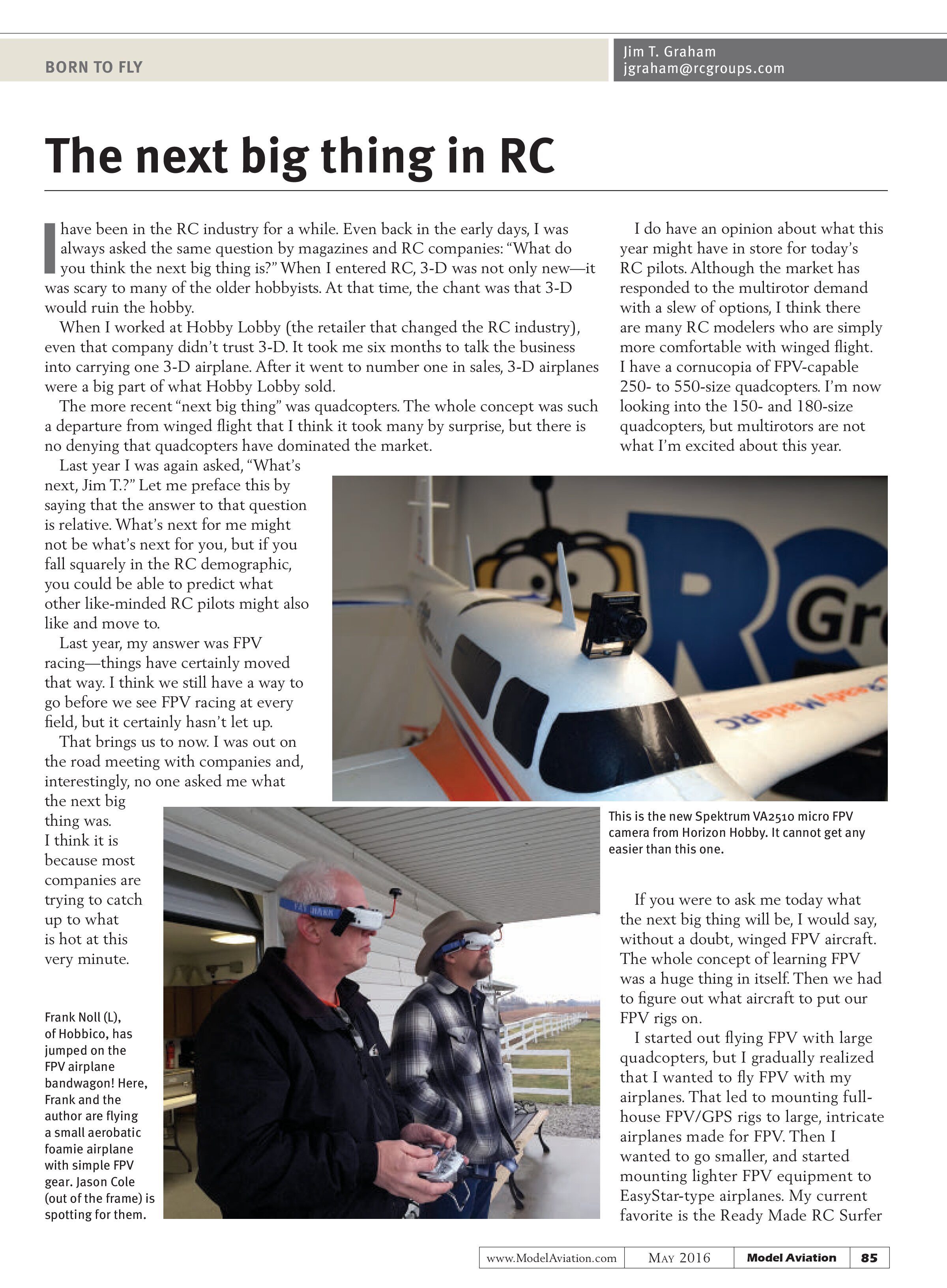
If you were to ask me today what the next big thing will be, I would say, without a doubt, winged FPV aircraft. The whole concept of learning FPV was a huge thing in itself. Then we had to figure out what aircraft to put our FPV rigs on.
I started out flying FPV with large quadcopters, but I gradually realized that I wanted to fly FPV with my airplanes. That led to mounting full-house FPV/GPS rigs to large, intricate airplanes made for FPV. Then I wanted to go smaller, and started mounting lighter FPV equipment to EasyStar-type airplanes. My current favorite is the Ready Made RC Surfer

1500, but I’m not there yet.
The next phase will be mounting lightweight FPV gear to midsize aerobatic airplanes. I have an International Miniature Aerobatic Club (IMAC)-based foam airplane that is next on my FPV list. I want something that I can effectively fly knife-edge and inverted.
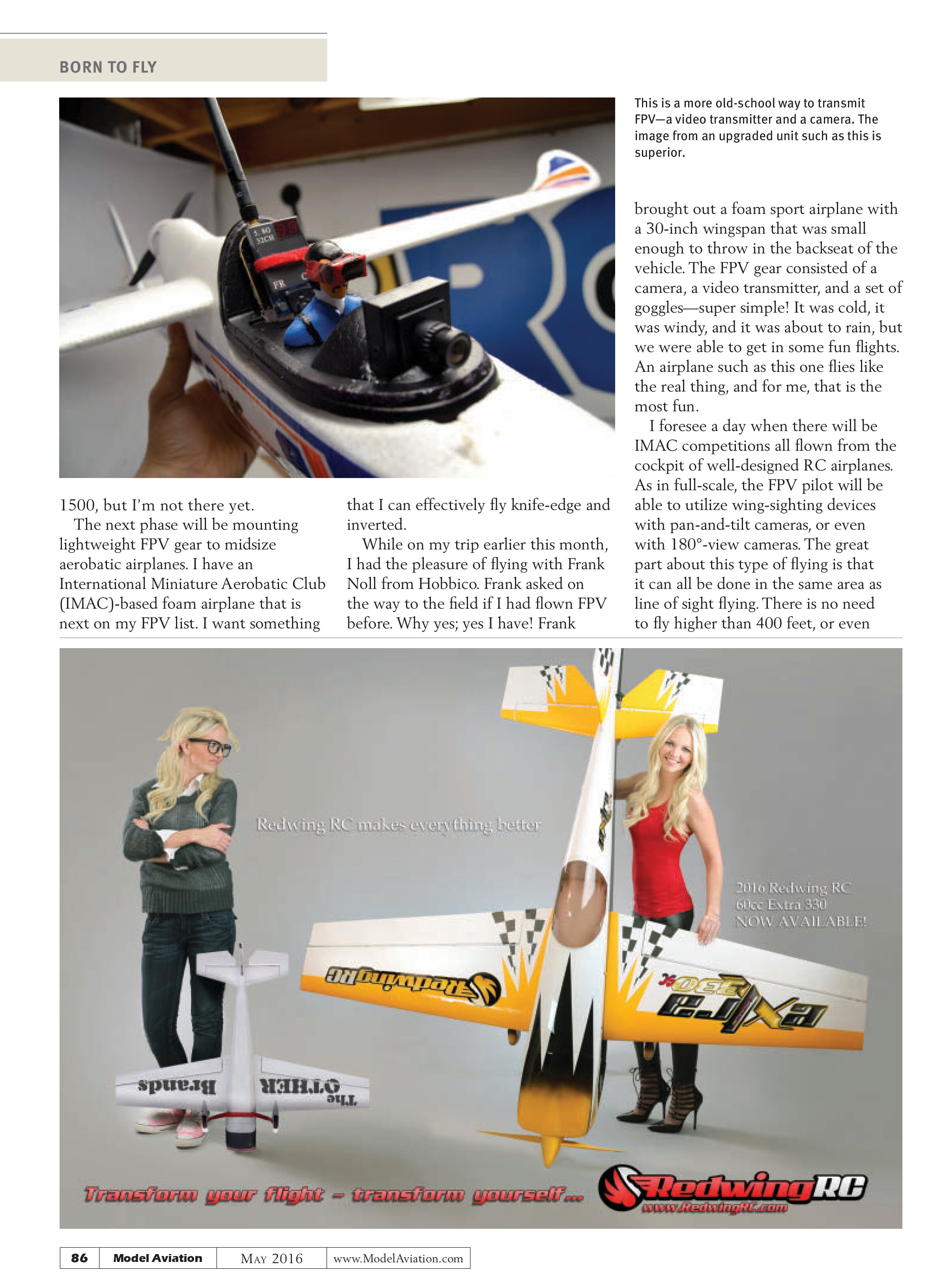
While on my trip earlier this month, I had the pleasure of flying with Frank Noll from Hobbico. Frank asked on the way to the field if I had flown FPV before. Why yes; yes I have! Frank

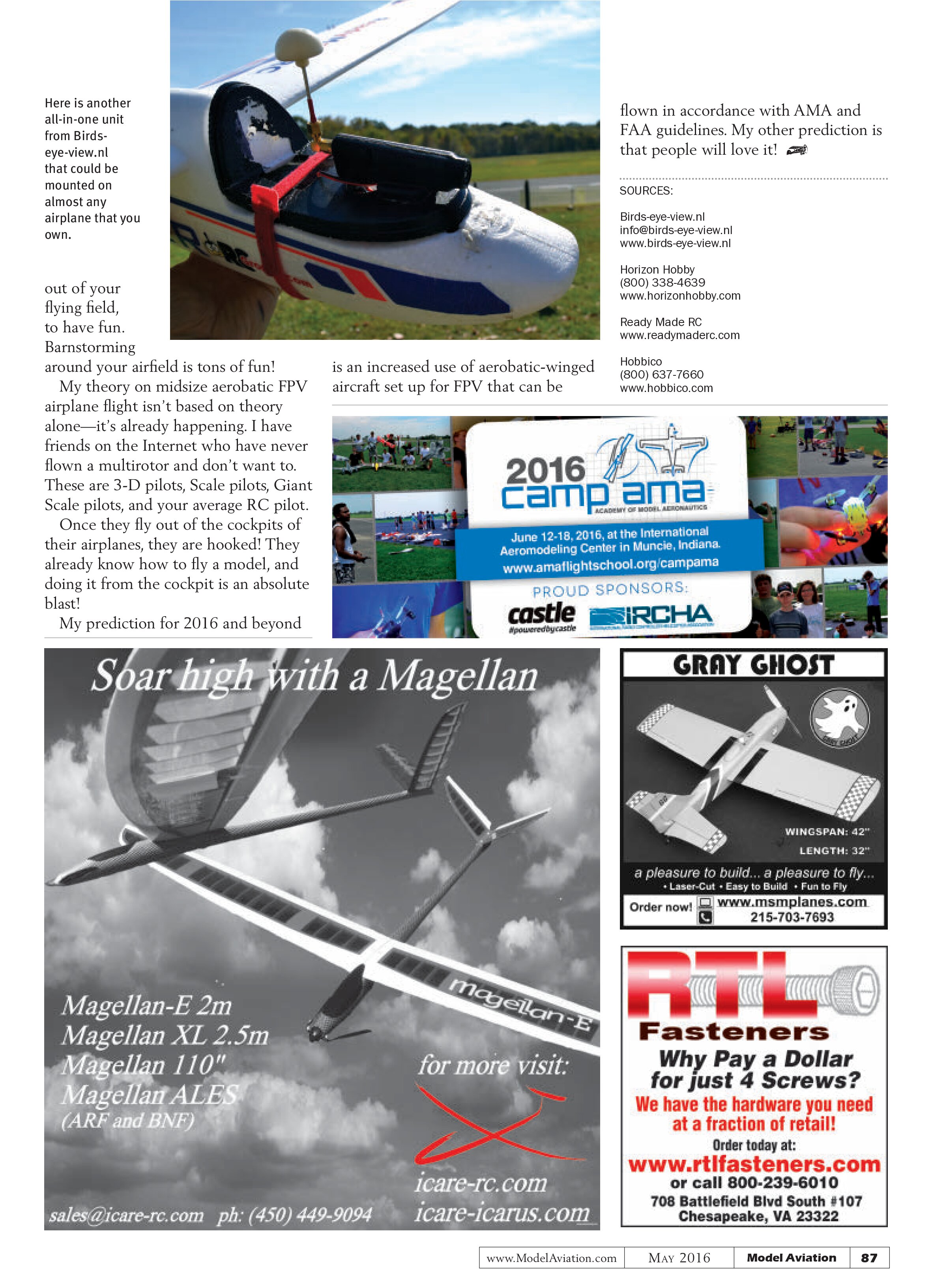
brought out a foam sport airplane with a 30-inch wingspan that was small enough to throw in the backseat of the vehicle. The FPV gear consisted of a camera, a video transmitter, and a set of goggles—super simple! It was cold, it was windy, and it was about to rain, but we were able to get in some fun flights. An airplane such as this one flies like the real thing, and for me, that is the most fun.
I foresee a day when there will be IMAC competitions all flown from the cockpit of well-designed RC airplanes. As in full-scale, the FPV pilot will be able to utilize wing-sighting devices with pan-and-tilt cameras, or even with 180°-view cameras. The great part about this type of flying is that it can all be done in the same area as line of sight flying. There is no need to fly higher than 400 feet, or even
out of your flying field, to have fun. Barnstorming around your airfield is tons of fun!
My theory on midsize aerobatic FPV airplane flight isn’t based on theory alone—it’s already happening. I have friends on the Internet who have never flown a multirotor and don’t want to. These are 3-D pilots, Scale pilots, Giant Scale pilots, and your average RC pilot.
Once they fly out of the cockpits of their airplanes, they are hooked! They already know how to fly a model, and doing it from the cockpit is an absolute blast!
My prediction for 2016 and beyond is an increased use of aerobatic-winged aircraft set up for FPV that can be flown in accordance with AMA and FAA guidelines. My other prediction is that people will love it!

Sources:
Birds-eye-view.nl
info@birds-eye-view.nl
www.birds-eye-view.nl
Horizon Hobby
(800) 338-4639
www.horizonhobby.com
Ready Made RC
www.readymaderc.com
Hobbico
(800) 637-7660
www.hobbico.com