Anything is better than nothing
Thayer Syme
thayer@flying-models.com
Something you might not know is that my son and I dabble a bit in model railroading. While looking through some train websites recently, I came across an interesting reflection by Mark Underwood that might feel familiar.
He lamented in a blog post a few years ago that real-life practicalities had gotten in the way of the grandiose vision he held for his model railroading and other hobbies. The gap between the basic start he first made on his layout and those dreams—along with comparing his own modeling skills to what he saw daily in Internet forums—killed much of his enthusiasm, leaving his project idle in its wake.
It was easier to do nothing than to try to live up to those personal expectations. He wrote, “It’s like this voice in my head is saying, ‘If I can’t climb Everest, I just won’t do any outdoors stuff at all.’”
He overcame this slump after realizing that a lot of enjoyment was still available from less-lofty goals. He decided that doing something at any level was better than doing nothing on the layout, even if he would later go back and rework specific areas. Instead of trying to
achieve an unrealistic level of execution, he instead dedicated his efforts to taking it step by small step, and doing the best he could at that moment.
With this seemingly simple change in attitude, he is making progress on his layout with a pace and level of quality that works for him. And guess what? He is having fun again, reaping the rewards of a favorite hobby by simply accepting the limitations of the time, skill, and resources that we all inevitably encounter.
He closes by musing that, “It’s far from perfect, but I hope you will agree that it is good, if for no other reason than that it is done.”
This realization is one we should apply to our flying projects as well. I believe that many of us let unrealistic dreams of building an overly complex, competition-quality model block us from the joys of building anything.

The time demands of our lives make it easy to forego the commitment of any new building project in favor of the ever-ready “have it now” golden ticket that is wrapped in a shiny new box on the shelves of your local hobby shop.
There is no question that today’s RTF and ARF models offer a lot of bang for the buck. And

given the fit and finish typically seen in these models, it is easy to think that it isn’t worth taking the time to build a model on your own.
If this sounds even a little familiar, let me propose the following: Carve out some space in your workshop or on the kitchen table, and build a simple kit or plans-built project alongside your day-to-day modeling fare. Even only an hour or two a week can show progress with a basic model and give you the chance to refresh some skills that might be a little rusty.
I expect that when you are done and make those first few flights, you will experience a satisfaction and pleasure that is much harder to find when flying a model that someone else has built.
Remember, not every new project has to mean a big commitment of time or resources to satisfy. As a lowly example, let’s take a look at my new hobby knife.
A Simple Fix
Although I have periodically used scalpel blades for light hobby work throughout the last 20 years, I have never actually had a proper handle for them. I’ve simply broken the back end off then used them with a typical hobby-knife handle. That worked, but it didn’t work well.
It turns out that scalpel handles aren’t expensive at all. I recently picked one up from eBay with a box of 100 #11 blades for $10.85 delivered.
When the package arrived a few days later, I immediately realized that
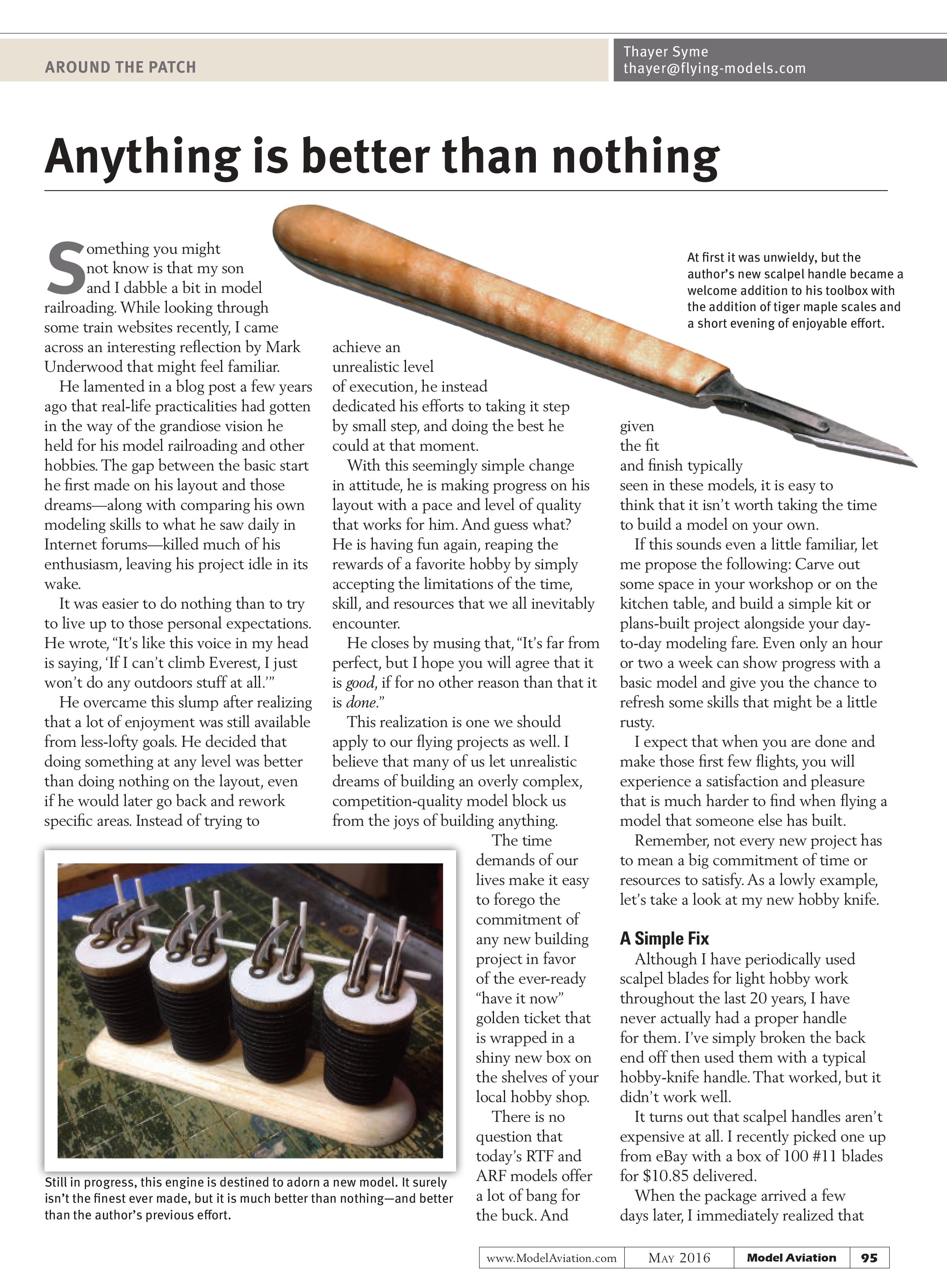
although a typical scalpel might work well for surgeons, its rectangular cross section was uncomfortable in my hands. I was committed to making it work, so instead of tossing it aside to revisit later—or never—I spent that evening on a most satisfying project.
A scrap of hardwood, split in half and buttered up with some Zap 30-minute Z-Poxy, made a quick and messy sandwich just before dinner. I went back to the workshop after the dishes were put away, and whittled down the wood a bit before using a strip of 120-grit sandpaper to “shoeshine” the handle to a pleasing shape.
After giving it a final smoothing with some finer-grit sandpaper, I added a couple of coats of Tung oil and now have a new favorite knife. The oval cross-section keeps it from rolling off of the bench, and more importantly, it is now much more comfortable than the shape that had disappointed me just a few hours earlier.
No, customizing the knife wasn’t the same commitment level as building a new airplane, but it was still rewarding. The emotional satisfaction of crafting a new, unique tool with little more than a thought and my hands makes it meaningful in its own right.
I assure you that I haven’t been this enthused about a new hobby knife since I earned my first X-Acto set selling Christmas cards door-to-door when I was nine. This simple moment of creation has also helped refocus my attention on a few other lingering projects.
An Elegant Solution
Before I close, let me also tell you about a new goodie Santa brought me this past Christmas. It is a simple device, yet so ingenious that everyone who has seen mine has asked where to get one, while also lamenting that they hadn’t come up with the idea first.
The SeatRack internal cargo rack is designed as a stand-in for a larger roof rack or even a pickup truck bed during

those occasional trips to the local home improvement center. Although it isn’t exactly flying season here in snowy New England right now, I expect the SeatRack will prove equally at home securing model airplane wings or fuselages for a quick trip to the field next summer when I don’t want to let precious cargo bounce around in the backseat.
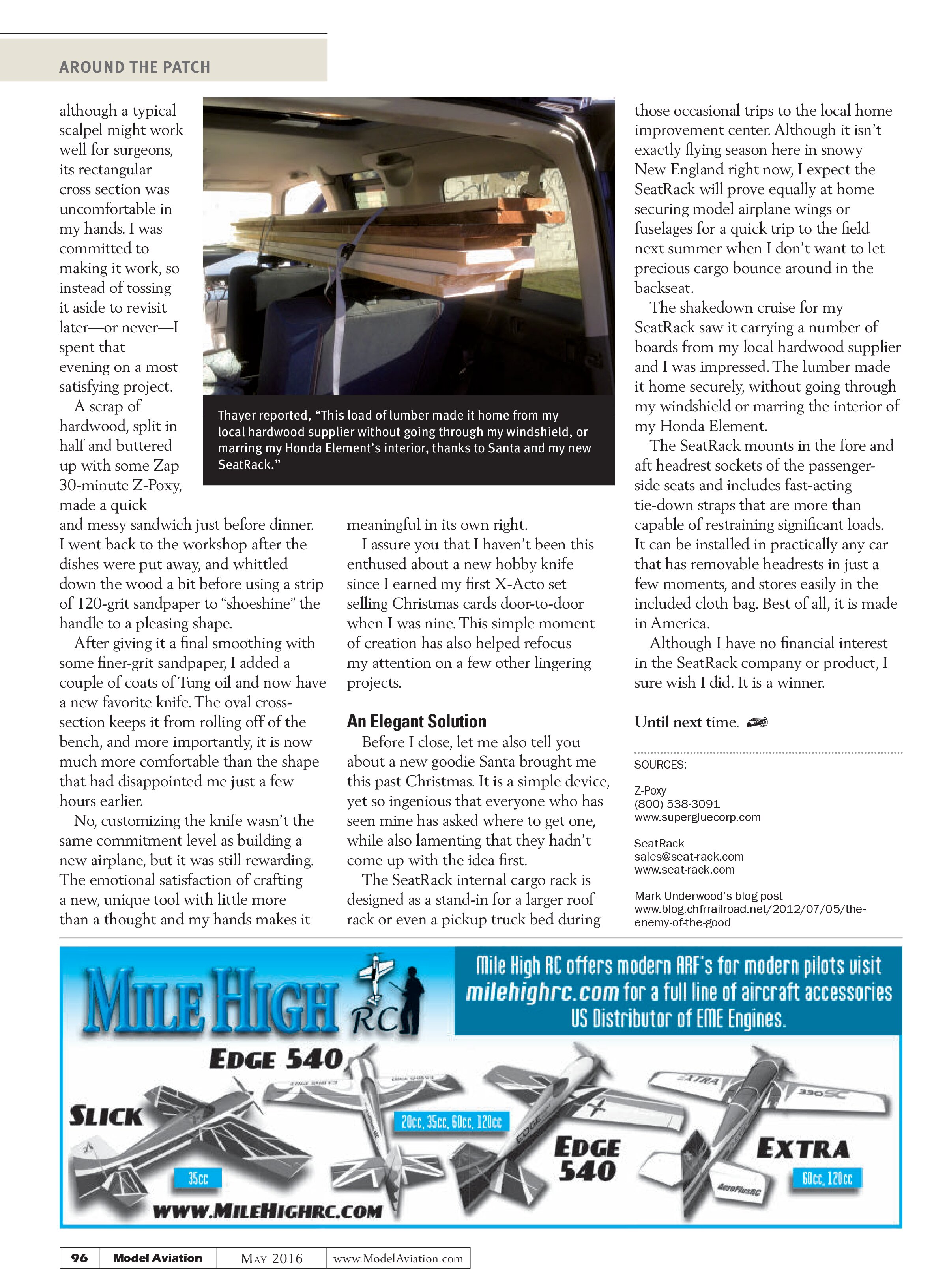
The shakedown cruise for my SeatRack saw it carrying a number of boards from my local hardwood supplier and I was impressed. The lumber made it home securely, without going through my windshield or marring the interior of my Honda Element.
The SeatRack mounts in the fore and aft headrest sockets of the passenger-side seats and includes fast-acting tie-down straps that are more than capable of restraining significant loads. It can be installed in practically any car that has removable headrests in just a few moments, and stores easily in the included cloth bag. Best of all, it is made in America.
Although I have no financial interest in the SeatRack company or product, I sure wish I did. It is a winner.
Until next time.
SOURCES:
Z-Poxy
(800) 538-3091
www.supergluecorp.com
SeatRack
sales@seat-rack.com
www.seat-rack.com
Mark Underwood’s blog post
www.blog.chfrrailroad.net/2012/07/05/the-enemy-of-the-good