Going professional
Patrick Sherman
lucidity@roswellflighttestcrew.com
Something strange has happened, owing to the Unmanned Aircraft Systems (UAS) revolution that began a few years ago. The same skills that model aviators spent years honing strictly for their own enjoyment, have suddenly acquired commercial value. In short, you can make money flying model airplanes.
This has always been true to some degree. If you were an exceptionally skilled pilot, you could earn money from sponsorships or win cash prizes in contests. A few people even get the opportunity to work for hobby companies or trade magazines and test-fly new designs. However, with drones set to launch the next great technological revolution in the coming decade, opportunities to earn a living as an RC pilot are about to proliferate beyond anything the industry has ever seen.
The Roswell Flight Test Crew members have always clung ferociously to our status as hobbyists, both to avoid the regulatory nightmares that have been imposed on the industry throughout the past few years, and because we strongly believe that amateurs have important contributions to make to the development of this important new technology.
However, as I sat down to write this article, I found that my background left me poorly suited to provide practical advice on this topic, so I turned to a couple of friends who are experts. Robert Rodriguez is the president and founder of the Society of Aerial Cinematography (SOAC) in Los Angeles, and Jonathan Rupprecht is the principal of an aviation law firm that bears his name. Jonathan is also among the top three attorneys nationwide in filing successful 333 Exemption petitions with the FAA.
Obviously, drones are going to be deployed across myriad applications in the coming years, from precision agriculture to emergency response, utility inspection, and parcel delivery, but I’ve decided to focus specifically on aerial video in this article.
Lights, Camera, Drone!
When I asked Robert what advice he would give a newcomer to the field of aerial video, I was honestly startled by his response. I expected he would say something like, “Line up your shot so

“you can’t see the shadow of your drone in the frame.” Instead, he started talking to me about etiquette.
“You have to understand what you’re getting into,” he said. “There is a very different etiquette in the hobby world and the professional world. Once you get on set, it’s painfully obvious who is a professional and who is a hobbyist.”
He went on to explain to me that far from being a freewheeling, creative exercise where everyone’s input is welcome, a modern film set much more resembles a military unit in terms of discipline and strict adherence to the chain of command.
“Many people believe that because they have a camera attached to their drone, they have a right to tell the director how to frame his or her shot, when in fact their role is to help the director realize his or her vision—not to tell them how to do their jobs,” he explained.
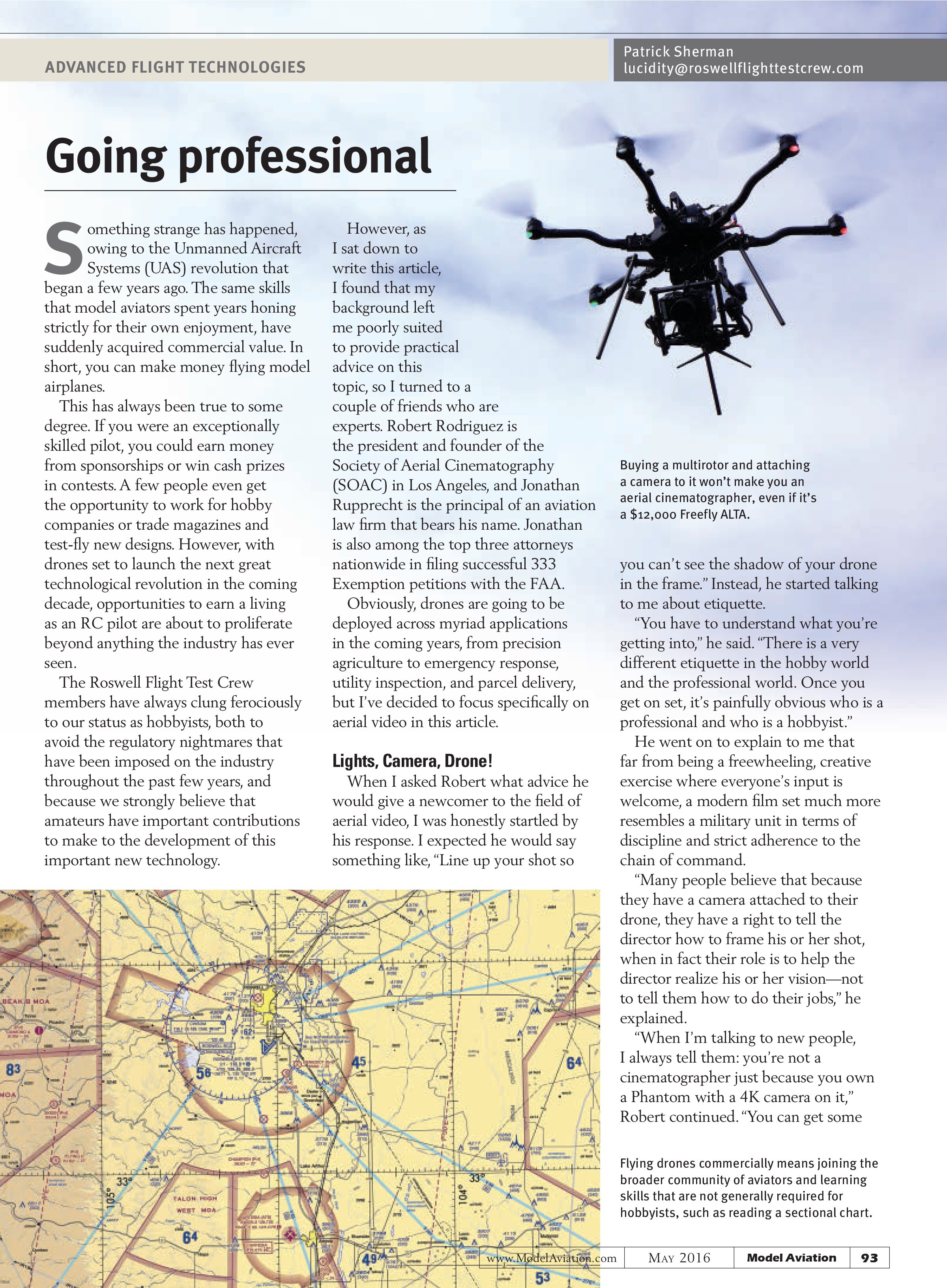
“When I’m talking to new people, I always tell them: you’re not a cinematographer just because you own a Phantom with a 4K camera on it,” Robert continued. “You can get some

stunning video and post it on YouTube, but calling yourself a cinematographer is disrespectful to the people who have honed this craft for decades.
“Going out and buying one of these things, throwing it up in the air, and calling yourself a cinematographer is the shortest path to failure in this industry—and it’s a small industry with a long memory.”
If you want to become a serious professional, Robert suggests you start by getting to know the industry. Talk to people and start figuring out how the different pieces fit together on a set. “One thing about this industry [is that] we love to talk about what we do,” Robert added.
Next, he recommends that you practice your craft and find a source for honest feedback. “Your friends and family are just going to tell you it’s wonderful,” he said. “On YouTube, there is a huge appetite for content, but if you only get one-word feedback, like ‘Awesome!’ or ‘Sucks!’ that isn’t really going to help you improve.
“You need to find an online community, like the forums on the SOAC website, where you can ask for, and receive, specific, constructive criticism. Then, once you become successful in your own career, stay active on those forums and help the new people who are coming up.”
Legal Eagle
As with my interview with Robert, Jonathan caught me off guard with the first piece of advice he said he would give a newcomer to the commercial drone space industry.
“Mapping, utilities, and aerial cinematography are the three areas where cash is coming in right now and where you can operate legally,” he said, before going on to explain that his work can involve as much business consulting as it does legal advice, by helping people to understand where they can realistically expect to make money while staying on the right side of the law.
As most people with even a passing interest in the subject understand at this point, if you are going to make money flying RC, you need something called a 333 Exemption, which Jonathan explained to me:
“If you’re strictly flying for recreation, you just need to adhere to Advisory Circular 91-57A, which is basically the same set of rules that modelers have been following for decades. However, once you make a dollar or receive any kind of indirect benefit, suddenly the entirety of the Federal Aviation Regulations (FARs) applies to you.
“There are many, many of those regulations [that] you simply can’t comply with as a drone operator, so you have to get an exemption from them. In order to get that exemption, you need to impose some restrictions on yourself to achieve an equivalent level of safety. The goal of the FAA is to keep everybody safe—and they don’t actually care how you get there.”
A few of these restrictions embedded into each 333 Exemption include:
- The pilot of the drone must hold, at a minimum, a sport pilot’s certificate.
- A visual observer is required on all flights to monitor the surrounding airspace for potential conflicts.
- The aircraft must remain a minimum of 500 feet away from property or persons who are not participating in the flight.
- The aircraft must weigh less than 55 pounds.
- The aircraft must maintain a speed [of] less than 100 miles per hour.
- Flying is permitted during daylight hours only.
- Maintain a visual line of sight with the aircraft.
- Only fly when there is a minimum of three nautical miles of visibility.
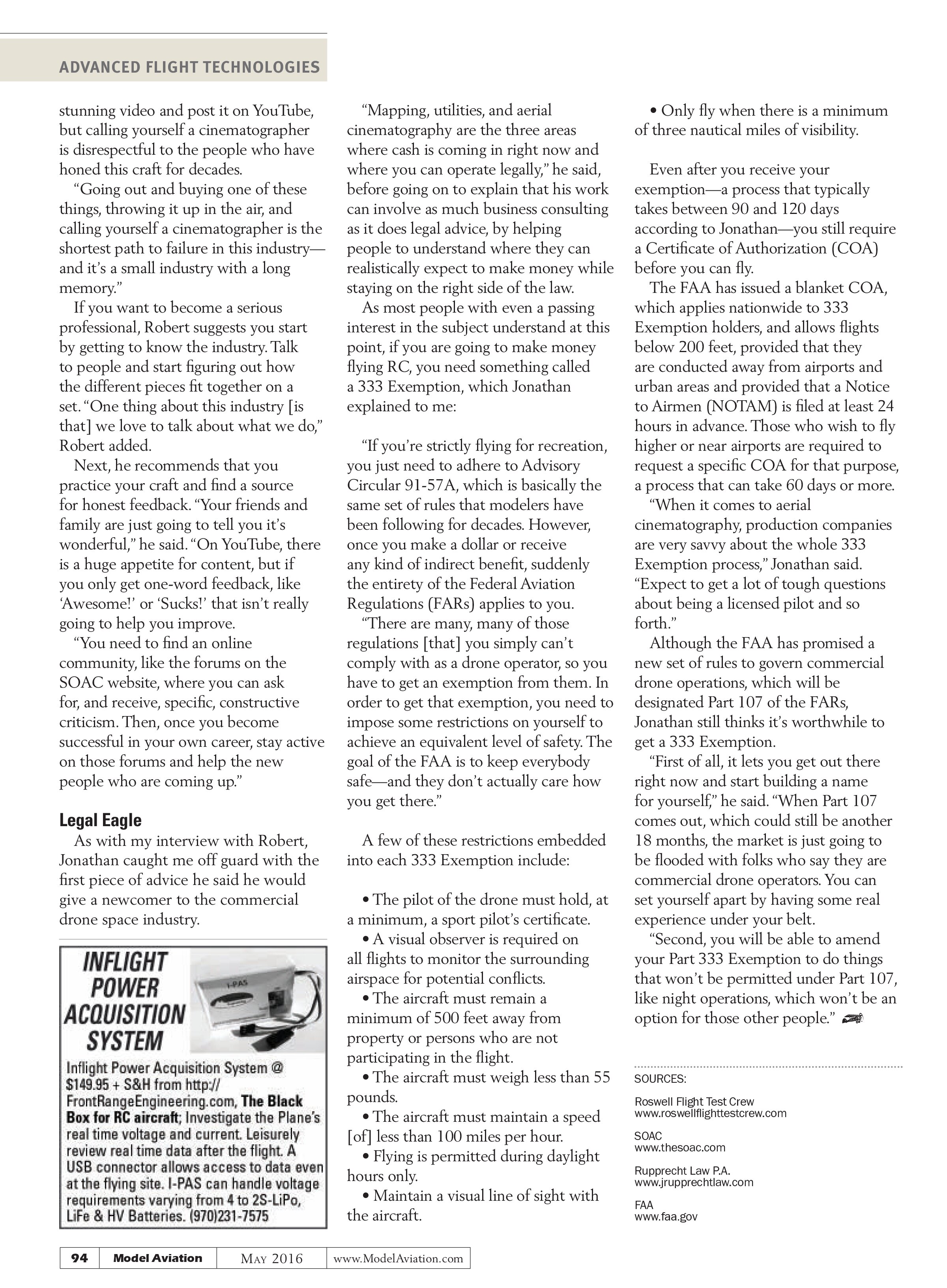
Even after you receive your exemption—a process that typically takes between 90 and 120 days according to Jonathan—you still require a Certificate of Authorization (COA) before you can fly.
The FAA has issued a blanket COA, which applies nationwide to 333 Exemption holders, and allows flights below 200 feet, provided that they are conducted away from airports and urban areas and provided that a Notice to Airmen (NOTAM) is filed at least 24 hours in advance. Those who wish to fly higher or near airports are required to request a specific COA for that purpose, a process that can take 60 days or more.
“When it comes to aerial cinematography, production companies are very savvy about the whole 333 Exemption process,” Jonathan said. “Expect to get a lot of tough questions about being a licensed pilot and so forth.”
Although the FAA has promised a new set of rules to govern commercial drone operations, which will be designated Part 107 of the FARs, Jonathan still thinks it’s worthwhile to get a 333 Exemption.
“First of all, it lets you get out there right now and start building a name for yourself,” he said. “When Part 107 comes out, which could still be another 18 months, the market is just going to be flooded with folks who say they are commercial drone operators. You can set yourself apart by having some real experience under your belt.
“Second, you will be able to amend your Part 333 Exemption to do things that won’t be permitted under Part 107, like night operations, which won’t be an option for those other people.”
SOURCES:
Roswell Flight Test Crew
www.roswellflighttestcrew.com
SOAC
www.thesoac.com
Rupprecht Law P.A.
www.jrupprechtlaw.com
FAA
www.faa.gov