Small-field models and computer-driven tools
The cost of computer-controlled machines that are suitable for our hobby has dropped since their introduction. Today it is practical for modelers to purchase their own equipment. Much depends on the level of expected use relative to the investment cost, and how that compares with having the work done by a source that offers custom fabrication services. The cost of a laser cutter is still above my price threshold.
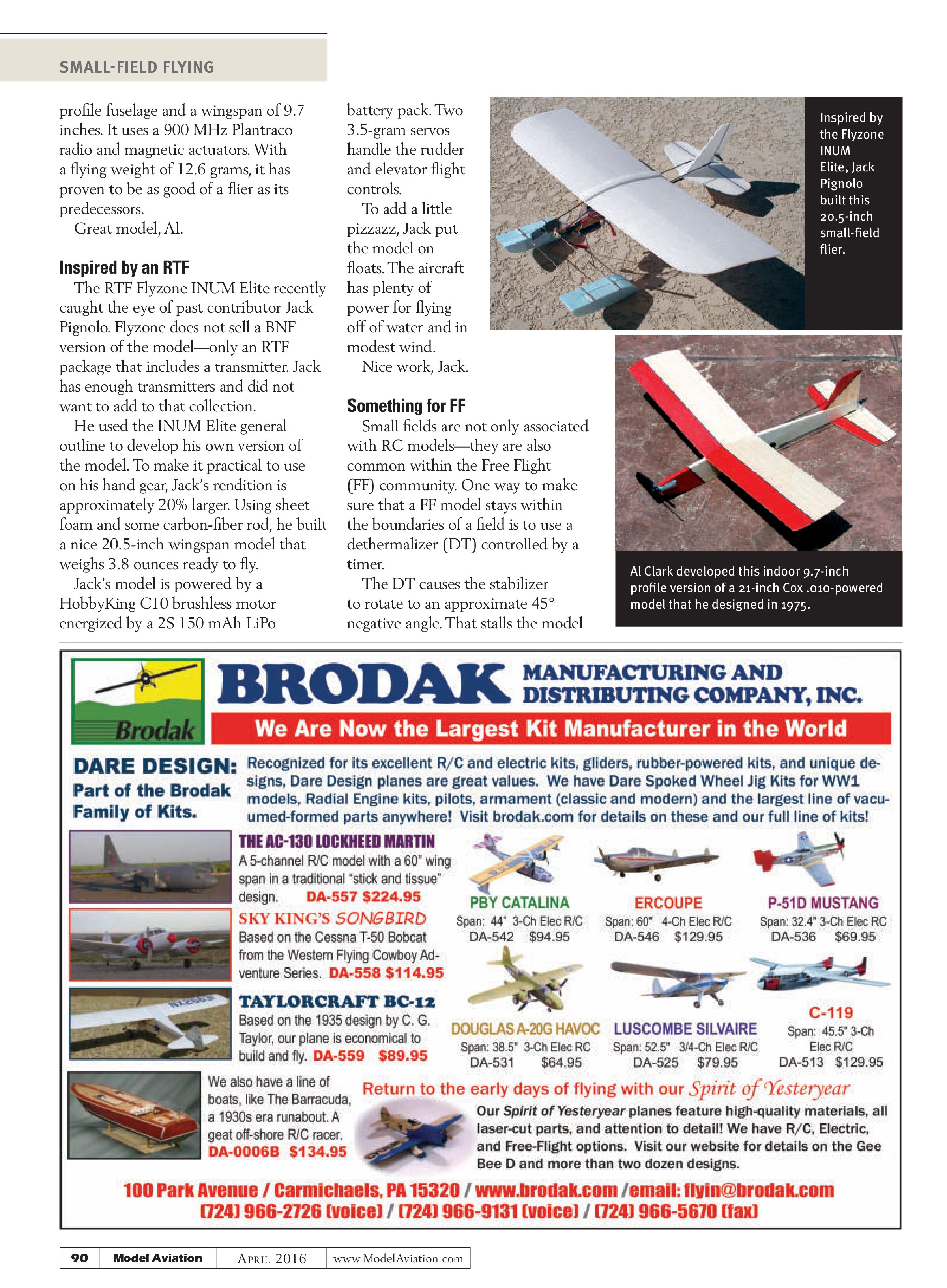
There are low-end vinyl cutters and 3-D printers that fall within my price range. I purchased a vinyl cutter several years ago. One nice thing about having my own vinyl cutter is the ability to cut covering film instead of traditional sign vinyl. It’s a nice perk that is not normally available when using a vinyl graphics vendor.
As an example, I have included a photo of my brother’s Quaker Old-Timer. Although not a small-field model, it does show what can be done with covering film and a vinyl cutter. The red trim was cut from Solartex, and lightweight film, such as UltraCote ParkLite, was also successfully cut.

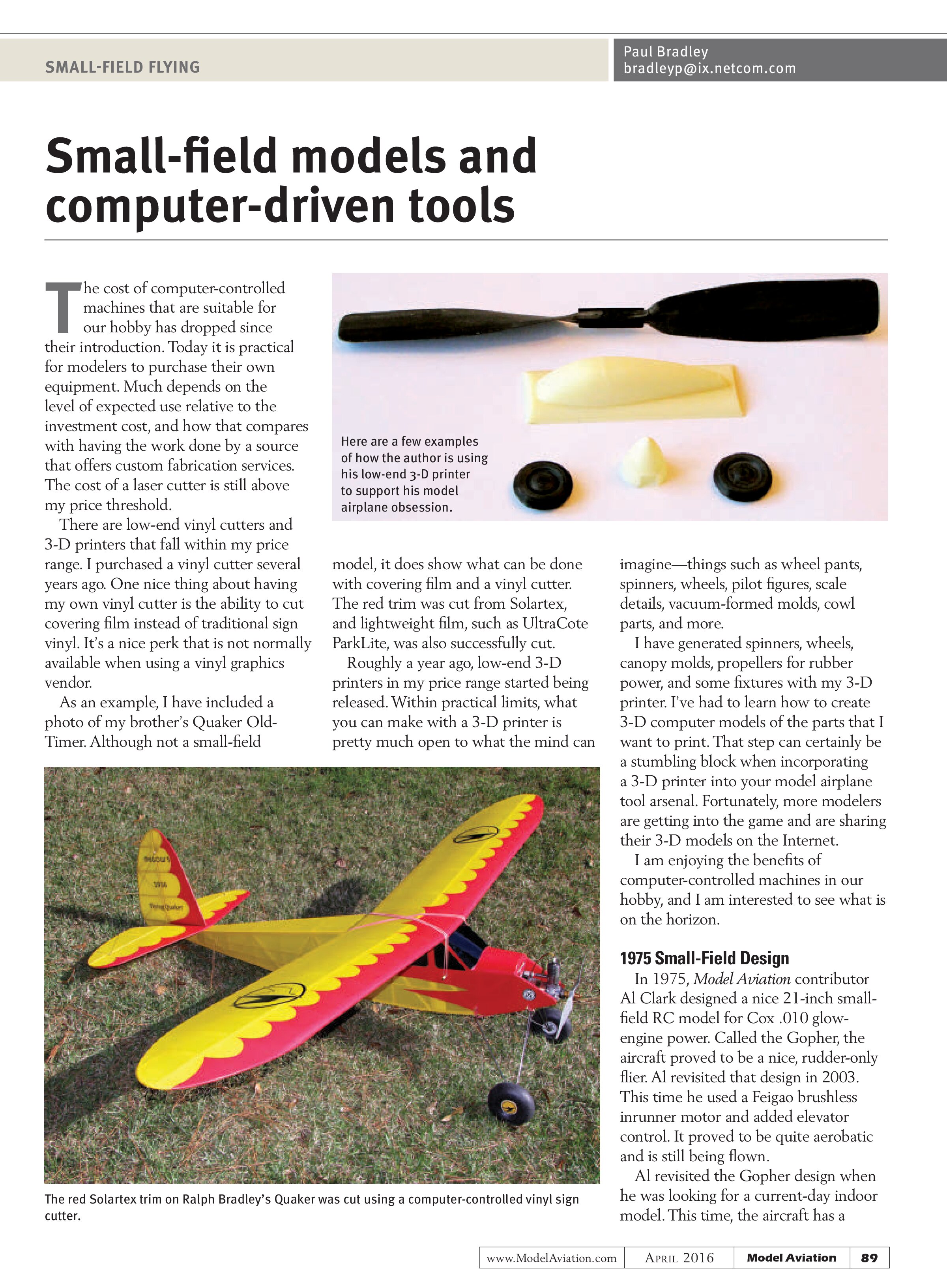
Roughly a year ago, low-end 3-D printers in my price range started being released. Within practical limits, what you can make with a 3-D printer is pretty much open to what the mind can imagine—things such as wheel pants, spinners, wheels, pilot figures, scale details, vacuum-formed molds, cowl parts, and more.
I have generated spinners, wheels, canopy molds, propellers for rubber power, and some fixtures with my 3-D printer. I’ve had to learn how to create 3-D computer models of the parts that I want to print. That step can certainly be a stumbling block when incorporating a 3-D printer into your model airplane tool arsenal. Fortunately, more modelers are getting into the game and are sharing their 3-D models on the Internet.
I am enjoying the benefits of computer-controlled machines in our hobby, and I am interested to see what is on the horizon.
1975 Small-Field Design
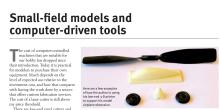
In 1975, Model Aviation contributor Al Clark designed a nice 21-inch small-field RC model for Cox .010 glow-engine power. Called the Gopher, the aircraft proved to be a nice, rudder-only flier. Al revisited that design in 2003. This time he used a Feigao brushless inrunner motor and added elevator control. It proved to be quite aerobatic and is still being flown.
Al revisited the Gopher design when he was looking for a current-day indoor model. This time, the aircraft has a

profile fuselage and a wingspan of 9.7 inches. It uses a 900 MHz Plantraco radio and magnetic actuators. With a flying weight of 12.6 grams, it has proven to be as good of a flier as its predecessors.
Great model, Al.
Inspired by an RTF
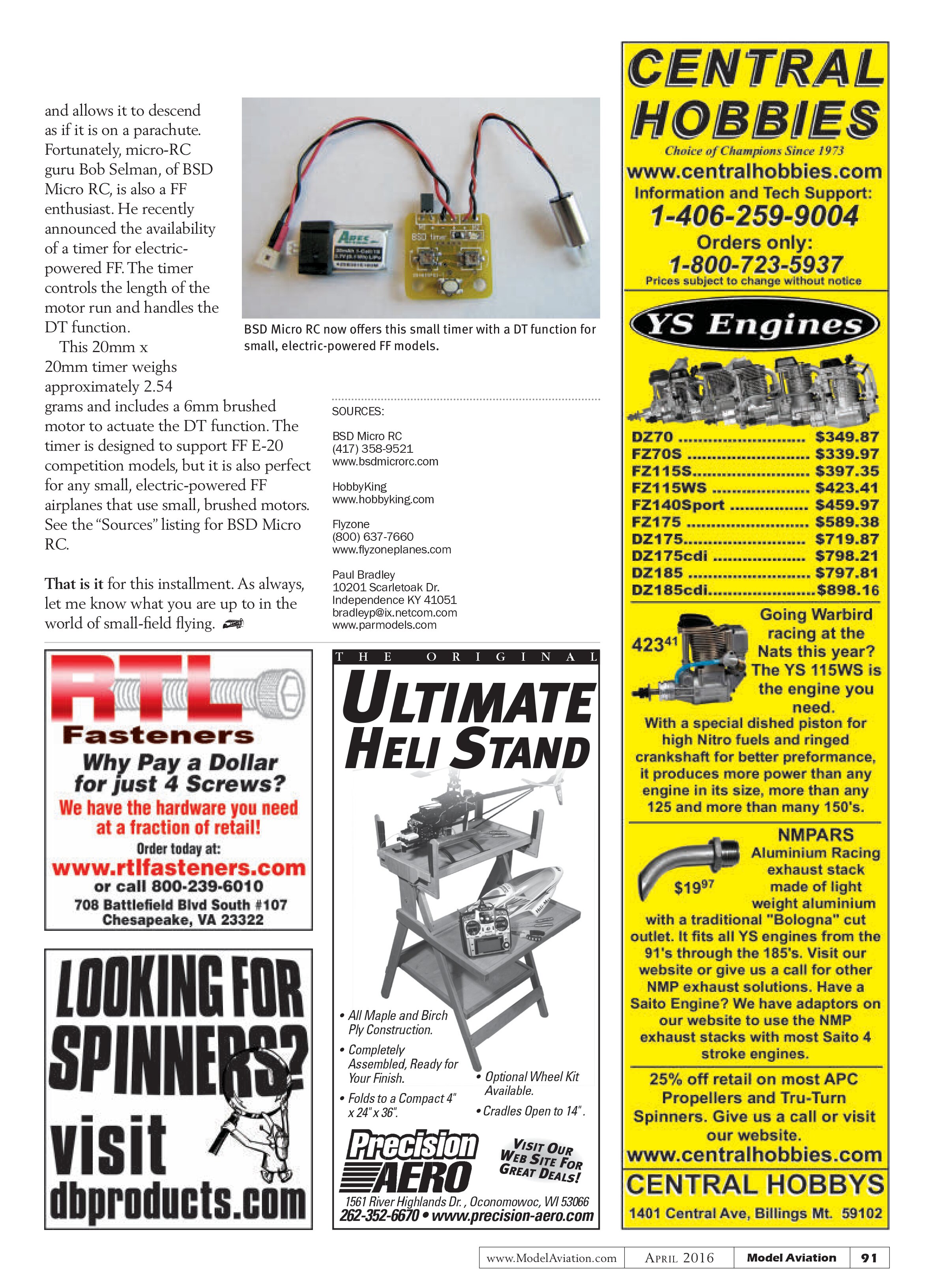
The RTF Flyzone INUM Elite recently caught the eye of past contributor Jack Pignolo. Flyzone does not sell a BNF version of the model—only an RTF package that includes a transmitter. Jack has enough transmitters and did not want to add to that collection.
He used the INUM Elite general outline to develop his own version of the model. To make it practical to use on his hand gear, Jack’s rendition is approximately 20% larger. Using sheet foam and some carbon-fiber rod, he built a nice 20.5-inch wingspan model that weighs 3.8 ounces ready to fly.
Jack’s model is powered by a HobbyKing C10 brushless motor energized by a 2S 150 mAh LiPo battery pack. Two 3.5-gram servos handle the rudder and elevator flight controls.
To add a little pizzazz, Jack put the model on floats. The aircraft has plenty of power for flying off of water and in modest wind.
Nice work, Jack.
Something for FF
Small fields are not only associated with RC models—they are also common within the Free Flight (FF) community. One way to make sure that a FF model stays within the boundaries of a field is to use a dethermalizer (DT) controlled by a timer.
The DT causes the stabilizer to rotate to an approximate 45° negative angle. That stalls the model and allows it to descend as if it is on a parachute. Fortunately, micro-RC guru Bob Selman, of BSD Micro RC, is also a FF enthusiast. He recently announced the availability of a timer for electric-powered FF. The timer controls the length of the motor run and handles the DT function.
This 20mm x 20mm timer weighs approximately 2.54 grams and includes a 6mm brushed motor to actuate the DT function. The timer is designed to support FF E-20 competition models, but it is also perfect for any small, electric-powered FF airplanes that use small, brushed motors. See the “Sources” listing for BSD Micro RC.
That is it for this installment. As always, let me know what you are up to in the world of small-field flying.


SOURCES:
BSD Micro RC
(417) 358-9521
www.bsdmicrorc.com
HobbyKing
www.hobbyking.com
Flyzone
(800) 637-7660
www.flyzoneplanes.com
Paul Bradley
10201 Scarletoak Dr.
Independence KY 41051
bradley@ix.netcom.com
www.parmodels.com