Did you go to the AMA Expo?
Dave Gee
safetycolumn@cs.com

My feet are tired, my wallet is empty, and I have an armload of fun, new modeling items. Yup, I just returned from AMA Expo 2016! The booths with safety-related stuff are, of course, extra interesting. This year’s show had plenty to see.
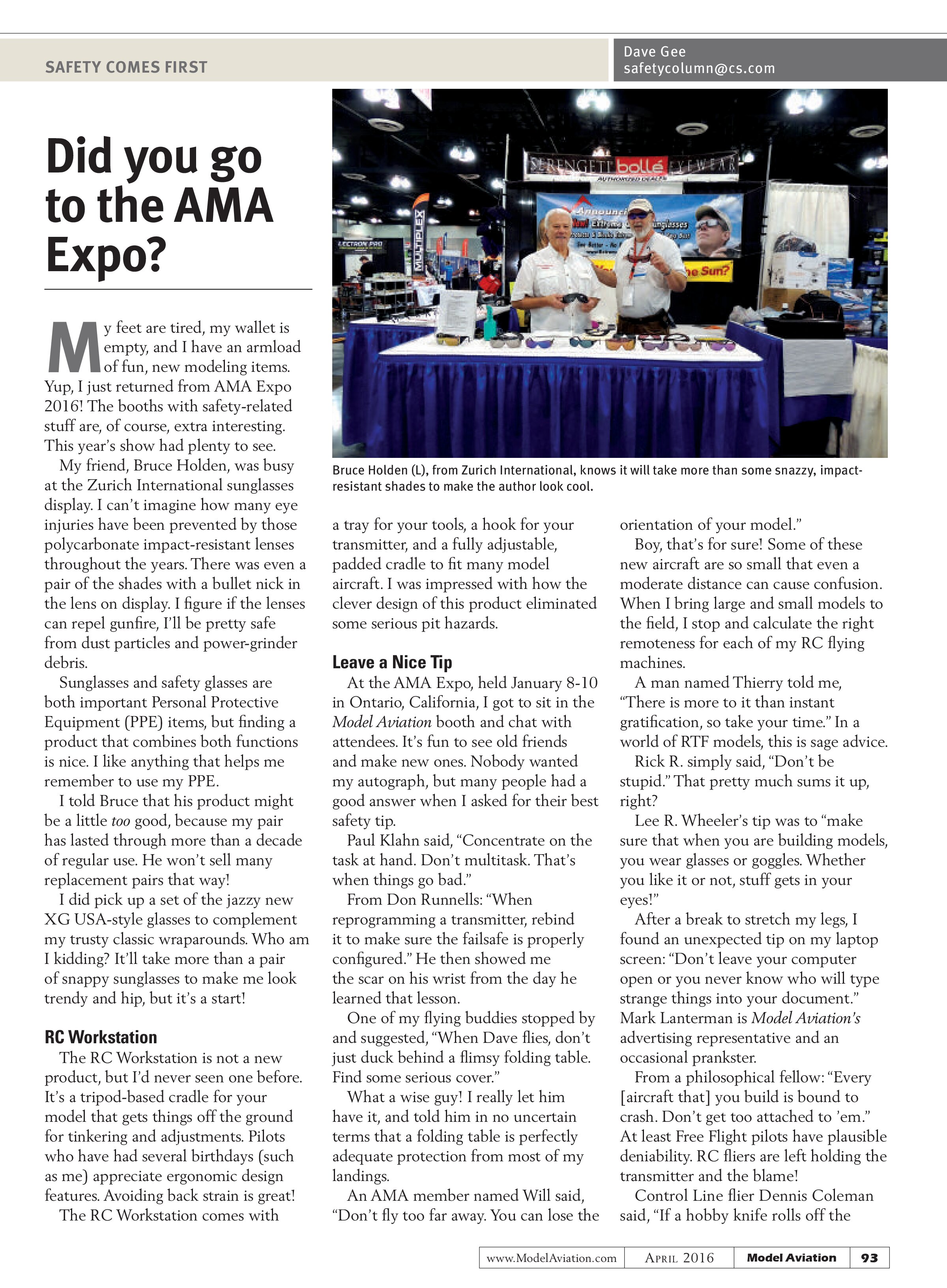
My friend, Bruce Holden, was busy at the Zurich International sunglasses display. I can’t imagine how many eye injuries have been prevented by those polycarbonate impact-resistant lenses throughout the years. There was even a pair of the shades with a bullet nick in the lens on display. I figure if the lenses can repel gunfire, I’ll be pretty safe from dust particles and power-grinder debris.
Sunglasses and safety glasses are both important Personal Protective Equipment (PPE) items, but finding a product that combines both functions is nice. I like anything that helps me remember to use my PPE.
I told Bruce that his product might be a little too good, because my pair has lasted through more than a decade of regular use. He won’t sell many replacement pairs that way!
I did pick up a set of the jazzy new XG USA-style glasses to complement my trusty classic wraparounds. Who am I kidding? It’ll take more than a pair of snappy sunglasses to make me look trendy and hip, but it’s a start!
RC Workstation
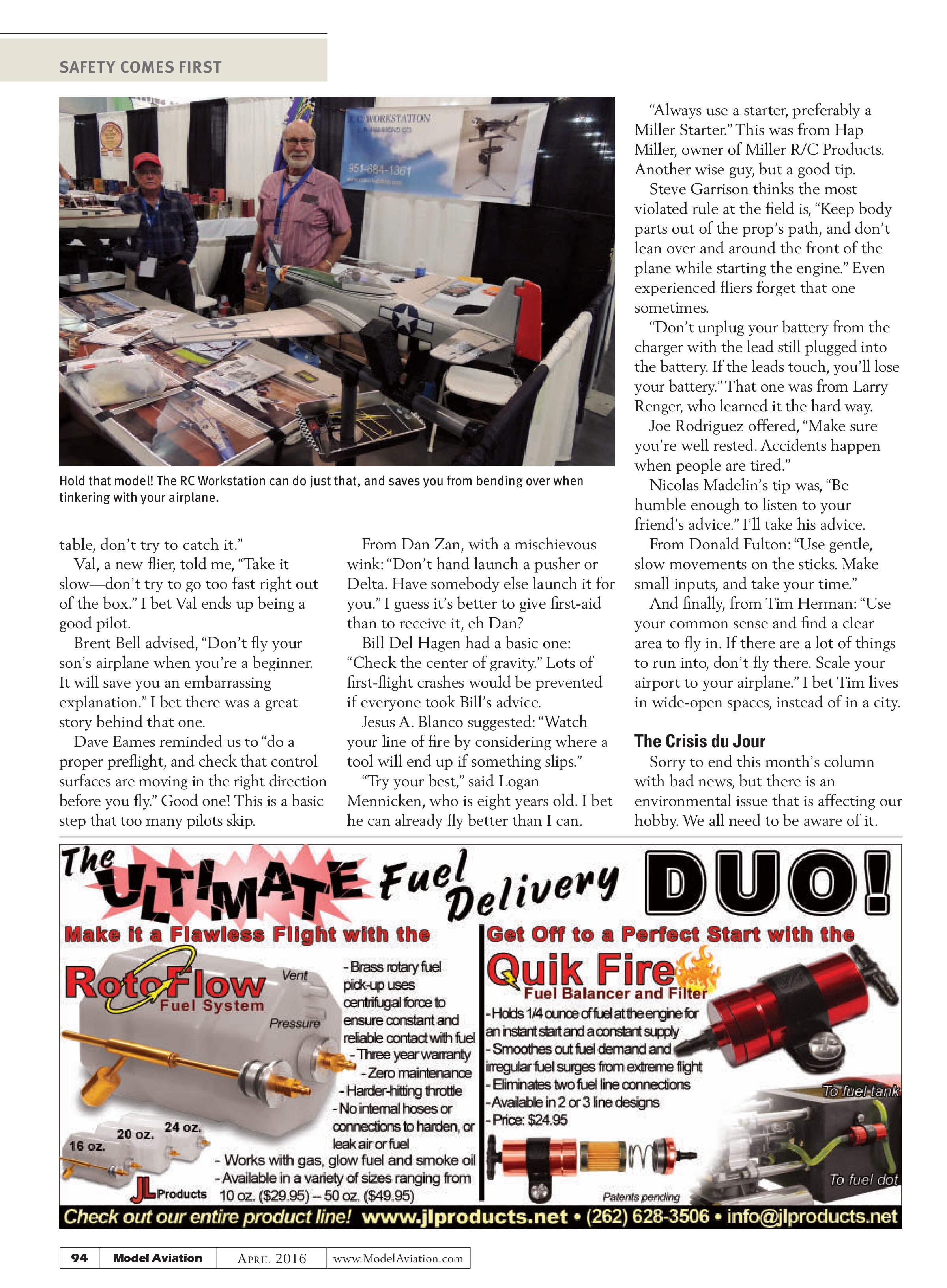
The RC Workstation is not a new product, but I’d never seen one before. It’s a tripod-based cradle for your model that gets things off the ground for tinkering and adjustments. Pilots who have had several birthdays (such as me) appreciate ergonomic design features. Avoiding back strain is great!
The RC Workstation comes with a tray for your tools, a hook for your transmitter, and a fully adjustable, padded cradle to fit many model aircraft. I was impressed with how the clever design of this product eliminated some serious pit hazards.
Leave a Nice Tip
At the AMA Expo, held January 8-10 in Ontario, California, I got to sit in the Model Aviation booth and chat with attendees. It’s fun to see old friends and make new ones. Nobody wanted my autograph, but many people had a good answer when I asked for their best safety tip.
Paul Klahn said, “Concentrate on the task at hand. Don’t multitask. That’s when things go bad.”
From Don Runnells: “When reprogramming a transmitter, rebind it to make sure the failsafe is properly configured.” He then showed me the scar on his wrist from the day he learned that lesson.
One of my flying buddies stopped by and suggested, “When Dave flies, don’t just duck behind a flimsy folding table. Find some serious cover.”
What a wise guy! I really let him have it, and told him in no uncertain terms that a folding table is perfectly adequate protection from most of my landings.
An AMA member named Will said, “Don’t fly too far away. You can lose the orientation of your model.”
Boy, that’s for sure! Some of these new aircraft are so small that even a moderate distance can cause confusion. When I bring large and small models to the field, I stop and calculate the right remoteness for each of my RC flying machines.
A man named Thierry told me, “There is more to it than instant gratification, so take your time.” In a world of RTF models, this is sage advice.
Rick R. simply said, “Don’t be stupid.” That pretty much sums it up, right?
Lee R. Wheeler’s tip was to “make sure that when you are building models, you wear glasses or goggles. Whether you like it or not, stuff gets in your eyes!”
After a break to stretch my legs, I found an unexpected tip on my laptop screen: “Don’t leave your computer open or you never know who will type strange things into your document.” Mark Lanterman is Model Aviation’s advertising representative and an occasional prankster.
From a philosophical fellow: “Every [aircraft that] you build is bound to crash. Don’t get too attached to ’em.” At least Free Flight pilots have plausible deniability. RC fliers are left holding the transmitter and the blame!
Control Line flier Dennis Coleman said, “If a hobby knife rolls off the
table, don’t try to catch it.
Val, a new flier, told me, “Take it slow—don’t try to go too fast right out of the box.” I bet Val ends up being a good pilot.
Brent Bell advised, “Don’t fly your son’s airplane when you’re a beginner. It will save you an embarrassing explanation.” I bet there was a great story behind that one.
Dave Eames reminded us to “do a proper preflight, and check that control surfaces are moving in the right direction before you fly.” Good one! This is a basic step that too many pilots skip.
From Dan Zan, with a mischievous wink: “Don’t hand launch a pusher or Delta. Have somebody else launch it for you.” I guess it’s better to give first-aid than to receive it, eh Dan?
Bill Del Hagen had a basic one: “Check the center of gravity.” Lots of first-flight crashes would be prevented if everyone took Bill’s advice.
Jesus A. Blanco suggested: “Watch your line of fire by considering where a tool will end up if something slips.”
“Try your best,” said Logan Mennicken, who is eight years old. I bet he can already fly better than I can.

“Always use a starter, preferably a Miller Starter.” This was from Hap Miller, owner of Miller R/C Products. Another wise guy, but a good tip.
Steve Garrison thinks the most violated rule at the field is, “Keep body parts out of the prop’s path, and don’t lean over and around the front of the plane while starting the engine.” Even experienced fliers forget that one sometimes.
“Don’t unplug your battery from the charger with the lead still plugged into the battery. If the leads touch, you’ll lose your battery.” That one was from Larry Renger, who learned it the hard way.
Joe Rodriguez offered, “Make sure you’re well rested. Accidents happen when people are tired.”
Nicolas Madelin’s tip was, “Be humble enough to listen to your friend’s advice.” I’ll take his advice.
From Donald Fulton: “Use gentle, slow movements on the sticks. Make small inputs, and take your time.”
And finally, from Tim Herman: “Use your common sense and find a clear area to fly in. If there are a lot of things to run into, don’t fly there. Scale your airport to your airplane.” I bet Tim lives in wide-open spaces, instead of in a city.
The Crisis du Jour
Sorry to end this month’s column with bad news, but there is an environmental issue that is affecting our hobby. We all need to be aware of it.
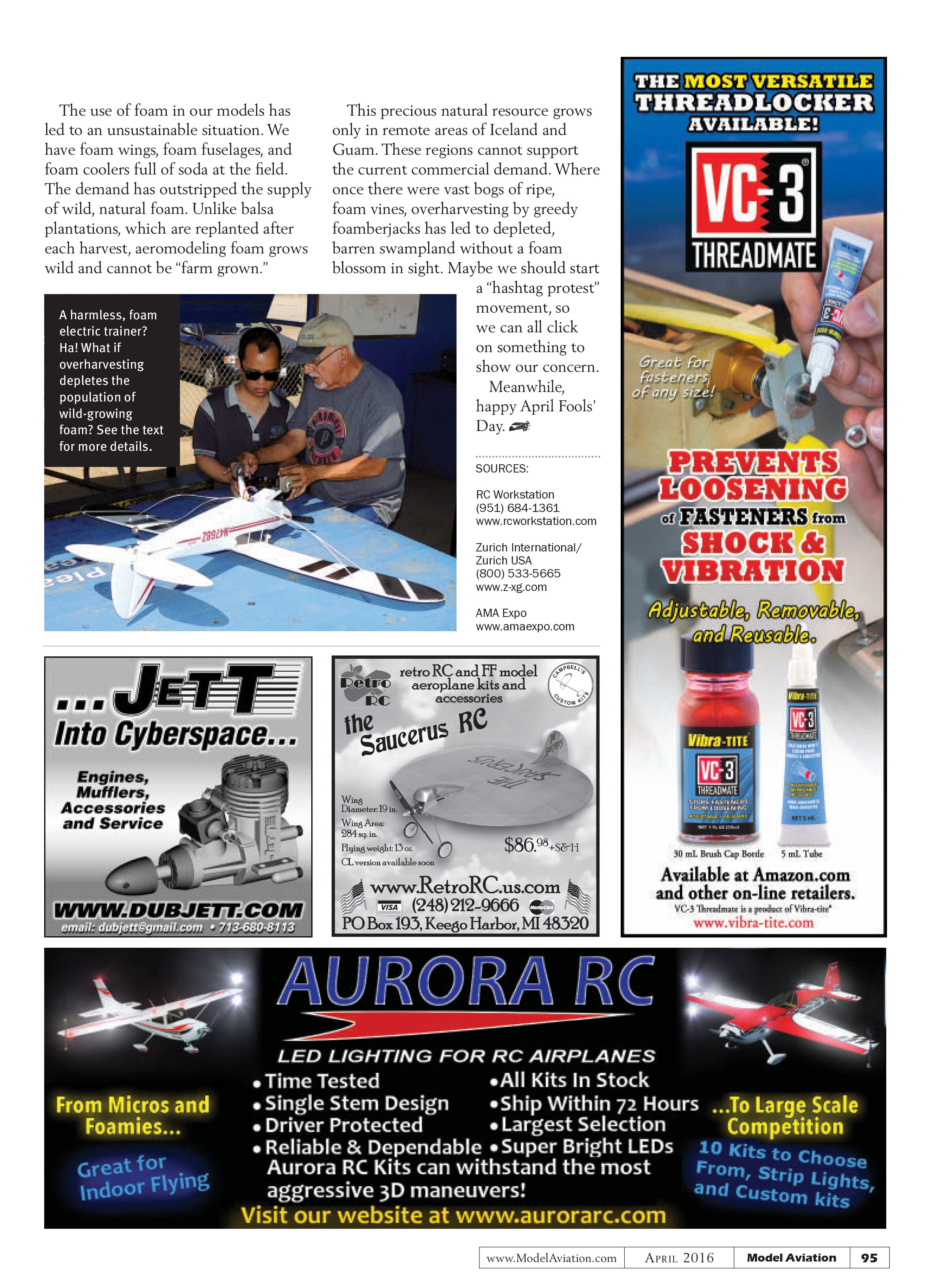
The use of foam in our models has led to an unsustainable situation. We have foam wings, foam fuselages, and foam coolers full of soda at the field. The demand has outstripped the supply of wild, natural foam. Unlike balsa plantations, which are replanted after each harvest, aeromodeling foam grows wild and cannot be “farm grown.”

This precious natural resource grows only in remote areas of Iceland and Guam. These regions cannot support the current commercial demand. Where once there were vast bogs of ripe, foam vines, overharvesting by greedy foamberjacks has led to depleted, barren swampland without a foam blossom in sight. Maybe we should start a “hashtag protest” movement, so we can all click on something to show our concern. Meanwhile, happy April Fools’ Day.
SOURCES:
RC Workstation
(951) 684-1361
www.rcworkstation.com
Zurich International/
Zurich USA
(800) 533-5665
www.z-xg.com
AMA Expo
www.amaexpo.com