Low-speed 3-D setups, part two
Chris Mulcahy
cspaced@gmail.com

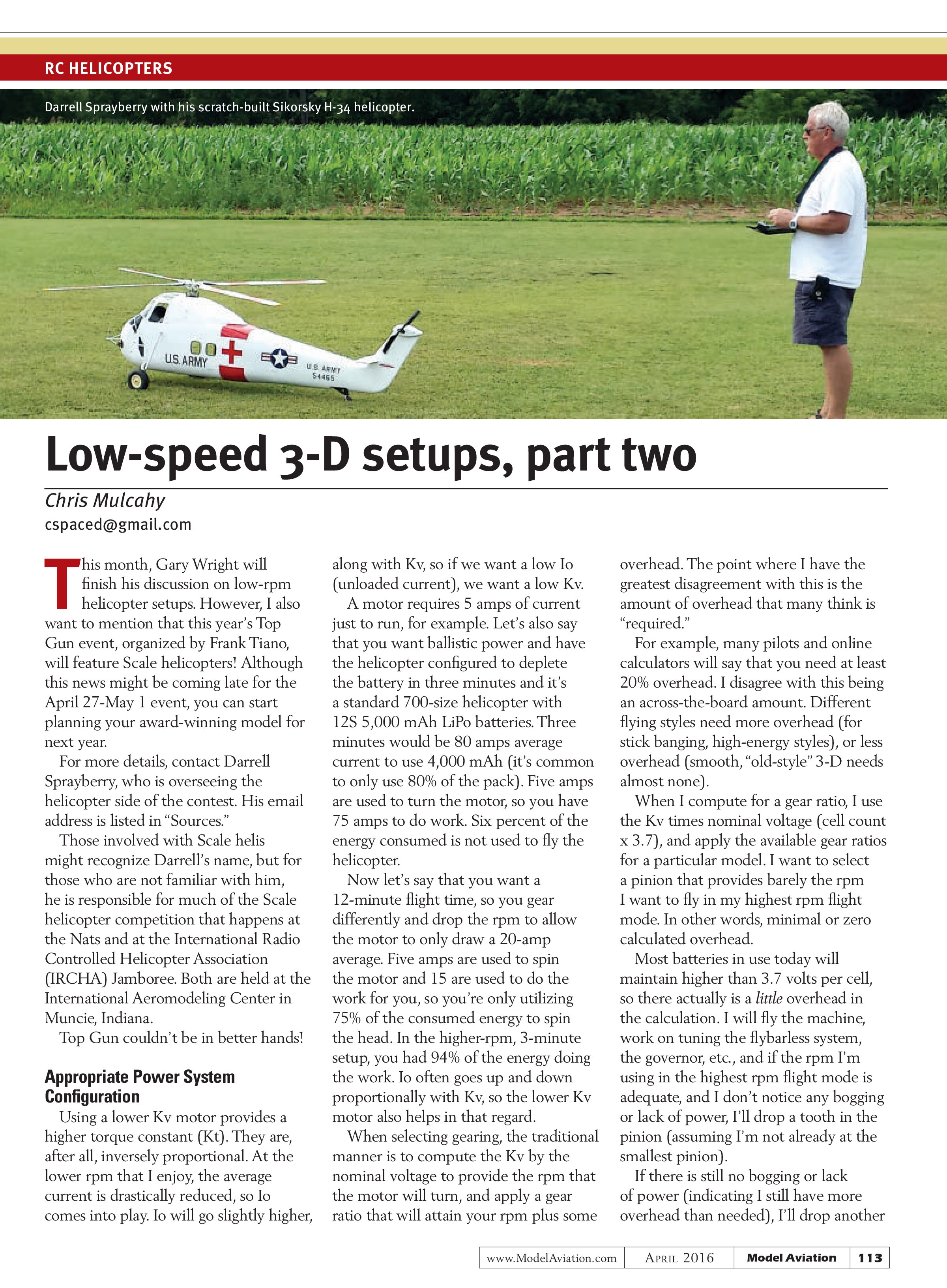
This month, Gary Wright will finish his discussion on low-rpm helicopter setups. However, I also want to mention that this year’s Top Gun event, organized by Frank Tiano, will feature Scale helicopters! Although this news might be coming late for the April 27-May 1 event, you can start planning your award-winning model for next year.
For more details, contact Darrell Sprayberry, who is overseeing the helicopter side of the contest. His email address is listed in “Sources.”
Those involved with Scale helis might recognize Darrell’s name, but for those who are not familiar with him, he is responsible for much of the Scale helicopter competition that happens at the Nats and at the International Radio Controlled Helicopter Association (IRCHA) Jamboree. Both are held at the International Aeromodeling Center in Muncie, Indiana.
Top Gun couldn’t be in better hands!
Appropriate Power System Configuration
Using a lower Kv motor provides a higher torque constant (Kt). They are, after all, inversely proportional. At the lower rpm that I enjoy, the average current is drastically reduced, so Io comes into play. Io will go slightly higher, along with Kv, so if we want a low Io (unloaded current), we want a low Kv.
A motor requires 5 amps of current just to run, for example. Let’s also say that you want ballistic power and have the helicopter configured to deplete the battery in three minutes and it’s a standard 700-size helicopter with 12S 5,000 mAh LiPo batteries. Three minutes would be 80 amps average current to use 4,000 mAh (it’s common to only use 80% of the pack). Five amps are used to turn the motor, so you have 75 amps to do the work. Six percent of the energy consumed is not used to fly the helicopter.
Now let’s say that you want a 12-minute flight time, so you gear differently and drop the rpm to allow the motor to only draw a 20-amp average. Five amps are used to spin the motor and 15 are used to do the work for you, so you’re only utilizing 75% of the consumed energy to spin the head. In the higher-rpm, 3-minute setup, you had 94% of the energy doing the work. Io often goes up and down proportionally with Kv, so the lower Kv motor also helps in that regard.
When selecting gearing, the traditional manner is to compute the Kv by the nominal voltage to provide the rpm that the motor will turn, and apply a gear ratio that will attain your rpm plus some overhead. The point where I have the greatest disagreement with this is the amount of overhead that many think is “required.”
For example, many pilots and online calculators will say that you need at least 20% overhead. I disagree with this being an across-the-board amount. Different flying styles need more overhead (for stick banging, high-energy styles), or less overhead (smooth, “old-style” 3-D needs almost none).
When I compute for a gear ratio, I use the Kv times nominal voltage (cell count x 3.7), and apply the available gear ratios for a particular model. I want to select a pinion that provides barely the rpm I want to fly in my highest rpm flight mode. In other words, minimal or zero calculated overhead.
Most batteries in use today will maintain higher than 3.7 volts per cell, so there actually is a little overhead in the calculation. I will fly the machine, work on tuning the flybarless system, the governor, etc., and if the rpm I’m using in the highest rpm flight mode is adequate, and I don’t notice any bogging or lack of power, I’ll drop a tooth in the pinion (assuming I’m not already at the smallest pinion).
If there is still no bogging or lack of power (indicating I still have more overhead than needed), I’ll drop another
tooth. If I’m at the smallest pinion, I will start dropping timing in the ESC. This lowers the Kv slightly, so it’s like a fine adjustment to the Kv of the motor.
The commutation algorithms on various speed controllers are not the same, therefore the same motor with five different ESCs can, and usually will, vary the actual Kv you use. Raising and lowering timing also raises and lowers the Kv slightly.
A side effect is that it will also slightly raise and lower the temperature of the motor. It can also increase and lower the temperature of the ESC as a by-product of the motor, drawing more or less current.
When I am setting up a new model, the initial flights are only a minute or two long before I stop to check temperatures. The manufacturer might state all sorts of numbers on the maximum continuous and burst watts, the maximum continuous and burst amps, etc., but it primarily boils down to temperature. If the temperatures are okay, the system will live. The only real caveat to that is an extreme current spike such as what would be seen in an overgeared, ballistic rpm setup.
When looking at performance logs for the ESC, the amperage will be jagged with up and down spikes. My goal is to have the lowest peak spikes, while still having adequate performance for my flying style. If it’s flying great, but I see high current spikes, I want to eliminate them.
Eliminating high current spikes lowers the temperature and makes the components happier. Achieve this by changing to a smaller pinion, lower timing, and possibly a lower Kv motor. Temperature is the prime concern and current spikes are a close second. I see logs from some of the smack-style 3-D pilots that show average currents in the 70- to 100-amp range and spikes of more than 200 amps. My 700-size helicopter averages less than 20 amps and rarely spikes above 70.
A helicopter that I currently fly has a 400 Kv motor and the gears are 12/121. This flies on 12S, so 44.4 (voltage) x 400 (Kv) x pinion (12) ÷ main gear (121) results in 1,761 possible rpm. I wanted 1,750 rpm. It would actually turn slightly more, so I had to tweak it if I wanted to optimize.
I started with a 13-tooth pinion that never loaded down, so I went to a 12 (the smallest available). There was still no loading, so I began dropping timing. I used a Castle Creations Talon HV 120 ESC. Default timing is 5° and I had started at a 15° advance. I continued to drop the timing until I arrived at 0.
I still have enough overhead because it does not load and bog down, and I’m using the smallest pinion and lowest possible timing. I would have preferred to use a slightly lower Kv motor so that I could find some loading down and raise timing a few degrees to compensate—knowing that it’s optimal—but I don’t have a lower Kv motor. I’ll have to make do with 12- to 14-minute flights.
Because the overhead is not extreme, the gearing allows lower throttle settings without overheating the ESC, so the normal range of 200 or 300 rpm from flight condition 1 to flight condition 3 can be increased. I’m down to 1,250 rpm in my lowest rpm mode, so the actual range I use is 1,250 to 1,750. I’ve had it lower—1,100—but the ESC starts getting warm and the collective feel is softer than I prefer.
Yes, the overall power is lower than the “standard smack” setup, but it’s appropriate for the way I want to fly. I can execute any 3-D maneuver, although slower and smoother (which I prefer), and it flies a long time on a charge. Is it for everyone? Definitely not, but I would bet it’s appropriate for many pilots.
SOURCES:
IRCHA
www.ircha.org
Synergy R/C Helicopters
www.synergychelicopters.com
Hacker Motor USA
(913) 214-6995
www.hackermotorusa.com
Castle Creations
(913) 390-6939
www.castlecreations.com
Top Gun
www.franktiano.com/TopGunFrameset.htm
Darrell Sprayberry
darrelluh1b@optlink.us