Highlighting winter projects
by Sal Calvagna
rcgiants@optonline.net
Welcome back. Spring is here, and with its arrival, the flying season begins in earnest. I hope that my readers took advantage of the winter building season, translating it into a slew of newly completed RC Giants that will be making their debut at the local flying field this season.
Whether you assembled an ARF, built a kit, built from plans, or designed your own, may your new RC aircraft fly straight and true. Oh, and of course, survive many flights.
Here are a couple of RC Giants that were designed by their builders.
Mike Goldowsky’s de Havilland DHC-8
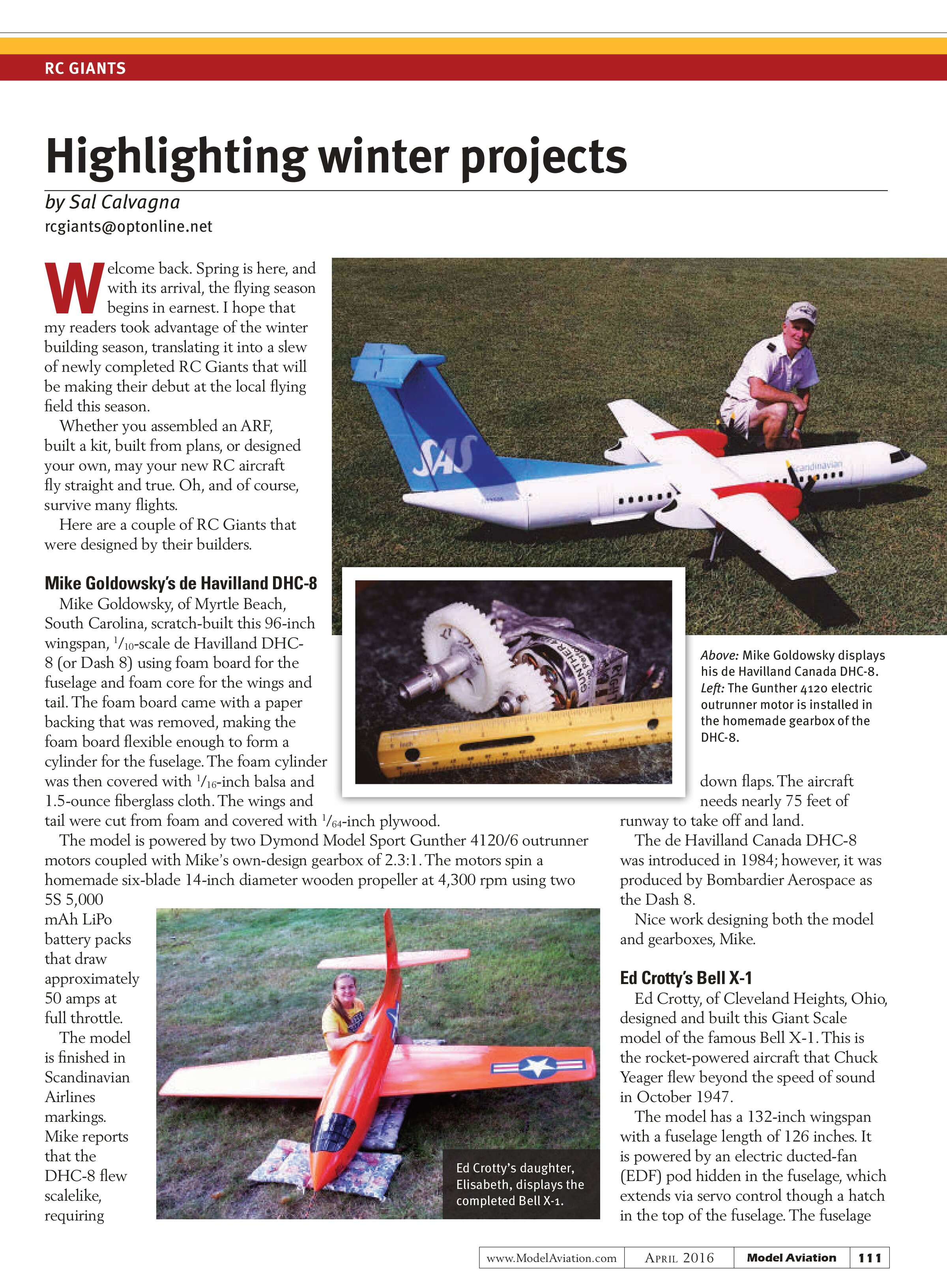
Mike Goldowsky, of Myrtle Beach, South Carolina, scratch-built this 96-inch wingspan, 1/10-scale de Havilland DHC-8 (or Dash 8) using foam board for the fuselage and foam core for the wings and tail. The foam board came with a paper backing that was removed, making the foam board flexible enough to form a cylinder for the fuselage. The foam cylinder was then covered with 1/16-inch balsa and 1.5-ounce fiberglass cloth. The wings and tail were cut from foam and covered with 1/64-inch plywood.
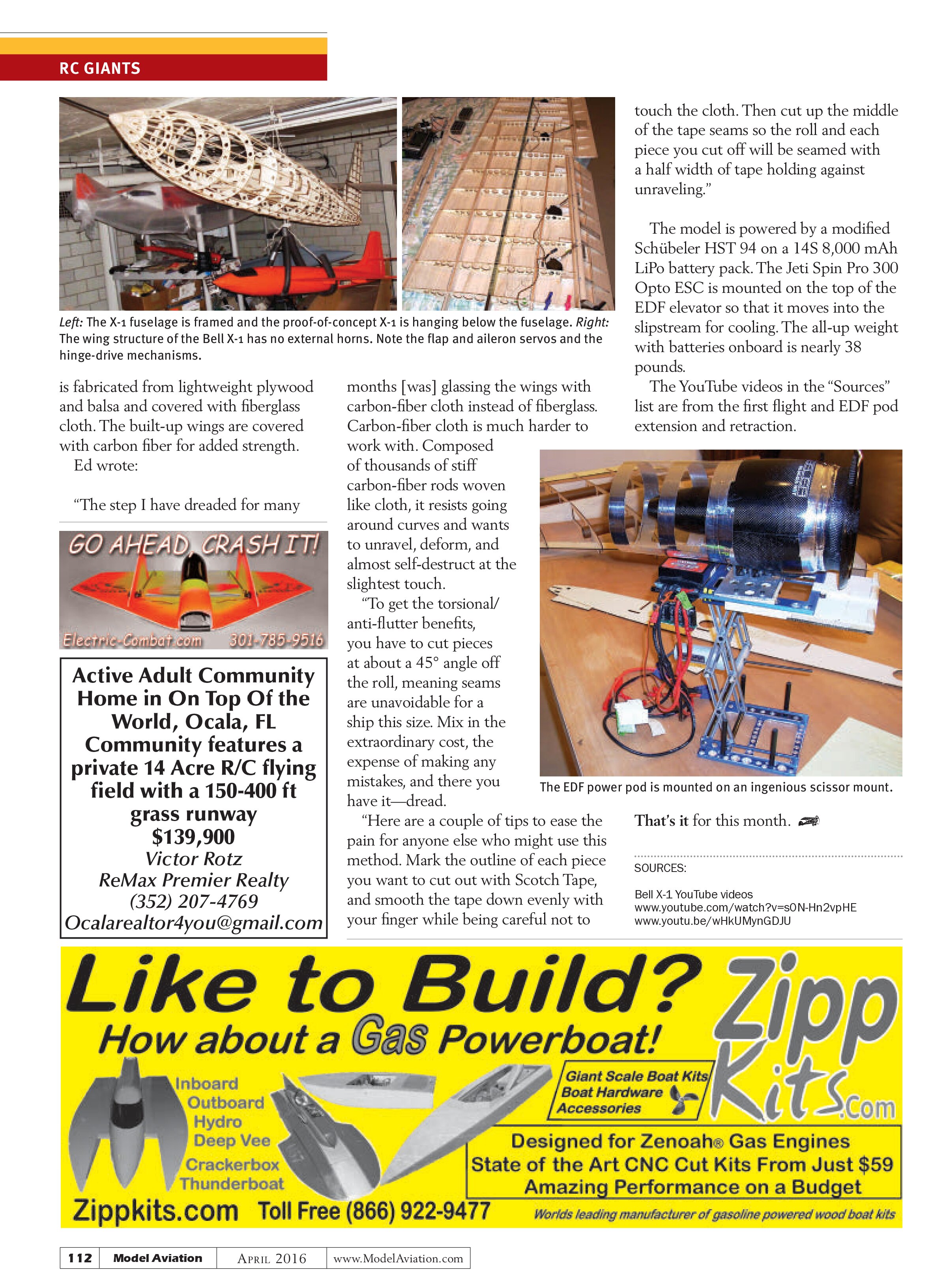
The model is powered by two Dymond Model Sport Gunther 4120/6 outrunner motors coupled with Mike’s own-design gearbox of 2.3:1. The motors spin a homemade six-blade 14-inch diameter wooden propeller at 4,300 rpm using two 5S 5,000 mAh LiPo battery packs that draw approximately 50 amps at full throttle. The model is finished in Scandinavian Airlines markings. Mike reports that the DHC-8 flew scalelike, requiring


Ed Crotty’s Bell X-1
Ed Crotty, of Cleveland Heights, Ohio, designed and built this Giant Scale model of the famous Bell X-1. This is the rocket-powered aircraft that Chuck Yeager flew beyond the speed of sound in October 1947.
The model has a 132-inch wingspan with a fuselage length of 126 inches. It is powered by an electric ducted-fan (EDF) pod hidden in the fuselage, which extends via servo control though a hatch in the top of the fuselage. The fuselage


is fabricated from lightweight plywood and balsa and covered with fiberglass cloth. The built-up wings are covered with carbon fiber for added strength.
Ed wrote:
“The step I have dreaded for many months [was] glassing the wings with carbon-fiber cloth instead of fiberglass. Carbon-fiber cloth is much harder to work with. Composed of thousands of stiff carbon-fiber rods woven like cloth, it resists going around curves and wants to unravel, deform, and almost self-destruct at the slightest touch.
“To get the torsional/anti-flutter benefits, you have to cut pieces at about a 45° angle off the roll, meaning seams are unavoidable for a ship this size. Mix in the extraordinary cost, the expense of making any mistakes, and there you have it—dread.
“Here are a couple of tips to ease the pain for anyone else who might use this method. Mark the outline of each piece you want to cut out with Scotch Tape, and smooth the tape down evenly with your finger while being careful not to touch the cloth. Then cut up the middle of the tape seams so the roll and each piece you cut off will be seamed with a half width of tape holding against unraveling.”
The model is powered by a modified Schübeler HST 94 on a 14S 8,000 mAh LiPo battery pack. The Jeti Spin Pro 300 Opto ESC is mounted on the top of the EDF elevator so that it moves into the slipstream for cooling. The all-up weight with batteries onboard is nearly 38 pounds.
The YouTube videos in the “Sources” list are from the first flight and EDF pod extension and retraction.

That’s it for this month.
SOURCES:
Bell X-1 YouTube videos
www.youtube.com/watch?v=sON-Hn2vpHE
www.youtube.be/wHkUMyNGDJU