Product Spotlight
New products that are Worth a Closer Look
HITEC X2 AC PLUS
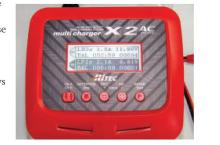
Greg Gimlick reviewed the Hitec X2 AC Plus. Here is what he had to say:
The Hitec X2 AC Plus is a complete battery-management system that is user updatable and capable of handling everything, including the newest LiHV battery packs. Its integrated power supply means no extra power supply unit or big batteries are required in the shop to power it, but it’s easy to pop the cord off of the back and haul it to the field for use with an external battery to power it. I like tidy, compact things.
SPECIFICATIONS:
DC input range: 11- to 18-volts DC
AC input range: 100- to 240-volts AC
Total charge circuit power: 100-watts AC or 200-watts DC
Discharge current range: 10 watts x 2
Charge current range: 0.1 to 10 amps x 2
Discharge current power: 0.1 to 5.0 amps x 2
Current drain for LiPo balancing: 200 mA per cell
LiPo/LiHV/LiFe/Li-Ion cell count: One to six cells (100 to 50,000 mAh)
NiCd/NiMH cell count: One to 15 cells (100 to 50,000 mAh)
Lead Acid (Pb) voltage: Two to 20 volts
Dimensions: 6.42 x 6.02 x 2.83 inches
Weight: 2.15 pounds
Price: $ 99.99
Info: www.hitecrcd.com
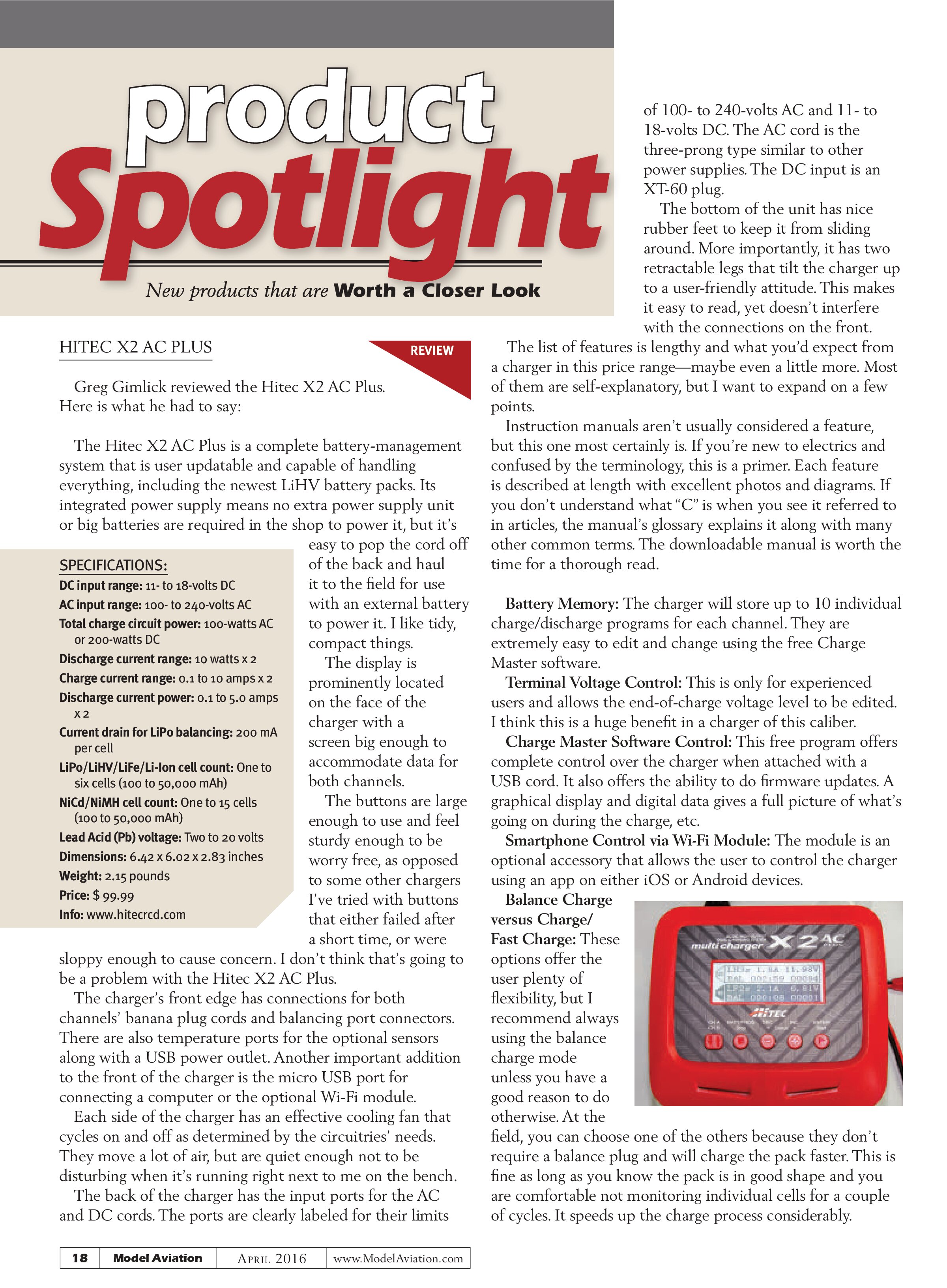
The display is prominently located on the face of the charger with a screen big enough to accommodate data for both channels.
The buttons are large enough to use and feel sturdy enough to be worry free, as opposed to some other chargers I’ve tried with buttons that either failed after a short time, or were sloppy enough to cause concern. I don’t think that’s going to be a problem with the Hitec X2 AC Plus.
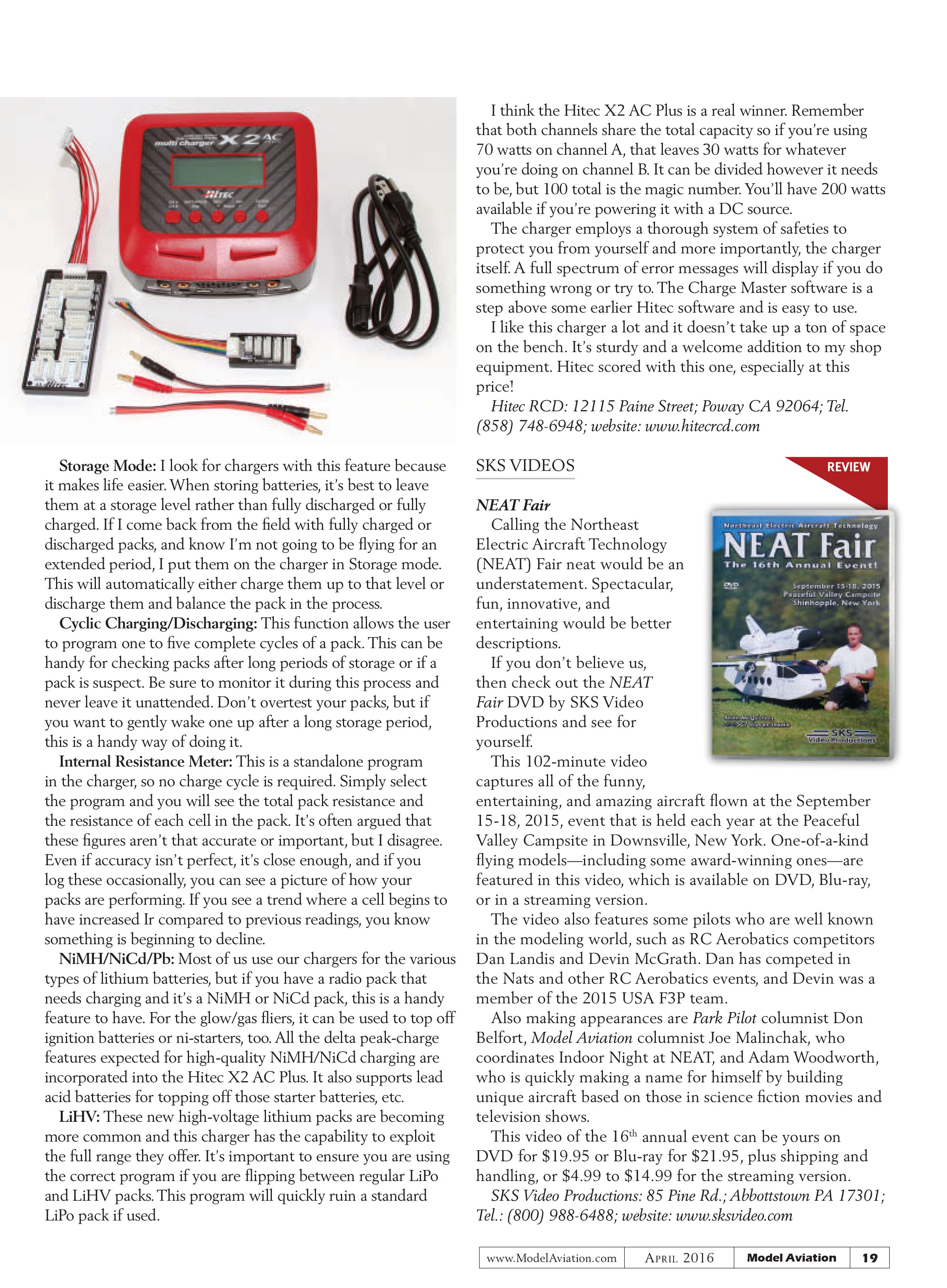
The charger’s front edge has connections for both channels’ banana plug cords and balancing port connectors. There are also temperature ports for the optional sensors along with a USB power outlet. Another important addition to the front of the charger is the micro USB port for connecting a computer or the optional Wi-Fi module.
Each side of the charger has an effective cooling fan that cycles on and off as determined by the circuitries’ needs. They move a lot of air, but are quiet enough not to be disturbing when it’s running right next to me on the bench.
The back of the charger has the input ports for the AC and DC cords. The ports are clearly labeled for their limits of 100- to 240-volts AC and 11- to 18-volts DC. The AC cord is the three-prong type similar to other power supplies. The DC input is an XT-60 plug.
The bottom of the unit has nice rubber feet to keep it from sliding around. More importantly, it has two retractable legs that tilt the charger up to a user-friendly attitude. This makes it easy to read, yet doesn’t interfere with the connections on the front.
The list of features is lengthy and what you’d expect from a charger in this price range—maybe even a little more. Most of them are self-explanatory, but I want to expand on a few points.
Instruction manuals aren’t usually considered a feature, but this one most certainly is. If you’re new to electrics and confused by the terminology, this is a primer. Each feature is described at length with excellent photos and diagrams. If you don’t understand what “C” is when you see it referred to in articles, the manual’s glossary explains it along with many other common terms. The downloadable manual is worth the time for a thorough read.
Battery Memory: The charger will store up to 10 individual charge/discharge programs for each channel. They are extremely easy to edit and change using the free Charge Master software.
Terminal Voltage Control: This is only for experienced users and allows the end-of-charge voltage level to be edited. I think this is a huge benefit in a charger of this caliber.
Charge Master Software Control: This free program offers complete control over the charger when attached with a USB cord. It also offers the ability to do firmware updates. A graphical display and digital data gives a full picture of what’s going on during the charge, etc.
Smartphone Control via Wi-Fi Module: The module is an optional accessory that allows the user to control the charger using an app on either iOS or Android devices.
Balance Charge versus Charge/Fast Charge: These options offer the user plenty of flexibility, but I recommend always using the balance charge mode unless you have a good reason to do otherwise. At the field, you can choose one of the others because they don’t require a balance plug and will charge the pack faster. This is fine as long as you know the pack is in good shape and you are comfortable not monitoring individual cells for a couple of cycles. It speeds up the charge process considerably.

I think the Hitec X2 AC Plus is a real winner. Remember that both channels share the total capacity so if you’re using 70 watts on channel A, that leaves 30 watts for whatever you’re doing on channel B. It can be divided however it needs to be, but 100 total is the magic number. You’ll have 200 watts available if you’re powering it with a DC source.
The charger employs a thorough system of safeties to protect you from yourself and more importantly, the charger itself. A full spectrum of error messages will display if you do something wrong or try to. The Charge Master software is a step above some earlier Hitec software and is easy to use.
I like this charger a lot and it doesn’t take up a ton of space on the bench. It’s sturdy and a welcome addition to my shop equipment. Hitec scored with this one, especially at this price!
Hitec RCD: 12115 Paine Street; Poway CA 92064; Tel. (858) 748-6948; website: www.hitecrcd.com

Storage Mode: I look for chargers with this feature because it makes life easier. When storing batteries, it’s best to leave them at a storage level rather than fully discharged or fully charged. If I come back from the field with fully charged or discharged packs, and know I’m not going to be flying for an extended period, I put them on the charger in Storage mode. This will automatically either charge them up to that level or discharge them and balance the pack in the process.
Cyclic Charging/Discharging: This function allows the user to program one to five complete cycles of a pack. This can be handy for checking packs after long periods of storage or if a pack is suspect. Be sure to monitor it during this process and never leave it unattended. Don’t overtest your packs, but if you want to gently wake one up after a long storage period, this is a handy way of doing it.
Internal Resistance Meter: This is a standalone program in the charger, so no charge cycle is required. Simply select the program and you will see the total pack resistance and the resistance of each cell in the pack. It’s often argued that these figures aren’t that accurate or important, but I disagree. Even if accuracy isn’t perfect, it’s close enough, and if you log these occasionally, you can see a picture of how your packs are performing. If you see a trend where a cell begins to have increased Ir compared to previous readings, you know something is beginning to decline.
NiMH/NiCd/Pb: Most of us use our chargers for the various types of lithium batteries, but if you have a radio pack that needs charging and it’s a NiMH or NiCd pack, this is a handy feature to have. For the glow/gas fliers, it can be used to top off ignition batteries or ni-starters, too. All the delta peak-charge features expected for high-quality NiMH/NiCd charging are incorporated into the Hitec X2 AC Plus. It also supports lead acid batteries for topping off those starter batteries, etc.
LiHV: These new high-voltage lithium packs are becoming more common and this charger has the capability to exploit the full range they offer. It’s important to ensure you are using the correct program if you are flipping between regular LiPo and LiHV packs. This program will quickly ruin a standard LiPo pack if used.
SKS VIDEOS
NEAT Fair
Calling the Northeast Electric Aircraft Technology (NEAT) Fair neat would be an understatement. Spectacular, fun, innovative, and entertaining would be better descriptions.
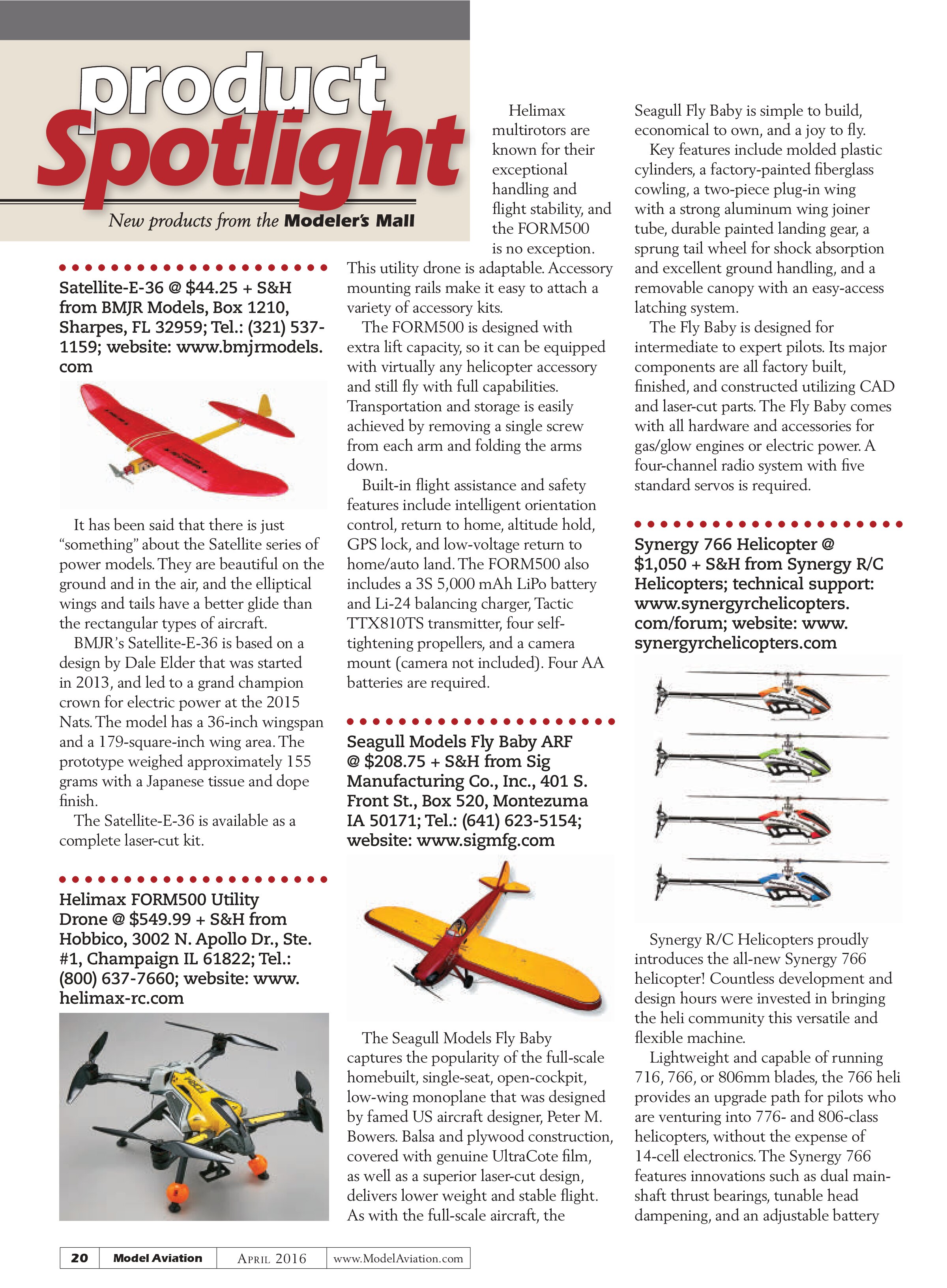
If you don’t believe us, then check out the NEAT Fair DVD by SKS Video Productions and see for yourself.
This 102-minute video captures all of the funny, entertaining, and amazing aircraft flown at the September 15-18, 2015, event that is held each year at the Peaceful Valley Campsite in Downsville, New York. One-of-a-kind flying models—including some award-winning ones—are featured in this video, which is available on DVD, Blu-ray, or in a streaming version.
The video also features some pilots who are well known in the modeling world, such as RC Aerobatics competitors Dan Landis and Devin McGrath. Dan has competed in the Nats and other RC Aerobatics events, and Devin was a member of the 2015 USA F3P team.
Also making appearances are Park Pilot columnist Don Belfort, Model Aviation columnist Joe Malinchak, who coordinates Indoor Night at NEAT, and Adam Woodworth, who is quickly making a name for himself by building unique aircraft based on those in science fiction movies and television shows.
This video of the 16th annual event can be yours on DVD for $19.95 or Blu-ray for $21.95, plus shipping and handling, or $4.99 to $14.99 for the streaming version.
SKS Video Productions: 85 Pine Rd.; Abbottstown PA 17301; Tel.: (800) 988-6488; website: www.sksvideo.com
Satellite-E-36 @ $44.25 + S&H from BMJR Models, Box 1210, Sharpes, FL 32959; Tel.: (321) 537-1159; website: www.bmj rmodels.com
It has been said that there is just “something” about the Satellite series of power models. They are beautiful on the ground and in the air, and the elliptical wings and tails have a better glide than the rectangular types of aircraft.
BMJR’s Satellite-E-36 is based on a design by Dale Elder that was started in 2013, and led to a grand champion crown for electric power at the 2015 Nats. The model has a 36-inch wingspan and a 179-square-inch wing area. The prototype weighed approximately 155 grams with a Japanese tissue and dope finish.
The Satellite-E-36 is available as a complete laser-cut kit.

Helimax FORM500 Utility Drone @ $549.99 + S&H from Hobbico, 3002 N. Apollo Dr., Ste. #1, Champaign IL 61822; Tel.: (800) 637-7660; website: www.helimax-rc.com

Helimax multirotors are known for their exceptional handling and flight stability, and the FORM500 is no exception.
This utility drone is adaptable. Accessory mounting rails make it easy to attach a variety of accessory kits.
The FORM500 is designed with extra lift capacity, so it can be equipped with virtually any helicopter accessory and still fly with full capabilities. Transportation and storage is easily achieved by removing a single screw from each arm and folding the arms down.
Built-in flight assistance and safety features include intelligent orientation control, return to home, altitude hold, GPS lock, and low-voltage return to home/auto land. The FORM500 also includes a 3S 5,000 mAh LiPo battery and Li-24 balancing charger, Tactic TTX810TS transmitter, four self-tightening propellers, and a camera mount (camera not included). Four AA batteries are required.
Seagull Models Fly Baby ARF @ $208.75 + S&H from Sig Manufacturing Co., Inc., 401 S. Front St., Box 520, Montezuma IA 50171; Tel.: (641) 623-5154; website: www.sigmfg.com

The Seagull Models Fly Baby captures the popularity of the full-scale homebuilt, single-seat, open-cockpit, low-wing monoplane that was designed by famed US aircraft designer, Peter M. Bowers. Balsa and plywood construction, covered with genuine UltraCote film, as well as a superior laser-cut design, delivers lower weight and stable flight. As with the full-scale aircraft, the Seagull Fly Baby is simple to build, economical to own, and a joy to fly. Key features include molded plastic cylinders, a factory-painted fiberglass cowling, a two-piece plug-in wing with a strong aluminum wing joiner tube, durable painted landing gear, a sprung tail wheel for shock absorption and excellent ground handling, and a removable canopy with an easy-access latching system.
The Fly Baby is designed for intermediate to expert pilots. Its major components are all factory built, finished, and constructed utilizing CAD and laser-cut parts. The Fly Baby comes with all hardware and accessories for gas/glow engines or electric power. A four-channel radio system with five standard servos is required.
Synergy 766 Helicopter @ $1,050 + S&H from Synergy R/C Helicopters; technical support: www.synergy rchelicopters.com/forum; website: www.synergy rchelicopters.com

Synergy R/C Helicopters proudly introduces the all-new Synergy 766 helicopter! Countless development and design hours were invested in bringing the heli community this versatile and flexible machine.
Lightweight and capable of running 716, 766, or 806mm blades, the 766 heli provides an upgrade path for pilots who are venturing into 776- and 806-class helicopters, without the expense of 14-cell electronics. The Synergy 766 features innovations such as dual main-shaft thrust bearings, tunable head dampening, and an adjustable battery tray system for quick center of gravity tuning.
With optimum tailboom size options available for each blade size, the Synergy 766 comes with a triple-panel canopy system with high-visibility paint, Delrin gears, links, and components throughout, and grease ports for all six thrust bearings. The Synergy 766 is designed and supported in the US. Visit the Synergy R/C Helicopters website for dealers.
Hangar 9 Carbon Cub 15cc @ $359.99 + S&H from Horizon Hobby, 4105 Fieldstone Rd., Champaign IL 61822; Tel.: (800) 338-4639; website: www.hangar-9.com

Hangar 9 brings to life the heritage and versatility of a classic aircraft adored by modelers and full-scale pilots with the Carbon Cub 15cc ARF. This laser-cut, all-wood airplane delivers the experience of Giant Scale aircraft, yet it is practical enough to fly every day.
The Cub features a two-piece, plug-in wing with functional flaps; shock-absorbing main landing gear and tundra-style wheels; quick-connect, streamlined wing struts; and precut hinge locations for all control surfaces. Scale details, such as the installed and functional LED landing lights, operational cockpit side doors, and cockpit instrument details and seats, will easily turn heads at the field.
The Carbon Cub 15cc is float-ready, with hard points for the optional 1/5-scale float set. With matching paint on the cowl and accessories and a genuine UltraCote film finish, the complete hardware kit features fiberglass control horns. A 15cc two-stroke gas engine is required for completion, as well as a six-plus-channel transmitter and receiver, seven standard digital servos, a propeller, and two batteries for the receiver and engine ignition.
KDE8218XF-120 Brushless Motor for Multi-Rotor (UAS) Series @ $596.95 + S&H from KDE Direct; email: sales@kdedirect.com; website: www.kdedirect.com
KDE Direct’s new production version of the KDE8218XF-120 brushless motor is a flagship of technology—designed specifically for a wide range of multirotor and UAS applications. Including a laser-etched serialization of a unique ID and an active-centrifugal fan for improved cooling and sustained performance, the motor features a new bearing design that is triple-supported with ABEC-7 angular-contact and radial bearings.
Designed with performance and durability in mind, the KDE8218XF-120 motor uses high-grade 240°C continuous high-temperature solid-core copper windings for failure-free operation in extreme climates, Japanese-built 0.2mm silicon-steel stator laminations, and Kevlar tie-wraps for high-efficiency performance. Bullet connectors are presoldered to the motor leads, with ESC female bullets included.
Anti-Slip Strap @ $3 to $8 + S&H from Esprit Tech/Model, Box 360815, Melbourne FL 32936; Tel.: (321) 729-4287; website: www.espritmodel.com
Take a look at the new and improved Anti-Slip Strap from Esprit Tech/Model!
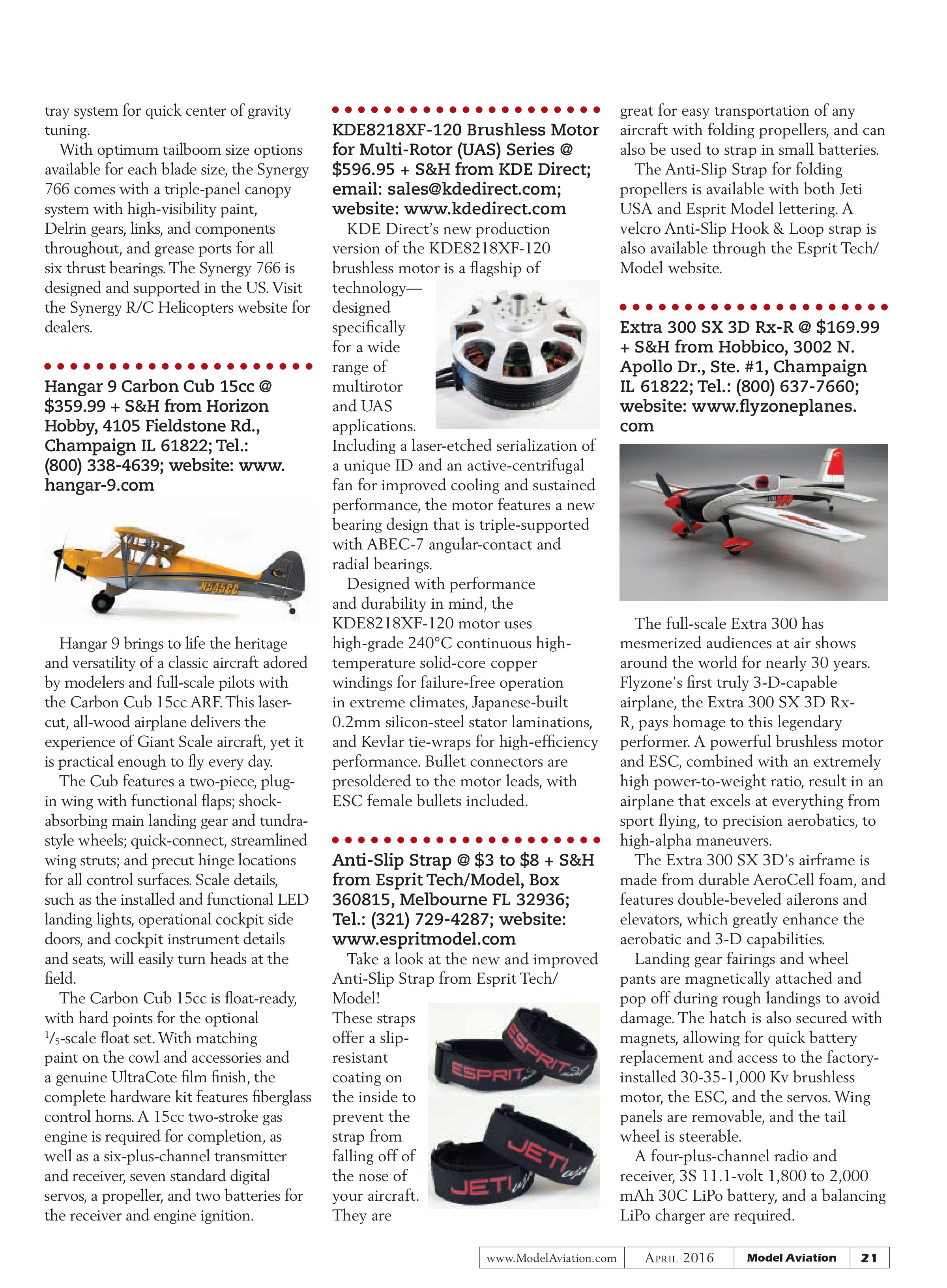
These straps offer a slip-resistant coating on the inside to prevent the strap from falling off of the nose of your aircraft. They are

The Anti-Slip Strap for folding propellers is available with both Jeti USA and Esprit Model lettering. A velcro Anti-Slip Hook & Loop strap is also available through the Esprit Tech/Model website.
Extra 300 SX 3D Rx-R @ $169.99 + S&H from Hobbico, 3002 N. Apollo Dr., Ste. #1, Champaign IL 61822; Tel.: (800) 637-7660; website: www.flyzoneplanes.com

The full-scale Extra 300 has mesmerized audiences at air shows around the world for nearly 30 years. Flyzone’s first truly 3-D-capable airplane, the Extra 300 SX 3D Rx-R, pays homage to this legendary performer. A powerful brushless motor and ESC, combined with an extremely high power-to-weight ratio, result in an airplane that excels at everything from sport flying, to precision aerobatics, to high-alpha maneuvers.
The Extra 300 SX 3D’s airframe is made from durable AeroCell foam, and features double-beveled ailerons and elevators, which greatly enhance the aerobatic and 3-D capabilities.
Landing gear fairings and wheel pants are magnetically attached and pop off during rough landings to avoid damage. The hatch is also secured with magnets, allowing for quick battery replacement and access to the factory-installed 30-35-1,000 Kv brushless motor, the ESC, and the servos. Wing panels are removable, and the tail wheel is steerable.
A four-plus-channel radio and receiver, 3S 11.1-volt 1,800 to 2,000 mAh 30C LiPo battery, and a balancing LiPo charger are required.