Revisiting ALOT

Bob Angel
samrcflier@verizon.net
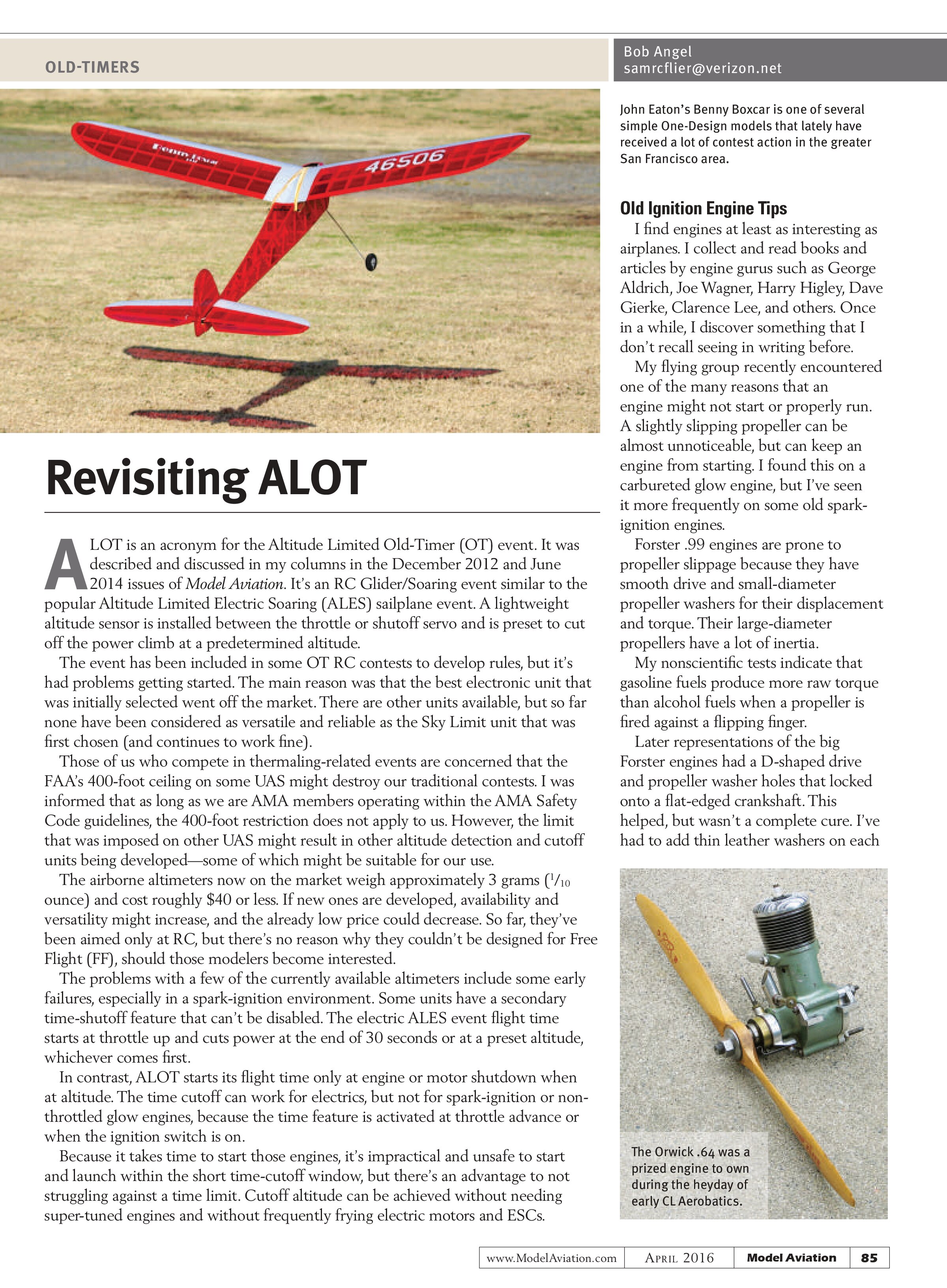
John Eaton’s Benny Boxcar is one of several simple One-Design models that lately have received a lot of contest action in the greater San Francisco area.
ALOT is an acronym for the Altitude Limited Old-Timer (OT) event. It was described and discussed in my columns in the December 2012 and June 2014 issues of Model Aviation. It’s an RC Glider/Soaring event similar to the popular Altitude Limited Electric Soaring (ALES) sailplane event. A lightweight altitude sensor is installed between the throttle or shutoff servo and is preset to cut off the power climb at a predetermined altitude.
The event has been included in some OT RC contests to develop rules, but it’s had problems getting started. The main reason was that the best electronic unit that was initially selected went off the market. There are other units available, but so far none have been considered as versatile and reliable as the Sky Limit unit that was first chosen (and continues to work fine).
Those of us who compete in thermaling-related events are concerned that the FAA’s 400-foot ceiling on some UAS might destroy our traditional contests. I was informed that as long as we are AMA members operating within the AMA Safety Code guidelines, the 400-foot restriction does not apply to us. However, the limit that was imposed on other UAS might result in other altitude detection and cutoff units being developed—some of which might be suitable for our use.
The airborne altimeters now on the market weigh approximately 3 grams (¹⁄₁₀ ounce) and cost roughly $40 or less. If new ones are developed, availability and versatility might increase, and the already low price could decrease. So far, they’ve been aimed only at RC, but there’s no reason why they couldn’t be designed for Free Flight (FF), should those modelers become interested.
The problems with a few of the currently available altimeters include some early failures, especially in a spark-ignition environment. Some units have a secondary time-shutoff feature that can’t be disabled. The electric ALES event flight time starts at throttle up and cuts power at the end of 30 seconds or at a preset altitude, whichever comes first.
In contrast, ALOT starts its flight time only at engine or motor shutdown when at altitude. The time cutoff can work for electrics, but not for spark-ignition or non-throttled glow engines, because the time feature is activated at throttle advance or when the ignition switch is on.
Because it takes time to start those engines, it’s impractical and unsafe to start and launch within the short time-cutoff window, but there’s an advantage to not struggling against a time limit. Cutoff altitude can be achieved without needing super-tuned engines and without frequently frying electric motors and ESCs.
Old Ignition Engine Tips
I find engines at least as interesting as airplanes. I collect and read books and articles by engine gurus such as George Aldrich, Joe Wagner, Harry Higley, Dave Gierke, Clarence Lee, and others. Once in a while, I discover something that I don’t recall seeing in writing before.
My flying group recently encountered one of the many reasons that an engine might not start or properly run. A slightly slipping propeller can be almost unnoticeable, but can keep an engine from starting. I found this on a carbureted glow engine, but I’ve seen it more frequently on some old spark-ignition engines.
Forster .99 engines are prone to propeller slippage because they have smooth drive and small-diameter propeller washers for their displacement and torque. Their large-diameter propellers have a lot of inertia.
My nonscientific tests indicate that gasoline fuels produce more raw torque than alcohol fuels when a propeller is fired against a flipping finger.
Later representations of the big Forster engines had a D-shaped drive and propeller washer holes that locked onto a flat-edged crankshaft. This helped, but wasn’t a complete cure. I’ve had to add thin leather washers on each


side of a wooden propeller to get a Forster .99 started.
Orwick Engines
Orwick .64s also have a propeller-slippage problem. I have a couple of them in my collection, but had never flown or run one until lately. They have smooth, small-diameter drive washers, and high-compression ratios. One of mine has a smooth propeller washer, while the other has propeller washers with a knurled rear surface.
Most of these old engines can’t have a starter applied without causing internal damage. I wasted a couple of hours trying to hand-start one of the Orwicks before removing the propeller and noticing signs of slippage under the washers. If you use wooden propellers for authenticity (and more importantly, for safety), you should loosen the prop nut between flying sessions to prevent shrinking and slipping.
I discovered something different about Orwick timers. I say “discovered” only because I hadn’t remembered the details covered in Charlie Bruce’s thorough review of the big Orwicks in the July 1996 issue of the Society of Antique Modelers (SAM) newsletter, SAM Speaks.
Before running an old spark-ignition engine for the first time, you need to check the timer to make sure the points are making and breaking, and that the timer is not so loose that it rotates and retards itself after starting.
My Orwick timer was slightly loose. Most timers have an obvious way to tighten them, but not the Orwick. The plain, round timer arm is screwed into the timer casing and locked with a nut.
Hidden beneath that arm is a small brass piece of which the arm presses against the front housing, serving as an adjustable friction regulator. I needed to loosen the nut, screw the arm in slightly tighter, and re-snug the nut. If you remove the timer, be careful not to lose that tiny brass friction piece.
The Orwick shares a point-gap adjustment method similar to the Brown Jr. and a few other spark-ignition engines. It becomes apparent with the drive washer removed. You’ll see a thick fiber washer with an eccentric shape. Loosening the outer metal lock ring allows the washer to be rotated to adjust the point gap.
In the developmental era of Control Line Aerobatics, Orwicks were considered the Cadillacs of competition engines. They were finely crafted and hand fitted by Henry Orwick, and priced well above most other brands. In early FF and SAM competition, they were frequent winners.
Today they are used less frequently in OT competition because fliers have learned how to tame the slightly stronger McCoy engines. There were probably fewer than 2,500 of the big Orwicks produced, so they are now valued more as collectibles.
A thoroughly researched history of the Orwicks was written by Bruce Chandler in the first two 1967 issues (Volume 5) of the Engine Collectors’ Journal (see “Sources”). They were produced in several sizes, with help from several shops and subcontractors. In later years, there have been several reproductions.
Soapbox
In earlier times, we called ourselves model builders, not model fliers. It was considered a hobby, not a sport. Many of us either pursued all aspects of the hobby, or at least considered those enjoying other facets as fellow modelers.
What changed? Mostly the rise of ARF models. Overall, ARFs have been good for the hobby by keeping our numbers, organizations, and publications strong and healthy. But sadly, today many of us have little interest in even talking to others outside our particular niche of the hobby.
SOURCES:
Engine Collectors’ Journal, Volume 5
ameebooks@gmail.com
www.modelenginecollecting.com
Jay Burkhart’s Lanzo Racer
www.rcgroups.com/forums/member.php?u=5330