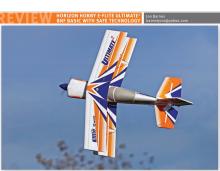
Horizon Hobby E-Flite Ultimate² BNF Basic with SAFE Technology
Jon Barnes

A durable aerobatic biplane to grow with
Although I could not be 100% sure that E-flite’s use of the “2” moniker was intended to connect its newest model of the Ultimate biplane with its similarly sized predecessor, I was 150% sure that I had to get my hands on the new E-flite Ultimate²!
World-class pilot and designer, Mike McConville, is the creative talent behind this new E-flite biplane. Although this Ultimate’s overall dimensions, all-up weight, and use of a 10-size brushless power system might initially cause a pilot to conclude that it is almost identical to the previously released Ultimate 20-300 ARF, a closer look reveals that E-flite and Mike have built a number of exciting and advanced features into this version!
First and foremost on the list of improvements is E-flite’s use of Z-Foam. I have owned and flown more than a few Z-Foam composition models and I love the finish and durability of E-flite’s unique and proprietary chemistry of foam. I have also grown to appreciate that a foam model’s covering does not wrinkle when left out in the sun too long on a warm or hot day.
Another noteworthy improvement that the Ultimate² enjoys is its use of an AS3X-equipped Spektrum receiver. The BNF version came with a Spektrum AR636A six-channel DSMX receiver preinstalled. AS3X technology works behind the scenes to provide an incredible level of in-flight stability.
The AR636A receiver also comes equipped with E-flite’s “Panic” feature. Should a pilot lose control orientation, or at any time find himself or herself hopelessly lost in the midst of an aerobatic maneuver, a simple push of the bind button on the transmitter will activate the Panic Mode and restore the model to level flight.
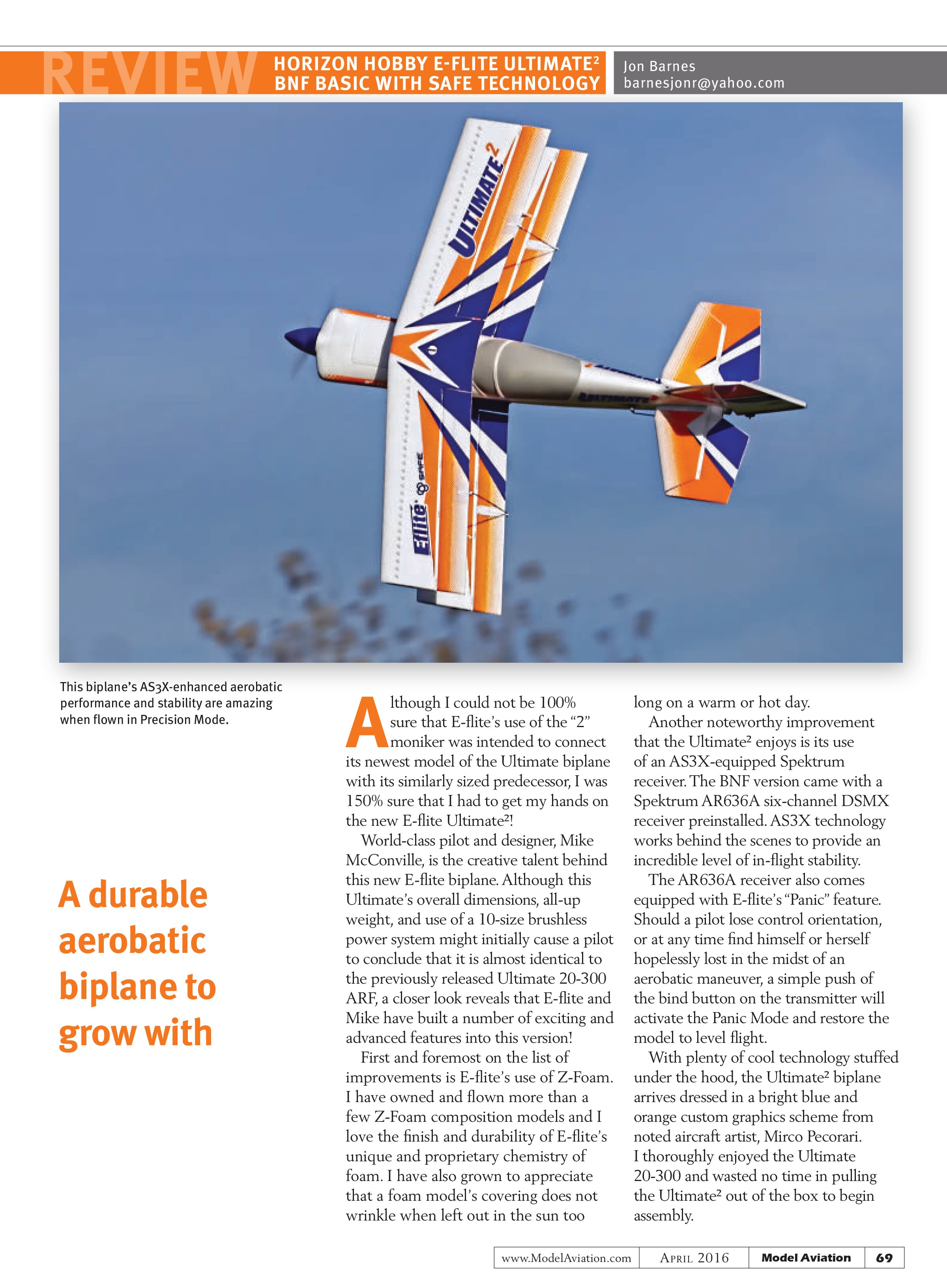
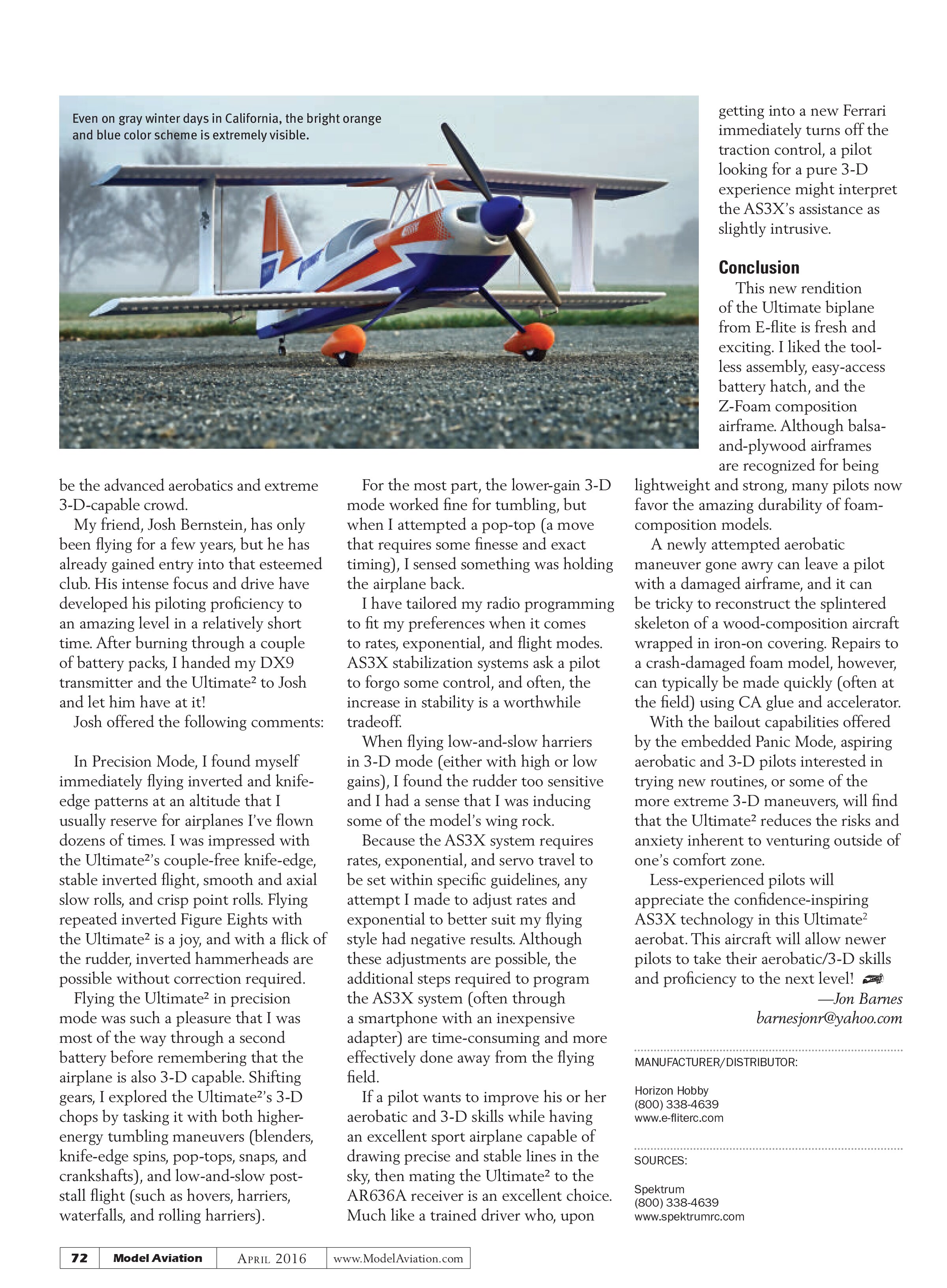
With plenty of cool technology stuffed under the hood, the Ultimate² biplane arrives dressed in a bright blue and orange custom graphics scheme from noted aircraft artist, Mirco Pecorari. I thoroughly enjoyed the Ultimate 20-300 and wasted no time in pulling the Ultimate² out of the box to begin assembly.
Assembly
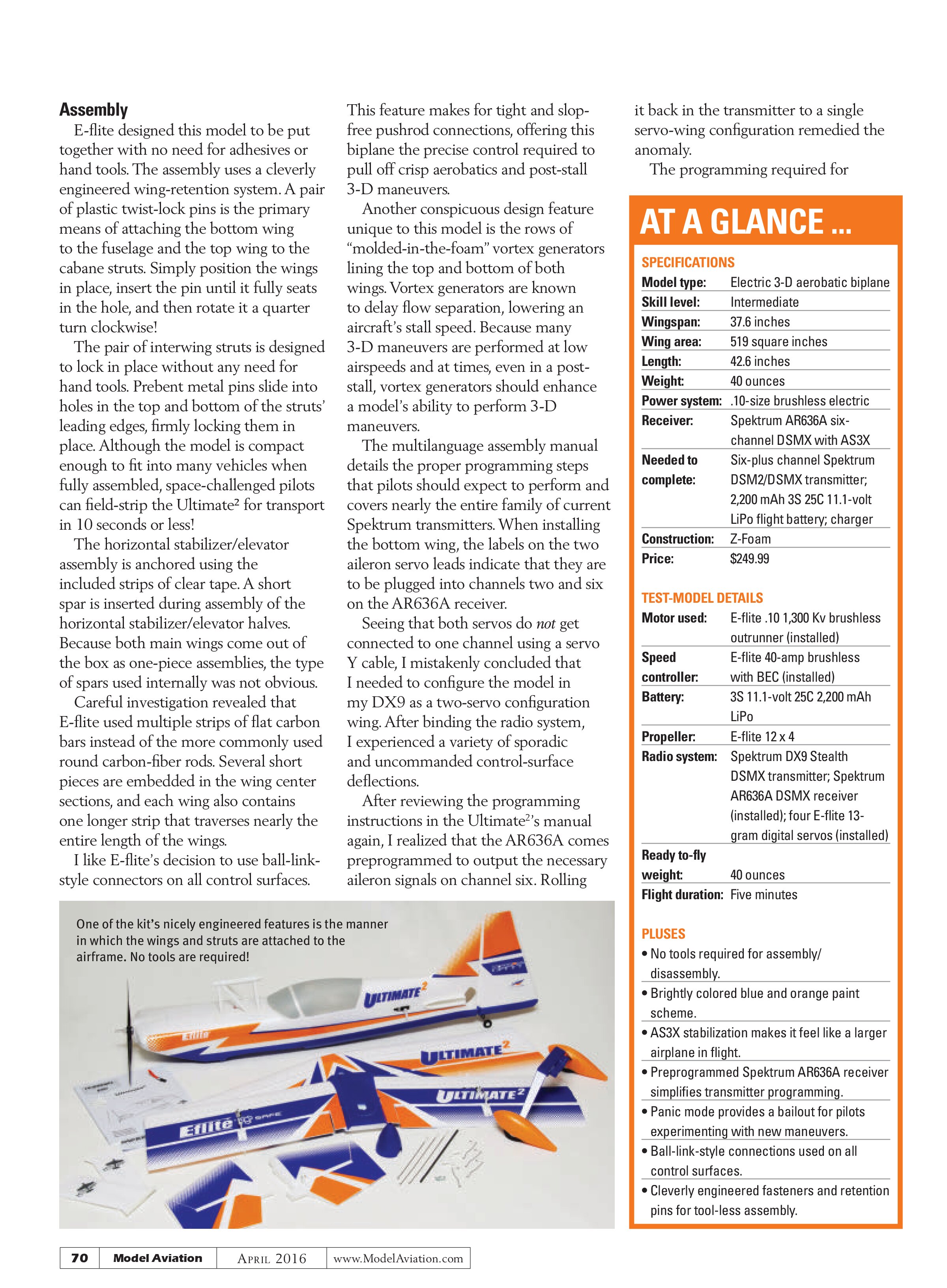
E-flite designed this model to be put together with no need for adhesives or hand tools. The assembly uses a cleverly engineered wing-retention system. A pair of plastic twist-lock pins is the primary means of attaching the bottom wing to the fuselage and the top wing to the cabane struts. Simply position the wings in place, insert the pin until it fully seats in the hole, and then rotate it a quarter turn clockwise!
The pair of interwing struts is designed to lock in place without any need for hand tools. Prebent metal pins slide into holes in the top and bottom of the struts’ leading edges, firmly locking them in place. Although the model is compact enough to fit into many vehicles when fully assembled, space-challenged pilots can field-strip the Ultimate² for transport in 10 seconds or less!
The horizontal stabilizer/elevator assembly is anchored using the included strips of clear tape. A short spar is inserted during assembly of the horizontal stabilizer/elevator halves. Because both main wings come out of the box as one-piece assemblies, the type of spars used internally was not obvious.
Careful investigation revealed that E-flite used multiple strips of flat carbon bars instead of the more commonly used round carbon-fiber rods. Several short pieces are embedded in the wing center sections, and each wing also contains one longer strip that traverses nearly the entire length of the wings.
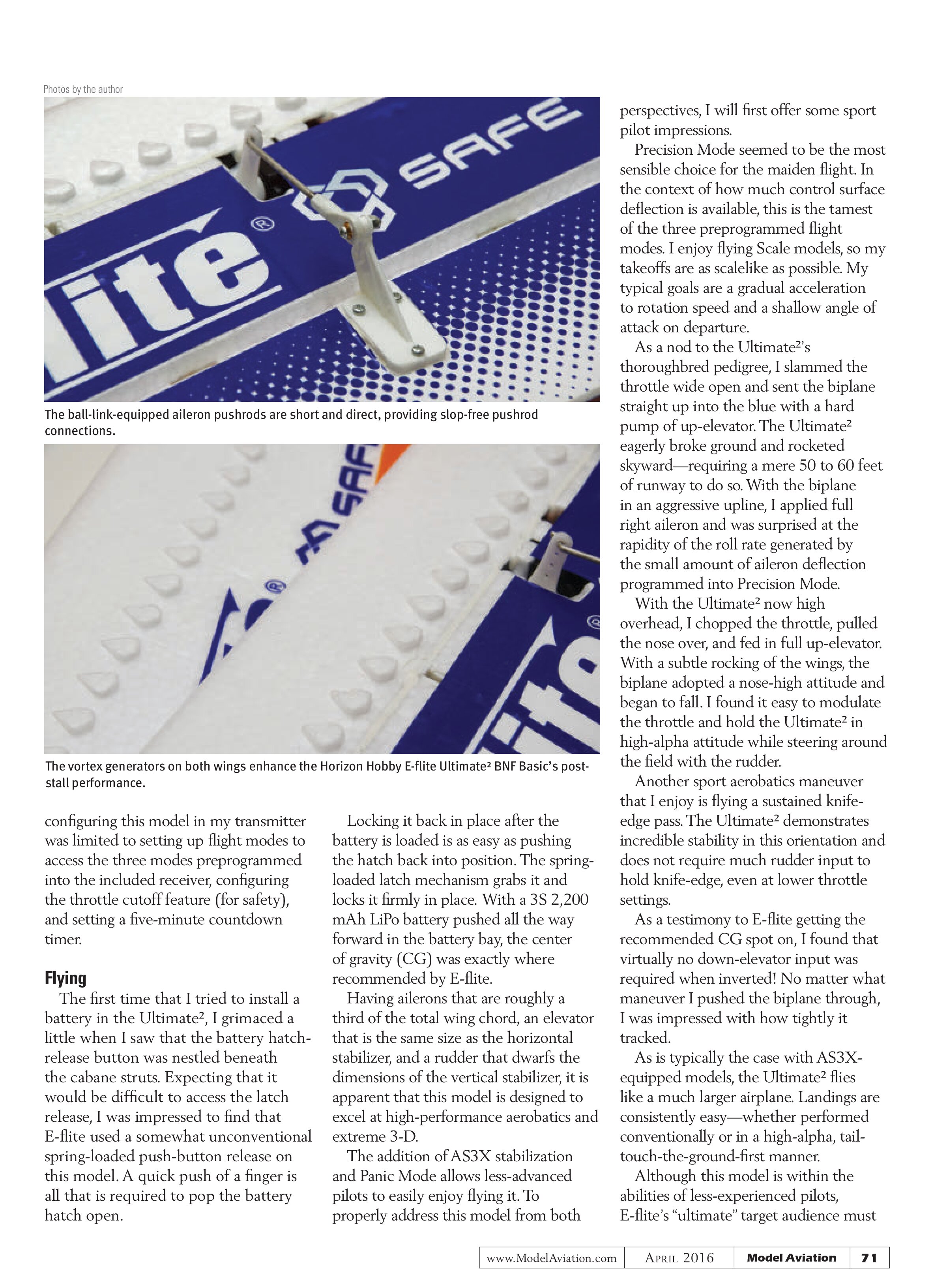
I like E-flite’s decision to use ball-link-style connectors on all control surfaces. This feature makes for tight and slop-free pushrod connections, offering this biplane the precise control required to pull off crisp aerobatics and post-stall 3-D maneuvers.
Another conspicuous design feature unique to this model is the rows of “molded-in-the-foam” vortex generators lining the top and bottom of both wings. Vortex generators are known to delay flow separation, lowering an aircraft’s stall speed. Because many 3-D maneuvers are performed at low airspeeds and at times, even in a post-stall, vortex generators should enhance a model’s ability to perform 3-D maneuvers.
The multilanguage assembly manual details the proper programming steps that pilots should expect to perform and covers nearly the entire family of current Spektrum transmitters. When installing the bottom wing, the labels on the two aileron servo leads indicate that they are to be plugged into channels two and six on the AR636A receiver.
Seeing that both servos do not get connected to one channel using a servo Y cable, I mistakenly concluded that I needed to configure the model in my DX9 as a two-servo configuration wing. After binding the radio system, I experienced a variety of sporadic and uncommanded control-surface deflections.
After reviewing the programming instructions in the Ultimate²’s manual again, I realized that the AR636A comes preprogrammed to output the necessary aileron signals on channel six. Rolling it back in the transmitter to a single servo-wing configuration remedied the anomaly. The programming required for

configuring this model in my transmitter was limited to setting up flight modes to access the three modes preprogrammed into the included receiver, configuring the throttle cutoff feature (for safety), and setting a five-minute countdown timer.
Flying
The first time that I tried to install a battery in the Ultimate², I grimaced a little when I saw that the battery hatch-release button was nestled beneath the cabane struts. Expecting that it would be difficult to access the latch release, I was impressed to find that E-flite used a somewhat unconventional spring-loaded push-button release on this model. A quick push of a finger is all that is required to pop the battery hatch open.


Locking it back in place after the battery is loaded is as easy as pushing the hatch back into position. The spring-loaded latch mechanism grabs it and locks it firmly in place. With a 3S 2,200 mAh LiPo battery pushed all the way forward in the battery bay, the center of gravity (CG) was exactly where recommended by E-flite.
Having ailerons that are roughly a third of the total wing chord, an elevator that is the same size as the horizontal stabilizer, and a rudder that dwarfs the dimensions of the vertical stabilizer, it is apparent that this model is designed to excel at high-performance aerobatics and extreme 3-D.
The addition of AS3X stabilization and Panic Mode allows less-advanced pilots to easily enjoy flying it. To properly address this model from both perspectives, I will first offer some sport pilot impressions.
Precision Mode seemed to be the most sensible choice for the maiden flight. In the context of how much control surface deflection is available, this is the tamest of the three preprogrammed flight modes. I enjoy flying Scale models, so my takeoffs are as scalelike as possible. My typical goals are a gradual acceleration to rotation speed and a shallow angle of attack on departure.
As a nod to the Ultimate²’s thoroughbred pedigree, I slammed the throttle wide open and sent the biplane straight up into the blue with a hard pump of up-elevator. The Ultimate² eagerly broke ground and rocketed skyward—requiring a mere 50 to 60 feet of runway to do so. With the biplane in an aggressive upline, I applied full right aileron and was surprised at the rapidity of the roll rate generated by the small amount of aileron deflection programmed into Precision Mode.
With the Ultimate² now high overhead, I chopped the throttle, pulled the nose over, and fed in full up-elevator. With a subtle rocking of the wings, the biplane adopted a nose-high attitude and began to fall. I found it easy to modulate the throttle and hold the Ultimate² in high-alpha attitude while steering around the field with the rudder.
Another sport aerobatics maneuver that I enjoy is flying a sustained knife-edge pass. The Ultimate² demonstrates incredible stability in this orientation and does not require much rudder input to hold knife-edge, even at lower throttle settings.
As a testimony to E-flite getting the recommended CG spot on, I found that virtually no down-elevator input was required when inverted! No matter what maneuver I pushed the biplane through, I was impressed with how tightly it tracked.
As is typically the case with AS3X-equipped models, the Ultimate² flies like a much larger airplane. Landings are consistently easy—whether performed conventionally or in a high-alpha, tail-touch-the-ground-first manner.
Although this model is within the abilities of less-experienced pilots, E-flite’s “ultimate” target audience must

be the advanced aerobatics and extreme 3-D-capable crowd.
My friend, Josh Bernstein, has only been flying for a few years, but he has already gained entry into that esteemed club. His intense focus and drive have developed his piloting proficiency to an amazing level in a relatively short time. After burning through a couple of battery packs, I handed my DX9 transmitter and the Ultimate² to Josh and let him have at it!
Josh offered the following comments:
In Precision Mode, I found myself immediately flying inverted and knife-edge patterns at an altitude that I usually reserve for airplanes I’ve flown dozens of times. I was impressed with the Ultimate²’s couple-free knife-edge, stable inverted flight, smooth and axial slow rolls, and crisp point rolls. Flying repeated inverted Figure Eights with the Ultimate² is a joy, and with a flick of the rudder, inverted hammerheads are possible without correction required.
Flying the Ultimate² in precision mode was such a pleasure that I was most of the way through a second battery before remembering that the airplane is also 3-D capable. Shifting gears, I explored the Ultimate²’s 3-D chops by tasking it with both higher-energy tumbling maneuvers (blenders, knife-edge spins, pop-tops, snaps, and crankshafts), and low-and-slow post-stall flight (such as hovers, harriers, waterfalls, and rolling harriers).
For the most part, the lower-gain 3-D mode worked fine for tumbling, but when I attempted a pop-top (a move that requires some finesse and exact timing), I sensed something was holding the airplane back.
I have tailored my radio programming to fit my preferences when it comes to rates, exponential, and flight modes. AS3X stabilization systems ask a pilot to forgo some control, and often, the increase in stability is a worthwhile tradeoff.
When flying low-and-slow harriers in 3-D mode (either with high or low gains), I found the rudder too sensitive and I had a sense that I was inducing some of the model’s wing rock.
Because the AS3X system requires rates, exponential, and servo travel to be set within specific guidelines, any attempt I made to adjust rates and exponential to better suit my flying style had negative results. Although these adjustments are possible, the additional steps required to program the AS3X system (often through a smartphone with an inexpensive adapter) are time-consuming and more effectively done away from the flying field.
If a pilot wants to improve his or her aerobatic and 3-D skills while having an excellent sport airplane capable of drawing precise and stable lines in the sky, then mating the Ultimate² to the AR636A receiver is an excellent choice. Much like a trained driver who, upon getting into a new Ferrari immediately turns off the traction control, a pilot looking for a pure 3-D experience might interpret the AS3X’s assistance as slightly intrusive.
Conclusion
This new rendition of the Ultimate biplane from E-flite is fresh and exciting. I liked the tool-less assembly, easy-access battery hatch, and the Z-Foam composition airframe. Although balsa-and-plywood airframes are recognized for being lightweight and strong, many pilots now favor the amazing durability of foam-composition models.
A newly attempted aerobatic maneuver gone awry can leave a pilot with a damaged airframe, and it can be tricky to reconstruct the splintered skeleton of a wood-composition aircraft wrapped in iron-on covering. Repairs to a crash-damaged foam model, however, can typically be made quickly (often at the field) using CA glue and accelerator.
With the bailout capabilities offered by the embedded Panic Mode, aspiring aerobatic and 3-D pilots interested in trying new routines, or some of the more extreme 3-D maneuvers, will find that the Ultimate² reduces the risks and anxiety inherent to venturing outside of one’s comfort zone.
Less-experienced pilots will appreciate the confidence-inspiring AS3X technology in this Ultimate² aerobat. This aircraft will allow newer pilots to take their aerobatic/3-D skills and proficiency to the next level!
—Jon Barnes
barnesjonr@yahoo.com
MANUFACTURER/DISTRIBUTOR:
Horizon Hobby
(800) 338-4639
www.e-fliterc.com
SOURCES:
Spektrum
(800) 338-4639
www.spektrumrc.com