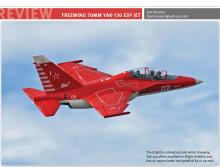
FREEWING 70MM YAK-130 EDF JET
Jon Barnes
barnesjonr@yahoo.com

An affordable and enjoyable EDF jet
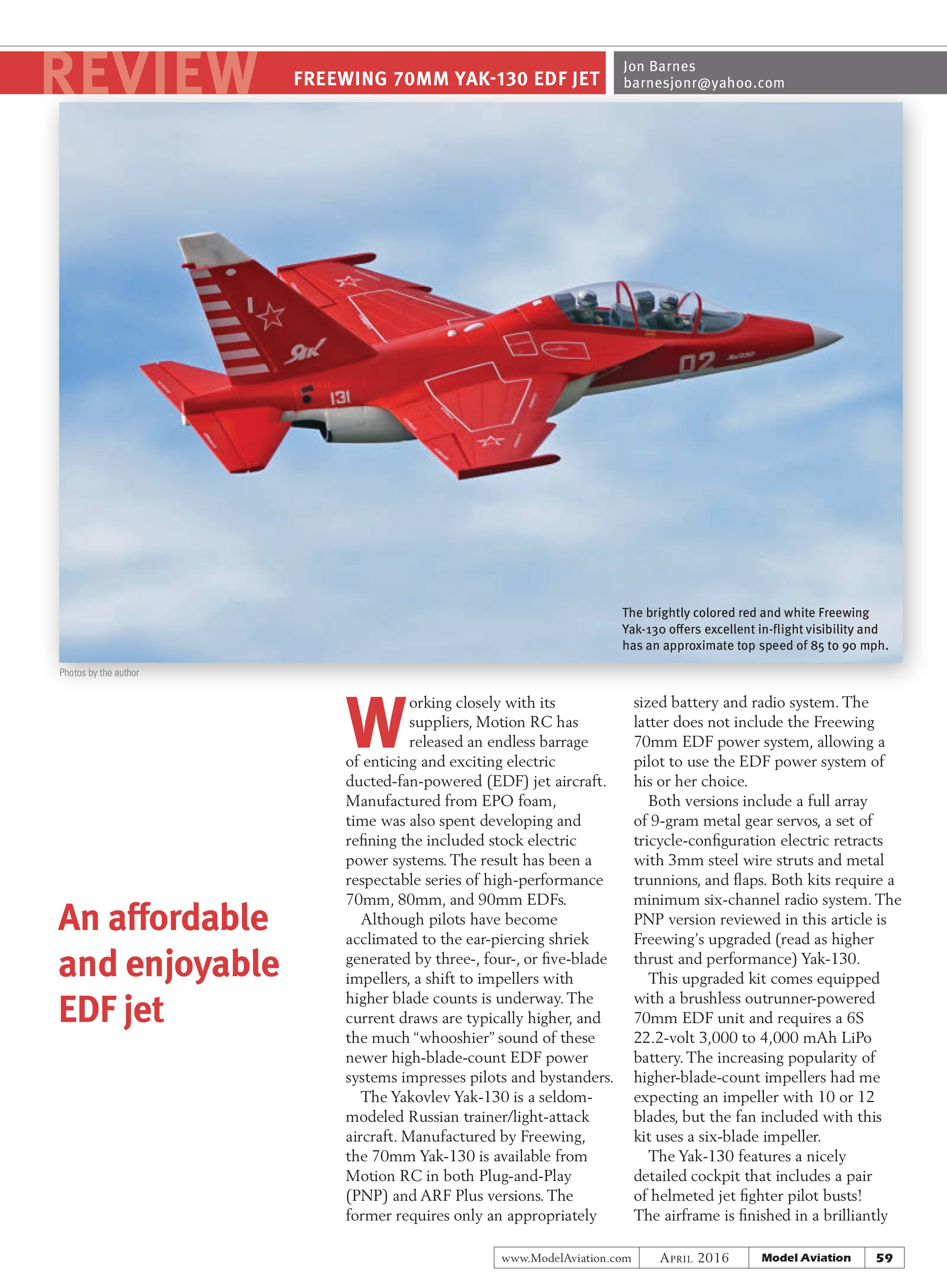
Working closely with its suppliers, Motion RC has released an endless barrage of enticing and exciting electric ducted-fan-powered (EDF) jet aircraft. Manufactured from EPO foam, time was also spent developing and refining the included stock electric power systems. The result has been a respectable series of high-performance 70mm, 80mm, and 90mm EDFs.
Although pilots have become acclimated to the ear-piercing shriek generated by three-, four-, or five-blade impellers, a shift to impellers with higher blade counts is underway. The current draws are typically higher, and the much “whooshier” sound of these newer high-blade-count EDF power systems impresses pilots and bystanders.
The Yakovlev Yak-130 is a seldom-modeled Russian trainer/light-attack aircraft. Manufactured by Freewing, the 70mm Yak-130 is available from Motion RC in both Plug-and-Play (PNP) and ARF Plus versions. The former requires only an appropriately sized battery and radio system. The latter does not include the Freewing 70mm EDF power system, allowing a pilot to use the EDF power system of his or her choice.
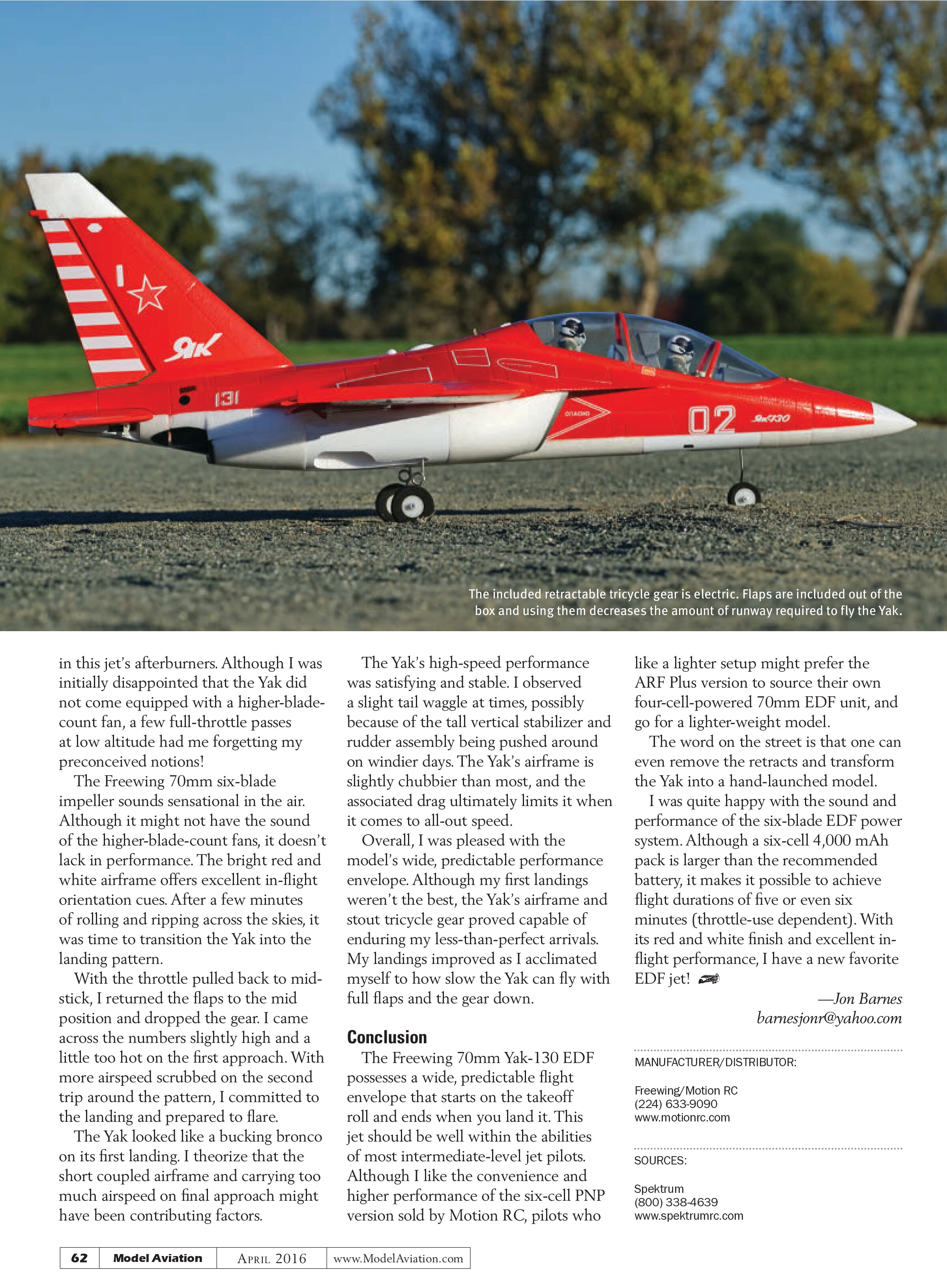
Both versions include a full array of 9-gram metal gear servos, a set of tricycle-configuration electric retracts with 3mm steel wire struts and metal trunnions, and flaps. Both kits require a minimum six-channel radio system. The PNP version reviewed in this article is Freewing’s upgraded (read as higher thrust and performance) Yak-130.
This upgraded kit comes equipped with a brushless outrunner-powered 70mm EDF unit and requires a 6S 22.2-volt 3,000 to 4,000 mAh LiPo battery. The increasing popularity of higher-blade-count impellers had me expecting an impeller with 10 or 12 blades, but the fan included with this kit uses a six-blade impeller.
The Yak-130 features a nicely detailed cockpit that includes a pair of helmeted jet fighter pilot busts! The airframe is finished in a brilliantly
colored Ferrari red and white scheme that promises to offer excellent in-flight orientation feedback.
The included tricycle electric retracts are equipped with sturdy metal struts. The Yak-130 fuselage features extended wing roots and wide-set engine intakes. I was glad to find that this model was designed to fly without the need for cheater holes.
This is the first Yak-130 model that I have ever built and flown, and I found myself studying the airplane closely in an effort to anticipate how it might perform in the air. The wide, flat design and dimensions of the Yak’s fuselage suggest that it will augment the lift generated by the relatively short wings.
The Yak’s vertical stabilizer and rudder assembly is amply sized and quite tall when compared with other jets. That could equate to excellent rudder authority in knife-edge flight. The Yak also possesses a relatively short tail moment. Models with short tail moments can often be pitch sensitive.
AT A GLANCE ...
SPECIFICATIONS
Model type: PNP EDF jet
Skill level: Intermediate
Wingspan: 36.2 inches
Length: 41.3 inches
Weight: 61 ounces
Power system: Freewing 70mm six-blade EDF
Needed to complete: Six-plus channel radio and receiver; 6S 22.2-volt 3,000 to 4,000 mAh LiPo battery pack
Construction: EPO foam
Street price: $229.99
TEST-MODEL DETAILS
Motor used: Freewing 2849/2200 Kv brushless outrunner (installed)
Speed controller: Freewing 60-amp with BEC (installed)
Battery: Admiral Pro 6S 22.2-volt 60C 4,000 mAh LiPo
Radio system: Spektrum DX9 transmitter; Spektrum AR7010 receiver
Ready-to-fly weight: 68 ounces
Flight duration: 4 to 7 minutes
PLUSES
- Brightly colored red and white airframe offers excellent in-flight visibility.
- Electric servoless tricycle retracts with 3mm diameter, spring-loaded struts are durable and make for easy ground handling.
- High-performance 70mm EDF power system propels the Yak to speeds of up to 90 mph.
- Included flaps allow the Yak to take off and land on shorter runways and at reduced speeds.
- Option to build and fly as a lighter, gearless, 4S-powered hand-launched model.
MINUS
- Slight gap between the wing and fuselage.
Construction
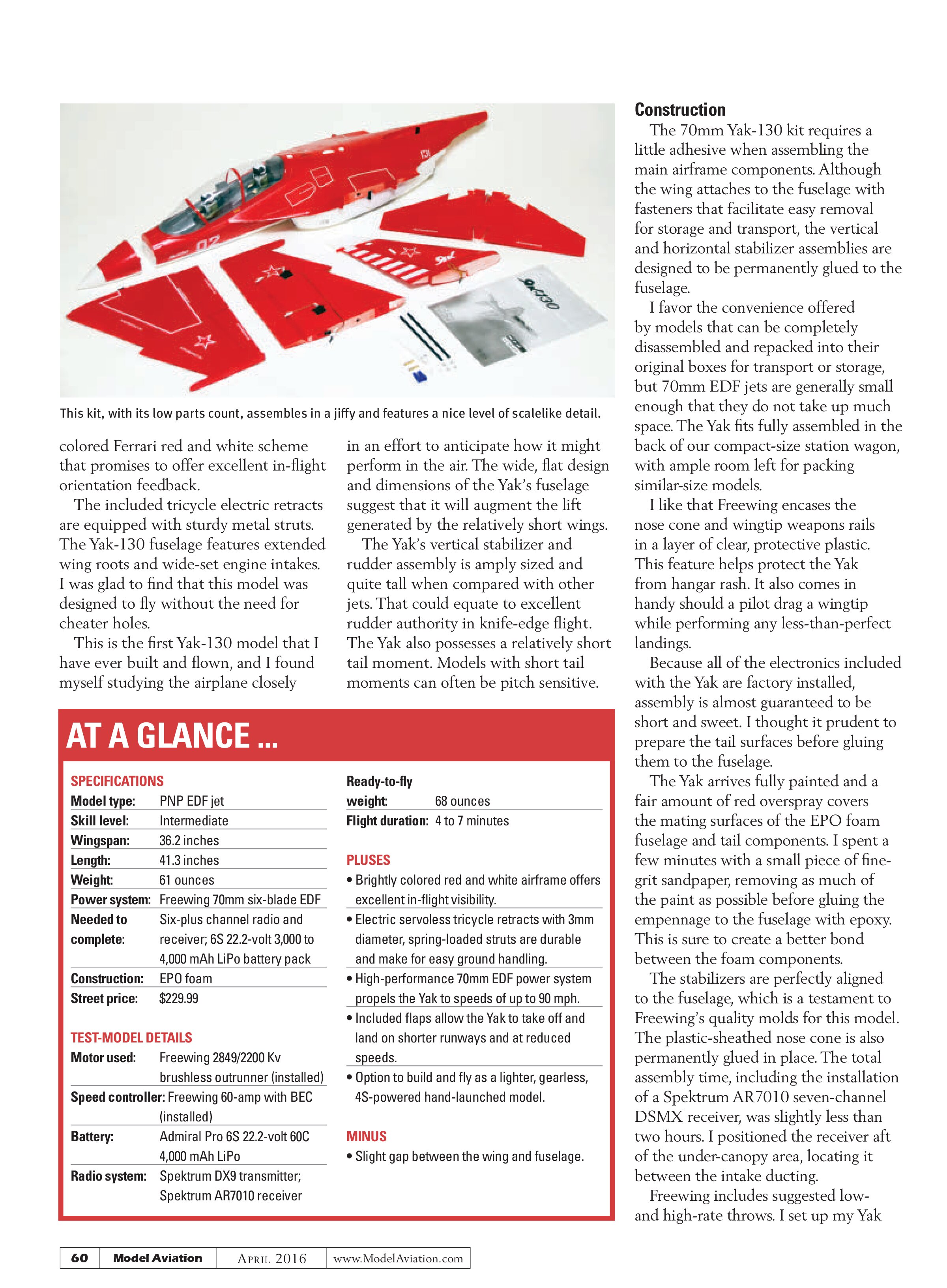
The 70mm Yak-130 kit requires a little adhesive when assembling the main airframe components. Although the wing attaches to the fuselage with fasteners that facilitate easy removal for storage and transport, the vertical and horizontal stabilizer assemblies are designed to be permanently glued to the fuselage.
I favor the convenience offered by models that can be completely disassembled and repacked into their original boxes for transport or storage, but 70mm EDF jets are generally small enough that they do not take up much space. The Yak fits fully assembled in the back of our compact-size station wagon, with ample room left for packing similar-size models.
I like that Freewing encases the nose cone and wingtip weapons rails in a layer of clear, protective plastic. This feature helps protect the Yak from hangar rash. It also comes in handy should a pilot drag a wingtip while performing any less-than-perfect landings.
Because all of the electronics included with the Yak are factory installed, assembly is almost guaranteed to be short and sweet. I thought it prudent to prepare the tail surfaces before gluing them to the fuselage.
The Yak arrives fully painted and a fair amount of red overspray covers the mating surfaces of the EPO foam fuselage and tail components. I spent a few minutes with a small piece of fine-grit sandpaper, removing as much of the paint as possible before gluing the empennage to the fuselage with epoxy. This is sure to create a better bond between the foam components.
The stabilizers are perfectly aligned to the fuselage, which is a testament to Freewing’s quality molds for this model. The plastic-sheathed nose cone is also permanently glued in place. The total assembly time, including the installation of a Spektrum AR7010 seven-channel DSMX receiver, was slightly less than two hours. I positioned the receiver aft of the under-canopy area, locating it between the intake ducting.
Freewing includes suggested low- and high-rate throws. I set up my Yak to use individual dual rates and then programmed a third set of rates to take advantage of full mechanical throws on all control surfaces, excluding the flaps. Although the chances of a high-performance EDF model needing massive amounts of control throws is almost nil, I can never resist setting up the option to have a little more throw available if needed.
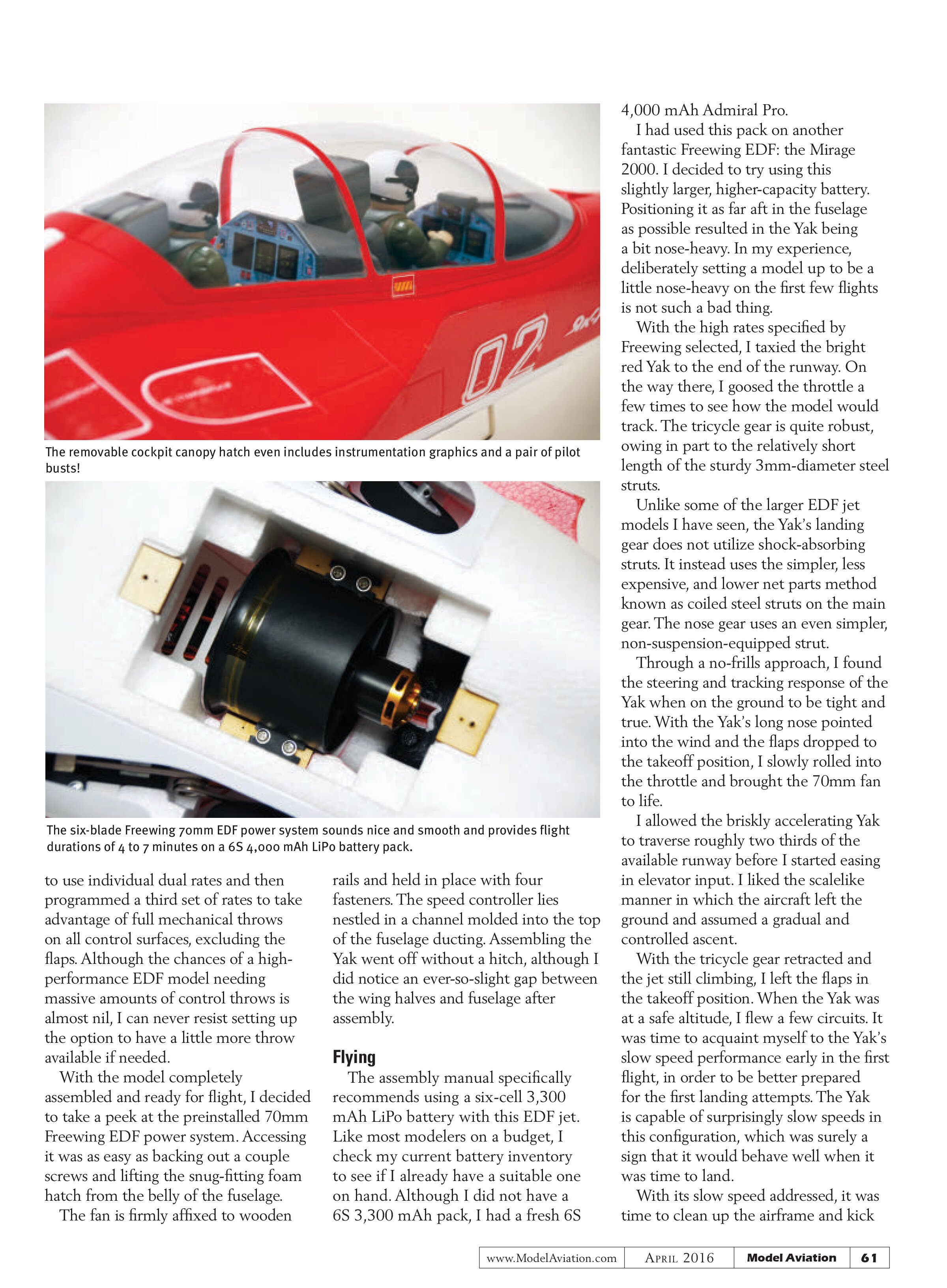
With the model completely assembled and ready for flight, I decided to take a peek at the preinstalled 70mm Freewing EDF power system. Accessing it was as easy as backing out a couple screws and lifting the snug-fitting foam hatch from the belly of the fuselage.
The fan is firmly affixed to wooden rails and held in place with four fasteners. The speed controller lies nestled in a channel molded into the top of the fuselage ducting. Assembling the Yak went off without a hitch, although I did notice an ever-so-slight gap between the wing halves and fuselage after assembly.
Flying
The assembly manual specifically recommends using a six-cell 3,300 mAh LiPo battery with this EDF jet. Like most modelers on a budget, I check my current battery inventory to see if I already have a suitable one on hand. Although I did not have a 6S 3,300 mAh pack, I had a fresh 6S 4,000 mAh Admiral Pro.
I had used this pack on another fantastic Freewing EDF: the Mirage 2000. I decided to try using this slightly larger, higher-capacity battery. Positioning it as far aft in the fuselage as possible resulted in the Yak being a bit nose-heavy. In my experience, deliberately setting a model up to be a little nose-heavy on the first few flights is not such a bad thing.
With the high rates specified by Freewing selected, I taxied the bright red Yak to the end of the runway. On the way there, I goosed the throttle a few times to see how the model would track. The tricycle gear is quite robust, owing in part to the relatively short length of the sturdy 3mm-diameter steel struts.
Unlike some of the larger EDF jet models I have seen, the Yak’s landing gear does not utilize shock-absorbing struts. It instead uses the simpler, less expensive, and lower net parts method known as coiled steel struts on the main gear. The nose gear uses an even simpler, non-suspension-equipped strut.
Through a no-frills approach, I found the steering and tracking response of the Yak when on the ground to be tight and true. With the Yak’s long nose pointed into the wind and the flaps dropped to the takeoff position, I slowly rolled into the throttle and brought the 70mm fan to life.
I allowed the briskly accelerating Yak to traverse roughly two thirds of the available runway before I started easing in elevator input. I liked the scalelike manner in which the aircraft left the ground and assumed a gradual and controlled ascent.
With the tricycle gear retracted and the jet still climbing, I left the flaps in the takeoff position. When the Yak was at a safe altitude, I flew a few circuits. It was time to acquaint myself to the Yak’s slow speed performance early in the first flight, in order to be better prepared for the first landing attempts. The Yak is capable of surprisingly slow speeds in this configuration, which was surely a sign that it would behave well when it was time to land.
With its slow speed addressed, it was time to clean up the airframe and kick


The removable cockpit canopy hatch even includes instrumentation graphics and a pair of pilot busts!
The six-blade Freewing 70mm EDF power system sounds nice and smooth and provides flight durations of 4 to 7 minutes on a 6S 4,000 mAh LiPo battery pack.


in this jet’s afterburners. Although I was initially disappointed that the Yak did not come equipped with a higher-blade-count fan, a few full-throttle passes at low altitude had me forgetting my preconceived notions!
The Freewing 70mm six-blade impeller sounds sensational in the air. Although it might not have the sound of the higher-blade-count fans, it doesn’t lack in performance. The bright red and white airframe offers excellent in-flight orientation cues. After a few minutes of rolling and ripping across the skies, it was time to transition the Yak into the landing pattern.
With the throttle pulled back to mid-stick, I returned the flaps to the mid position and dropped the gear. I came across the numbers slightly high and a little too hot on the first approach. With more airspeed scrubbed on the second trip around the pattern, I committed to the landing and prepared to flare.
The Yak looked like a bucking bronco on its first landing. I theorize that the short coupled airframe and carrying too much airspeed on final approach might have been contributing factors.
The Yak’s high-speed performance was satisfying and stable. I observed a slight tail waggle at times, possibly because of the tall vertical stabilizer and rudder assembly being pushed around on windier days. The Yak’s airframe is slightly chubbier than most, and the associated drag ultimately limits it when it comes to all-out speed.
Overall, I was pleased with the model’s wide, predictable performance envelope. Although my first landings weren’t the best, the Yak’s airframe and stout tricycle gear proved capable of enduring my less-than-perfect arrivals. My landings improved as I acclimated myself to how slow the Yak can fly with full flaps and the gear down.
Conclusion
The Freewing 70mm Yak-130 EDF possesses a wide, predictable flight envelope that starts on the takeoff roll and ends when you land it. This jet should be well within the abilities of most intermediate-level jet pilots. Although I like the convenience and higher performance of the six-cell PNP version sold by Motion RC, pilots who like a lighter setup might prefer the ARF Plus version to source their own four-cell-powered 70mm EDF unit, and go for a lighter-weight model.
The word on the street is that one can even remove the retracts and transform the Yak into a hand-launched model.
I was quite happy with the sound and performance of the six-blade EDF power system. Although a six-cell 4,000 mAh pack is larger than the recommended battery, it makes it possible to achieve flight durations of five or even six minutes (throttle-use dependent). With its red and white finish and excellent in-flight performance, I have a new favorite EDF jet!
—Jon Barnes
barnesjonr@yahoo.com
MANUFACTURER/DISTRIBUTOR:
Freewing/Motion RC
(224) 633-9090
www.motionrc.com
SOURCES:
Spektrum
(800) 338-4639
www.spektrumrc.com