Focal Point

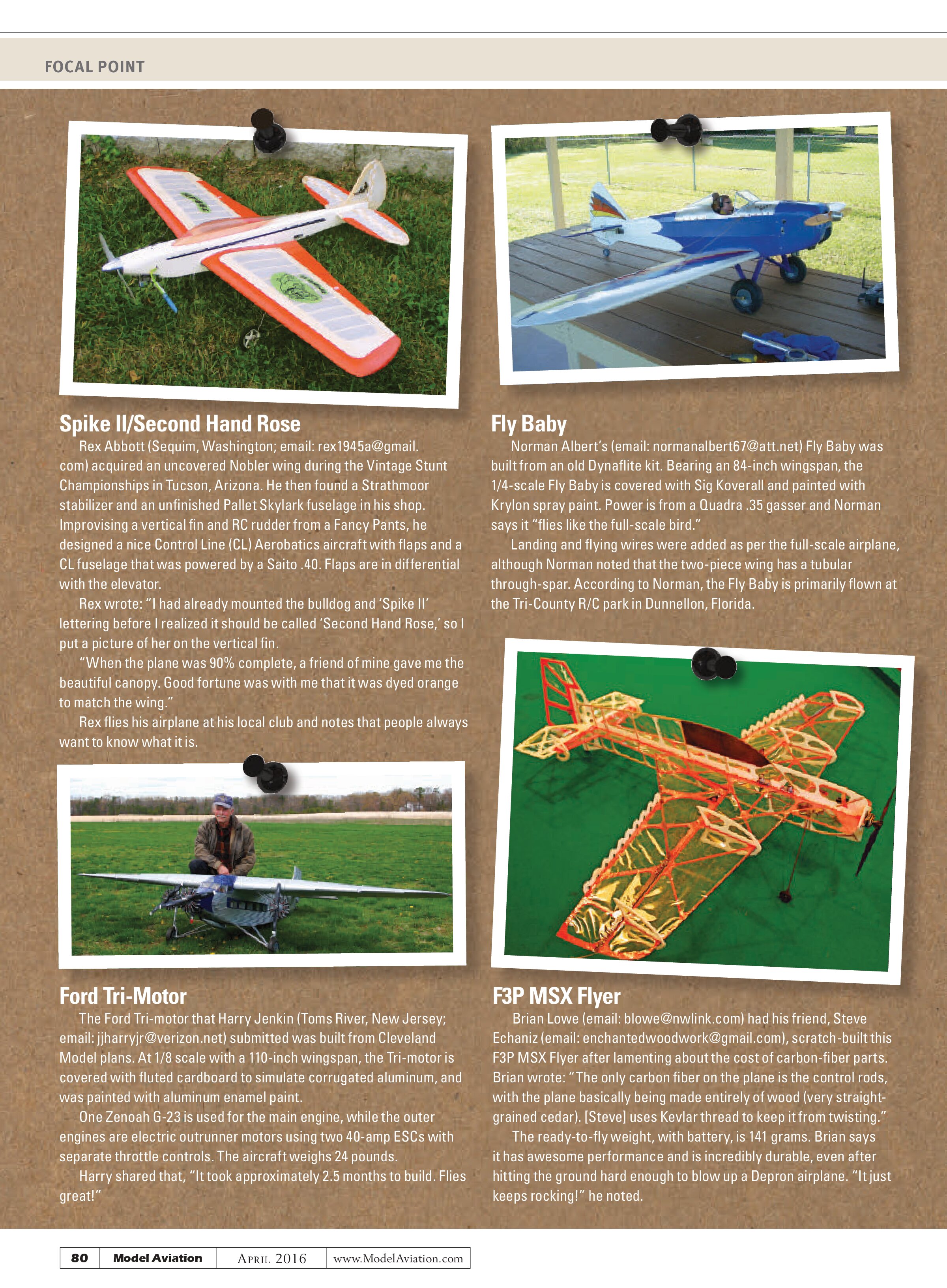
Spike II/Second Hand Rose
Rex Abbott (Sequim, Washington; email: rex1945a@gmail.com) acquired an uncovered Nobler wing during the Vintage Stunt Championships in Tucson, Arizona. He then found a Strathmoor stabilizer and an unfinished Pallet Skylark fuselage in his shop. Improvising a vertical fin and RC rudder from a Fancy Pants, he designed a nice Control Line (CL) Aerobatics aircraft with flaps and a CL fuselage that was powered by a Saito .40. Flaps are in differential with the elevator.
Rex wrote: “I had already mounted the bulldog and ‘Spike II’ lettering before I realized it should be called ‘Second Hand Rose,’ so I put a picture of her on the vertical fin.
“When the plane was 90% complete, a friend of mine gave me the beautiful canopy. Good fortune was with me that it was dyed orange to match the wing.”
Rex flies his airplane at his local club and notes that people always want to know what it is.

Ford Tri-Motor
The Ford Tri-motor that Harry Jenkin (Toms River, New Jersey; email: jjharryjr@verizon.net) submitted was built from Cleveland Model plans. At 1/8 scale with a 110-inch wingspan, the Tri-motor is covered with fluted cardboard to simulate corrugated aluminum, and was painted with aluminum enamel paint.
One Zenoah G-23 is used for the main engine, while the outer engines are electric outrunner motors using two 40-amp ESCs with separate throttle controls. The aircraft weighs 24 pounds.
Harry shared that, “It took approximately 2.5 months to build. Flies great!”

Fly Baby
Norman Albert’s (email: normanalbert67@att.net) Fly Baby was built from an old Dynaflite kit. Bearing an 84-inch wingspan, the 1/4-scale Fly Baby is covered with Sig Koverall and painted with Krylon spray paint. Power is from a Quadra .35 gasser and Norman says it “flies like the full-scale bird.”
Landing and flying wires were added as per the full-scale airplane, although Norman noted that the two-piece wing has a tubular through-spar. According to Norman, the Fly Baby is primarily flown at the Tri-County R/C park in Dunnellon, Florida.

F3P MSX Flyer
Brian Lowe (email: blowe@nwlink.com) had his friend, Steve Echaniz (email: enchantedwoodwork@gmail.com), scratch-built this F3P MSX Flyer after lamenting about the cost of carbon-fiber parts. Brian wrote: “The only carbon fiber on the plane is the control rods, with the plane basically being made entirely of wood (very straight-grained cedar). [Steve] uses Kevlar thread to keep it from twisting.”
The ready-to-fly weight, with battery, is 141 grams. Brian says it has awesome performance and is incredibly durable, even after hitting the ground hard enough to blow up a Depron airplane. “It just keeps rocking!” he noted.

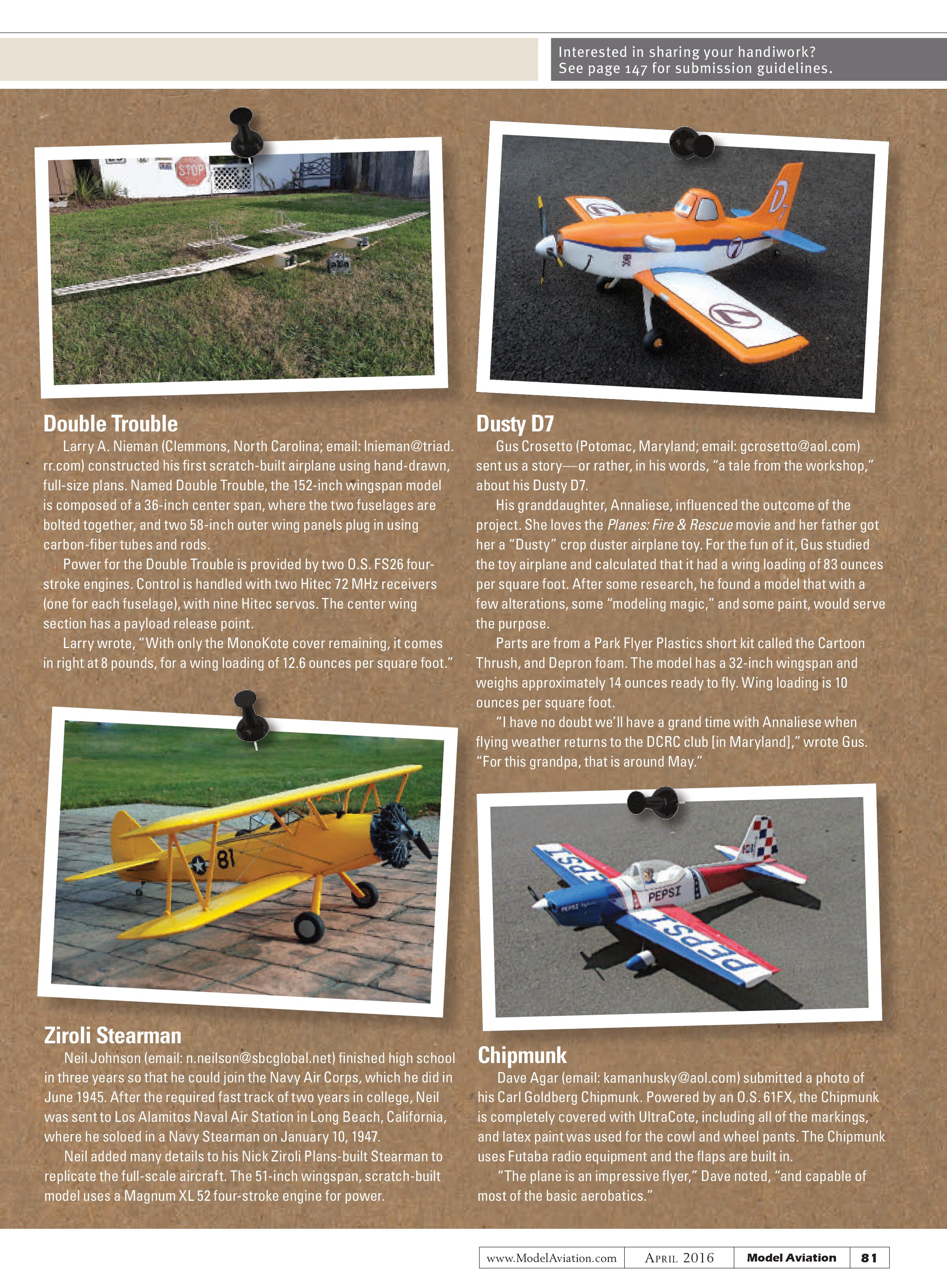
Double Trouble
Larry A. Nieman (Clemmons, North Carolina; email: lnieman@triad.rr.com) constructed his first scratch-built airplane using hand-drawn, full-size plans. Named Double Trouble, the 152-inch wingspan model is composed of a 36-inch center span, where the two fuselages are bolted together, and two 58-inch outer wing panels plug in using carbon-fiber tubes and rods.
Power for the Double Trouble is provided by two O.S. FS26 four-stroke engines. Control is handled with two Hitec 72 MHz receivers (one for each fuselage), with nine Hitec servos. The center wing section has a payload release point.
Larry wrote, “With only the MonoKote cover remaining, it comes in right at 8 pounds, for a wing loading of 12.6 ounces per square foot.”

Ziroli Stearman
Neil Johnson (email: n.neilson@sbcglobal.net) finished high school in three years so that he could join the Navy Air Corps, which he did in June 1945. After the required fast track of two years in college, Neil was sent to Los Alamitos Naval Air Station in Long Beach, California, where he soloed in a Navy Stearman on January 10, 1947.
Neil added many details to his Nick Ziroli Plans-built Stearman to replicate the full-scale aircraft. The 51-inch wingspan, scratch-built model uses a Magnum XL 52 four-stroke engine for power.

Dusty D7
Gus Crosetto (Potomac, Maryland; email: gcrosetto@aol.com) sent us a story—or rather, in his words, “a tale from the workshop,” about his Dusty D7.
His granddaughter, Annaliese, influenced the outcome of the project. She loves the Planes: Fire & Rescue movie and her father got her a “Dusty” crop duster airplane toy. For the fun of it, Gus studied the toy airplane and calculated that it had a wing loading of 83 ounces per square foot. After some research, he found a model that with a few alterations, some “modeling magic,” and some paint, would serve the purpose.
Parts are from a Park Flyer Plastics short kit called the Cartoon Thrush, and Depron foam. The model has a 32-inch wingspan and weighs approximately 14 ounces ready to fly. Wing loading is 10 ounces per square foot.
“I have no doubt we’ll have a grand time with Annaliese when flying weather returns to the DCRC club [in Maryland],” wrote Gus. “For this grandpa, that is around May.”

Chipmunk
Dave Agar (email: kamanhusky@aol.com) submitted a photo of his Carl Goldberg Chipmunk. Powered by an O.S. 61FX, the Chipmunk is completely covered with UltraCote, including all of the markings, and latex paint was used for the cowl and wheel pants. The Chipmunk uses Futaba radio equipment and the flaps are built in.
“The plane is an impressive flyer,” Dave noted, “and capable of most of the basic aerobatics.”