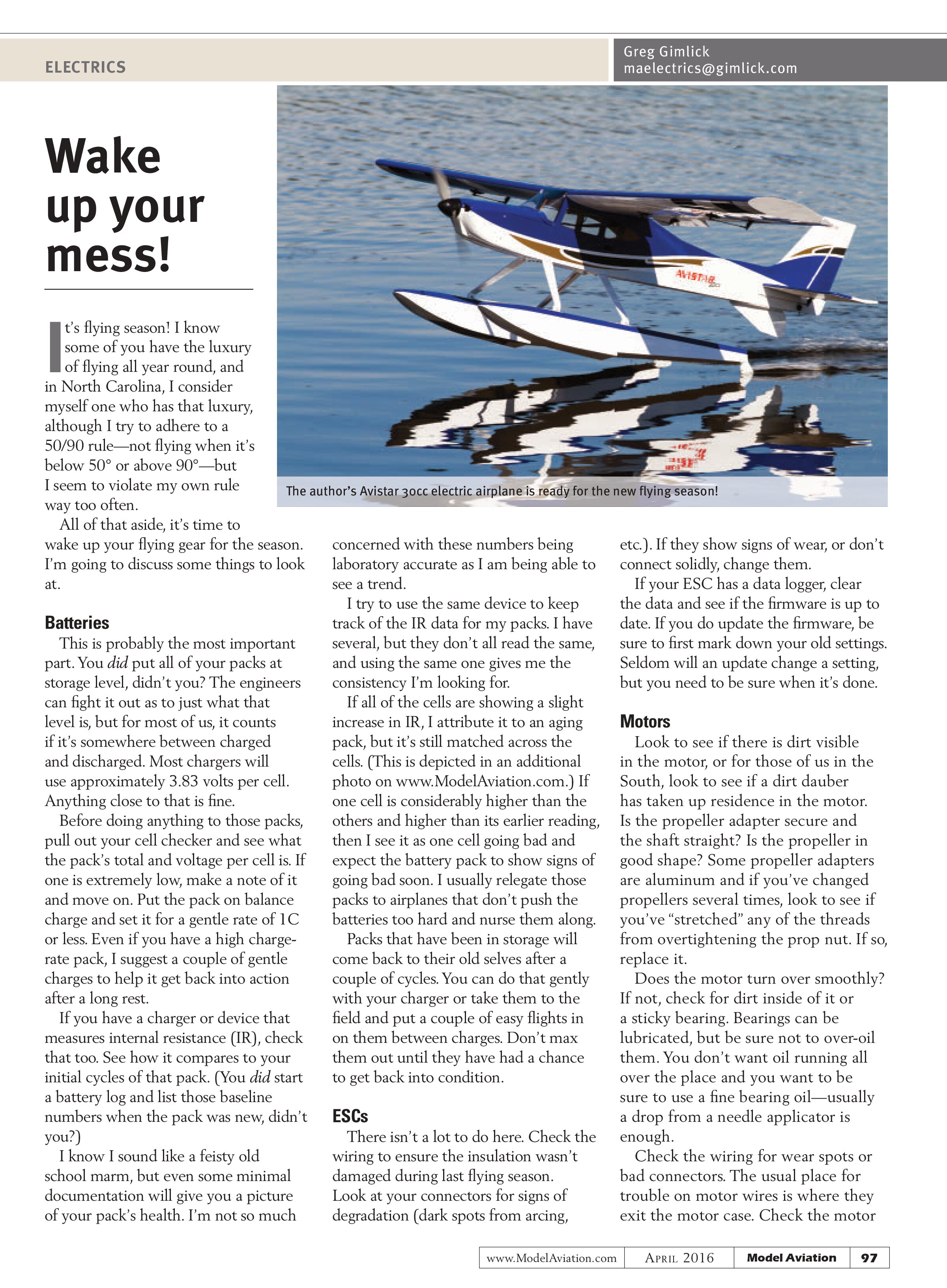
Wake up your mess!
It’s flying season! I know some of you have the luxury of flying all year round, and in North Carolina, I consider myself one who has that luxury, although I try to adhere to a 50/90 rule—not flying when it’s below 50° or above 90°—but I seem to violate my own rule way too often.

All of that aside, it’s time to wake up your flying gear for the season. I’m going to discuss some things to look at.
Batteries
This is probably the most important part. You did put all of your packs at storage level, didn’t you? The engineers can fight it out as to just what that level is, but for most of us, it counts if it’s somewhere between charged and discharged. Most chargers will use approximately 3.83 volts per cell. Anything close to that is fine.
Before doing anything to those packs, pull out your cell checker and see what the pack’s total and voltage per cell is. If one is extremely low, make a note of it and move on. Put the pack on balance charge and set it for a gentle rate of 1C or less. Even if you have a high charge-rate pack, I suggest a couple of gentle charges to help it get back into action after a long rest.
If you have a charger or device that measures internal resistance (IR), check that too. See how it compares to your initial cycles of that pack. (You did start a battery log and list those baseline numbers when the pack was new, didn’t you?)
I know I sound like a feisty old school marm, but even some minimal documentation will give you a picture of your pack’s health. I’m not so much concerned with these numbers being laboratory accurate as I am being able to see a trend.
I try to use the same device to keep track of the IR data for my packs. I have several, but they don’t all read the same, and using the same one gives me the consistency I’m looking for.
If all of the cells are showing a slight increase in IR, I attribute it to an aging pack, but it’s still matched across the cells. (This is depicted in an additional photo on www.ModelAviation.com.) If one cell is considerably higher than the others and higher than its earlier reading, then I see it as one cell going bad and expect the battery pack to show signs of going bad soon. I usually relegate those packs to airplanes that don’t push the batteries too hard and nurse them along.
Packs that have been in storage will come back to their old selves after a couple of cycles. You can do that gently with your charger or take them to the field and put a couple of easy flights in on them between charges. Don’t max them out until they have had a chance to get back into condition.
ESCs
There isn’t a lot to do here. Check the wiring to ensure the insulation wasn’t damaged during last flying season. Look at your connectors for signs of degradation (dark spots from arcing, etc.). If they show signs of wear, or don’t connect solidly, change them.
If your ESC has a data logger, clear the data and see if the firmware is up to date. If you do update the firmware, be sure to first mark down your old settings. Seldom will an update change a setting, but you need to be sure when it’s done.
Motors
Look to see if there is dirt visible in the motor, or for those of us in the South, look to see if a dirt dauber has taken up residence in the motor. Is the propeller adapter secure and the shaft straight? Is the propeller in good shape? Some propeller adapters are aluminum and if you’ve changed propellers several times, look to see if you’ve “stretched” any of the threads from overtightening the prop nut. If so, replace it.
Does the motor turn over smoothly? If not, check for dirt inside of it or a sticky bearing. Bearings can be lubricated, but be sure not to over-oil them. You don’t want oil running all over the place and you want to be sure to use a fine bearing oil—usually a drop from a needle applicator is enough.
Check the wiring for wear spots or bad connectors. The usual place for trouble on motor wires is where they exit the motor case. Check the motor
Make your first flights of the season gentle ones, and do a thorough postflight inspection of everything. Good preflight and postflight inspections help ensure a happy and safe flying season.
Springtime in Toledo!
If it’s spring, and I’ve got a big grin on my face, you know that something is about to happen: the Weak Signals Toledo Show: R/C Model Expo.
This year, the Toledo Show is April 1-3 at the Seagate Convention Centre in Toledo, Ohio, so punch that into your GPS and make your plans. Check the event website, listed in “Sources,” for more information.
The event is in its 62nd year and no two years are the same. Nearly every vendor or manufacturer you see mentioned in my column throughout the year is represented. You can check out the latest and greatest new items and talk with the people who design, manufacture, and sell them.
It’s like a great homecoming! Whether you’re new to electrics or an old hand at them, there is always something to be learned by talking to the people on the show floor or attending one of the many seminars. If you’re looking for deals, they’re available throughout the building from the main floor, to the swap shop, to the annual auction.
Wrapping It Up
There you have it—a leap into spring and a new flying season. I hope to see you in Toledo. Stop by the AMA and Model Aviation booths and say hello.
Be sure to check out all of the electric entries on the competition tables. You might even run into and talk to some great modelers such as Keith Shaw, Laddie Mikulasko, or Dave Platt.
SOURCES:
The Toledo Show: R/C Model Expo
www.toledoshow.com