Government work continues
From the Copilot’s Seat
by Gary Fitch, Executive Vice President

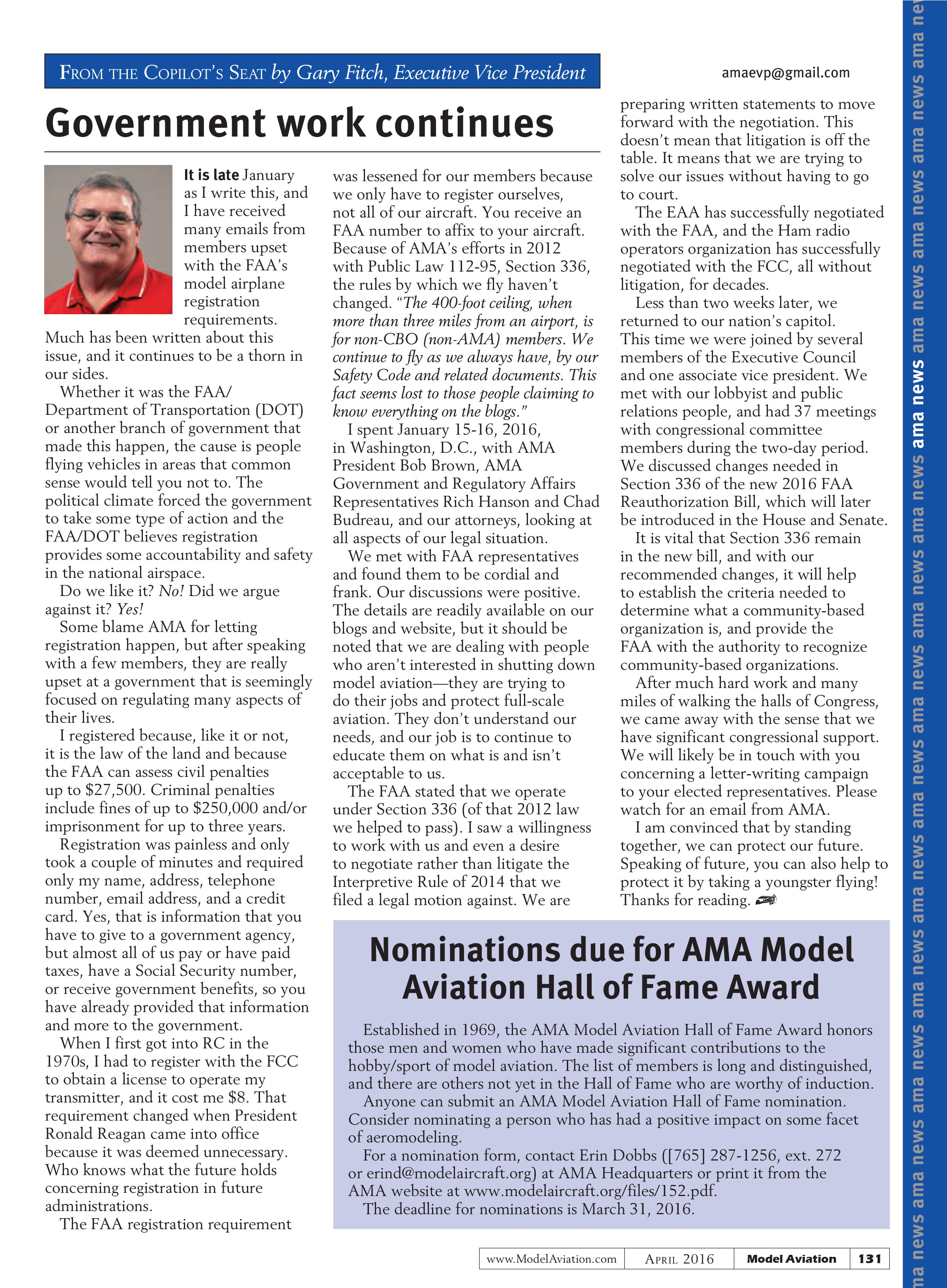
It is late January as I write this, and I have received many emails from members upset with the FAA’s model airplane registration requirements.
Much has been written about this issue, and it continues to be a thorn in our sides.
Whether it was the FAA/Department of Transportation (DOT) or another branch of government that made this happen, the cause is people flying vehicles in areas that common sense would tell you not to. The political climate forced the government to take some type of action and the FAA/DOT believes registration provides some accountability and safety in the national airspace.
Do we like it? No! Did we argue against it? Yes!
Some blame AMA for letting registration happen, but after speaking with a few members, they are really upset at a government that is seemingly focused on regulating many aspects of their lives.
I registered because, like it or not, it is the law of the land and because the FAA can assess civil penalties up to $27,500. Criminal penalties include fines of up to $250,000 and/or imprisonment for up to three years.
Registration was painless and only took a couple of minutes and required only my name, address, telephone number, email address, and a credit card. Yes, that is information that you have to give to a government agency, but almost all of us pay or have paid taxes, have a Social Security number, or receive government benefits, so you have already provided that information and more to the government.
When I first got into RC in the 1970s, I had to register with the FCC to obtain a license to operate my transmitter, and it cost me $8. That requirement changed when President Ronald Reagan came into office because it was deemed unnecessary. Who knows what the future holds concerning registration in future administrations.
The FAA registration requirement was lessened for our members because we only have to register ourselves, not all of our aircraft. You receive an FAA number to affix to your aircraft. Because of AMA’s efforts in 2012 with Public Law 112-95, Section 336, the rules by which we fly haven’t changed. “The 400-foot ceiling, when more than three miles from an airport, is for non-CBO (non-AMA) members. We continue to fly as we always have, by our Safety Code and related documents. This fact seems lost to those people claiming to know everything on the blogs.”
I spent January 15-16, 2016, in Washington, D.C., with AMA President Bob Brown, AMA Government and Regulatory Affairs Representatives Rich Hanson and Chad Budreau, and our attorneys, looking at all aspects of our legal situation.
We met with FAA representatives and found them to be cordial and frank. Our discussions were positive. The details are readily available on our blogs and website, but it should be noted that we are dealing with people who aren’t interested in shutting down model aviation—they are trying to do their jobs and protect full-scale aviation. They don’t understand our needs, and our job is to continue to educate them on what is and isn’t acceptable to us.
The FAA stated that we operate under Section 336 (of that 2012 law we helped to pass). I saw a willingness to work with us and even a desire to negotiate rather than litigate the Interpretive Rule of 2014 that we filed a legal motion against. We are preparing written statements to move forward with the negotiation. This doesn’t mean that litigation is off the table. It means that we are trying to solve our issues without having to go to court.
The EAA has successfully negotiated with the FAA, and the Ham radio operators organization has successfully negotiated with the FCC, all without litigation, for decades.
Less than two weeks later, we returned to our nation’s capitol. This time we were joined by several members of the Executive Council and one associate vice president. We met with our lobbyist and public relations people, and had 37 meetings with congressional committee members during the two-day period. We discussed changes needed in Section 336 of the new 2016 FAA Reauthorization Bill, which will later be introduced in the House and Senate.
It is vital that Section 336 remain in the new bill, and with our recommended changes, it will help to establish the criteria needed to determine what a community-based organization is, and provide the FAA with the authority to recognize community-based organizations.
After much hard work and many miles of walking the halls of Congress, we came away with the sense that we have significant congressional support. We will likely be in touch with you concerning a letter-writing campaign to your elected representatives. Please watch for an email from AMA.
I am convinced that by standing together, we can protect our future. Speaking of future, you can also help to protect it by taking a youngster flying! Thanks for reading.
Nominations due for AMA Model Aviation Hall of Fame Award
Established in 1969, the AMA Model Aviation Hall of Fame Award honors those men and women who have made significant contributions to the hobby/sport of model aviation. The list of members is long and distinguished, and there are others not yet in the Hall of Fame who are worthy of induction.
Anyone can submit an AMA Model Aviation Hall of Fame nomination. Consider nominating a person who has had a positive impact on some facet of aeromodeling.
For a nomination form, contact Erin Dobbs ([765] 287-1256, ext. 272 or erind@modelaircraft.org) at AMA Headquarters or print it from the AMA website at www.modelaircraft.org/files/152.pdf.
The deadline for nominations is March 31, 2016.