Rules change proposals
by Dick Perry
tailhooker@comcast.net
Just a quick reminder that rules change proposals will be voted on in April. Because of the three-month lead time for my column, it is impossible to list proposals or discuss them here. Although there are still two months before the deadline for submitting proposals as I write this, you will read it after that deadline.
Presently, there are no Control Line (CL) Navy Carrier proposals for consideration. To find out what is being considered, go to the AMA website at the beginning of April. Select “Competition & Events” then “Rule Proposals” to see what proposals have been submitted, and to monitor the status of proposals as they pass through the process.
You can comment to your CL Navy Carrier Contest Board representative during the first few weeks of April. The voting deadline is May 1.
After a proposal passes the initial ballot on May 1, cross proposals can present alternative wording or methods for accomplishing the same intent. Cross proposals can be submitted from May 31 through July 15.
Surprise!
There is an adage in full-scale aviation that states that a good pilot will often be disappointed by his aircraft, but he should never be surprised by it. Safe operation of any system depends on anticipating the possible ways that the system can surprise the operator, and taking action to mitigate damage or injury should a surprise occur.
Surprises are often failures of some kind. Something that doesn’t work when you turn it on is not often a critical safety event. Something such as a broken line or handle during a model’s flight, however, is a failure with serious safety ramifications.
Surprises can also involve unintended operations—things that either occur when we are not expecting them, or things that operate when we expect them to, but are different from what we expect. I want to address one of the potentially more serious occurrences of this type of surprise.
I have heard of engines starting when power is applied to the glow plug, but I had not experienced such an event on my own models until recently. At a contest in 2015, Burt Brokaw was starting the engine of my Class II MO-1, and Eric Conley was holding the


Nothing adverse happened. Eric was surprised, but he was already holding the model, and he kept it from moving. If Eric had not been holding the model when Burt was preparing to start the engine, there could have been a serious accident. Had some part of Burt’s body been near the propeller arc when he connected the glow plug, he could easily have been injured, even with the model restrained.
The likelihood of an unintentional glow engine start is remote, but not impossible. The safety procedures are readily apparent—restrain the model before you begin the starting sequence, and stay clear of the propeller when you connect the glow plug leads.
There are corollaries for the electric events. Whenever the primary battery is connected to the ESC, there is potential for the motor to run.
Batteries are often connected to the motor circuit in the pit area, where there is a high probability that people are in close proximity and are unaware of what is happening around them because they are paying attention to other models or activities.
The pilot is usually not holding the handle, and the model is seldom restrained, with the modeler having one hand on the battery side of the plug and the other hand on the airplane wiring side of the plug.
The safety solution to this potential

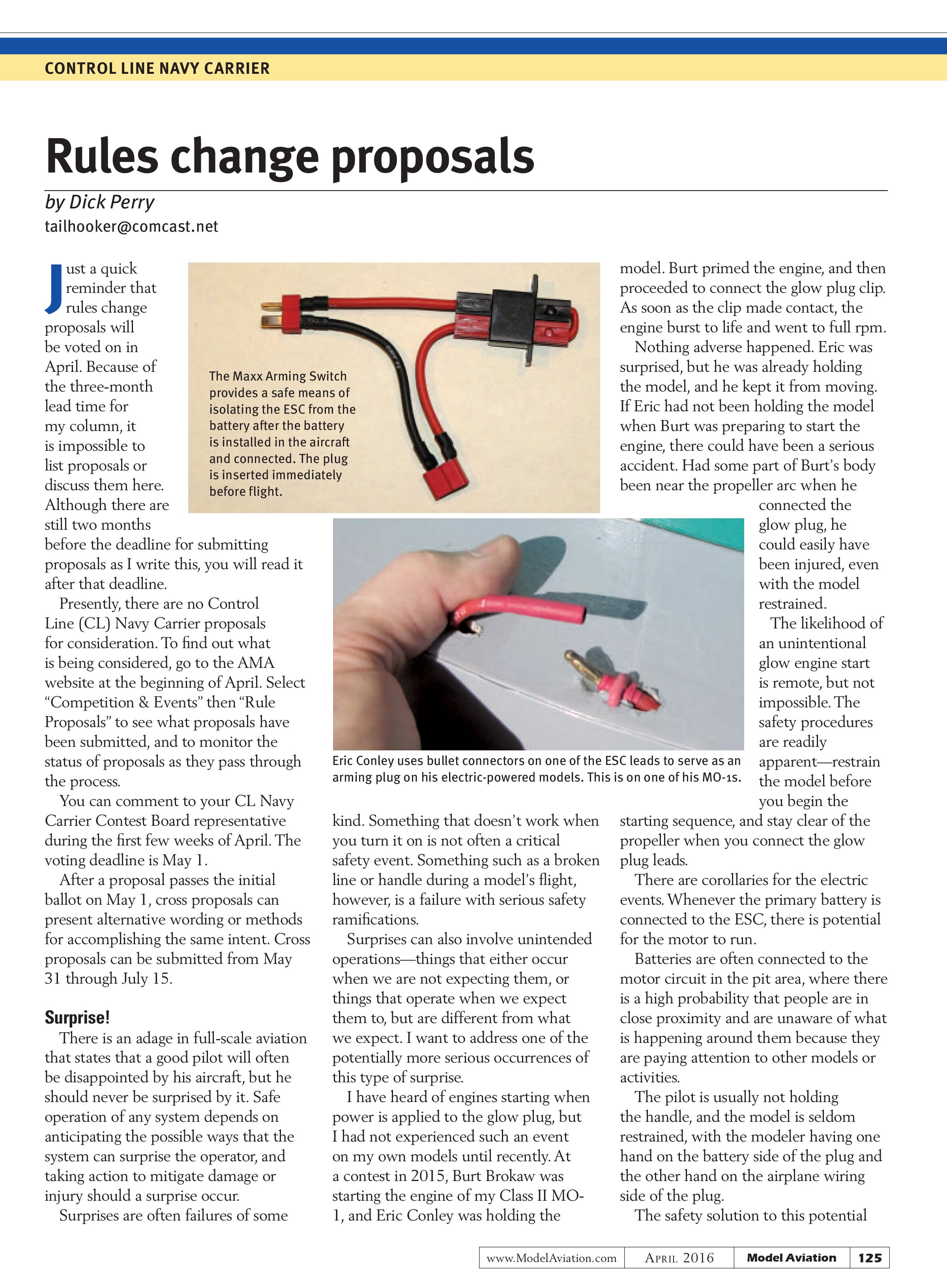
problem is common, but I’ve still seen models that do not incorporate it. Include a high-current arming device in one of the power leads (the positive side is the usually accepted practice). The one shown in the picture is from Maxx Products. An alternative is the ArmSafe system from Schumacher Products that advertises as SharpRC.com in Model Aviation.
The Maxx unit is designed as a plug-and-play system with a plug/socket on both sides of the arming plug so that it can be mounted independent of the battery and ESC. It comes in 14 AWG and 12 AWG wire options. The ArmSafe units come as components and have an arming plug, mount, heat-shrink tubing, and wiring (up to 10 AWG), and will need additional plugs to assemble an independent harness.
In general terms, 14 AWG wire should be able to handle 50 amps, 12 AWG should handle 80 amps, and 10 AWG should handle 100 amps. Separate components are available for both Maxx and ArmSafe units.
When using either system, it is almost essential to tether the plug to the model so as not to lose the plug when it is disconnected (its usual state). ArmSafe offers optional tethers.
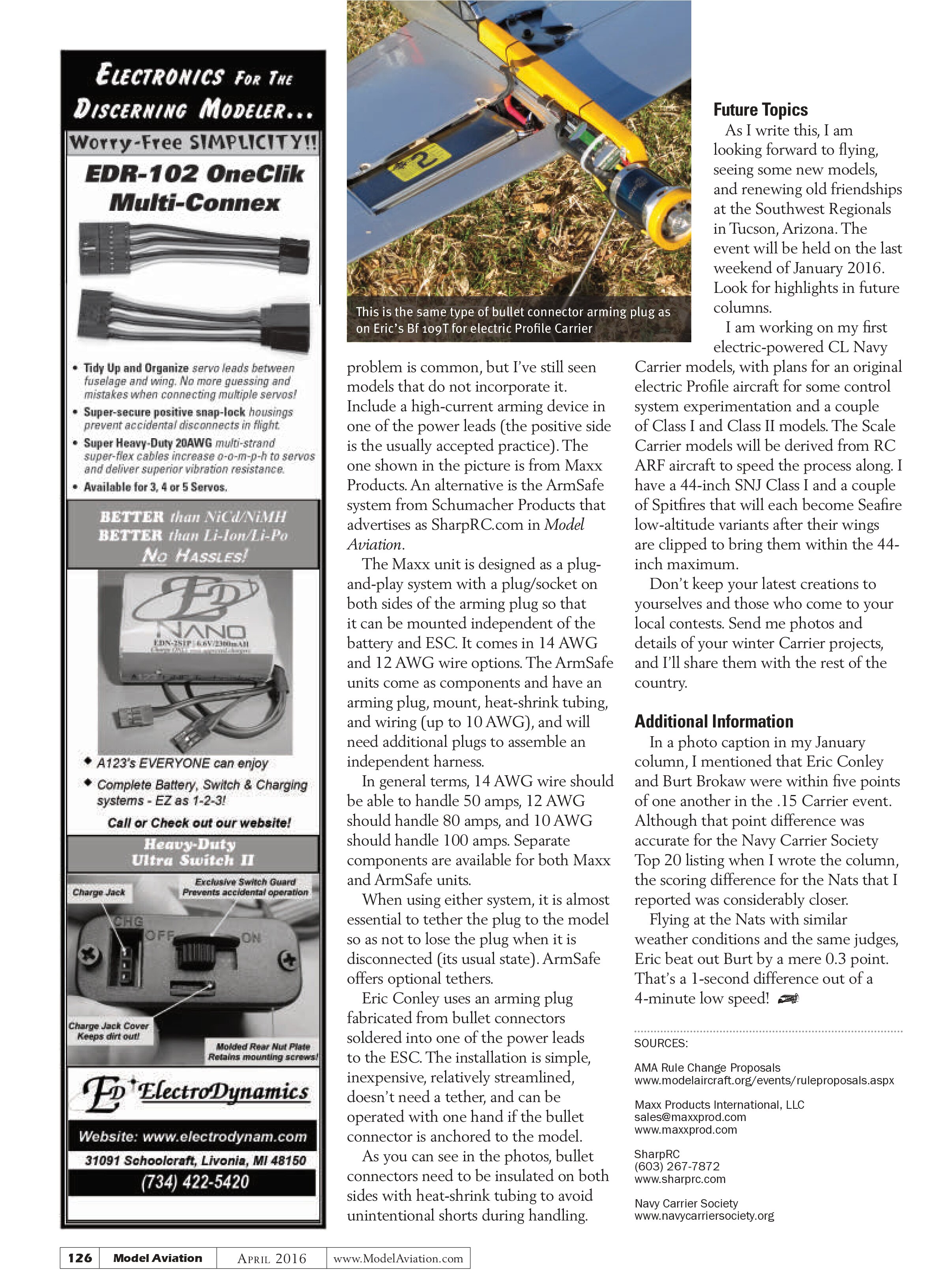
Eric Conley uses an arming plug fabricated from bullet connectors soldered into one of the power leads to the ESC. The installation is simple, inexpensive, relatively streamlined, doesn’t need a tether, and can be operated with one hand if the bullet connector is anchored to the model.
As you can see in the photos, bullet connectors need to be insulated on both sides with heat-shrink tubing to avoid unintentional shorts during handling.
Future Topics
As I write this, I am looking forward to flying, seeing some new models, and renewing old friendships at the Southwest Regionals in Tucson, Arizona. The event will be held on the last weekend of January 2016. Look for highlights in future columns.
I am working on my first electric-powered CL Navy Carrier models, with plans for an original electric Profile aircraft for some control system experimentation and a couple of Class I and Class II models. The Scale Carrier models will be derived from RC ARF aircraft to speed the process along. I have a 44-inch SNJ Class I and a couple of Spitfires that will each become Seafire low-altitude variants after their wings are clipped to bring them within the 44-inch maximum.
Don’t keep your latest creations to yourselves and those who come to your local contests. Send me photos and details of your winter Carrier projects, and I’ll share them with the rest of the country.
Additional Information
In a photo caption in my January column, I mentioned that Eric Conley and Burt Brokaw were within five points of one another in the .15 Carrier event. Although that point difference was accurate for the Navy Carrier Society Top 20 listing when I wrote the column, the scoring difference for the Nats that I reported was considerably closer.
Flying at the Nats with similar weather conditions and the same judges, Eric beat out Burt by a mere 0.3 point. That’s a 1-second difference out of a 4-minute low speed!
SOURCES:
AMA Rule Change Proposals
www.modelaircraft.org/events/ruleproposals.aspx
Maxx Products International, LLC
sales@maxxprod.com
www.maxxprod.com
SharpRC
(603) 267-7872
www.sharprc.com
Navy Carrier Society
www.navycarriersociety.org