In the Air
Membership news and updates
from AMA Headquarters
Carl and Beth Goldberg Vital People Award
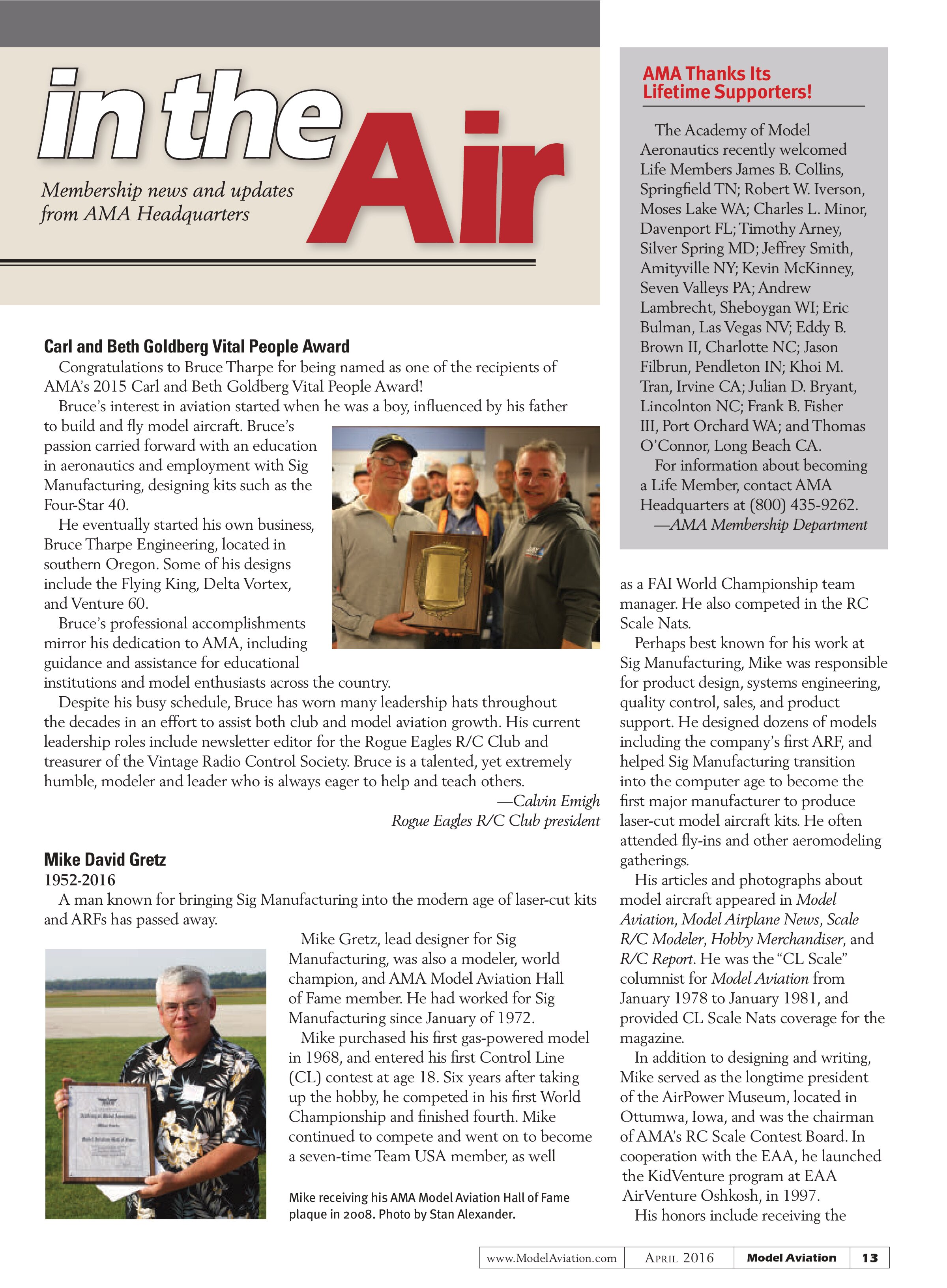
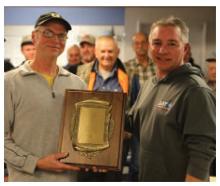
Congratulations to Bruce Tharpe for being named as one of the recipients of AMA’s 2015 Carl and Beth Goldberg Vital People Award!
Bruce’s interest in aviation started when he was a boy, influenced by his father to build and fly model aircraft. Bruce’s passion carried forward with an education in aeronautics and employment with Sig Manufacturing, designing kits such as the Four-Star 40.
He eventually started his own business, Bruce Tharpe Engineering, located in southern Oregon. Some of his designs include the Flying King, Delta Vortex, and Venture 60.
Bruce’s professional accomplishments mirror his dedication to AMA, including guidance and assistance for educational institutions and model enthusiasts across the country.

Despite his busy schedule, Bruce has worn many leadership hats throughout the decades in an effort to assist both club and model aviation growth. His current leadership roles include newsletter editor for the Rogue Eagles R/C Club and treasurer of the Vintage Radio Control Society. Bruce is a talented, yet extremely humble, modeler and leader who is always eager to help and teach others.
—Calvin Emigh
Rogue Eagles R/C Club president
Mike David Gretz
1952-2016
A man known for bringing Sig Manufacturing into the modern age of laser-cut kits and ARFs has passed away.

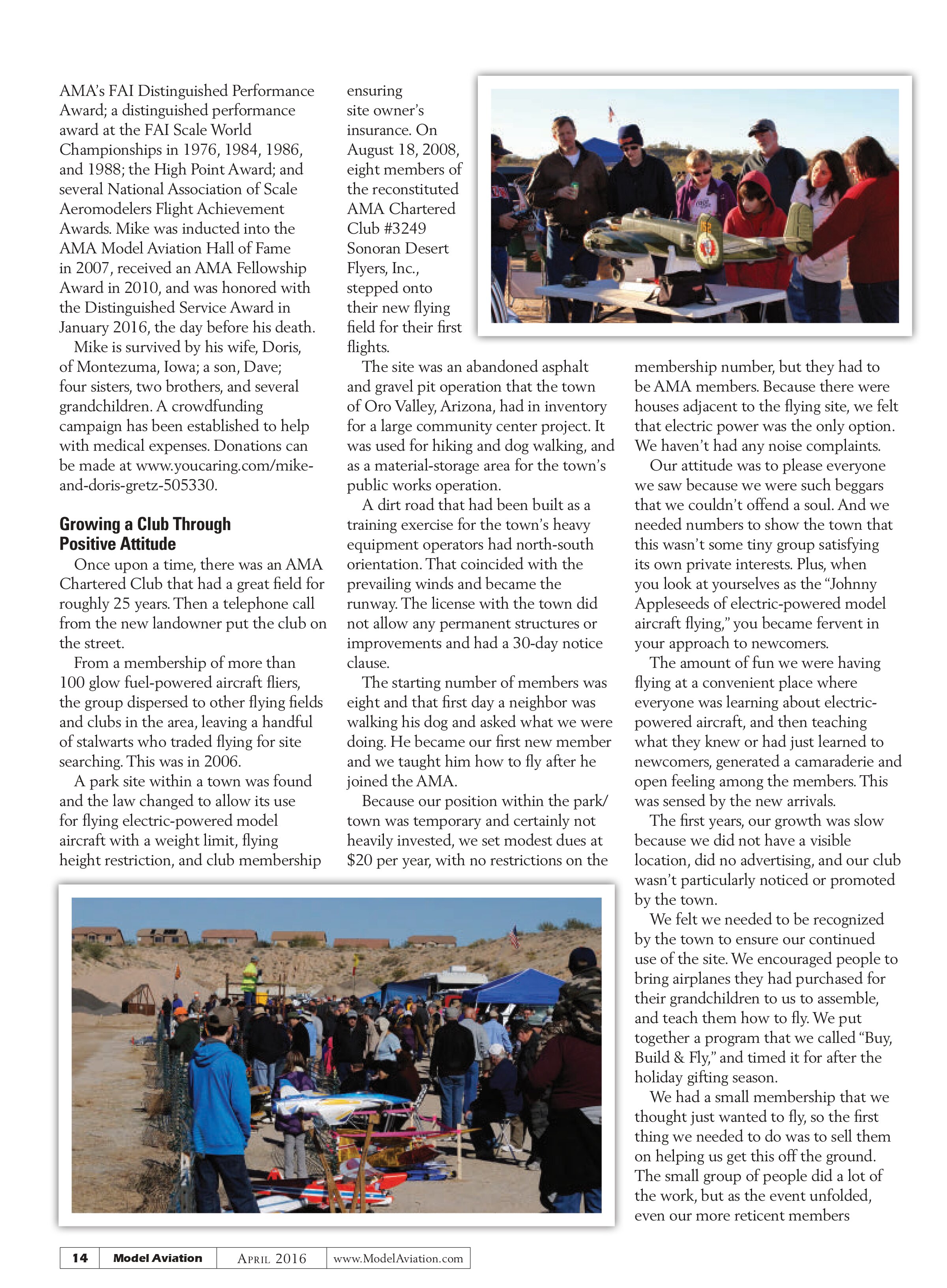
Mike Gretz, lead designer for Sig Manufacturing, was also a modeler, world champion, and AMA Model Aviation Hall of Fame member. He had worked for Sig Manufacturing since January of 1972.
Mike purchased his first gas-powered model in 1968, and entered his first Control Line (CL) contest at age 18. Six years after taking up the hobby, he competed in his first World Championship and finished fourth. Mike continued to compete and went on to become a seven-time Team USA member, as well as a FAI World Championship team manager. He also competed in the RC Scale Nats.
Perhaps best known for his work at Sig Manufacturing, Mike was responsible for product design, systems engineering, quality control, sales, and product support. He designed dozens of models including the company’s first ARF, and helped Sig Manufacturing transition into the computer age to become the first major manufacturer to produce laser-cut model aircraft kits. He often attended fly-ins and other aeromodeling gatherings.
His articles and photographs about model aircraft appeared in Model Aviation, Model Airplane News, Scale R/C Modeler, Hobby Merchandiser, and R/C Report. He was the “CL Scale” columnist for Model Aviation from January 1978 to January 1981, and provided CL Scale Nats coverage for the magazine.
In addition to designing and writing, Mike served as the longtime president of the AirPower Museum, located in Ottumwa, Iowa, and was the chairman of AMA’s RC Scale Contest Board. In cooperation with the EAA, he launched the KidVenture program at EAA AirVenture Oshkosh, in 1997.
His honors include receiving the
AMA Thanks Its Lifetime Supporters!
The Academy of Model Aeronautics recently welcomed Life Members James B. Collins, Springfield TN; Robert W. Iverson, Moses Lake WA; Charles L. Minor, Davenport FL; Timothy Arney, Silver Spring MD; Jeffrey Smith, Amityville NY; Kevin McKinney, Seven Valleys PA; Andrew Lambrecht, Sheboygan WI; Eric Bulman, Las Vegas NV; Eddy B. Brown II, Charlotte NC; Jason Filbrun, Pendleton IN; Khoi M. Tran, Irvine CA; Julian D. Bryant, Lincolnton NC; Frank B. Fisher III, Port Orchard WA; and Thomas O’Connor, Long Beach CA.
For information about becoming a Life Member, contact AMA Headquarters at (800) 435-9262.
—AMA Membership Department
Growing a Club Through Positive Attitude
Once upon a time, there was an AMA Chartered Club that had a great field for roughly 25 years. Then a telephone call from the new landowner put the club on the street.
From a membership of more than 100 glow fuel-powered aircraft fliers, the group dispersed to other flying fields and clubs in the area, leaving a handful of stalwarts who traded flying for site searching. This was in 2006.
A park site within a town was found and the law changed to allow its use for flying electric-powered model aircraft with a weight limit, flying height restriction, and club membership
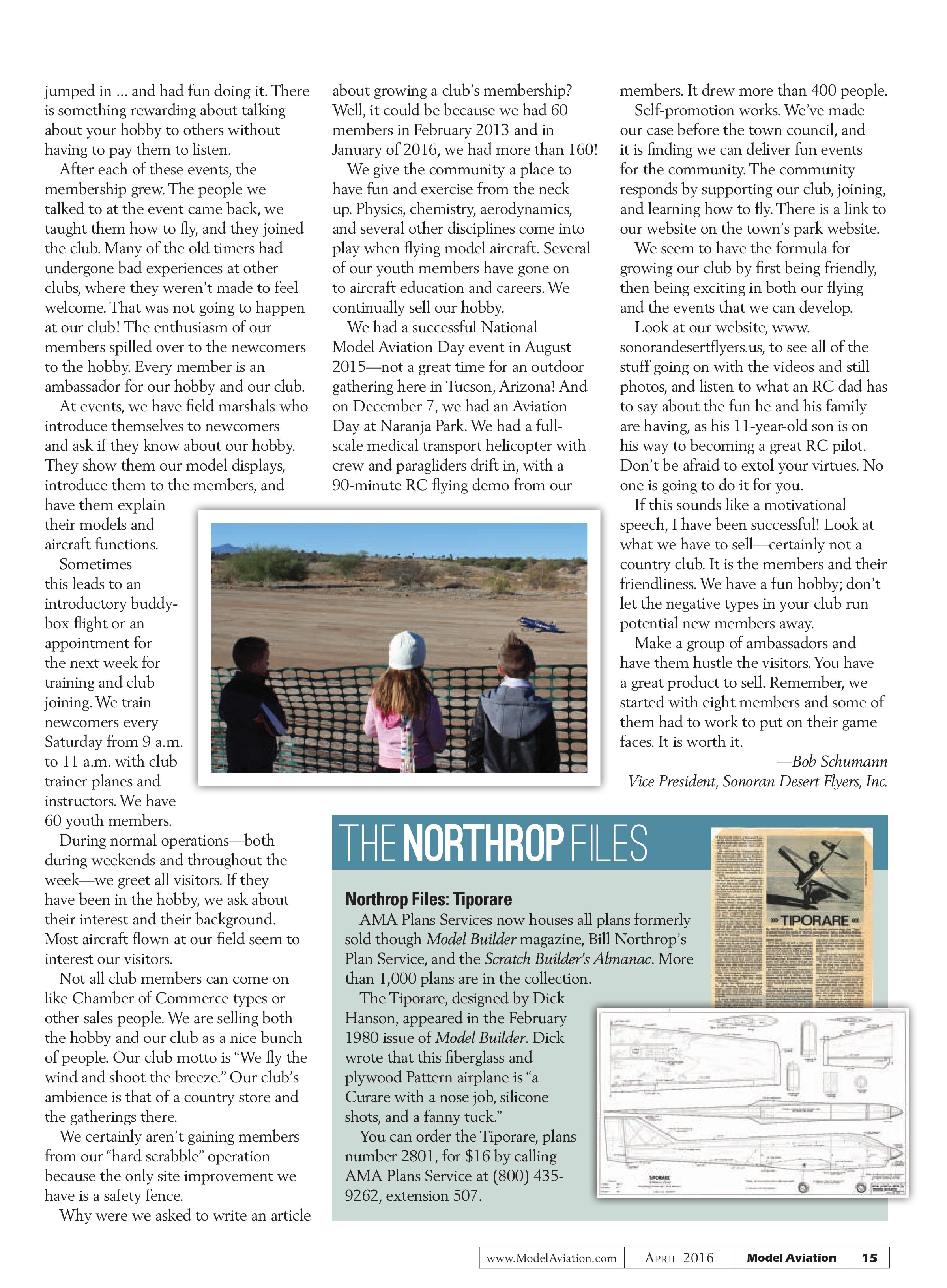
ensuring site owner’s insurance. On August 18, 2008, eight members of the reconstituted AMA Chartered Club #3249 Sonoran Desert Flyers, Inc., stepped onto their new flying field for their first flights.

The site was an abandoned asphalt and gravel pit operation that the town of Oro Valley, Arizona, had in inventory for a large community center project. It was used for hiking and dog walking, and as a material-storage area for the town’s public works operation.
A dirt road that had been built as a training exercise for the town’s heavy equipment operators had north-south orientation. That coincided with the prevailing winds and became the runway. The license with the town did not allow any permanent structures or improvements and had a 30-day notice clause.
The starting number of members was eight and that first day a neighbor was walking his dog and asked what we were doing. He became our first new member and we taught him how to fly after he joined the AMA.
Because our position within the park/town was temporary and certainly not heavily invested, we set modest dues at $20 per year, with no restrictions on the membership number, but they had to be AMA members. Because there were houses adjacent to the flying site, we felt that electric power was the only option. We haven’t had any noise complaints.
Our attitude was to please everyone we saw because we were such beggars that we couldn’t offend a soul. And we needed numbers to show the town that this wasn’t some tiny group satisfying its own private interests. Plus, when you look at yourselves as the “Johnny Appleseeds of electric-powered model aircraft flying,” you became fervent in your approach to newcomers.
The amount of fun we were having flying at a convenient place where everyone was learning about electric-powered aircraft, and then teaching what they knew or had just learned to newcomers, generated a camaraderie and open feeling among the members. This was sensed by the new arrivals.
The first years, our growth was slow because we did not have a visible location, did no advertising, and our club wasn’t particularly noticed or promoted by the town.
We felt we needed to be recognized by the town to ensure our continued use of the site. We encouraged people to bring airplanes they had purchased for their grandchildren to us to assemble, and teach them how to fly. We put together a program that we called “Buy, Build & Fly,” and timed it for after the holiday gifting season.
We had a small membership that we thought just wanted to fly, so the first thing we needed to do was to sell them on helping us get this off the ground. The small group of people did a lot of the work, but as the event unfolded, even our more reticent members jumped in ... and had fun doing it. There is something rewarding about talking about your hobby to others without having to pay them to listen.
After each of these events, the membership grew. The people we talked to at the event came back, we taught them how to fly, and they joined the club. Many of the old timers had undergone bad experiences at other clubs, where they weren’t made to feel welcome. That was not going to happen at our club! The enthusiasm of our members spilled over to the newcomers to the hobby. Every member is an ambassador for our hobby and our club.
At events, we have field marshals who introduce themselves to newcomers and ask if they know about our hobby. They show them our model displays, introduce them to the members, and have them explain their models and aircraft functions.
Sometimes this leads to an introductory buddy-box flight or an appointment for the next week for training and club joining. We train newcomers every Saturday from 9 a.m. to 11 a.m. with club trainer planes and instructors. We have 60 youth members.
During normal operations—both during weekends and throughout the week—we greet all visitors. If they have been in the hobby, we ask about their interest and their background. Most aircraft flown at our field seem to interest our visitors.
Not all club members can come on like Chamber of Commerce types or other sales people. We are selling both the hobby and our club as a nice bunch of people. Our club motto is “We fly the wind and shoot the breeze.” Our club’s ambience is that of a country store and the gatherings there.
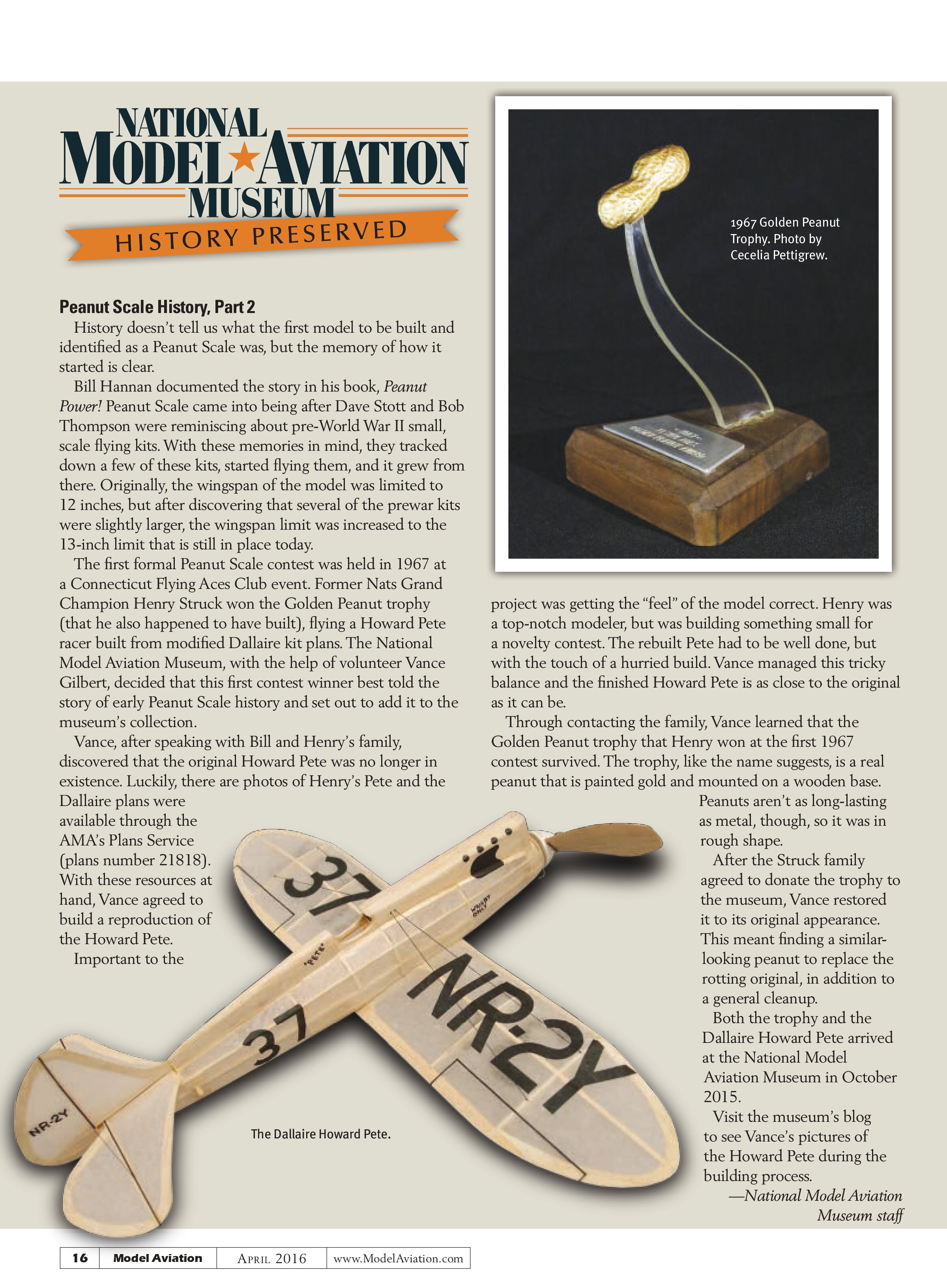
We certainly aren’t gaining members from our “hard scrabble” operation because the only site improvement we have is a safety fence.
Why were we asked to write an article about growing a club’s membership? Well, it could be because we had 60 members in February 2013 and in January of 2016, we had more than 160!
We give the community a place to have fun and exercise from the neck up. Physics, chemistry, aerodynamics, and several other disciplines come into play when flying model aircraft. Several of our youth members have gone on to aircraft education and careers. We continually sell our hobby.
We had a successful National Model Aviation Day event in August 2015—not a great time for an outdoor gathering here in Tucson, Arizona! And on December 7, we had an Aviation Day at Naranja Park. We had a full-scale medical transport helicopter with crew and paragliders drift in, with a 90-minute RC flying demo from our

members. It drew more than 400 people.
Self-promotion works. We’ve made our case before the town council, and it is finding we can deliver fun events for the community. The community responds by supporting our club, joining, and learning how to fly. There is a link to our website on the town’s park website.
We seem to have the formula for growing our club by first being friendly, then being exciting in both our flying and the events that we can develop.
Look at our website, www.sonorandesertflyers.us, to see all of the stuff going on with the videos and still photos, and listen to what an RC dad has to say about the fun he and his family are having, as his 11-year-old son is on his way to becoming a great RC pilot. Don’t be afraid to extol your virtues. No one is going to do it for you.
If this sounds like a motivational speech, I have been successful! Look at what we have to sell—certainly not a country club. It is the members and their friendliness. We have a fun hobby; don’t let the negative types in your club run potential new members away.
Make a group of ambassadors and have them hustle the visitors. You have a great product to sell. Remember, we started with eight members and some of them had to work to put on their game faces. It is worth it.
—Bob Schumann
Vice President, Sonoran Desert Flyers, Inc.
Northrop Files: Tiporare
AMA Plans Services now houses all plans formerly sold though Model Builder magazine, Bill Northrop’s Plan Service, and the Scratch Builder’s Almanac. More than 1,000 plans are in the collection.
The Tiporare, designed by Dick Hanson, appeared in the February 1980 issue of Model Builder. Dick wrote that this fiberglass and plywood Pattern airplane is “a Curare with a nose job, silicone shots, and a fanny tuck.”
You can order the Tiporare, plans number 2801, for $16 by calling AMA Plans Service at (800) 435-9262, extension 507.


Peanut Scale History, Part 2
History doesn’t tell us what the first model to be built and identified as a Peanut Scale was, but the memory of how it started is clear.
Bill Hannan documented the story in his book, Peanut Power! Peanut Scale came into being after Dave Stott and Bob Thompson were reminiscing about pre-World War II small, scale flying kits. With these memories in mind, they tracked down a few of these kits, started flying them, and it grew from there. Originally, the wingspan of the model was limited to 12 inches, but after discovering that several of the prewar kits were slightly larger, the wingspan limit was increased to the 13-inch limit that is still in place today.
The first formal Peanut Scale contest was held in 1967 at a Connecticut Flying Aces Club event. Former Nats Grand Champion Henry Struck won the Golden Peanut trophy (that he also happened to have built), flying a Howard Pete racer built from modified Dallaire kit plans. The National Model Aviation Museum, with the help of volunteer Vance Gilbert, decided that this first contest winner best told the story of early Peanut Scale history and set out to add it to the museum’s collection.
Vance, after speaking with Bill and Henry’s family, discovered that the original Howard Pete was no longer in existence. Luckily, there are photos of Henry’s Pete and the Dallaire plans were available through the AMA’s Plans Service (plans number 21818). With these resources at hand, Vance agreed to build a reproduction of the Howard Pete.
Important to the

project was getting the “feel” of the model correct. Henry was a top-notch modeler, but was building something small for a novelty contest. The rebuilt Pete had to be well done, but with the touch of a hurried build. Vance managed this tricky balance and the finished Howard Pete is as close to the original as it can be.
Through contacting the family, Vance learned that the Golden Peanut trophy that Henry won at the first 1967 contest survived. The trophy, like the name suggests, is a real peanut that is painted gold and mounted on a wooden base.
Peanuts aren’t as long-lasting as metal, though, so it was in rough shape.
After the Struck family agreed to donate the trophy to the museum, Vance restored it to its original appearance. This meant finding a similar-looking peanut to replace the rotting original, in addition to a general cleanup.
Both the trophy and the Dallaire Howard Pete arrived at the National Model Aviation Museum in October 2015.
Visit the museum’s blog to see Vance’s pictures of the Howard Pete during the building process.
—National Model Aviation Museum staff