Lasers vs. razors
Dave Gee
safetycolumn@cs.com

Laser beams have gone from science fiction to being a part of our everyday life. We use them in everything from barcode readers to DVD players. Kit manufacturers have been using laser cutters for years. I love model kits with precise, laser-cut parts that I don’t have to hack out by hand with a razor blade.
These cutting machines have become small and inexpensive enough for cottage-industry businesses and individual modelers to own. What a gas—CO2 gas, as a matter of fact. That’s the type of laser found in small laser-cutting machines.
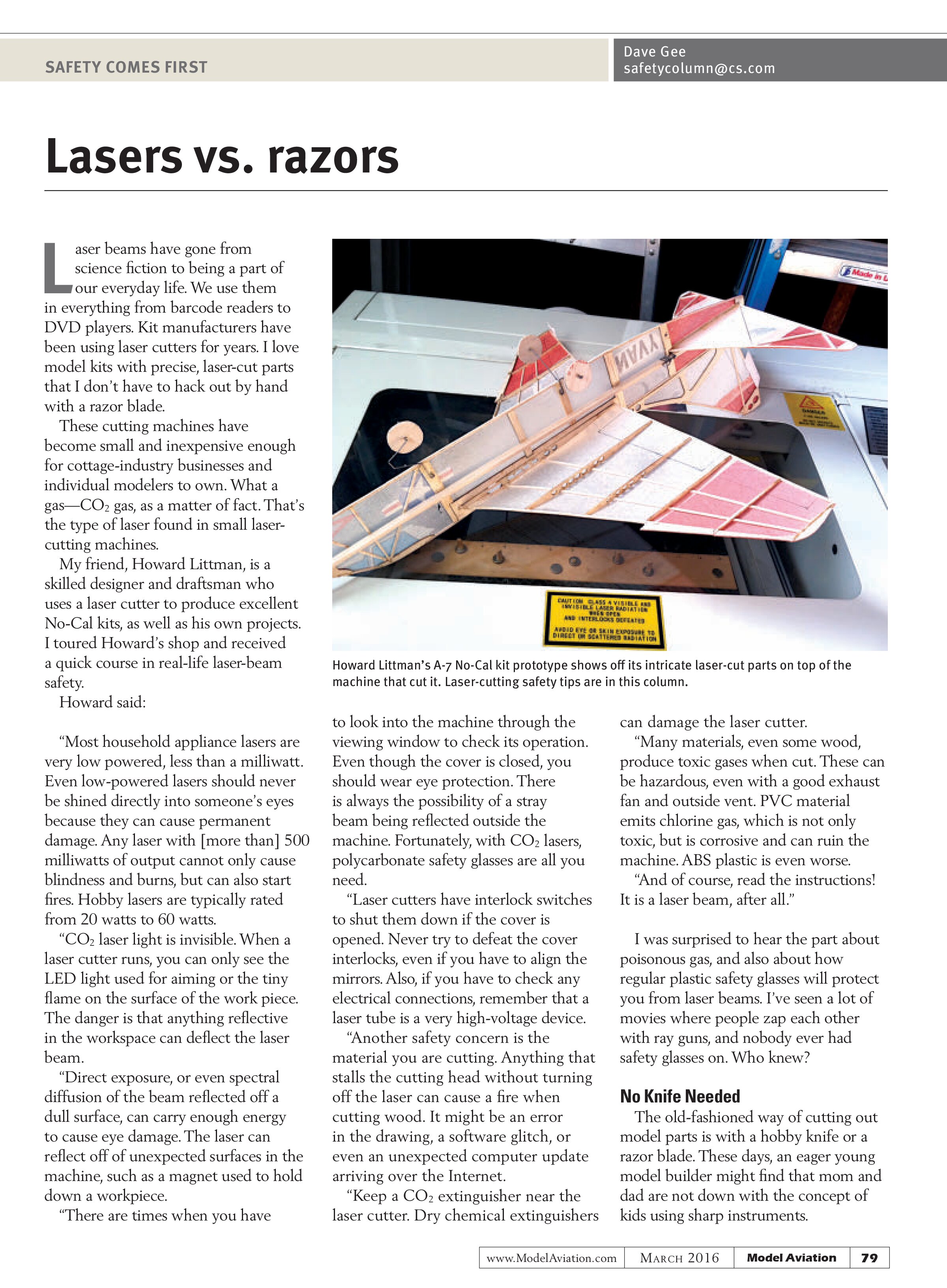
My friend, Howard Littman, is a skilled designer and draftsman who uses a laser cutter to produce excellent No-Cal kits, as well as his own projects. I toured Howard’s shop and received a quick course in real-life laser-beam safety.
Howard said:
“Most household appliance lasers are very low powered, less than a milliwatt. Even low-powered lasers should never be shined directly into someone’s eyes because they can cause permanent damage. Any laser with [more than] 500 milliwatts of output cannot only cause blindness and burns, but can also start fires. Hobby lasers are typically rated from 20 watts to 60 watts.
“CO2 laser light is invisible. When a laser cutter runs, you can only see the LED light used for aiming or the tiny flame on the surface of the work piece. The danger is that anything reflective in the workspace can deflect the laser beam.
“Direct exposure, or even spectral diffusion of the beam reflected off a dull surface, can carry enough energy to cause eye damage. The laser can reflect off of unexpected surfaces in the machine, such as a magnet used to hold down a workpiece.
“There are times when you have to look into the machine through the viewing window to check its operation. Even though the cover is closed, you should wear eye protection. There is always the possibility of a stray beam being reflected outside the machine. Fortunately, with CO2 lasers, polycarbonate safety glasses are all you need.
“Laser cutters have interlock switches to shut them down if the cover is opened. Never try to defeat the cover interlocks, even if you have to align the mirrors. Also, if you have to check any electrical connections, remember that a laser tube is a very high-voltage device.
“Another safety concern is the material you are cutting. Anything that stalls the cutting head without turning off the laser can cause a fire when cutting wood. It might be an error in the drawing, a software glitch, or even an unexpected computer update arriving over the Internet.
“Keep a CO2 extinguisher near the laser cutter. Dry chemical extinguishers can damage the laser cutter.
“Many materials, even some wood, produce toxic gases when cut. These can be hazardous, even with a good exhaust fan and outside vent. PVC material emits chlorine gas, which is not only toxic, but is corrosive and can ruin the machine. ABS plastic is even worse.
“And of course, read the instructions! It is a laser beam, after all.”
I was surprised to hear the part about poisonous gas, and also about how regular plastic safety glasses will protect you from laser beams. I’ve seen a lot of movies where people zap each other with ray guns, and nobody ever had safety glasses on. Who knew?
No Knife Needed
The old-fashioned way of cutting out model parts is with a hobby knife or a razor blade. These days, an eager young model builder might find that mom and dad are not down with the concept of kids using sharp instruments.
with information that new pilots might need, and then went to local toy and department stores and gave a stack to the managers. The cards have website addresses for AMA, the Know Before You Fly campaign for multirotor pilots, and of course, a local club. If those store managers are smart, they will realize that they have a terrific sales booster in their hands.

With the information on that little card, a new pilot might enjoy the aircraft more and be a happier customer. Earle’s practice could bring fine results!
Lefties and Righties
Kirt Blattenberger emailed me about an unusual close call he had. It had to do with the left-hand propellers that are sometimes used on Control Line (CL) models to make the torque rotate the outboard wing away from the lines, instead of toward the pilot.
Kirt wrote:
“A potentially disastrous event occurred despite my precautions. My failure to fully check the operation of a new power system on an electric-powered CL Stunt [Aerobatics] model showed that Mr. Murphy’s law is always waiting to strike.
“I always remove the propeller prior to programming the ESC module and changing the motor run timer and rpm setting. When programming was complete, I installed a new propeller to try out a different pitch and diameter combo. Unknown to me, the propeller was one with a left-hand pitch, versus the right-hand type that had been on it.
“My wife, Melanie, and I set up the model, rolled out the control lines, [and] did the appropriate pull test. I confidently connected the LiPo battery, switched on the start-up delay, and walked out to the handle while my better half held the model. The motor started after the 20-second delay and promptly pushed itself backward out of her hands and began running in circles through the grass.
“Fortunately, I was able to run over and step on the lines and it stood still in the long grass while I unplugged the battery. The adrenaline was really flowing after that incident, especially considering that the propeller blade could easily have caused harm to Melanie.
“All ended well, with only a bent tail wheel and a bit of embarrassment.”
I feel a special bond with Kirt because I have screwed up with left-hand propellers, too. It can be pretty spectacular, and your friends will mock you afterward.
Now I keep the lefties in a separate drawer, rubber-banded together so they don’t get mixed up with the righties. One session of mockery is enough for me.
SOURCES:
Howard Littman Model Aircraft
howard@hjlmodels.com
www.hjlmodels.com
Guillow’s
(781) 245-5255
www.guillow.com
Volaré Products
(269) 339-9795
www.volareproducts.com/buy
Know Before You Fly
www.knowbeforeyoufly.org