Soaring from a woman’s perspective
by Gordon Buckland
gordon@gatorf3b.com
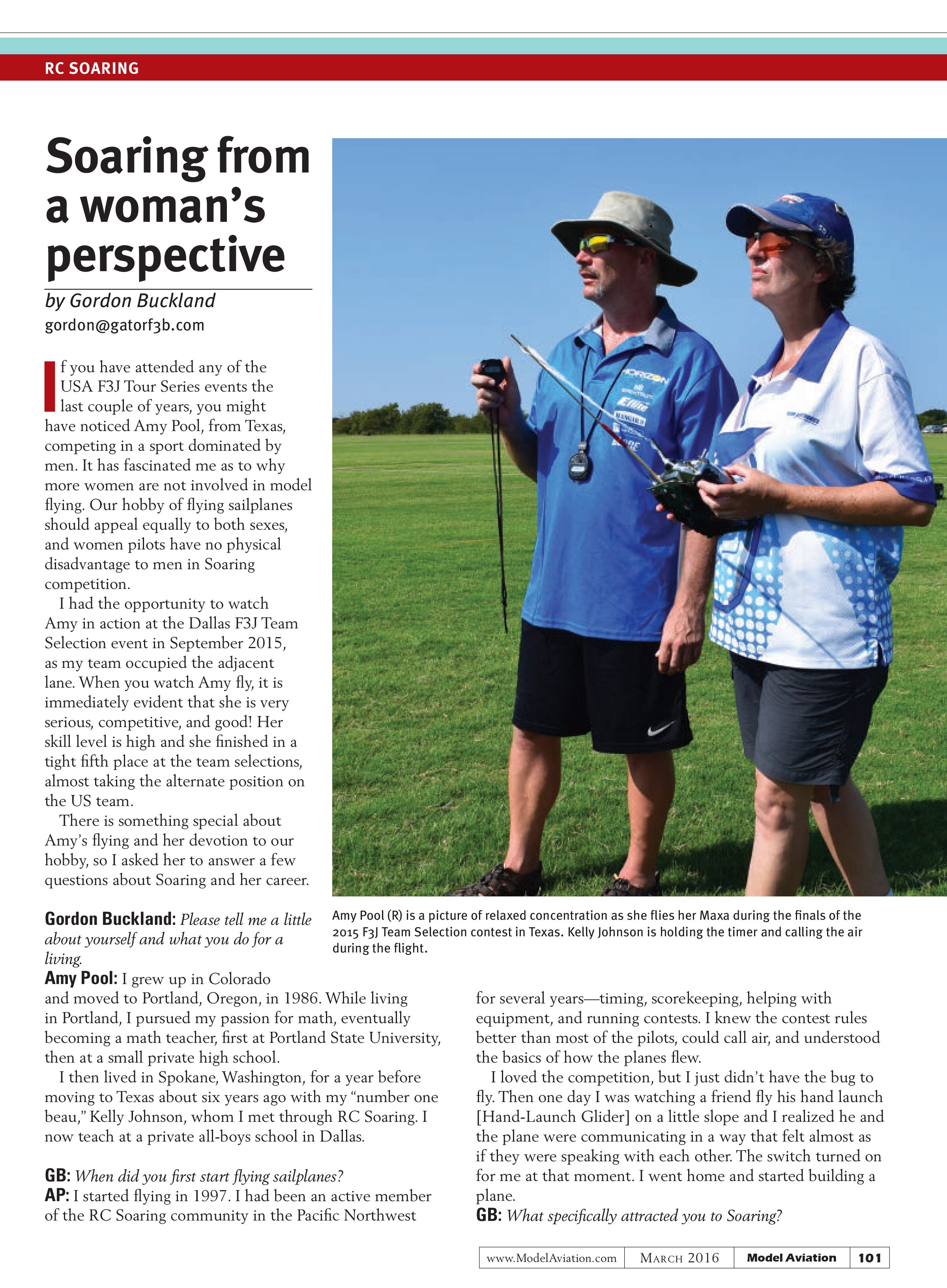
If you have attended any of the USA F3J Tour Series events the last couple of years, you might have noticed Amy Pool, from Texas, competing in a sport dominated by men. It has fascinated me as to why more women are not involved in model flying. Our hobby of flying sailplanes should appeal equally to both sexes, and women pilots have no physical disadvantage to men in Soaring competition.
I had the opportunity to watch Amy in action at the Dallas F3J Team Selection event in September 2015, as my team occupied the adjacent lane. When you watch Amy fly, it is immediately evident that she is very serious, competitive, and good! Her skill level is high and she finished in a tight fifth place at the team selections, almost taking the alternate position on the US team.
There is something special about Amy’s flying and her devotion to our hobby, so I asked her to answer a few questions about Soaring and her career.

Gordon Buckland: Please tell me a little about yourself and what you do for a living.
Amy Pool: I grew up in Colorado and moved to Portland, Oregon, in 1986. While living in Portland, I pursued my passion for math, eventually becoming a math teacher, first at Portland State University, then at a small private high school.
I then lived in Spokane, Washington, for a year before moving to Texas about six years ago with my “number one beau,” Kelly Johnson, whom I met through RC Soaring. I now teach at a private all-boys school in Dallas.
GB: When did you first start flying sailplanes?
AP: I started flying in 1997. I had been an active member of the RC Soaring community in the Pacific Northwest for several years—timing, scorekeeping, helping with equipment, and running contests. I knew the contest rules better than most of the pilots, could call air, and understood the basics of how the planes flew.
I loved the competition, but I just didn’t have the bug to fly. Then one day I was watching a friend fly his hand launch [Hand-Launch Glider] on a little slope and I realized he and the plane were communicating in a way that felt almost as if they were speaking with each other. The switch turned on for me at that moment. I went home and started building a plane.
GB: What specifically attracted you to Soaring?
AP: I think Soaring is magic. I never tire of the challenge of finding low-level lift and working the plane back to altitude. I’m also pretty competitive and the tasks associated with RC Soaring—whether they are LSF [League of Silent Flight] tasks or contest tasks—never fail to motivate me.
I am also very fond of the people in the Soaring community. They form my extended family. Had my exposure to RC flying been [with] power, I don’t know that it would have held my interest or if I would have ever even started flying. Who knows?
GB: Who has been the greatest influence on your flying?
AP: There are so many. Barry Kurath was the person who introduced me to the sport. Don “Pesz” Pesznecker was the man who taught me how to fly, and I still see reminders of his early instruction in my flying. More than that, Pesz and I would spend hours and hours talking about everything from how Soaring worked, to contest strategies. I often find that I am quoting Pesz to myself both on and off the field.
David Portwood gently pushed me forward during my first few years, particularly when I didn’t think I was good enough to handle a better plane.
More recently, without a doubt, it’s Kelly who has had the greatest influence on my flying. He has been a part of my RC community longer than I’ve been flying, and he’s been one of my primary air callers for more than a decade.
Kelly is a teacher by nature, if not by profession, so he is always finding opportunities to increase my knowledge and experience. He has also pushed me out of my comfort zone many times, for which I am grateful. Because of this, I am often learning that I was wrong about my limitations as a pilot.
GB: What do you think is your greatest asset as a Soaring pilot?
AP: My competitive nature and my willingness to fly at the limits of my vision.
GB: What is the magic ingredient that makes you so competitive?
AP: It is not in my nature to do something halfway. For example, three weeks after learning to fly, I entered my first contest. As an experienced timer, I knew the rules and tasks. Where most Novice [class] pilots weren’t even attempting to get points on landing, I was aggressively slamming the belly of my Gentle Lady (with no spoilers) down in the point zone because, after all, that was part of the task. I went through a lot of glue and rubber bands back then, but I also got landing points!
GB: Do you think being female gives you an advantage?
AP: I don’t think being a woman gives me any advantages in the air or in landing. There are times when I have felt like the other competitors want to foster female participation, so they give me a little extra help and support, but then I look around and see so many other examples of one pilot helping another that I think maybe it’s just the nature of our community to help each other. It’s part of what I love about the glider community.
GB: What has been your most memorable achievement in Soaring?
AP: The week after David Hobby, of Australia, won the F3J World Championships in Canada, he unexpectedly showed up for a TD [Thermal Duration] contest hosted by my local club, the Portland Area Sailplane Society.
I had recently moved up from our competitor/Sportsman class to Expert class, so I wasn’t particularly confident about how I would finish. But I flew an almost perfect day—winning the contest that day and beating David Hobby.
GB: What do you think we should do in the US to increase Soaring participation?
AP: We aren’t a very visible branch of RC aviation. Everyone has seen helicopters, quads, and power planes, but when I tell people that I fly RC gliders, they are often surprised that such things exist. We need to find ways to get more exposure so that people, both in and out of the RC community, know we are here. Not everyone will fall in love with Soaring, but some will!
GB: Do you have any ideas about how we might attract more Juniors to the sport?
AP: It seems like few Juniors get into RC Soaring, unless they have a friend or family member [who] is already involved with it. I believe most Juniors who get hooked will find a way to keep coming to the flying field, but that means we need to start by inviting young people to the field, and, if possible, putting a transmitter in their hands.
This could be as simple as inviting a coworker and his son or daughter to the flying field, or as involved as inviting the local Boy Scout troop to spend a day with your club.
GB: Tell us what you expect from the US Team in Slovenia.
AP: This is going to be a great team. We have several experienced team members, both on the pilot and the helper side, as well as some great talent new to F3J competition at this level. With strong team work before and at the event, I see potential for Team USA to do well in Slovenia.