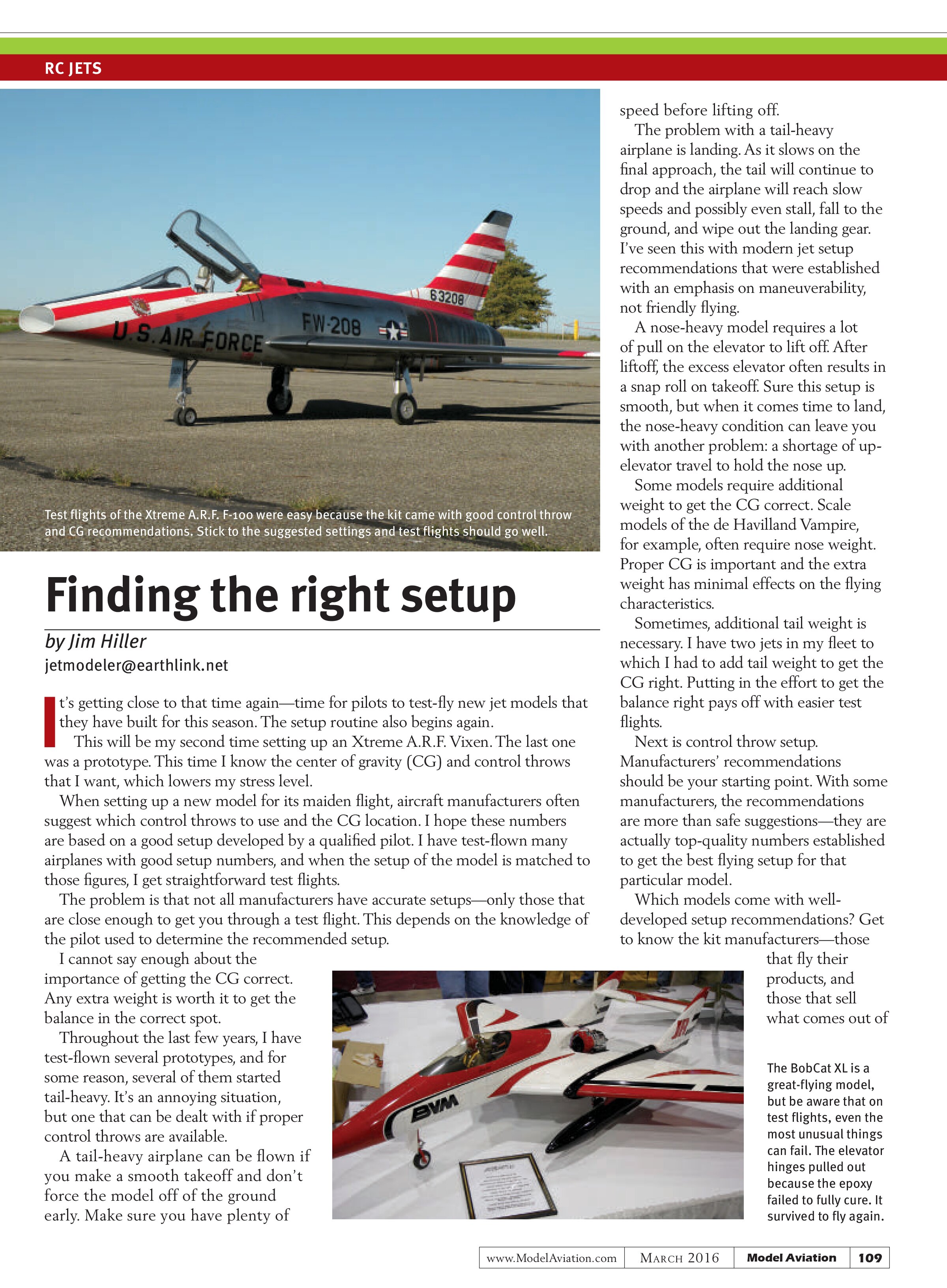

Finding the right setup
by Jim Hiller
jetmodeler@earthlink.net
It’s getting close to that time again—time for pilots to test-fly new jet models that they have built for this season. The setup routine also begins again.
This will be my second time setting up an Xtreme A.R.F. Vixen. The last one was a prototype. This time I know the center of gravity (CG) and control throws that I want, which lowers my stress level.
When setting up a new model for its maiden flight, aircraft manufacturers often suggest which control throws to use and the CG location. I hope these numbers are based on a good setup developed by a qualified pilot. I have test-flown many airplanes with good setup numbers, and when the setup of the model is matched to those figures, I get straightforward test flights.
The problem is that not all manufacturers have accurate setups—only those that are close enough to get you through a test flight. This depends on the knowledge of the pilot used to determine the recommended setup.
I cannot say enough about the importance of getting the CG correct. Any extra weight is worth it to get the balance in the correct spot.
Throughout the last few years, I have test-flown several prototypes, and for some reason, several of them started tail-heavy. It’s an annoying situation, but one that can be dealt with if proper control throws are available.
A tail-heavy airplane can be flown if you make a smooth takeoff and don’t force the model off of the ground early. Make sure you have plenty of speed before lifting off.
The problem with a tail-heavy airplane is landing. As it slows on the final approach, the tail will continue to drop and the airplane will reach slow speeds and possibly even stall, fall to the ground, and wipe out the landing gear. I’ve seen this with modern jet setup recommendations that were established with an emphasis on maneuverability, not friendly flying.
A nose-heavy model requires a lot of pull on the elevator to lift off. After liftoff, the excess elevator often results in a snap roll on takeoff. Sure this setup is smooth, but when it comes time to land, the nose-heavy condition can leave you with another problem: a shortage of up-elevator travel to hold the nose up.
Some models require additional weight to get the CG correct. Scale models of the de Havilland Vampire, for example, often require nose weight. Proper CG is important and the extra weight has minimal effects on the flying characteristics.
Sometimes, additional tail weight is necessary. I have two jets in my fleet to which I had to add tail weight to get the CG right. Putting in the effort to get the balance right pays off with easier test flights.
Next is control throw setup. Manufacturers’ recommendations should be your starting point. With some manufacturers, the recommendations are more than safe suggestions—they are actually top-quality numbers established to get the best flying setup for that particular model.
Which models come with well-developed setup recommendations? Get to know the kit manufacturers—those that fly their products, and those that sell what comes out of

the molds. I will happily spend more for well-engineered and developed models because I get what I pay for.
For all test flights, I like to take the time to use dual rates to my advantage. Options are nice to have when things don’t go well in the air. My setup for control throws starts with the recommended rates on mid-rates, then approximately 10% less on low rates, and 20% more on high rates. The extra high rate is there for problems such as a nose-heavy model.
The use of extra elevator travel on high rates can be the difference between a successful landing and a full up-elevator run into the runway with no landing flare, followed by the dreaded kangaroo hops, and wiping out the landing gear. Take the time to properly set up control throws as recommended, then set up options with the use of the dual rates for a bad situation, should one arise. Someday you will need it and you will be able to bring the aircraft home because of the extra effort.
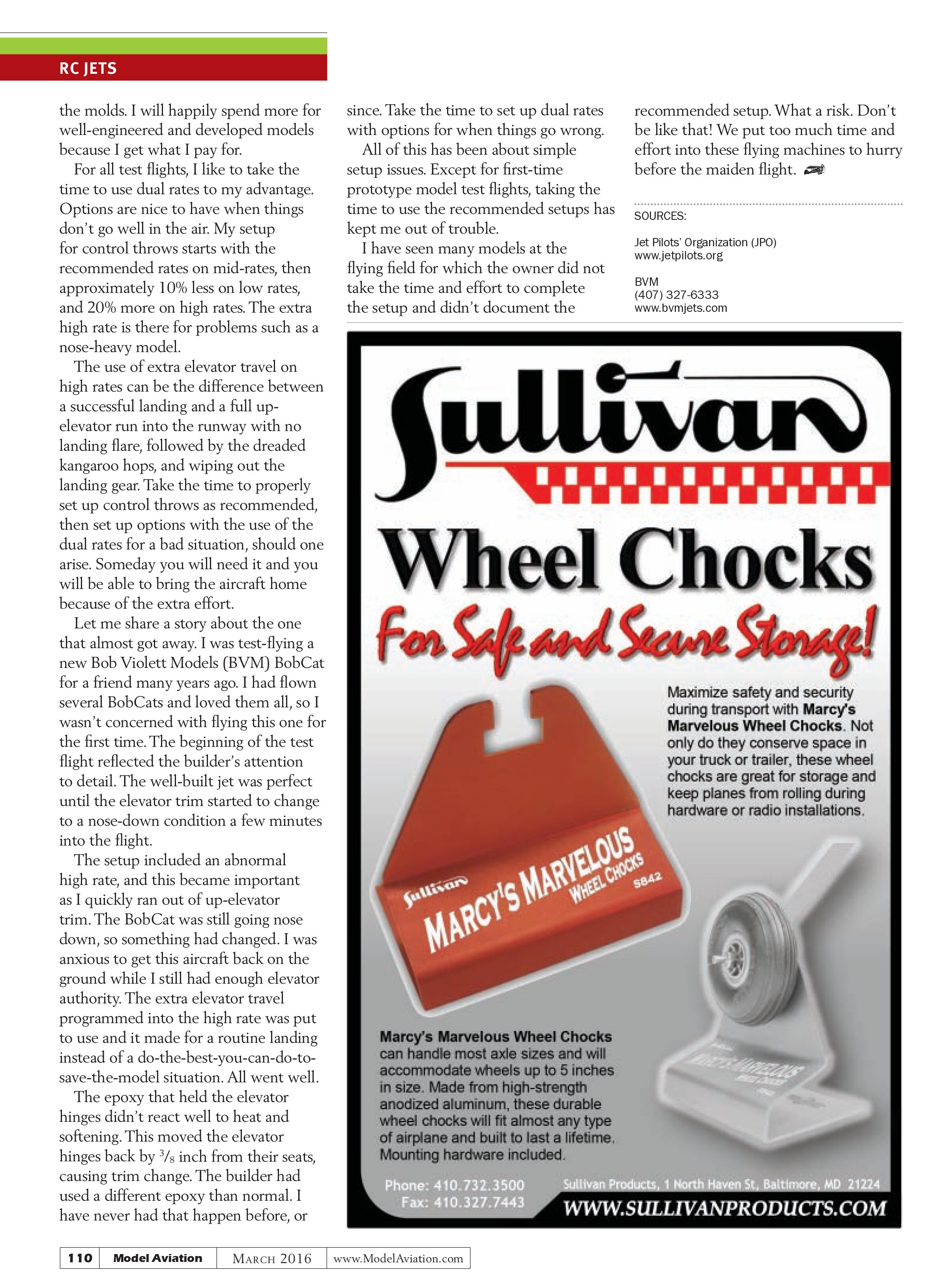
Let me share a story about the one that almost got away. I was test-flying a new Bob Violett Models (BVM) BobCat for a friend many years ago. I had flown several BobCats and loved them all, so I wasn’t concerned with flying this one for the first time. The beginning of the test flight reflected the builder’s attention to detail. The well-built jet was perfect until the elevator trim started to change to a nose-down condition a few minutes into the flight.
The setup included an abnormal high rate, and this became important as I quickly ran out of up-elevator trim. The BobCat was still going nose down, so something had changed. I was anxious to get this aircraft back on the ground while I still had enough elevator authority. The extra elevator travel programmed into the high rate was put to use and it made for a routine landing instead of a do-the-best-you-can-do-to-save-the-model situation. All went well.
The epoxy that held the elevator hinges didn’t react well to heat and softening. This moved the elevator hinges back by ⅜ inch from their seats, causing trim change. The builder had used a different epoxy than normal. I have never had that happen before, or since. Take the time to set up dual rates with options for when things go wrong.
All of this has been about simple setup issues. Except for first-time prototype model test flights, taking the time to use the recommended setups has kept me out of trouble.
I have seen many models at the flying field for which the owner did not take the time and effort to complete the setup and didn’t document the recommended setup. What a risk. Don’t be like that! We put too much time and effort into these flying machines to hurry before the maiden flight.
Sources:
Jet Pilots’ Organization (JPO)
www.jetpilots.org
BVM
(407) 327-6333
www.bvmjets.com