Low-speed 3-D setups, part one
Chris Mulcahy
cspaced@gmail.com
Last month I discussed my 6S 600-size Synergy E5s that I set up for low-speed 3-D flying. The inspiration for building the model came after I flew Gary Wright’s helicopter with a similar setup. I asked Gary to explain his setups and some of his thinking behind them. There is much to cover, so this will be a two-part column. The second part will be in next month’s issue. This is what Gary had to say:

Appropriate Configuration
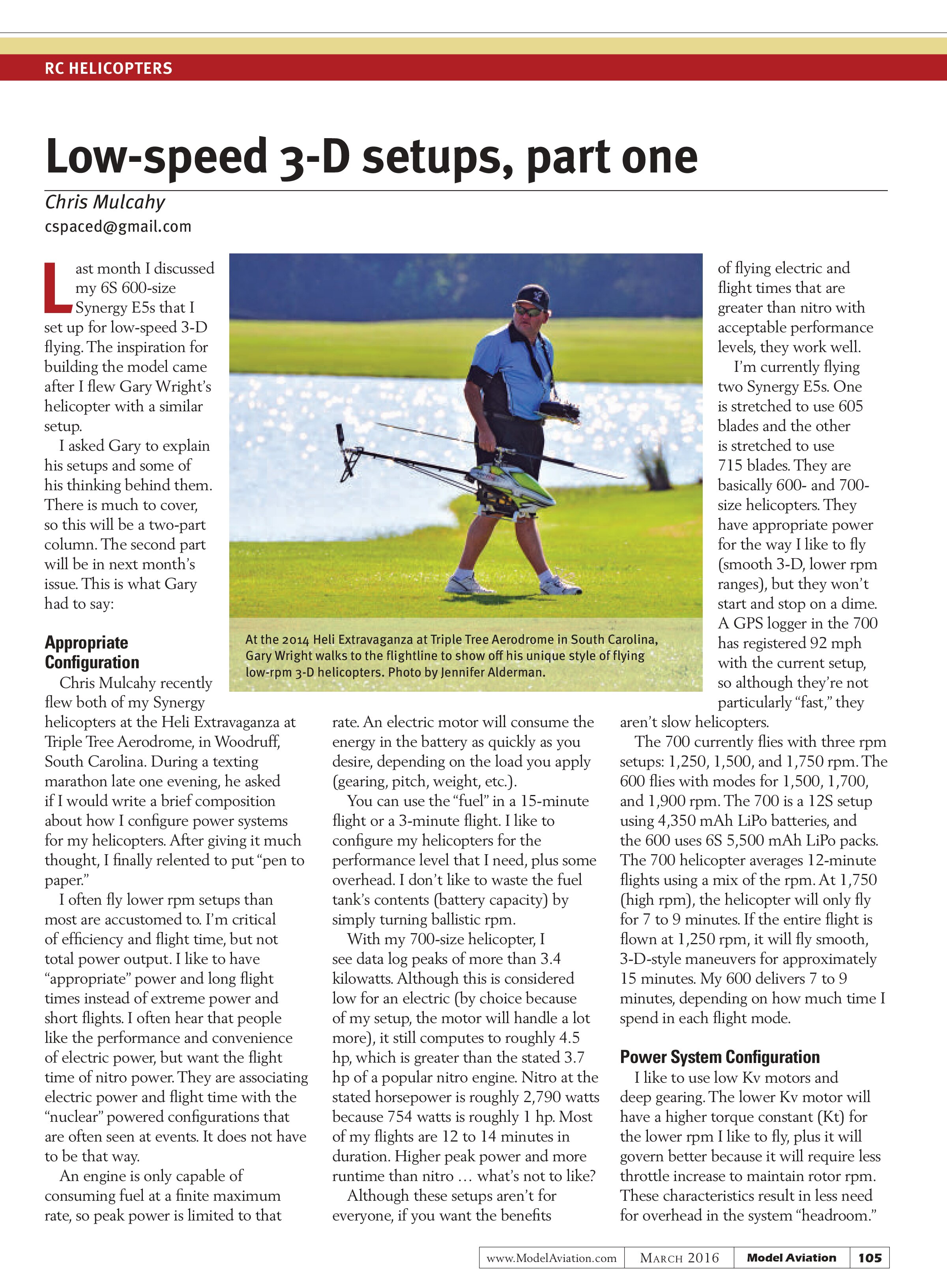
Chris Mulcahy recently flew both of my Synergy helicopters at the Heli Extravaganza at Triple Tree Aerodrome, in Woodruff, South Carolina. During a texting marathon late one evening, he asked if I would write a brief composition about how I configure power systems for my helicopters. After giving it much thought, I finally relented to put “pen to paper.”
I often fly lower rpm setups than most are accustomed to. I’m critical of efficiency and flight time, but not total power output. I like to have “appropriate” power and long flight times instead of extreme power and short flights. I often hear that people like the performance and convenience of electric power, but want the flight time of nitro power. They are associating electric power and flight time with the “nuclear” powered configurations that are often seen at events. It does not have to be that way.
An engine is only capable of consuming fuel at a finite maximum rate, so peak power is limited to that rate. An electric motor will consume the energy in the battery as quickly as you desire, depending on the load you apply (gearing, pitch, weight, etc.).
You can use the “fuel” in a 15-minute flight or a 3-minute flight. I like to configure my helicopters for the performance level that I need, plus some overhead. I don’t like to waste the fuel tank’s contents (battery capacity) by simply turning ballistic rpm.
With my 700-size helicopter, I see data log peaks of more than 3.4 kilowatts. Although this is considered low for an electric (by choice because of my setup, the motor will handle a lot more), it still computes to roughly 4.5 hp, which is greater than the stated 3.7 hp of a popular nitro engine. Nitro at the stated horsepower is roughly 2,790 watts because 754 watts is roughly 1 hp. Most of my flights are 12 to 14 minutes in duration. Higher peak power and more runtime than nitro … what’s not to like?
Although these setups aren’t for everyone, if you want the benefits of flying electric and flight times that are greater than nitro with acceptable performance levels, they work well. I’m currently flying two Synergy E5s. One is stretched to use 605 blades and the other is stretched to use 715 blades. They are basically 600- and 700-size helicopters. They have appropriate power for the way I like to fly (smooth 3-D, lower rpm ranges), but they won’t start and stop on a dime. A GPS logger in the 700 has registered 92 mph with the current setup, so although they’re not particularly “fast,” they aren’t slow helicopters.
The 700 currently flies with three rpm setups: 1,250, 1,500, and 1,750 rpm. The 600 flies with modes for 1,500, 1,700, and 1,900 rpm. The 700 is a 12S setup using 4,350 mAh LiPo batteries, and the 600 uses 6S 5,500 mAh LiPo packs. The 700 helicopter averages 12-minute flights using a mix of the rpm. At 1,750 (high rpm), the helicopter will only fly for 7 to 9 minutes. If the entire flight is flown at 1,250 rpm, it will fly smooth, 3-D-style maneuvers for approximately 15 minutes. My 600 delivers 7 to 9 minutes, depending on how much time I spend in each flight mode.
Power System Configuration
I like to use low Kv motors and deep gearing. The lower Kv motor will have a higher torque constant (Kt) for the lower rpm I like to fly, plus it will govern better because it will require less throttle increase to maintain rotor rpm. These characteristics result in less need for overhead in the system “headroom.”
The less overhead, the lower the current peaks will be. That means less load on the batteries, less load on the ESC, etc. Lower C-rated batteries may be used (which are generally lighter), and a smaller/lighter ESC can be utilized.
With electrics, there are certain motor “constants” that can measure performance. The one we often hear of is Kv, which is a motor velocity characteristic. It expresses how many rpm the motor will turn per volt applied. There will be some variations depending on the speed controller used, but essentially, a motor of 500 Kv will spin 500 rpm for each volt applied.
Io is the no-load current of a motor, and Rm is the terminal resistance. Kt is sometimes mentioned because it is a torque constant. Kt is inversely proportional to Kv, so if you know the Kv, you also know the Kt (Kt x Kv = 1,352).
As you place a load on an electric motor, it does not react like a nitro motor. It will attempt to hold the same rpm (or close to it) and simply draw more current from the battery. If we are running the motor at 80% throttle, we add load with collective and/or cyclic pitch.
There is some overhead, or headroom, available for the governor to increase throttle and maintain exact rpm. As this load is applied, the motor begins drawing more current to maintain rpm, the governor adds throttle for the ESC if it senses a drop in rpm, and even more current flows. Wouldn’t it be great if we had more torque available so the motor could maintain the rpm with less throttle increase?
Unfortunately I have to stop here, but next month I’ll pick this back up. Gary will go deeper into some of the technical details about his setups.
SOURCES:
International Radio Controlled Helicopter Association (IRCHA)
www.ircha.org
Synergy R/C Helicopters
www.synergyhelicopters.com
Hacker Motor USA
(913) 214-6995
www.hackermotorusa.com
Castle Creations
(913) 390-6939
www.castlecreations.com