HORIZON HOBBY E-FLITE CARBON-Z T-28 BNF BASIC
Troy Hamm kc3drc@gmail.com and Ryan Ramsey rcairtrainingcommand1@gmail.com

The North American Aviation T-28 Trojan prototype flew for the first time in 1949. The T-28 was designed to replace the aging North American T-6 Texan as the military’s basic trainer.
The T-28 was a large aircraft that stood more than 12 feet tall and weighed roughly 8,000 pounds. Approximately 2,000 T-28s were built in several variations, with radial engines ranging from 800 to 1,425 hp. With its large size and abundance of horsepower, it must have been intimidating to student pilots.
Many T-28s are still airworthy and can be seen at air shows and warbird fly-ins across the country.
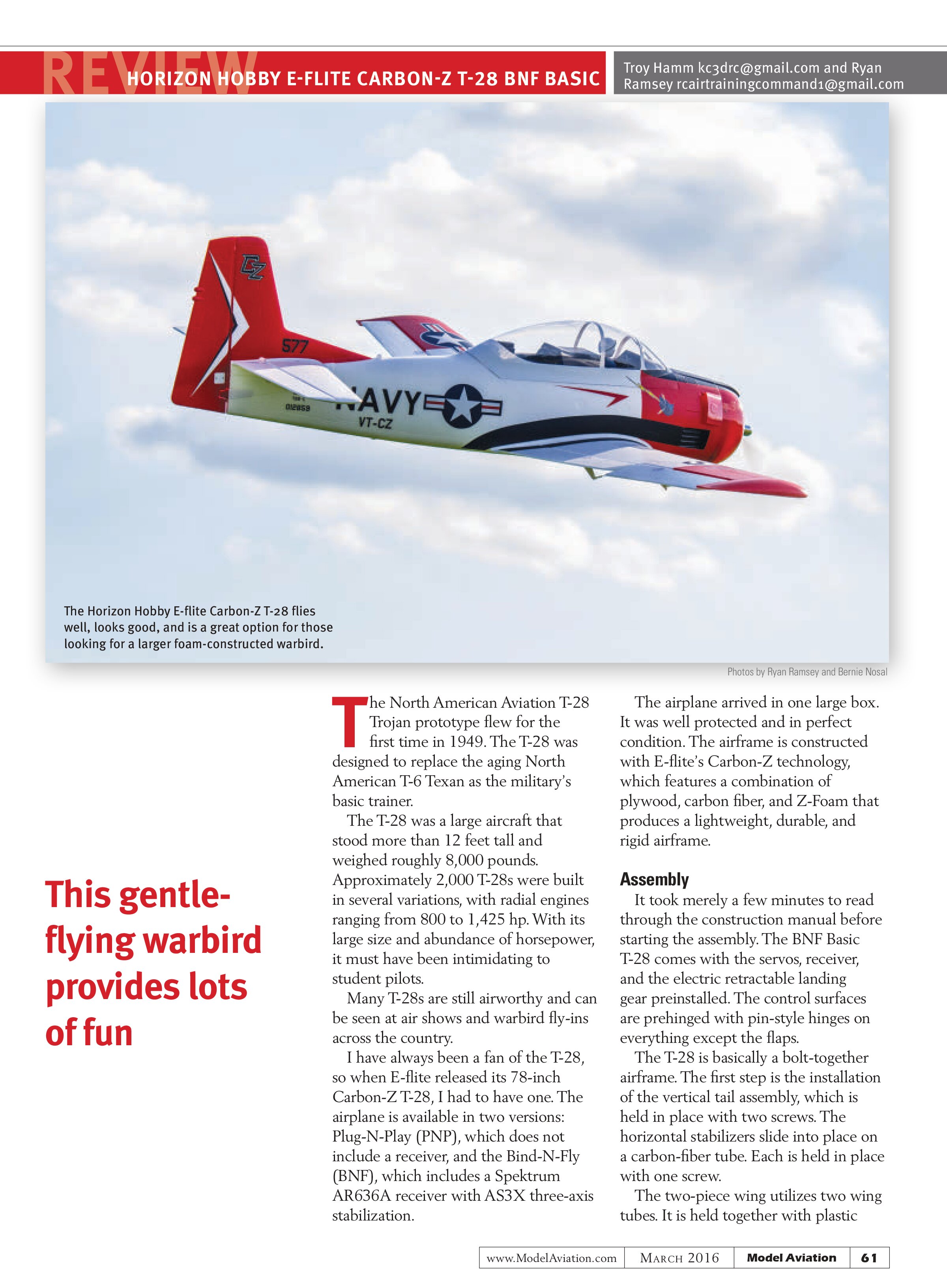
I have always been a fan of the T-28, so when E-flite released its 78-inch Carbon-Z T-28, I had to have one. The airplane is available in two versions: Plug-N-Play (PNP), which does not include a receiver, and the Bind-N-Fly (BNF), which includes a Spektrum AR636A receiver with AS3X three-axis stabilization.
The airplane arrived in one large box. It was well protected and in perfect condition. The airframe is constructed with E-flite’s Carbon-Z technology, which features a combination of plywood, carbon fiber, and Z-Foam that produces a lightweight, durable, and rigid airframe.
Assembly
It took merely a few minutes to read through the construction manual before starting the assembly. The BNF Basic T-28 comes with the servos, receiver, and the electric retractable landing gear preinstalled. The control surfaces are prehinged with pin-style hinges on everything except the flaps.
The T-28 is basically a bolt-together airframe. The first step is the installation of the vertical tail assembly, which is held in place with two screws. The horizontal stabilizers slide into place on a carbon-fiber tube. Each is held in place with one screw.
The two-piece wing utilizes two wing tubes. It is held together with plastic
brackets. Four screws installed through the brackets hold the wing in place on the fuselage.
The last step in the airframe assembly is bolting the motor, propeller, cowling, and spinner in place. When assembling the model, leave the propeller off until after the airplane is bound to your transmitter and you know everything is correct.
AS3X
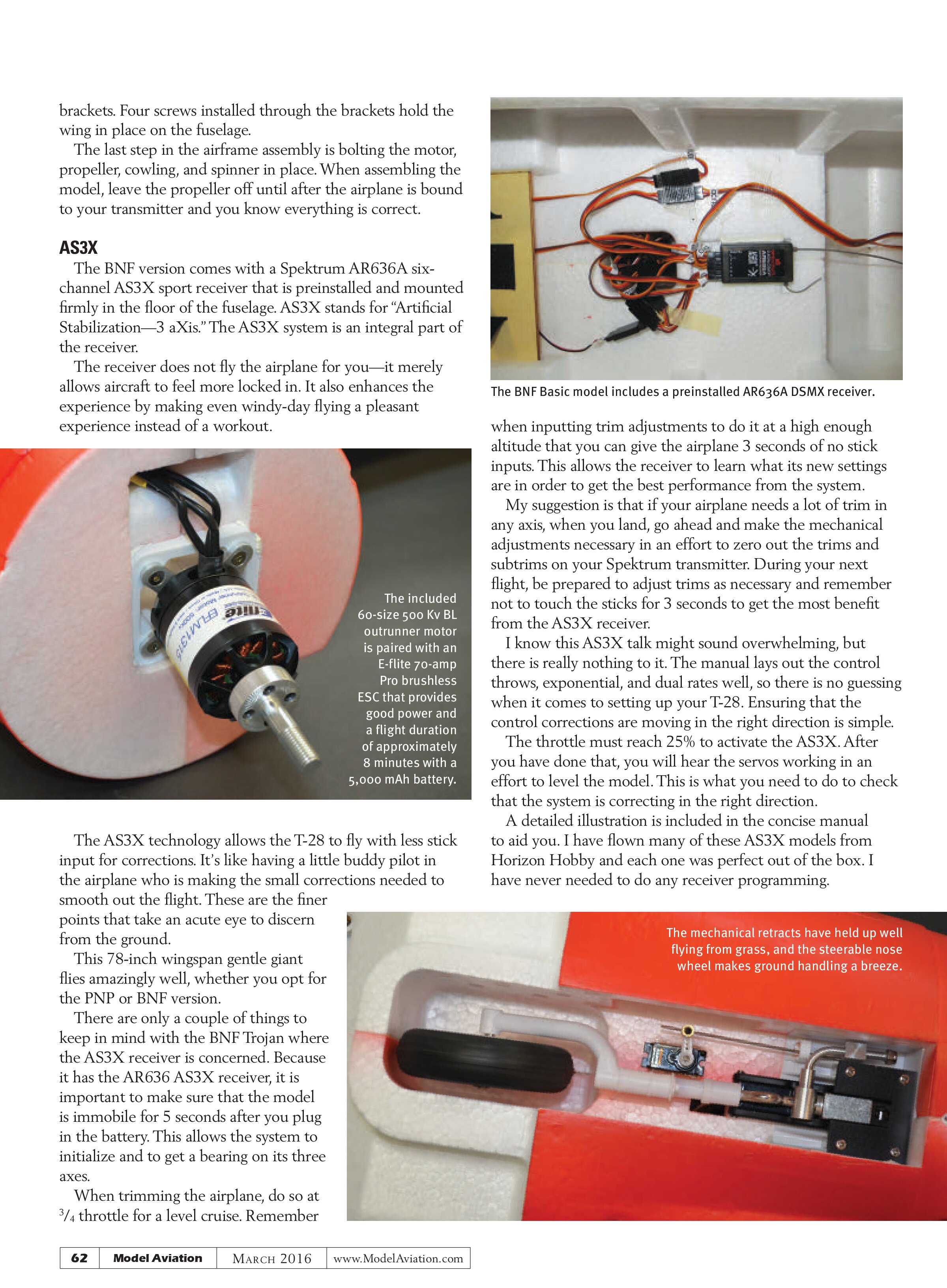
The BNF version comes with a Spektrum AR636A six-channel AS3X sport receiver that is preinstalled and mounted firmly in the floor of the fuselage. AS3X stands for “Artificial Stabilization—3 aXis.” The AS3X system is an integral part of the receiver.
The receiver does not fly the airplane for you—it merely allows aircraft to feel more locked in. It also enhances the experience by making even windy-day flying a pleasant experience instead of a workout.


The AS3X technology allows the T-28 to fly with less stick input for corrections. It’s like having a little buddy pilot in the airplane who is making the small corrections needed to smooth out the flight. These are the finer points that take an acute eye to discern from the ground.
This 78-inch wingspan gentle giant flies amazingly well, whether you opt for the PNP or BNF version.
There are only a couple of things to keep in mind with the BNF Trojan where the AS3X receiver is concerned. Because it has the AR636 AS3X receiver, it is important to make sure that the model is immobile for 5 seconds after you plug in the battery. This allows the system to initialize and to get a bearing on its three axes.
When trimming the airplane, do so at ¾ throttle for a level cruise. Remember

A quick-start guide on page three of the manual lays out the setup for BNF. Start with a blank model. Set the servo reversing to normal and travel adjustment to 100%. The control surface rates, flap settings, and exponential are set per the manual. The manual calls out a down mix of elevator for both flap settings. This is an important step. This mix keeps the nose from pitching up when the flaps are deployed.
I’m using my DX6 DSMX transmitter. I set my flaps to deploy at a rate of 9 seconds, which looks cool and gives the Trojan ample time to slip into its new groove. The landing gear also deploys in a slow fashion, adding to the model’s scale appeal.
AT A GLANCE ...
SPECIFICATIONS
Model type: Semiscale foam ARF
Skill level: Intermediate
Wingspan: 78 inches
Wing area: 1,073 square inches
Length: 63 inches
Ready-to-fly weight: 12 pounds
Power system: 60-size 500 Kv BL outrunner; E-flite 70-amp Pro brushless ESC; E-flite two-blade 14.75 x 10 propeller (all included)
Radio: Spektrum six-channel AR636A DSMX receiver with seven metal-gear servos (installed)
Construction: Z-Foam
Needed to complete: Six-channel Spektrum transmitter; E-flite 6S 22.2-volt 3,500 to 5,000 mAh LiPo battery pack
Price: BNF Basic $569.99; PNP $519.99
Flight duration: Approximately 8 minutes with 5,000 mAh battery
PLUSES
- Fast assembly.
- Excellent manual and instructions.
- Durable foam construction.
- Great flight characteristics.
- Electric retractable tricycle landing gear.
MINUS
- Flap hinges might need reinforcement.
Optional Modifications
Hinge Line Reinforcement
All of the T-28’s control surfaces use pin-style hinges with the exception of the flaps, which are skin-hinged with Z-Foam. The foam hinge line is thin and can be easily reinforced by applying 1-inch-wide Blenderm tape along the top and the bottom of the hinge line. It’s a simple process.
First, disconnect the flap from the servo so it hinges freely. Fold the flap up and run the tape along the underside of the hinge line, then move the flap all the way down and run the tape along the top of the hinge line. Repeat this process on the other flap. This inexpensive modification is quick to perform, and holds up well.
Sound System
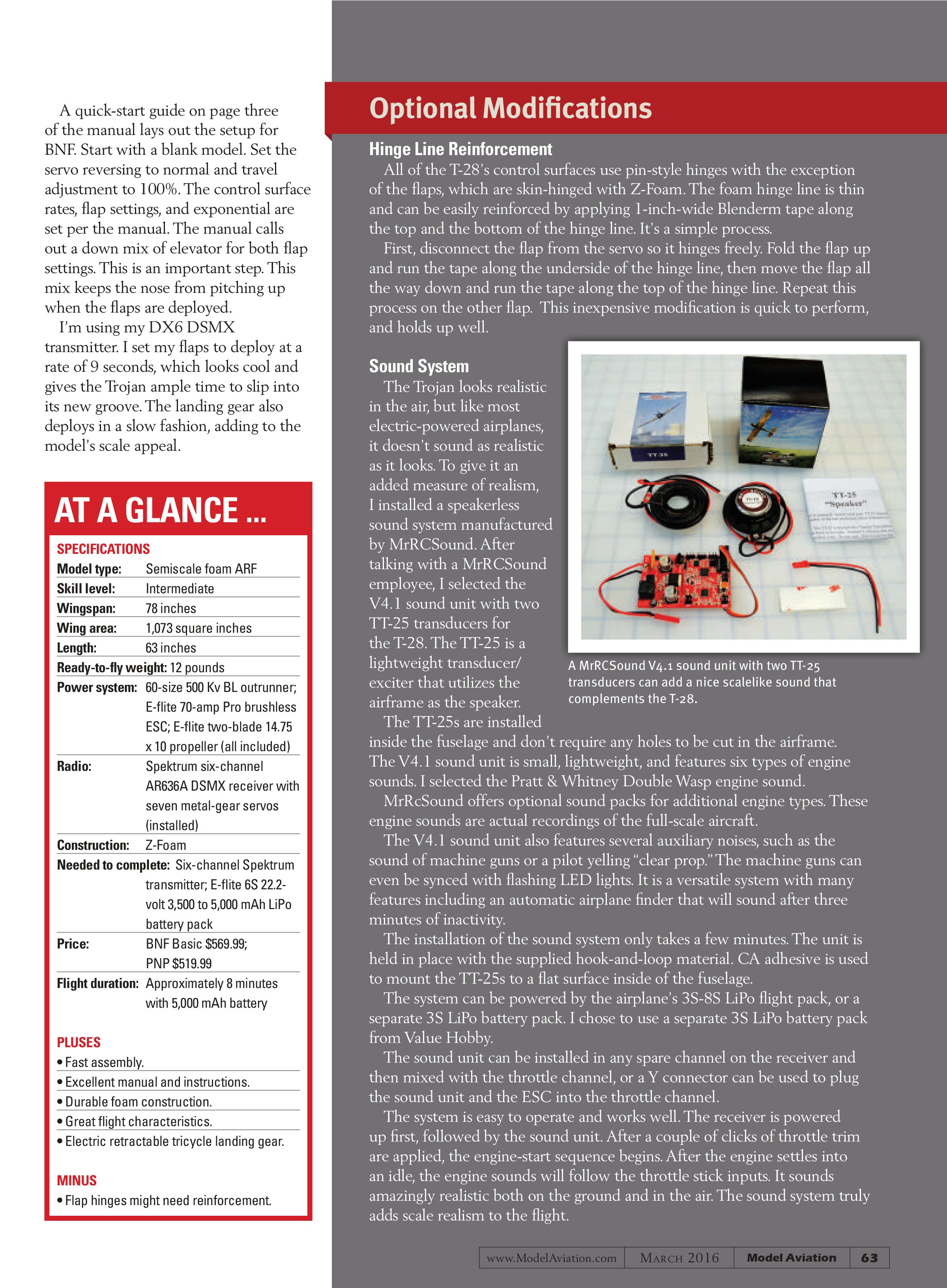
The Trojan looks realistic in the air, but like most electric-powered airplanes, it doesn’t sound as realistic as it looks. To give it an added measure of realism, I installed a speakerless sound system manufactured by MrRCSound. After talking with a MrRCSound employee, I selected the V4.1 sound unit with two TT-25 transducers for the T-28. The TT-25 is a lightweight transducer/exciter that utilizes the airframe as the speaker.

The TT-25s are installed inside the fuselage and don’t require any holes to be cut in the airframe. The V4.1 sound unit is small, lightweight, and features six types of engine sounds. I selected the Pratt & Whitney Double Wasp engine sound.
MrRCSound offers optional sound packs for additional engine types. These engine sounds are actual recordings of the full-scale aircraft.
The V4.1 sound unit also features several auxiliary noises, such as the sound of machine guns or a pilot yelling “clear prop.” The machine guns can even be synced with flashing LED lights. It is a versatile system with many features including an automatic airplane finder that will sound after three minutes of inactivity.
The installation of the sound system only takes a few minutes. The unit is held in place with the supplied hook-and-loop material. CA adhesive is used to mount the TT-25s to a flat surface inside of the fuselage.
The system can be powered by the airplane’s 3S-8S LiPo flight pack, or a separate 3S LiPo battery pack. I chose to use a separate 3S LiPo battery pack from Value Hobby.
The sound unit can be installed in any spare channel on the receiver and then mixed with the throttle channel, or a Y connector can be used to plug the sound unit and the ESC into the throttle channel.
The system is easy to operate and works well. The receiver is powered up first, followed by the sound unit. After a couple of clicks of throttle trim are applied, the engine-start sequence begins. After the engine settles into an idle, the engine sounds will follow the throttle stick inputs. It sounds amazingly realistic both on the ground and in the air. The sound system truly adds scale realism to the flight.

Ryan’s Flight Report
Flying this gentle giant is an awesome experience. I love the locked-in feel the AS3X system gives to the flight character of this Carbon-Z T-28. It is breathtaking to watch this airplane fly. It has a presence that is unmatched.
Weighing 12 pounds with a 78-inch wingspan, and having no bad habits, are testaments to its Carbon-Z design.
This Trojan performs well throughout its flight envelope. On one hand, it can slow to a crawl for that sweet landing, and on the other, it can come roaring by and pull impressive vertical. This Carbon-Z has it all!
Transporting it is no chore. Simply remove the four bolts that hold the wing on, unplug a few servo leads, and you are on your way to the next Carbon-Z T-28 air show.
Every now and then, a model comes along that cannot be resisted. This is one of those models. Great work Horizon Hobby. I can’t wait for the next one!
Troy’s Flight Report
When we reached the flying field, the airplane was given a range check and a preflight inspection. The T-28 tracked straight on takeoff and was airborne from the grass runway in less than 150 feet. No rudder or aileron trim was needed, but it was slightly nose-heavy and required a few clicks of up-trim. On subsequent flights, the batteries were moved back a couple of inches and then the Trojan required no elevator trim.
The T-28 is more aerobatic than expected. Aileron rolls were axial and when the center of gravity was correctly set, it only required a small amount of forward stick to maintain inverted flight. The Trojan is stable at all speeds and handles wind well.
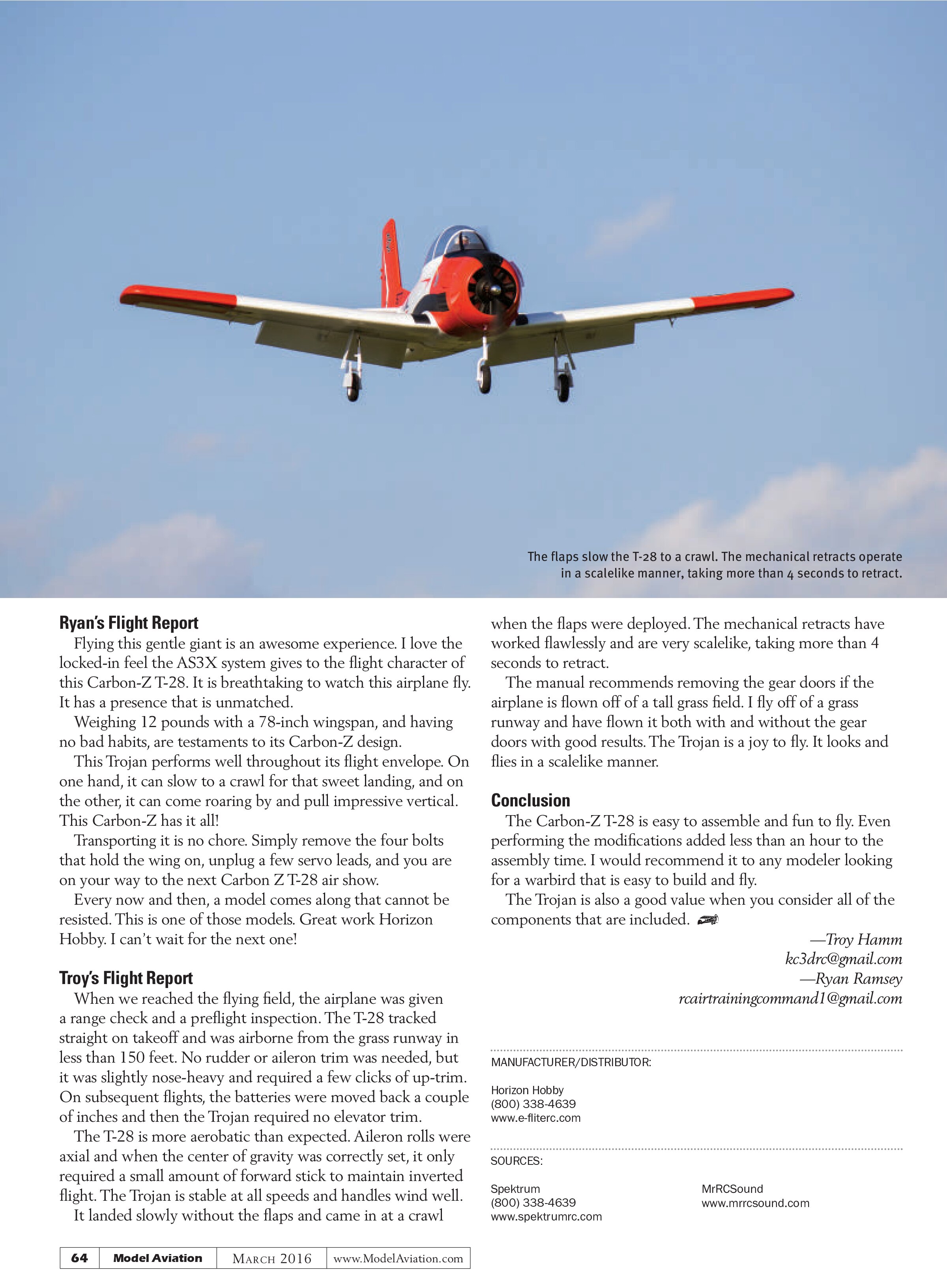
It landed slowly without the flaps and came in at a crawl when the flaps were deployed. The mechanical retracts have worked flawlessly and are very scalelike, taking more than 4 seconds to retract.
The manual recommends removing the gear doors if the airplane is flown off of a tall grass field. I fly off of a grass runway and have flown it both with and without the gear doors with good results. The Trojan is a joy to fly. It looks and flies in a scalelike manner.
Conclusion
The Carbon-Z T-28 is easy to assemble and fun to fly. Even performing the modifications added less than an hour to the assembly time. I would recommend it to any modeler looking for a warbird that is easy to build and fly.
The Trojan is also a good value when you consider all of the components that are included.
—Troy Hamm
kc3drc@gmail.com
—Ryan Ramsey
rcairtrainingcommand1@gmail.com
MANUFACTURER/DISTRIBUTOR:
Horizon Hobby
(800) 338-4639
www.e-fliterc.com
SOURCES:
Spektrum
(800) 338-4639
www.spektrumrc.com
MrRCSound
www.mrrcsound.com