World Air Games
by Mark Rudner
rudner@mit.edu
This past December, I had the opportunity to partake in a unique event in the history of aeromodeling: the World Air Games. For several years, the FAI has been trying to build on the idea of creating Olympic Games for aerosports including all disciplines, from full-scale glider aerobatics, to parachuting, to aeromodeling, and more.
The first World Air Games were held in Turkey in 1997. Since then, the event has been held in Spain (2001) and Italy (2009). This time Dubai played host, and the city went all out to put together an impressive two-week spectacle in the desert.
As fortune would have it, Control Line (CL) Combat was featured this year as one of four aeromodeling events; the others were indoor RC Aerobatics (F3P), RC Pylon Racing (F3D), and RC Helicopter Freestyle Aerobatics (F3N). Notably, this was the first time that any

CL event was featured at the World Air Games.
It was interesting to meet competitors from the other disciplines and witness new types of aerosports that I had never before seen. Two of my favorites were full-scale Glider Aerobatics and RC Helicopter Freestyle Aerobatics. In both cases, pilots executed carefully choreographed aerobatic routines set to individually selected and compiled musical arrangements. The gliders had smoke generators on their wingtips that left twisting colored trails through the sky as they dashed back and forth through maneuvers that most mortals wouldn’t dare attempt in a powerless aircraft. When the top pilots hit their marks and their routines clicked with the music, it was impressive.
The Competition
F2D Combat at the World Air Games was run as an invitational “tournament of champions,” with the 2014 national champions from 16 countries pitted against each other to see who would reign supreme. Andrey Nadein, the 2014 US National Champion, was invited to represent the US. Alex Prokofiev, of New Jersey, was invited to represent Latvia.
In contrast to the usual world or European championships, the World Air Games only allowed the selected pilot from each country to bring one mechanic. This meant that mechanics and pilots from different countries were allowed (and needed) to help each other in every match.
This is how we operate at local contests, but at the big championships, each competitor is only allowed to help one country. I accompanied Andrey as the US team mechanic, but also pitted for Alex, as well as Pat MacKenzie (Canada), Rudi Königshofer (Austria), and James Palmer (New Zealand) at

various times. Before the competition, the organizers and judges emphasized to all competitors that this event represented a singular opportunity for demonstrating CL Combat to the world, and strongly urged all pilots to fly cleanly and to put on a good show for the spectators. The close proximity to spectators, other ongoing events, and a bustling urban center, also meant that safety was on everyone’s mind.
The plans for beautiful Combat were hampered by strong winds that built steadily throughout the three days of competition (exceeding 20 mph on the last two days). Nonetheless, there were many exciting matches and fortunately

only one heart-stopping flyaway that started off heading straight for the skyscrapers, but then took a sweeping turn straight into the bay.
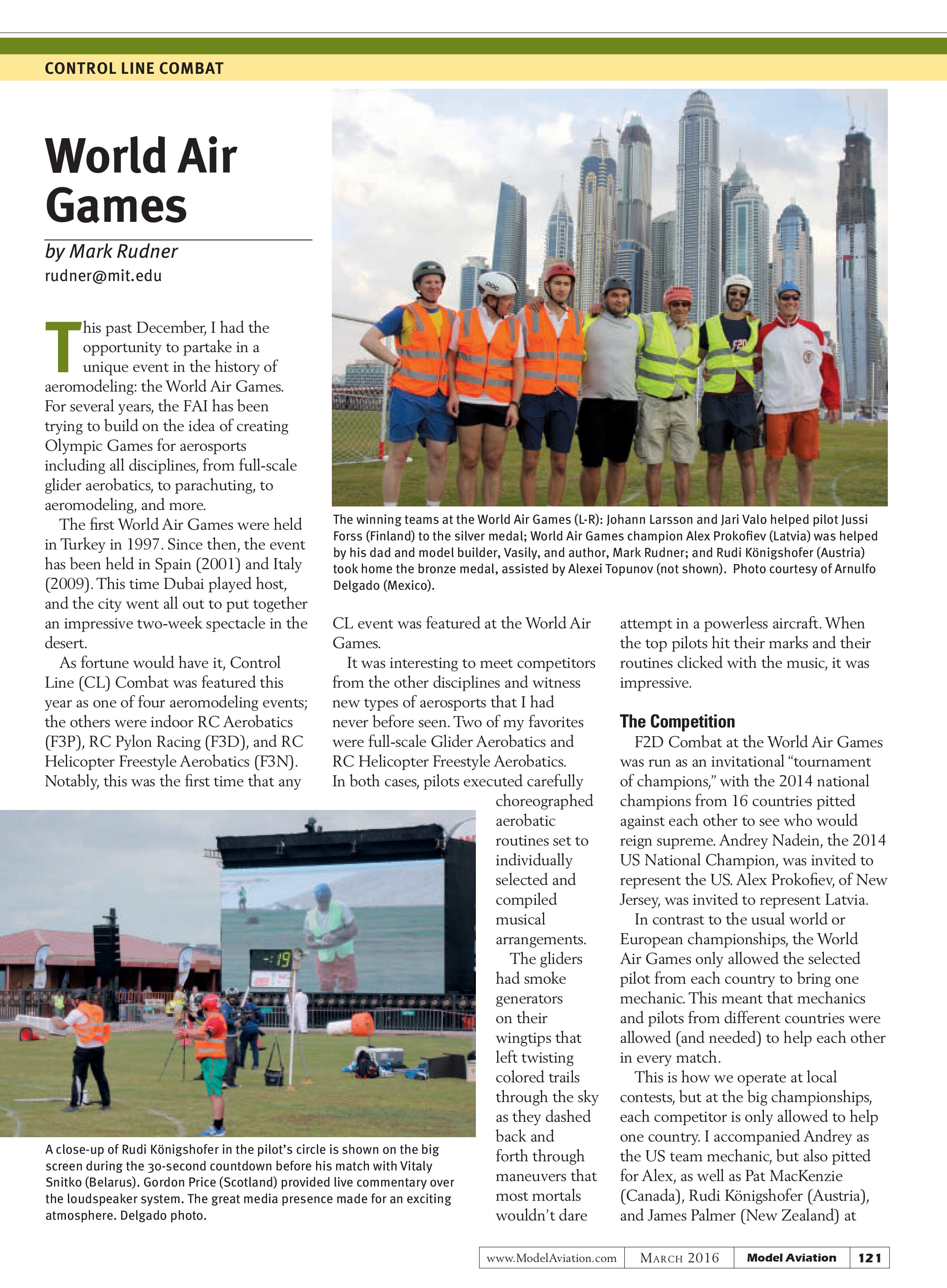
In the end, Alex Prokofiev prevailed, taking home the gold medal as the first-ever World Air Games Champion in CL Combat. Jussi Forss, of Finland, took second place, and Rudi Königshofer, of Austria, was third.
Exposure and Promotion
Being a high-profile sporting event in a country of apparently unlimited resources, there was a huge media presence at the competition. One cool feature of the venue was the presence of several Jumbotron screens showing the crowd close-ups of the action from various angles.
Possibly for the first time in history, CL Combat was also shown live on a major television station. His Highness Sheikh Mohammed Bin Rashid Al Maktoum, Vice President and Prime Minister of the United Arab Emirates and Ruler of Dubai, even made an appearance on day two of Combat to take in a bit of the action.
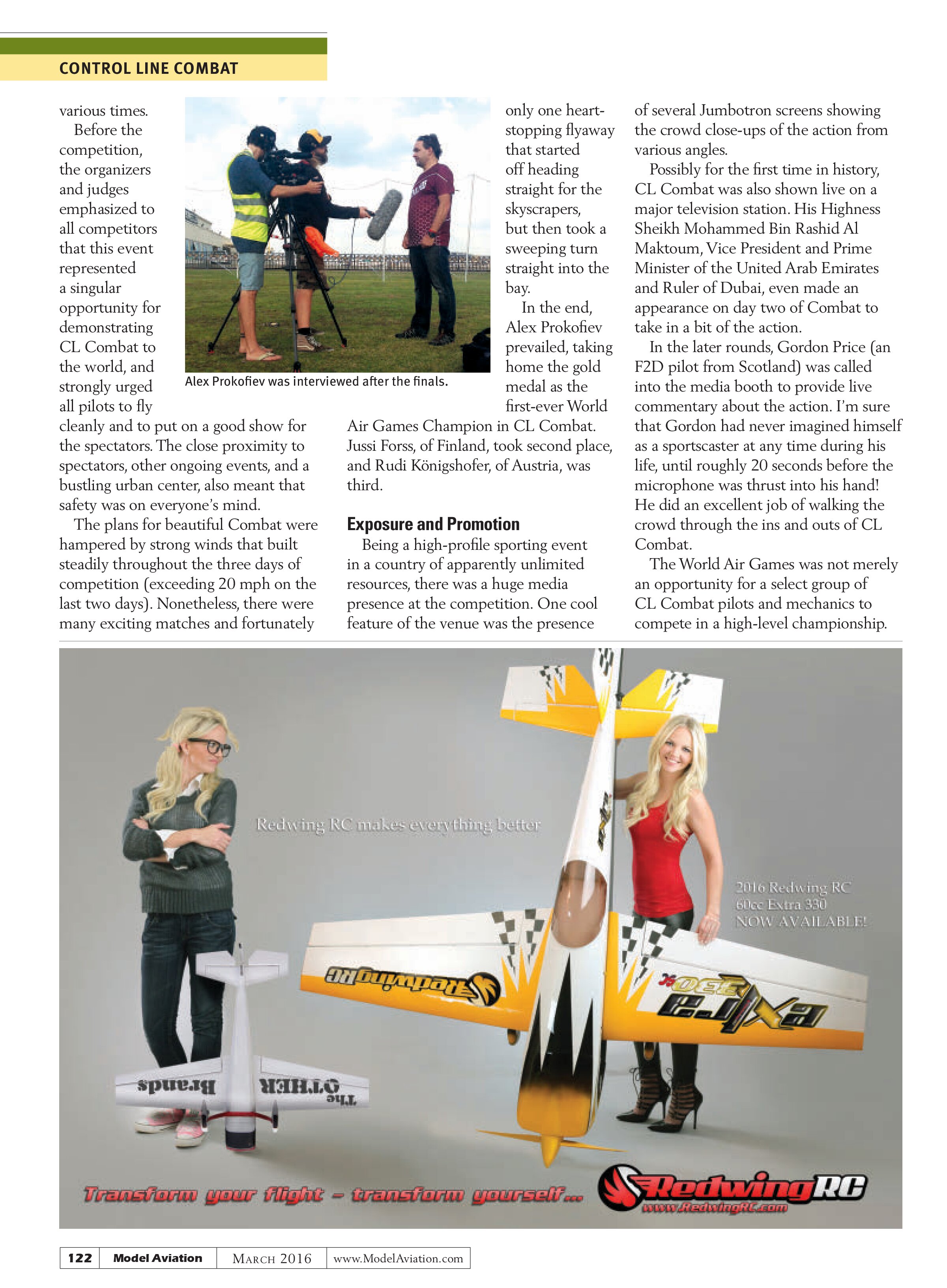
In the later rounds, Gordon Price (an F2D pilot from Scotland) was called into the media booth to provide live commentary about the action. I’m sure that Gordon had never imagined himself as a sportscaster at any time during his life, until roughly 20 seconds before the microphone was thrust into his hand! He did an excellent job of walking the crowd through the ins and outs of CL Combat.
The World Air Games was not merely an opportunity for a select group of CL Combat pilots and mechanics to compete in a high-level championship.
The event was also a big opportunity for us to promote our sport to the public and to the FAI. Among ourselves, we all know how exciting Combat is to both fly and watch, but it remains relatively unknown outside of CL circles. From this point of view, the games were a smashing success.

Many competitors from other disciplines, as well as spectators, saw CL Combat for the first time, and I sensed a lot of excitement and wonder in their reactions to it. Even the organizers seemed impressed with F2D’s level of flying and the adrenaline-pumping action.
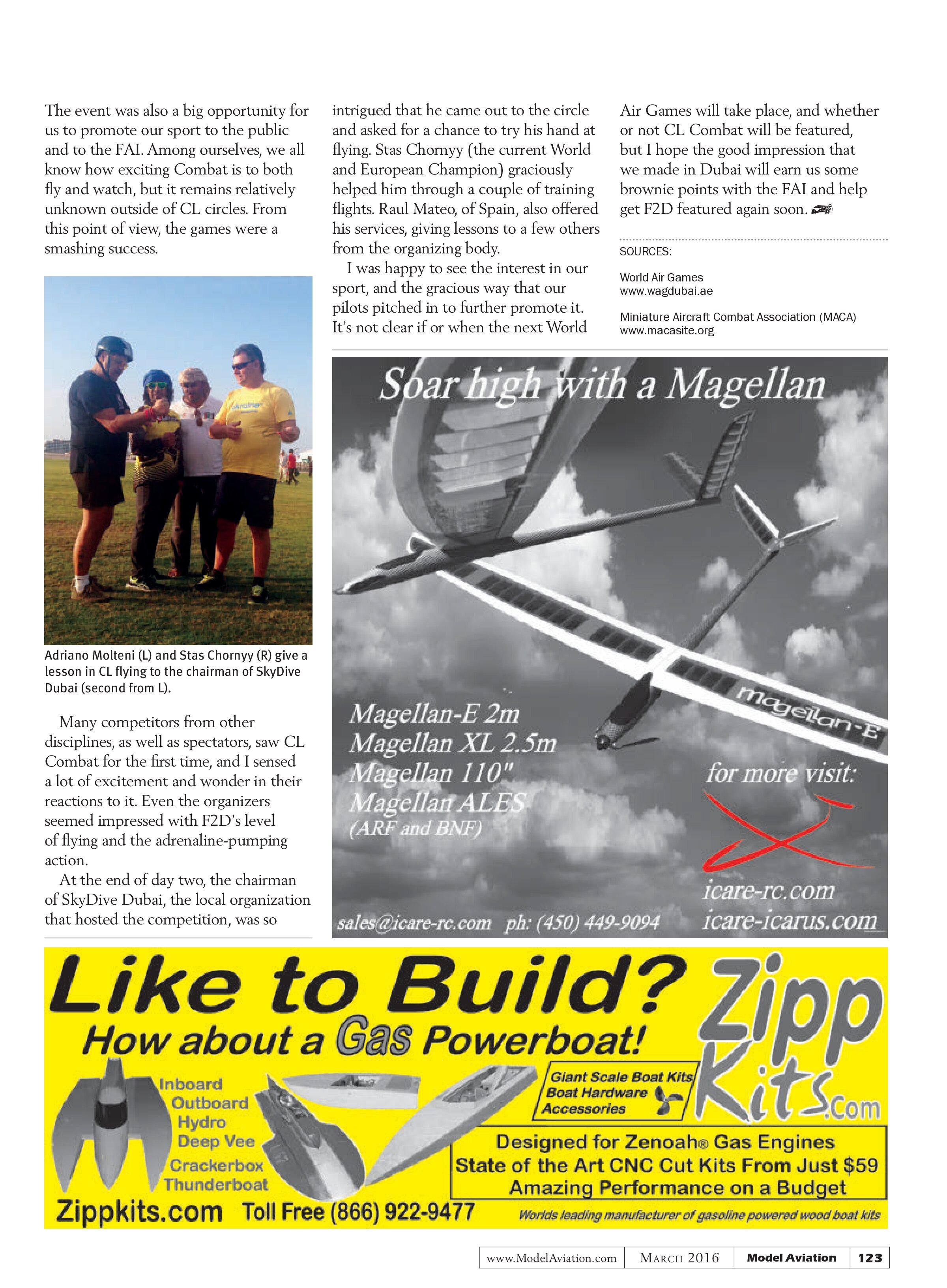
At the end of day two, the chairman of SkyDive Dubai, the local organization that hosted the competition, was so intrigued that he came out to the circle and asked for a chance to try his hand at flying. Stas Chornyy (the current World and European Champion) graciously helped him through a couple of training flights. Raul Mateo, of Spain, also offered his services, giving lessons to a few others from the organizing body.
I was happy to see the interest in our sport, and the gracious way that our pilots pitched in to further promote it. It’s not clear if or when the next World Air Games will take place, and whether or not CL Combat will be featured, but I hope the good impression that we made in Dubai will earn us some brownie points with the FAI and help get F2D featured again soon.
SOURCES:
World Air Games
www.wagdubai.ae
Miniature Aircraft Combat Association (MACA)
www.macasite.org