Bah, humbug? No!
by Bob Hunt
robinhunt@rcn.com

I attended a local Control Line (CL) Aerobatics (Stunt) contest as a spectator rather than as a competitor. This gave me the opportunity to step back from the “trees” and see the “forest.” It was an enlightening experience.
I had not taken the time at contests in which I was competing to watch what the fliers in the other classes were doing, and how they were progressing. This was especially true of the Beginner and Intermediate Precision Aerobatics Model Pilots Association (PAMPA) classes.
Three new friends I met on life’s path are CL retreads from the 1960s. The Huff brothers—Pete, Tom and Rick—have returned to CL flying after a long absence. Rick was the most accomplished of the three in their early days of flying, and since his return he has quickly climbed the ladder in competition from Beginner, through Intermediate, and on into the Advanced class, where currently he’s always in one of the top three spots at local and regional contests.
The other two brothers are making great progress and are ready to make the jump from Beginner to Intermediate. All three of the Huffs have become extremely close friends of mine, and I have offered to help them in any way that I can.
I noticed that Pete and Tom were flying rather rudimentary, profile-type models in the Beginner class. Those models are rugged and easily repairable when the inevitable training accidents happen.
Because they are now past the point of crashing every few flights, and are striving to execute more precise maneuvers, I mentioned to them that the models they have been flying up to this point might not be the best choice for their next step in learning.
Profile models certainly have their place in our sport. They are easy to build and repair, and generally fly well, but when the wind picks up or when they are being flown at a turbulent field (like most of our East Coast venues), their profile fuselages are prone to twist and cause the airplane to do “funny” things at the end of the lines.
For many years, I’ve thought that there needs to be a better type of training airplane for CL Stunt. It ideally would have a built-up fuselage that would resist twisting in wind and turbulence. I also believe that a transitional model for those coming out of the Beginner class and entering the Intermediate division doesn’t need moveable flaps if the model could be built light enough to perform well without them. There is no need to add an unnecessary complication at the Intermediate stage.
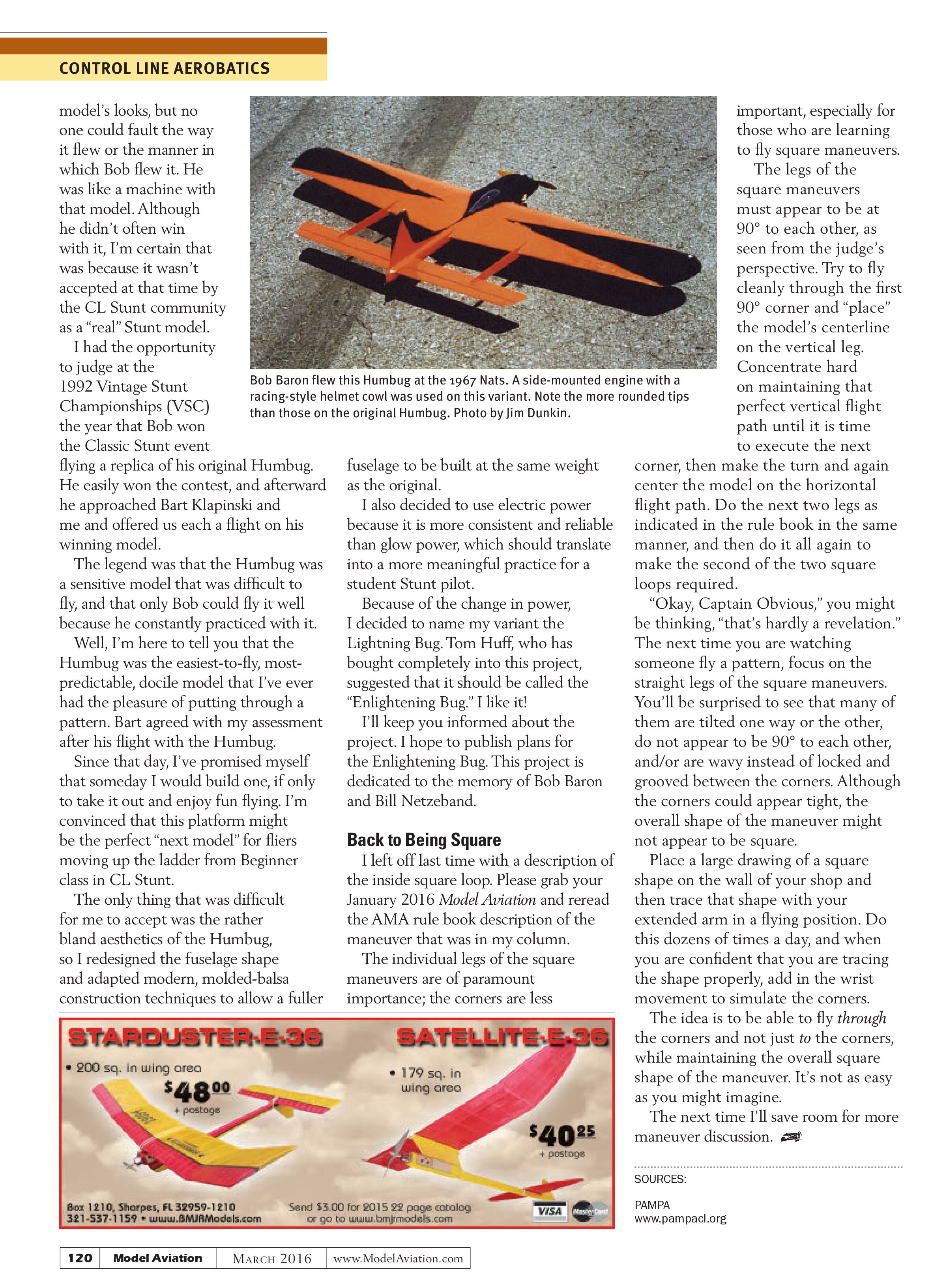
In thinking back about the best-flying, non-flap-equipped models I’ve flown, one stands out above the rest. Although slightly unorthodox looking, Bob Baron and Bill Netzeband designed and developed the Humbug (featured in the July 1993 Model Aviation). It fits the bill for a model that can take a new flier all the way to the Expert class.
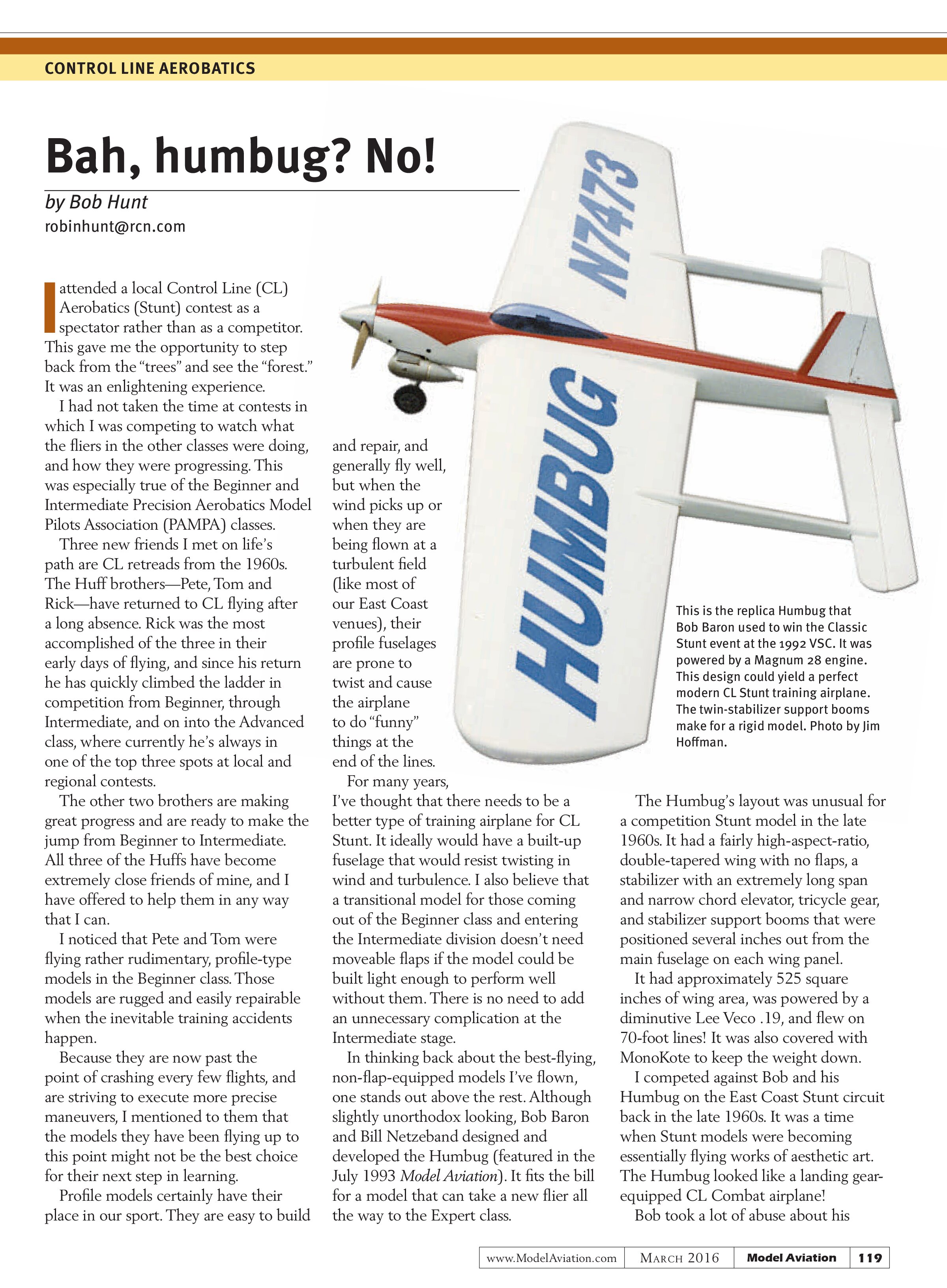
The Humbug’s layout was unusual for a competition Stunt model in the late 1960s. It had a fairly high-aspect-ratio, double-tapered wing with no flaps, a stabilizer with an extremely long span and narrow chord elevator, tricycle gear, and stabilizer support booms that were positioned several inches out from the main fuselage on each wing panel.
It had approximately 525 square inches of wing area, was powered by a diminutive Lee Veco .19, and flew on 70-foot lines! It was also covered with MonoKote to keep the weight down.
I competed against Bob and his Humbug on the East Coast Stunt circuit back in the late 1960s. It was a time when Stunt models were becoming essentially flying works of aesthetic art. The Humbug looked like a landing gear-equipped CL Combat airplane!
Bob took a lot of abuse about his
model’s looks, but no one could fault the way it flew or the manner in which Bob flew it. He was like a machine with that model. Although he didn’t often win with it, I’m certain that was because it wasn’t accepted at that time by the CL Stunt community as a “real” Stunt model.

I had the opportunity to judge at the 1992 Vintage Stunt Championships (VSC) the year that Bob won the Classic Stunt event flying a replica of his original Humbug. He easily won the contest, and afterward he approached Bart Klapinski and me and offered us each a flight on his winning model.
The legend was that the Humbug was a sensitive model that was difficult to fly, and that only Bob could fly it well because he constantly practiced with it.
Well, I’m here to tell you that the Humbug was the easiest-to-fly, most-predictable, docile model that I’ve ever had the pleasure of putting through a pattern. Bart agreed with my assessment after his flight with the Humbug.
Since that day, I’ve promised myself that someday I would build one, if only to take it out and enjoy fun flying. I’m convinced that this platform might be the perfect “next model” for fliers moving up the ladder from Beginner class in CL Stunt.
The only thing that was difficult for me to accept was the rather bland aesthetics of the Humbug, so I redesigned the fuselage shape and adapted modern, molded-balsa construction techniques to allow a fuller fuselage to be built at the same weight as the original.
I also decided to use electric power because it is more consistent and reliable than glow power, which should translate into a more meaningful practice for a student Stunt pilot.
Because of the change in power, I decided to name my variant the Lightning Bug. Tom Huff, who has bought completely into this project, suggested that it should be called the “Enlightening Bug.” I like it!
I’ll keep you informed about the project. I hope to publish plans for the Enlightening Bug. This project is dedicated to the memory of Bob Baron and Bill Netzeband.
Back to Being Square
I left off last time with a description of the inside square loop. Please grab your January 2016 Model Aviation and reread the AMA rule book description of the maneuver that was in my column.
The individual legs of the square maneuvers are of paramount importance; the corners are less important, especially for those who are learning to fly square maneuvers. The legs of the square maneuvers must appear to be at 90° to each other, as seen from the judge’s perspective. Try to fly cleanly through the first 90° corner and “place” the model’s centerline on the vertical leg. Concentrate hard on maintaining that perfect vertical flight path until it is time to execute the next corner, then make the turn and again center the model on the horizontal flight path. Do the next two legs as indicated in the rule book in the same manner, and then do it all again to make the second of the two square loops required.
“Okay, Captain Obvious,” you might be thinking, “that’s hardly a revelation.” The next time you are watching someone fly a pattern, focus on the straight legs of the square maneuvers. You’ll be surprised to see that many of them are tilted one way or the other, do not appear to be 90° to each other, and/or are wavy instead of locked and grooved between the corners. Although the corners could appear tight, the overall shape of the maneuver might not appear to be square.
Place a large drawing of a square shape on the wall of your shop and then trace that shape with your extended arm in a flying position. Do this dozens of times a day, and when you are confident that you are tracing the shape properly, add in the wrist movement to simulate the corners.
The idea is to be able to fly through the corners and not just to the corners, while maintaining the overall square shape of the maneuver. It’s not as easy as you might imagine.
The next time I’ll save room for more maneuver discussion.
SOURCES:
PAMPA
www.pampacl.org