It’s a bird, it’s a plane,
it’s the flying field’s
lawn mower?
For the many years that I’ve been an RC modeler, I’ve observed plenty of incredible flights. However, I’ve come to realize that a lot of creativity is also happening on the ground, not just in the sky. Tons of interesting creations exist around the field, ranging from functional to fun—and many times, both!
Winter Project
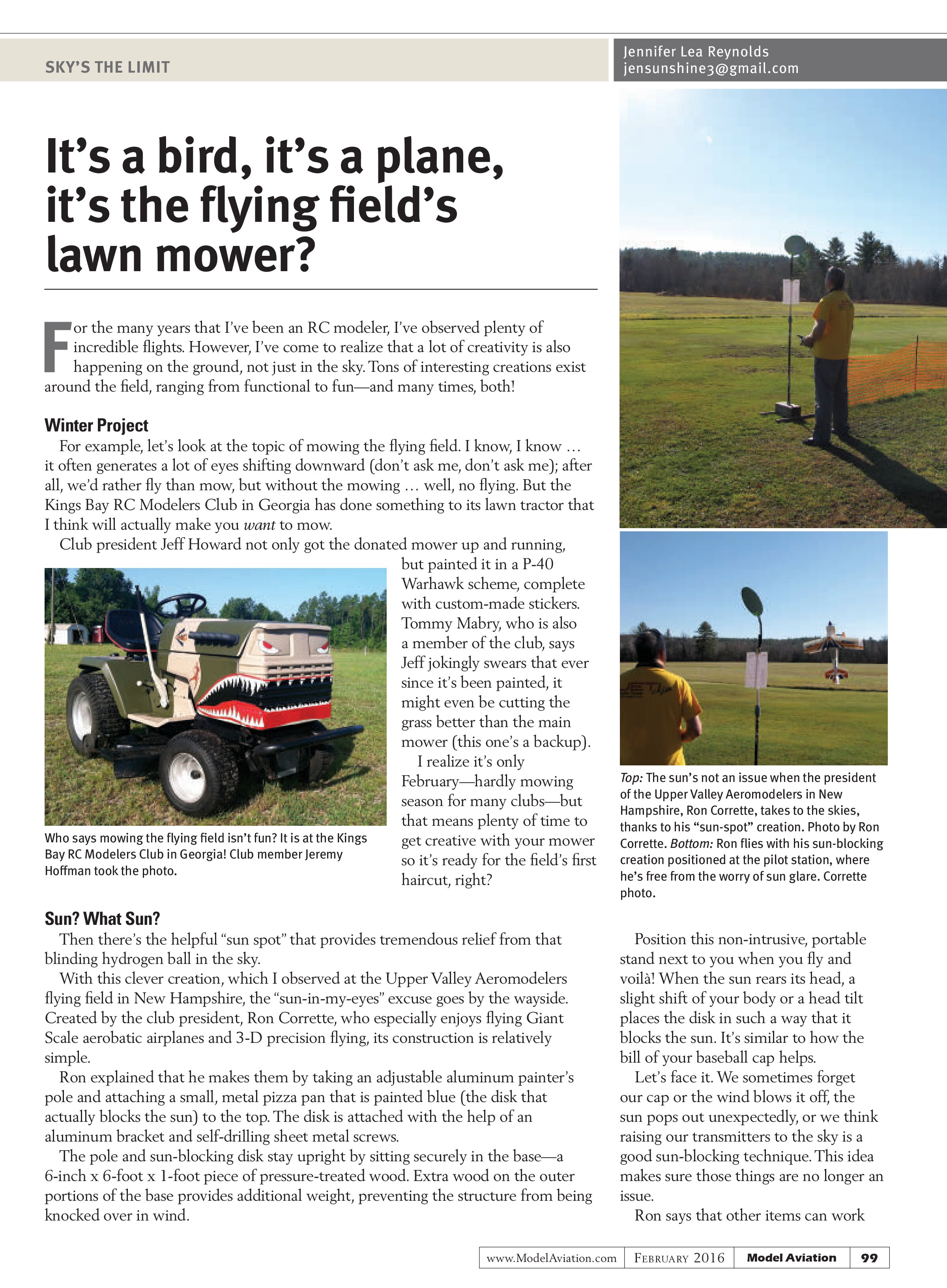
For example, let’s look at the topic of mowing the flying field. I know, I know … it often generates a lot of eyes shifting downward (don’t ask me, don’t ask me); after all, we’d rather fly than mow, but without the mowing … well, no flying. But the Kings Bay RC Modelers Club in Georgia has done something to its lawn tractor that I think will actually make you want to mow.
Club president Jeff Howard not only got the donated mower up and running,

but painted it in a P-40 Warhawk scheme, complete with custom-made stickers. Tommy Mabry, who is also a member of the club, says Jeff jokingly swears that ever since it’s been painted, it might even be cutting the grass better than the main mower (this one’s a backup).
I realize it’s only February—hardly mowing season for many clubs—but that means plenty of time to get creative with your mower so it’s ready for the field’s first haircut, right?
Sun? What Sun?
Then there’s the helpful “sun spot” that provides tremendous relief from that blinding hydrogen ball in the sky.
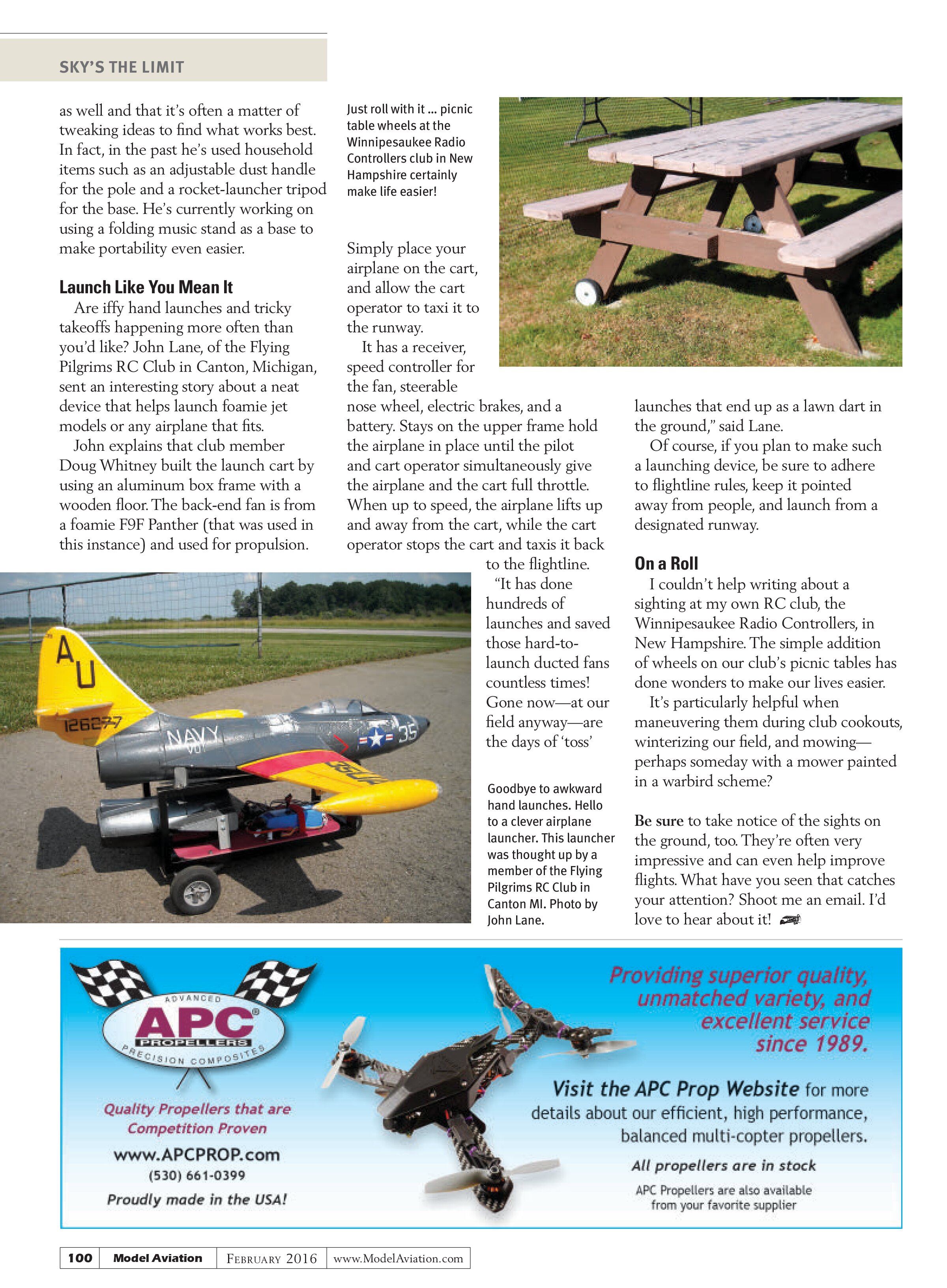
With this clever creation, which I observed at the Upper Valley Aeromodelers flying field in New Hampshire, the “sun-in-my-eyes” excuse goes by the wayside. Created by the club president, Ron Corrette, who especially enjoys flying Giant Scale aerobatic airplanes and 3-D precision flying, its construction is relatively simple.
Ron explained that he makes them by taking an adjustable aluminum painter’s pole and attaching a small, metal pizza pan that is painted blue (the disk that actually blocks the sun) to the top. The disk is attached with the help of an aluminum bracket and self-drilling sheet metal screws.
The pole and sun-blocking disk stay upright by sitting securely in the base—a 6-inch x 6-foot x 1-foot piece of pressure-treated wood. Extra wood on the outer portions of the base provides additional weight, preventing the structure from being knocked over in wind.


Position this non-intrusive, portable stand next to you when you fly and voilà! When the sun rears its head, a slight shift of your body or a head tilt places the disk in such a way that it blocks the sun. It’s similar to how the bill of your baseball cap helps.
Let’s face it. We sometimes forget our cap or the wind blows it off, the sun pops out unexpectedly, or we think raising our transmitters to the sky is a good sun-blocking technique. This idea makes sure those things are no longer an issue.
Ron says that other items can work
as well and that it’s often a matter of tweaking ideas to find what works best. In fact, in the past he’s used household items such as an adjustable dust handle for the pole and a rocket-launcher tripod for the base. He’s currently working on using a folding music stand as a base to make portability even easier.
Launch Like You Mean It
Are iffy hand launches and tricky takeoffs happening more often than you’d like? John Lane, of the Flying Pilgrims RC Club in Canton, Michigan, sent an interesting story about a neat device that helps launch foamie jet models or any airplane that fits.
John explains that club member Doug Whitney built the launch cart by using an aluminum box frame with a wooden floor. The back-end fan is from a foamie F9F Panther (that was used in this instance) and used for propulsion.

Simply place your airplane on the cart, and allow the cart operator to taxi it to the runway.
It has a receiver, speed controller for the fan, steerable nose wheel, electric brakes, and a battery. Stays on the upper frame hold the airplane in place until the pilot and cart operator simultaneously give the airplane and the cart full throttle. When up to speed, the airplane lifts up and away from the cart, while the cart operator stops the cart and taxis it back to the flightline.
“It has done hundreds of launches and saved those hard-to-launch ducted fans countless times! Gone now—at our field anyway—are the days of ‘toss’ launches that end up as a lawn dart in the ground,” said Lane.
Of course, if you plan to make such a launching device, be sure to adhere to flightline rules, keep it pointed away from people, and launch from a designated runway.

On a Roll
I couldn’t help writing about a sighting at my own RC club, the Winnipesaukee Radio Controllers, in New Hampshire. The simple addition of wheels on our club’s picnic tables has done wonders to make our lives easier.
It’s particularly helpful when maneuvering them during club cookouts, winterizing our field, and mowing—perhaps someday with a mower painted in a warbird scheme?
Be sure to take notice of the sights on the ground, too. They’re often very impressive and can even help improve flights. What have you seen that catches your attention? Shoot me an email. I’d love to hear about it!