Droning on
Dave Gee
safetycolumn@cs.com
Have you had “the drone talk” yet with your non-modeling friends and relatives? People come up to me and say, “Dave, you’re an airplane guy … what about this drone situation? Is it really a danger?”
All that they know is the stuff from television or Internet news sources. It seems that not every reporter has a clear understanding of model aviation, and some just want a sensational story regardless of the facts.
What do you tell your friends? It’s a new topic for most people, and they have only seen drones portrayed as some kind of ominous danger. I think that’s a shame, and of course, it’s untrue. I tell them that model aircraft have been continuously developed throughout the years, and multirotors aren’t the first or the last cool, new idea. They’re pretty much like any model, and (as we’ve sometimes seen on video) it’s possible to misuse a quadcopter, just like any other thing that humans invent.

Commercial-size unmanned aerial vehicles (UAVs) are a different matter. Professional pilots use them to earn a living, much like transport aircraft. Camera work, cargo delivery, scientific research, and other tasks are clearly different from the recreational use of a model airplane or rotorcraft.
It’s clear enough to us, but not always to the general public. That’s why our answers to people’s questions matter so much.
Regulated or Outlawed
In my opinion, the true danger from drones is that our sport could be heavily restricted or outlawed because lawmakers don’t always know enough about modeling. Some of the proposed regulations for UAVs could accidentally restrict all sorts of model aircraft, too. Now that’s scary! (I am convinced that AMA lobbying and education has saved our hobby thus far. Please support these efforts!)
Ask a non-modeler to define the terms drone or UAV, and you’ll hear some odd responses:
“That’s when something carries a camera.”
“It’s a quadcopter with six rotors.”
“You know, like when you’re the pilot of an autonomous drone?”
Hey, why would an autonomous vehicle need a pilot? Hammering out the legal definitions of UAV, drone, and hobby or sport aircraft, will be a challenge. The fun that we have building and flying models is at stake.
Rotor Racers
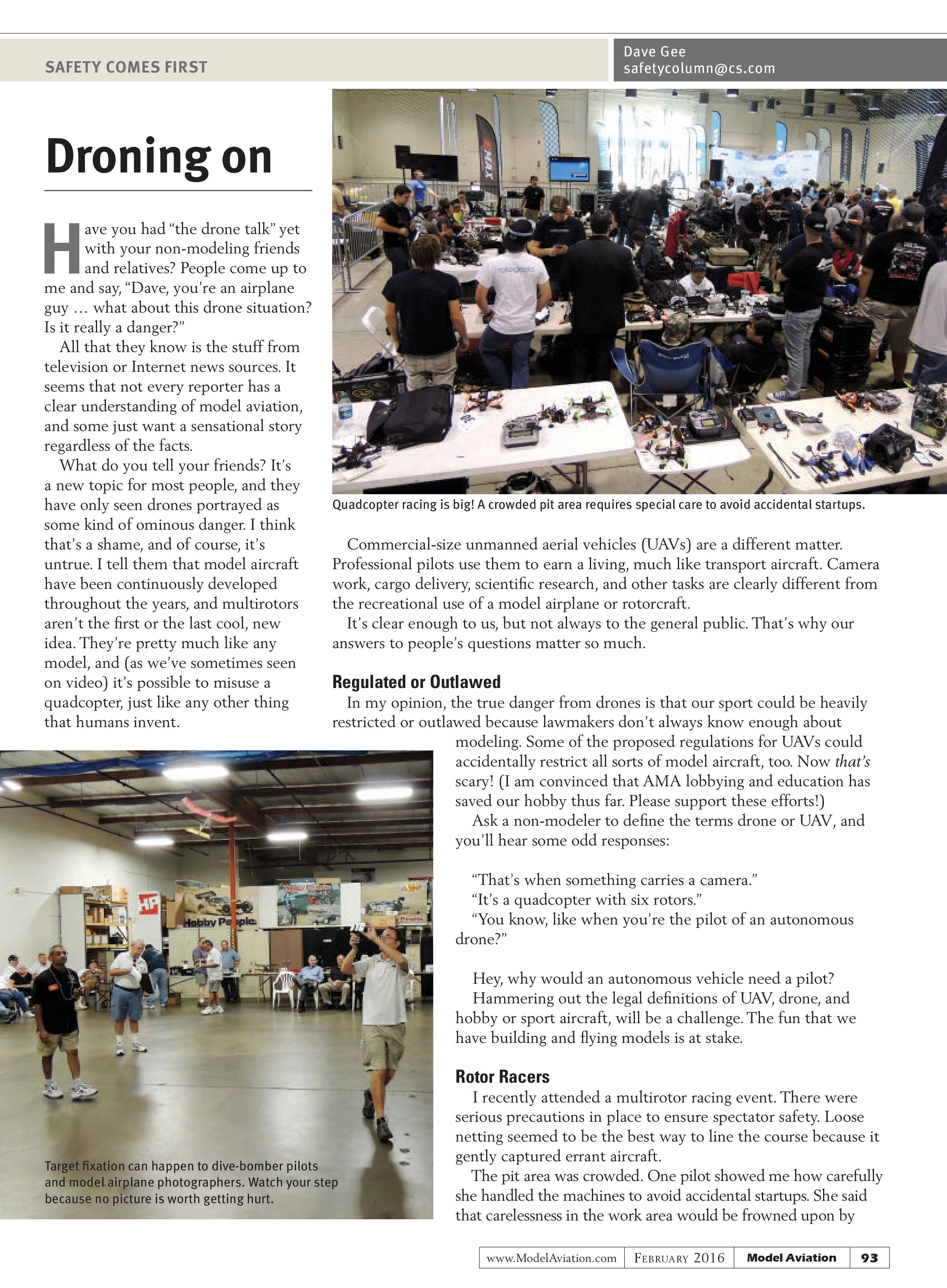
I recently attended a multirotor racing event. There were serious precautions in place to ensure spectator safety. Loose netting seemed to be the best way to line the course because it gently captured errant aircraft.
The pit area was crowded. One pilot showed me how carefully she handled the machines to avoid accidental startups. She said that carelessness in the work area would be frowned upon by

the other pilots, so everyone was polite and vigilant.
The quadcopters were flown via onboard cameras, and big TV screens allowed spectators to see the pilot’s view from the goggles. The race I watched was chaotic and brief, with several crashes and minor damage—a real crowd-pleaser. I think this event is just getting started and will develop fast.
The bottom line is that multirotors are a big thing in aeromodeling right now, and many people are having fun with them. Even if you aren’t interested in these aircraft, some of the new technology is liable to spill over and bring some keen gadgets into your workshop. That’s how things work in the world of model aviation.
Get Fixed and Get Broken
Target fixation is when a dive-bomber pilot gets totally involved in the target run and forgets to pull out. Some ground-attack aircraft have automatic pullout devices to counter this phenomenon. It can happen in other areas of life, too.
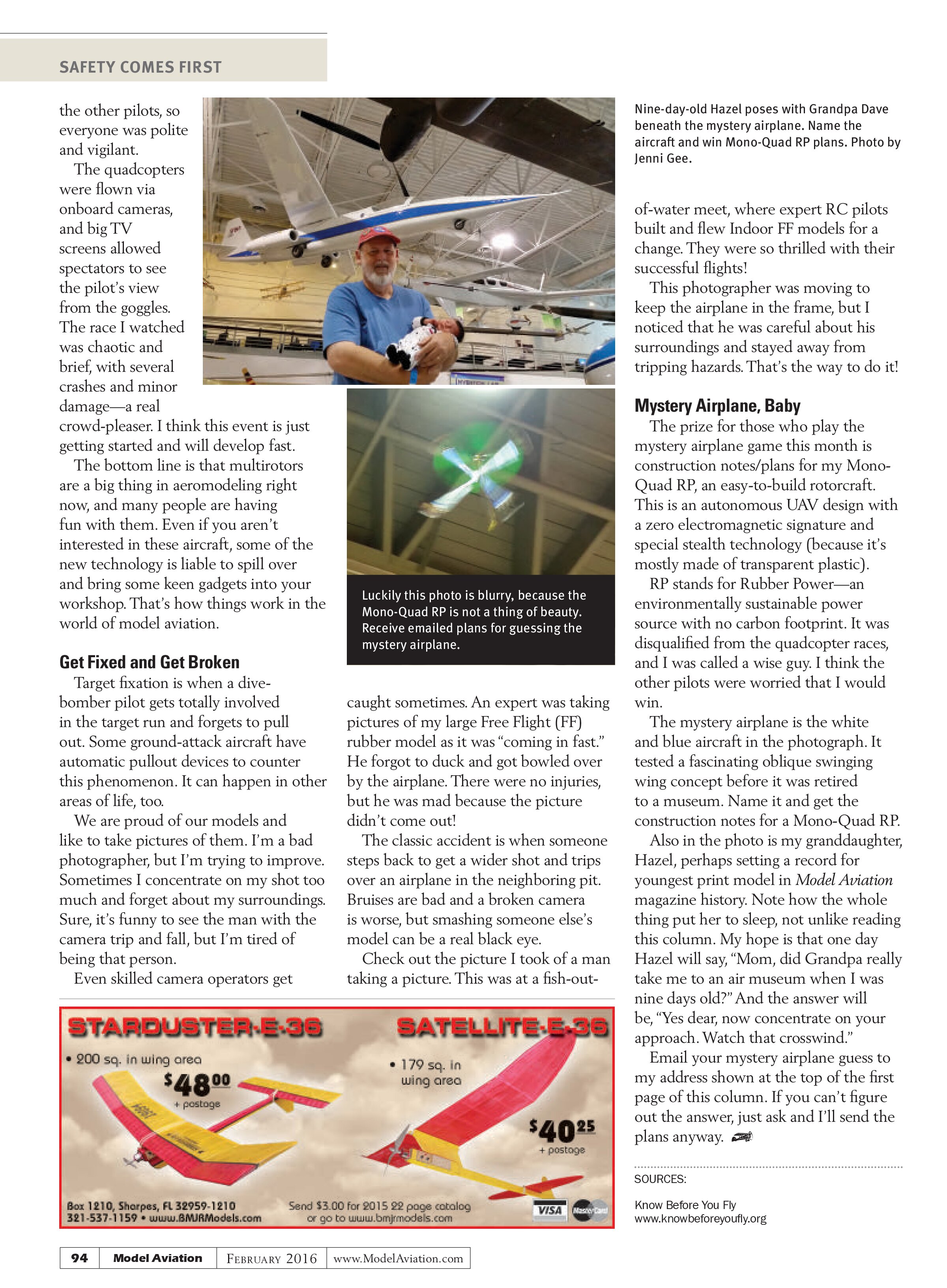
We are proud of our models and like to take pictures of them. I’m a bad photographer, but I’m trying to improve. Sometimes I concentrate on my shot too much and forget about my surroundings. Sure, it’s funny to see the man with the camera trip and fall, but I’m tired of being that person.
Even skilled camera operators get caught sometimes. An expert was taking pictures of my large Free Flight (FF) rubber model as it was “coming in fast.” He forgot to duck and got bowled over by the airplane. There were no injuries, but he was mad because the picture didn’t come out.
The classic accident is when someone steps back to get a wider shot and trips over an airplane in the neighboring pit. Bruises are bad and a broken camera is worse, but smashing someone else’s model can be a real black eye.
Check out the picture I took of a man taking a picture. This was at a fish-out-of-water meet, where expert RC pilots built and flew Indoor FF models for a change. They were so thrilled with their successful flights!
This photographer was moving to keep the airplane in the frame, but I noticed that he was careful about his surroundings and stayed away from tripping hazards. That’s the way to do it!

Mystery Airplane, Baby
The prize for those who play the mystery airplane game this month is construction notes/plans for my Mono-Quad RP, an easy-to-build rotorcraft. This is an autonomous UAV design with a zero electromagnetic signature and special stealth technology (because it’s mostly made of transparent plastic).
RP stands for Rubber Power—an environmentally sustainable power source with no carbon footprint. It was disqualified from the quadcopter races, and I was called a wise guy. I think the other pilots were worried that I would win.
The mystery airplane is the white and blue aircraft in the photograph. It tested a fascinating oblique swinging wing concept before it was retired to a museum. Name it and get the construction notes for a Mono-Quad RP.
Also in the photo is my granddaughter, Hazel, perhaps setting a record for youngest print model in Model Aviation magazine history. Note how the whole thing put her to sleep, not unlike reading this column. My hope is that one day Hazel will say, “Mom, did Grandpa really take me to an air museum when I was nine days old?” And the answer will be, “Yes dear, now concentrate on your approach. Watch that crosswind.”
Email your mystery airplane guess to my address shown at the top of the first page of this column. If you can’t figure out the answer, just ask and I’ll send the plans anyway.

SOURCES:
Know Before You Fly
www.knowbeforeyoufly.org