Be prepared for engine failures
by John Glezellis
jglezellis@gmail.com
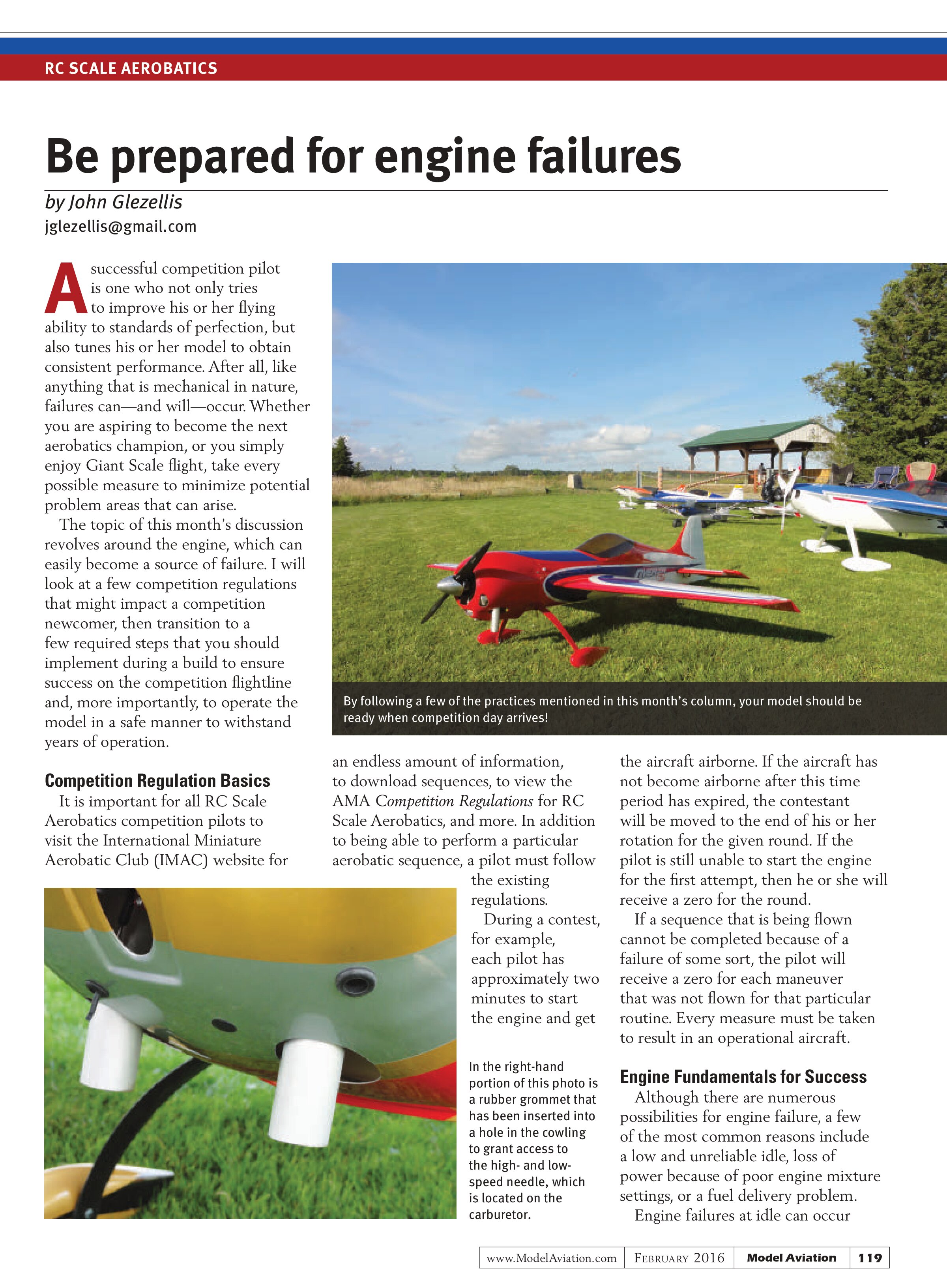
A successful competition pilot is one who not only tries to improve his or her flying ability to standards of perfection, but also tunes his or her model to obtain consistent performance. After all, like anything that is mechanical in nature, failures can—and will—occur. Whether you are aspiring to become the next aerobatics champion, or you simply enjoy Giant Scale flight, take every possible measure to minimize potential problem areas that can arise.
The topic of this month’s discussion revolves around the engine, which can easily become a source of failure. I will look at a few competition regulations that might impact a competition newcomer, then transition to a few required steps that you should implement during a build to ensure success on the competition flightline and, more importantly, to operate the model in a safe manner to withstand years of operation.

Competition Regulation Basics
It is important for all RC Scale Aerobatics competition pilots to visit the International Miniature Aerobatic Club (IMAC) website for

an endless amount of information, to download sequences, to view the AMA Competition Regulations for RC Scale Aerobatics, and more. In addition to being able to perform a particular aerobatic sequence, a pilot must follow the existing regulations.
During a contest, for example, each pilot has approximately two minutes to start the engine and get the aircraft airborne. If the aircraft has not become airborne after this time period has expired, the contestant will be moved to the end of his or her rotation for the given round. If the pilot is still unable to start the engine for the first attempt, then he or she will receive a zero for the round.
If a sequence that is being flown cannot be completed because of a failure of some sort, the pilot will receive a zero for each maneuver that was not flown for that particular routine. Every measure must be taken to result in an operational aircraft.
Engine Fundamentals for Success
Although there are numerous possibilities for engine failure, a few of the most common reasons include a low and unreliable idle, loss of power because of poor engine mixture settings, or a fuel delivery problem. Engine failures at idle can occur
during a spin or a Hammerhead maneuver if the idle is set too low at the start of the flight. Another possible reason is because of a poor servo and/or linkage choice.
During the build, a high-performance servo to control the throttle, coupled with proper linkage geometry, will result in a linear throttle response. Ensure that the length of the servo arm—when it’s measured from the center of the servo arm screw to the linkage pivot point—is the same length or smaller when compared with the distance from the center of the carburetor arm (where it pivots the butterfly) and the linkage attachment point.
You might notice that most gasoline carburetors have a spring attached to the butterfly/throttle shaft called the return spring. If you feel there

is too much tension, simply unhook the spring. The spring should not be removed. The brass plate on the carburetor can become damaged because of excessive amounts of vibration.
The goal is to obtain full range of travel for the throttle servo with similar, if not the same, Adjustable
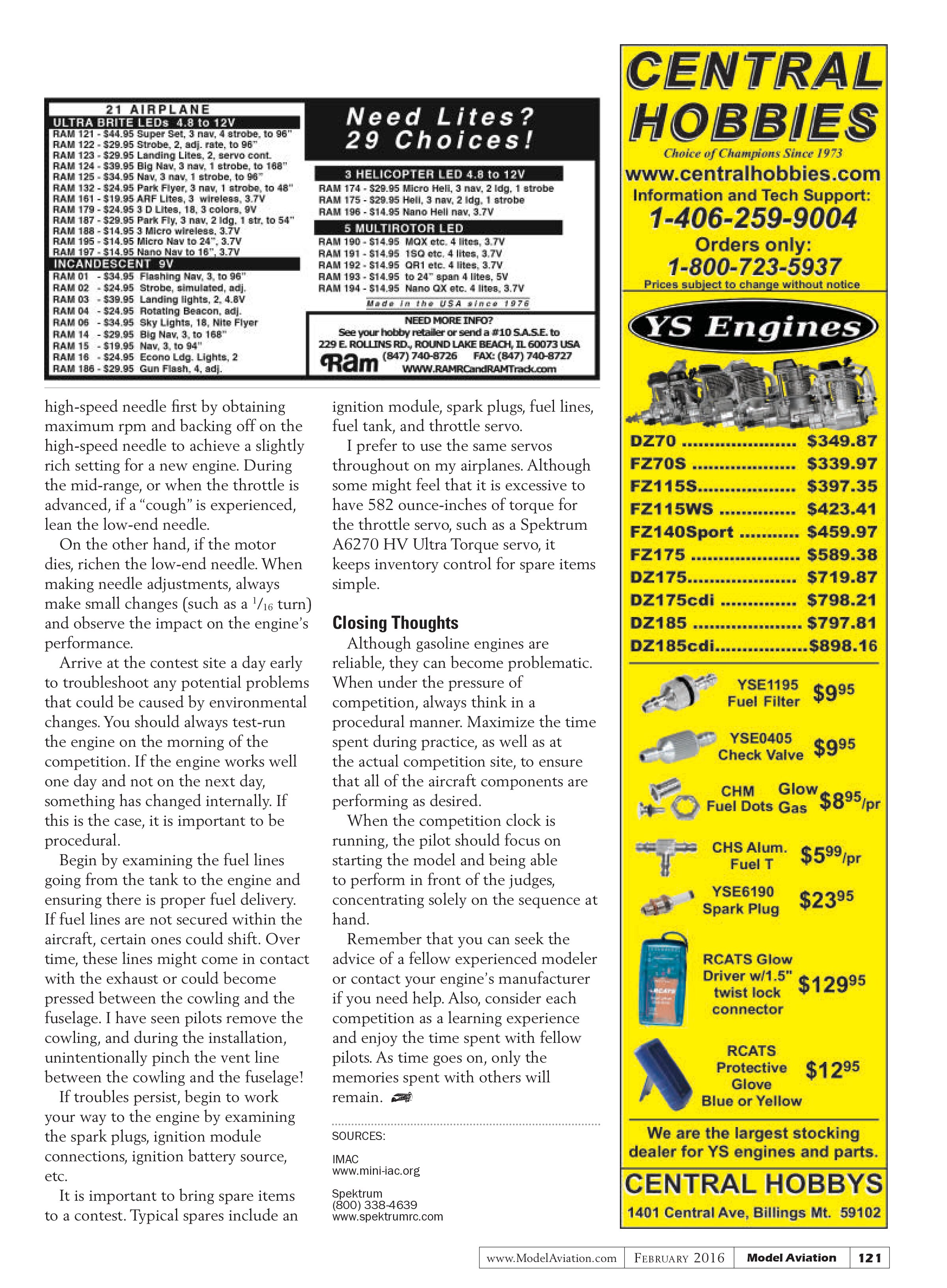
Secure all of the fuel lines within the aircraft to ensure proper fuel delivery to the engine. Replace all fuel lines, especially those inside the fuel tank, during routine maintenance if a particular type of fuel line tends to harden.
Travel Volume (ATV) settings for both the high and low setting.
Regarding engine mixture settings, most engines are factory tested, but changes are often required when flying at different temperatures or elevations.
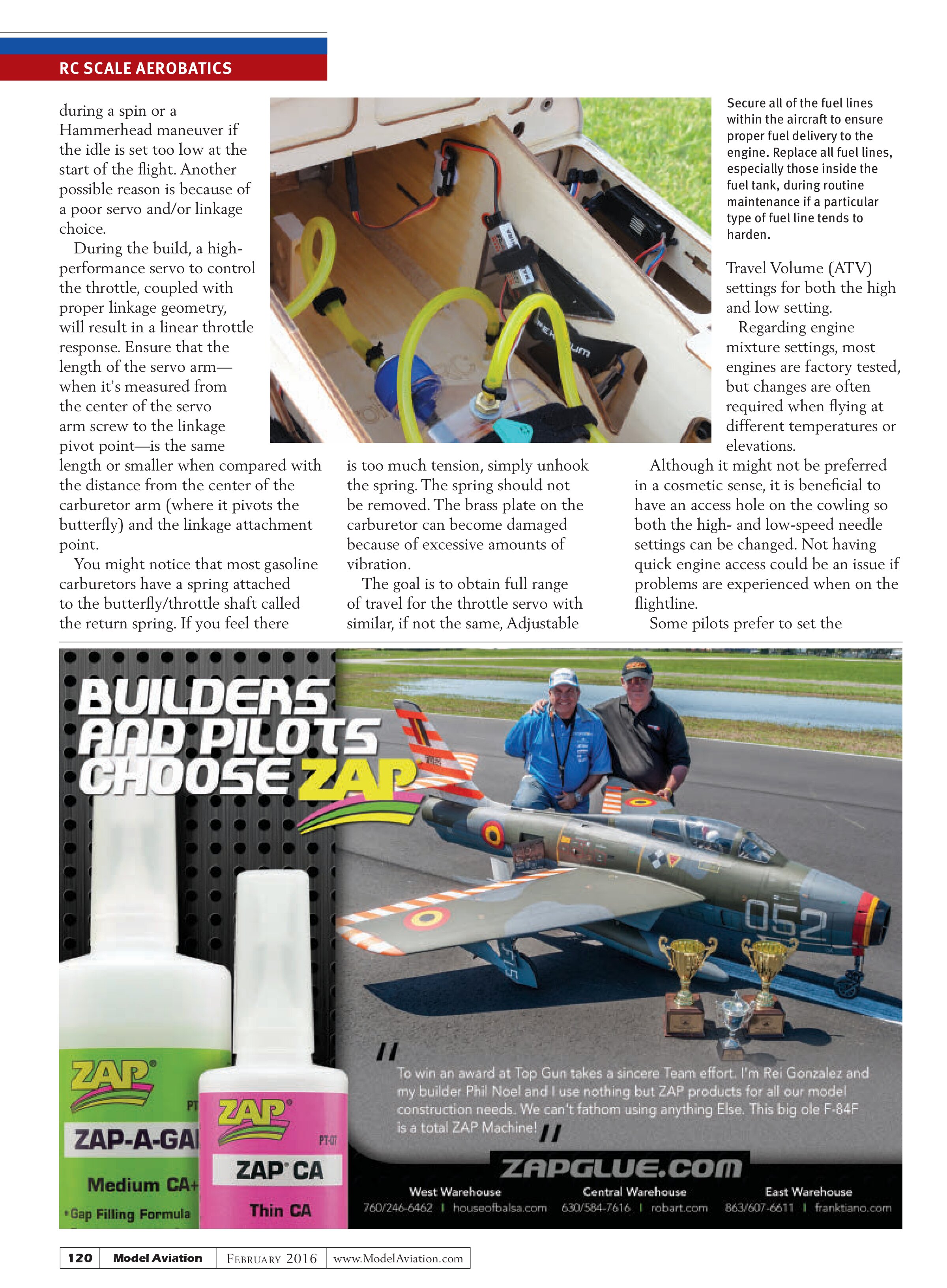
Although it might not be preferred in a cosmetic sense, it is beneficial to have an access hole on the cowling so both the high- and low-speed needle settings can be changed. Not having quick engine access could be an issue if problems are experienced when on the flightline.
Some pilots prefer to set the high-speed needle first by obtaining maximum rpm and backing off on the high-speed needle to achieve a slightly rich setting for a new engine. During the mid-range, or when the throttle is advanced, if a “cough” is experienced, lean the low-end needle.
On the other hand, if the motor dies, richen the low-end needle. When making needle adjustments, always make small changes (such as a ¹⁄₁₆ turn) and observe the impact on the engine’s performance.
Arrive at the contest site a day early to troubleshoot any potential problems that could be caused by environmental changes. You should always test-run the engine on the morning of the competition. If the engine works well one day and not on the next day, something has changed internally. If this is the case, it is important to be procedural.
Begin by examining the fuel lines going from the tank to the engine and ensuring there is proper fuel delivery. If fuel lines are not secured within the aircraft, certain ones could shift. Over time, these lines might come in contact with the exhaust or could become pressed between the cowling and the fuselage. I have seen pilots remove the cowling, and during the installation, unintentionally pinch the vent line between the cowling and the fuselage!
If troubles persist, begin to work your way to the engine by examining the spark plugs, ignition module connections, ignition battery source, etc.
It is important to bring spare items to a contest. Typical spares include an ignition module, spark plugs, fuel lines, fuel tank, and throttle servo.
I prefer to use the same servos throughout on my airplanes. Although some might feel that it is excessive to have 582 ounce-inches of torque for the throttle servo, such as a Spektrum A6270 HV Ultra Torque servo, it keeps inventory control for spare items simple.
Closing Thoughts
Although gasoline engines are reliable, they can become problematic. When under the pressure of competition, always think in a procedural manner. Maximize the time spent during practice, as well as at the actual competition site, to ensure that all of the aircraft components are performing as desired.
When the competition clock is running, the pilot should focus on starting the model and being able to perform in front of the judges, concentrating solely on the sequence at hand.
Remember that you can seek the advice of a fellow experienced modeler or contact your engine’s manufacturer if you need help. Also, consider each competition as a learning experience and enjoy the time spent with fellow pilots. As time goes on, only the memories spent with others will remain.
SOURCES:
IMAC
www.mini-iac.org
Spektrum
(800) 338-4639
www.spektrumrc.com