Low-speed 3-D
Chris Mulcahy
cspaced@gmail.com

Low-speed 3-D flying is nothing new for some people, but for those who are unfamiliar with it, please let me explain. The idea of low-speed 3-D is that instead of setting your helicopter up for high-octane, all-out power for a 3- or 4-minute flight (on a 700-size heli), you gear your helicopter to run a lower Kv motor, run a much lower head speed, and still have enough power to be able to fly most 3-D maneuvers. You won’t have the “pop” that a 2,000 rpm or more 700-size heli will give you, but there is still plenty of power to do most things, as well as offer some additional advantages.
The first is flight time. You can dramatically increase your flight time with the right setup. I’m referring to a possible 10-minute flight with a 700-size machine. How does doubling your flight time sound?
This type of setup is not for everyone because you lose the ability to perform extreme stops (and the blade noise that goes with it), but if you feel like trying something different, then this could be the ticket.
There are also several ways to build a low-rpm helicopter, but this is what worked for me and my fellow pilots based on the equipment and batteries that we had.
When it comes to low rpm flying, there is only one person who springs to mind: Gary Wright. I had the chance to fly his Synergy E5, which was stretched to a 600-size machine with a longer boom, and it totally changed my point of view on a low-speed setup.
Gary’s Synergy E5 Stretch was a 6S setup running a Hacker

Tornado 850 Kv short can motor. His head speeds were set to 1,500, 1,700, and 1,900 rpm. An rpm of 1,900 is considered a low head speed for many 600 setups, and 2,200 to 2,300 rpm is a normal 3-D flying mode, so Gary’s head speeds are pretty low. When flying with a mix of those three rpms throughout the flight, Gary was achieving 8-plus-minute flight times.
I wasn’t sure what to expect from flying Gary’s E5. At first, I just lifted off of the ground, and even at 1,500 rpm, it was smooth. I did a couple of flips and everything felt great. I soon started flying the E5 around and was surprised at how much speed it could pick up. It certainly didn’t lack power.
What astounded me the most was when I was doing aileron Tic-Tocs. They were some of the smoothest-looking Tic-Tocs I had ever flown—a testament to Gary’s tuning on the Futaba CGY750 flybarless system.
I tried 1,700 rpm for a little while and found it to also be a great head speed, with plenty of performance and agility. Flipping up to 1,900 rpm, I started to do some fast-forward flight—making passes up and down the runway. I was again surprised at how quick the helicopter was. After approximately eight minutes of an enjoyable flight, I finally brought it back down to

land. Not once did I feel like, “Uh oh, not enough power for that!”
It took everything I threw at it. The only difference I noticed was that I had to move the collective stick slightly farther than normal when performing maneuvers. I knew right there and then that I had to build myself a similar setup.
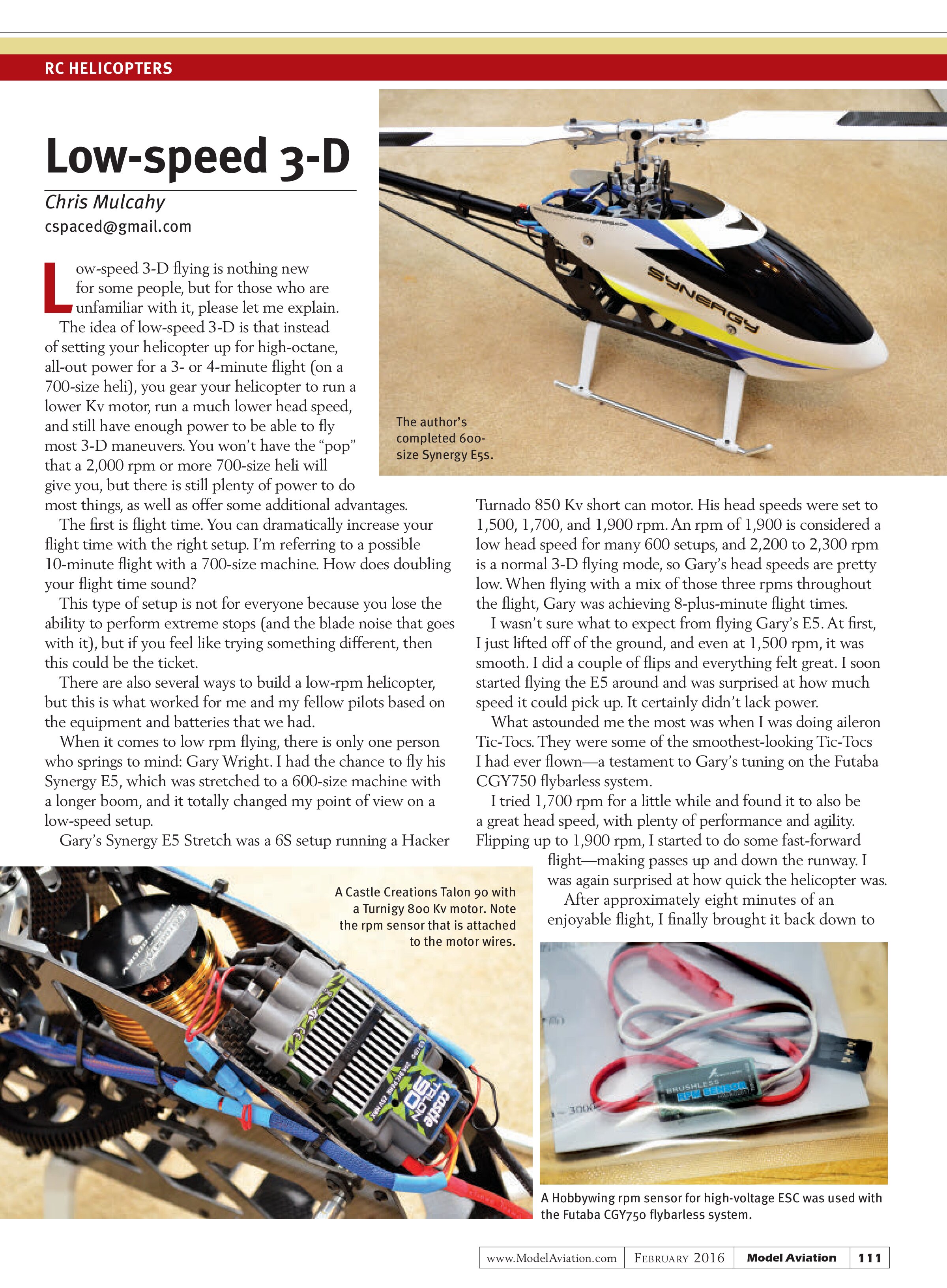
I chose the Synergy E5, which is a great platform. Stretch kits are already available to make it a 600- or 700-size heli. My E5 came out at 6 pounds, 5 ounces without the flight battery. The 6S 5,500 LiPo batteries that Gary used weighed 27 ounces, creating a ready-to-fly weight of 7 pounds, 9 ounces.
There are a few things that need to be done to make everything work at the lower head speeds. Starting with the tail, I changed the gear ratio by switching out the stock 13-tooth spur gear for an 11-tooth spur gear. I also switched out the 52-tooth autorotation gear for a 54-tooth gear. This gave me a 1:4.9 gear ratio on the tail instead of the stock 1:4.0 ratio—speeding up the tail rotor to make it more effective at the lower head speed.
The next thing is pitch range. A low head speed likes more pitch to give it a similar feel to higher head speed/lower pitch. I typically run 12° to 13° on a high head-speed setup, and for the low head speed, 14° and up appears to be the magic number. The CGY750 needs slightly more cyclic pitch range to maintain a similar pitch/roll rate at the lower head speed, so I installed longer balls on the inner swashplate for the pitch links.
I also wanted to use the CGY750’s governor feature. To do this, I had to get a brushless rpm sensor. Hobbywing makes one that works great, so I added it to the list.
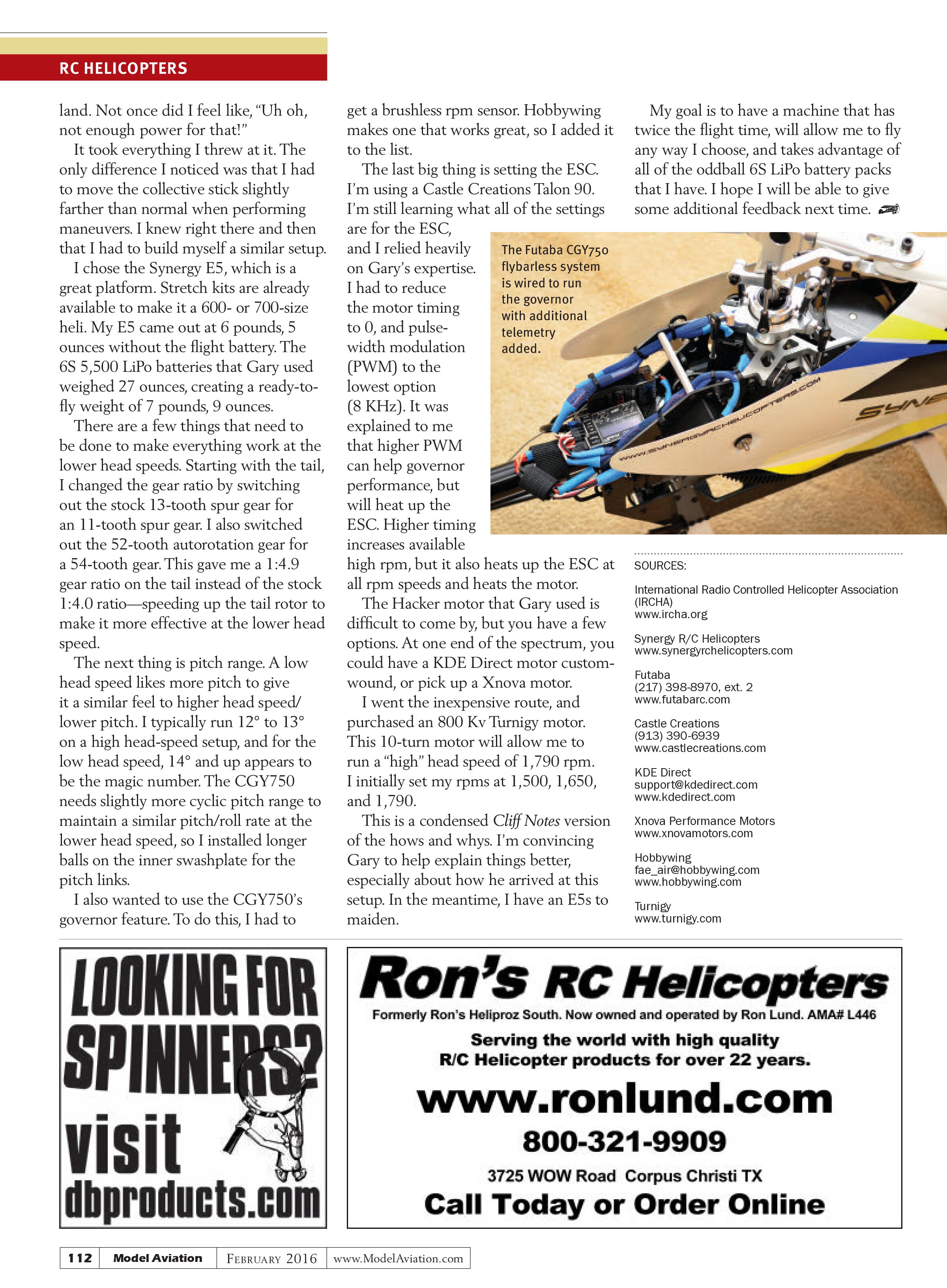
The last big thing is setting the ESC. I’m using a Castle Creations Talon 90. I’m still learning what all of the settings are for the ESC, and I relied heavily on Gary’s expertise. I had to reduce the motor timing to 0, and pulse-width modulation (PWM) to the lowest option (8 KHz). It was explained to me that higher PWM can help governor performance, but will heat up the ESC. Higher timing increases available high rpm, but it also heats up the ESC at all rpm speeds and heats the motor.
The Hacker motor that Gary used is difficult to come by, but you have a few options. At one end of the spectrum, you could have a KDE Direct motor custom-wound, or pick up a Xnova motor.
I went the inexpensive route, and purchased an 800 Kv Turnigy motor. This 10-turn motor will allow me to run a “high” head speed of 1,790 rpm. I initially set my rpms at 1,500, 1,650, and 1,790.
This is a condensed Cliff Notes version of the hows and whys. I’m convincing Gary to help explain things better, especially about how he arrived at this setup. In the meantime, I have an E5s to maiden.
My goal is to have a machine that has twice the flight time, will allow me to fly any way I choose, and takes advantage of all of the oddball 6S LiPo battery packs that I have. I hope I will be able to give some additional feedback next time.

Sources:
International Radio Controlled Helicopter Association (IRCHA)
www.ircha.org
Synergy R/C Helicopters
www.synergyrc helicopters.com
Futaba
(217) 398-8970, ext. 2
www.futaba rc.com
Castle Creations
(913) 390-6939
www.castlecreations.com
KDE Direct
support@kdedirect.com
www.kdedirect.com
Xnova Performance Motors
www.xnovamotors.com
Hobbywing
fae_air@hobbywing.com
www.hobbywing.com
Turnigy
www.turnigy.com