RC Combat explained
by Don Grissom
dongrissom@hilltopflyers.com
RC Combat information: I am frequently asked about RC Combat and the basic rules, so here is some information about the different events that are flown throughout the country.
The first thing to remember is that RC Combat was designed as a way to have fun and enjoy the thrill of flying in a dogfight. In Combat, you begin by towing a 30-foot streamer behind your airplane. During a Combat heat, your objective is to retain as much of your own streamer as you can, while also trying to cut those of your opponents.
In most contests, you have from five to as many as 10 airplanes in the air at any one time. Every time you cut another contestant’s streamer, you get points. This is known as a kill, which is as though you shot down an opposing pilot’s airplane.
You can get as many cuts as you want on any streamer during a Combat heat, but you want to be careful that you keep as much of your own as you can. Even if you lose some or all of your own streamer, you can continue to engage the other contestants until the end of the heat.
Combat can be confusing because more than one type of Combat is flown. When trying to determine which type of Combat you want to fly, visit a club in your area and see what others are flying. Having someone to fly with regularly makes it easier to get started, as well as practice.


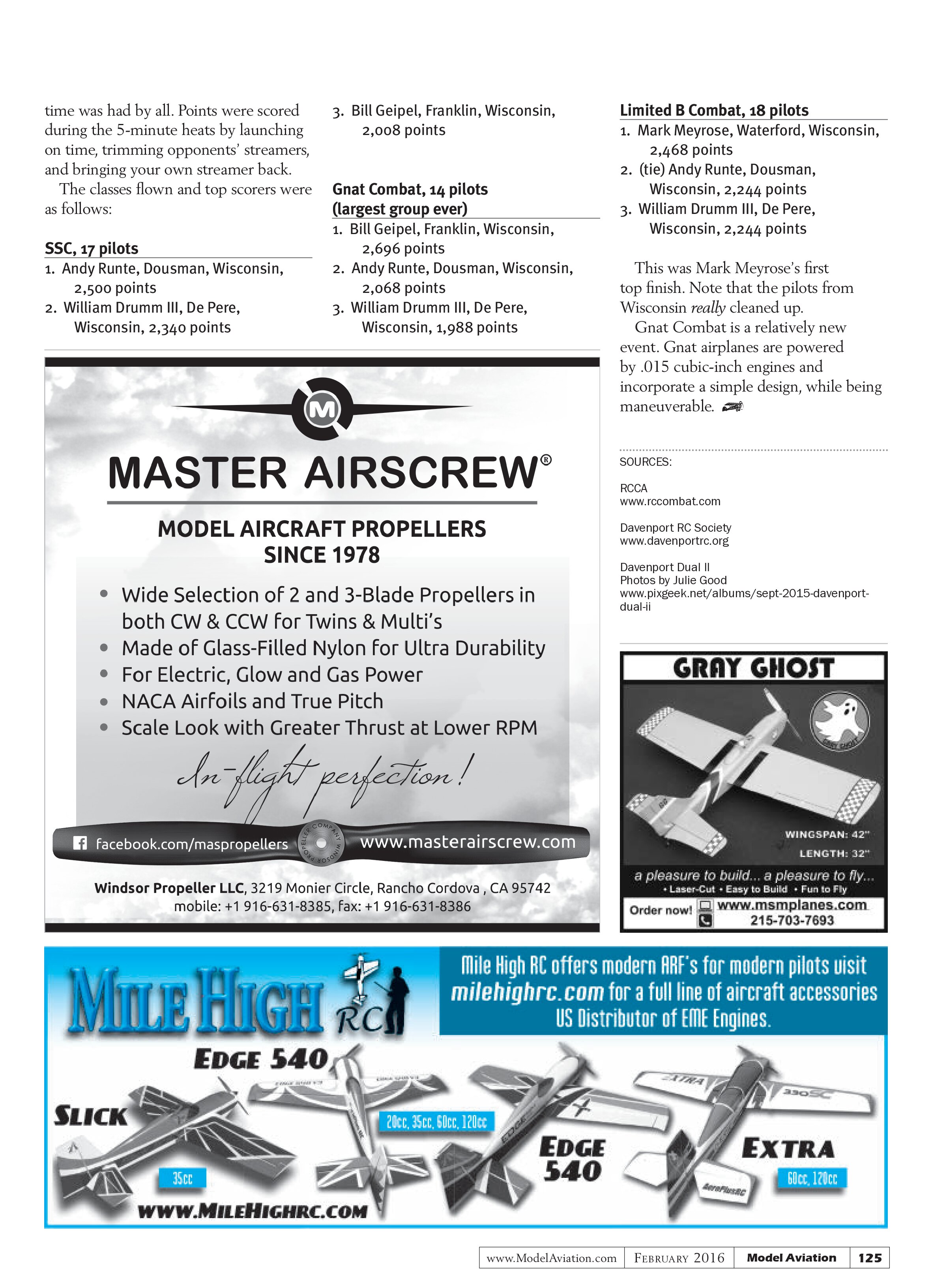
Slow Survivable Combat (SSC) began in 2003 and has become one of the most frequently flown contests throughout the year. This can be attributed to the cost of airplanes, as well as shorter repair time. In SSC, there are rules limiting weight, engine size, and even the price of the engine, as well as other stipulations.
Another version of Combat that has become popular is Limited B. This is similar to SSC, but with a .25 cubic-inch-displacement engine instead of the .15 engine used in SSC. The rpm limit is 14,500 with a 10 x 4 propeller, where as in SSC it is 17,500 rpm with an 8 x 3 propeller. There are many designs available online to help you build an airplane from scratch, as well as for those sold in kit form.
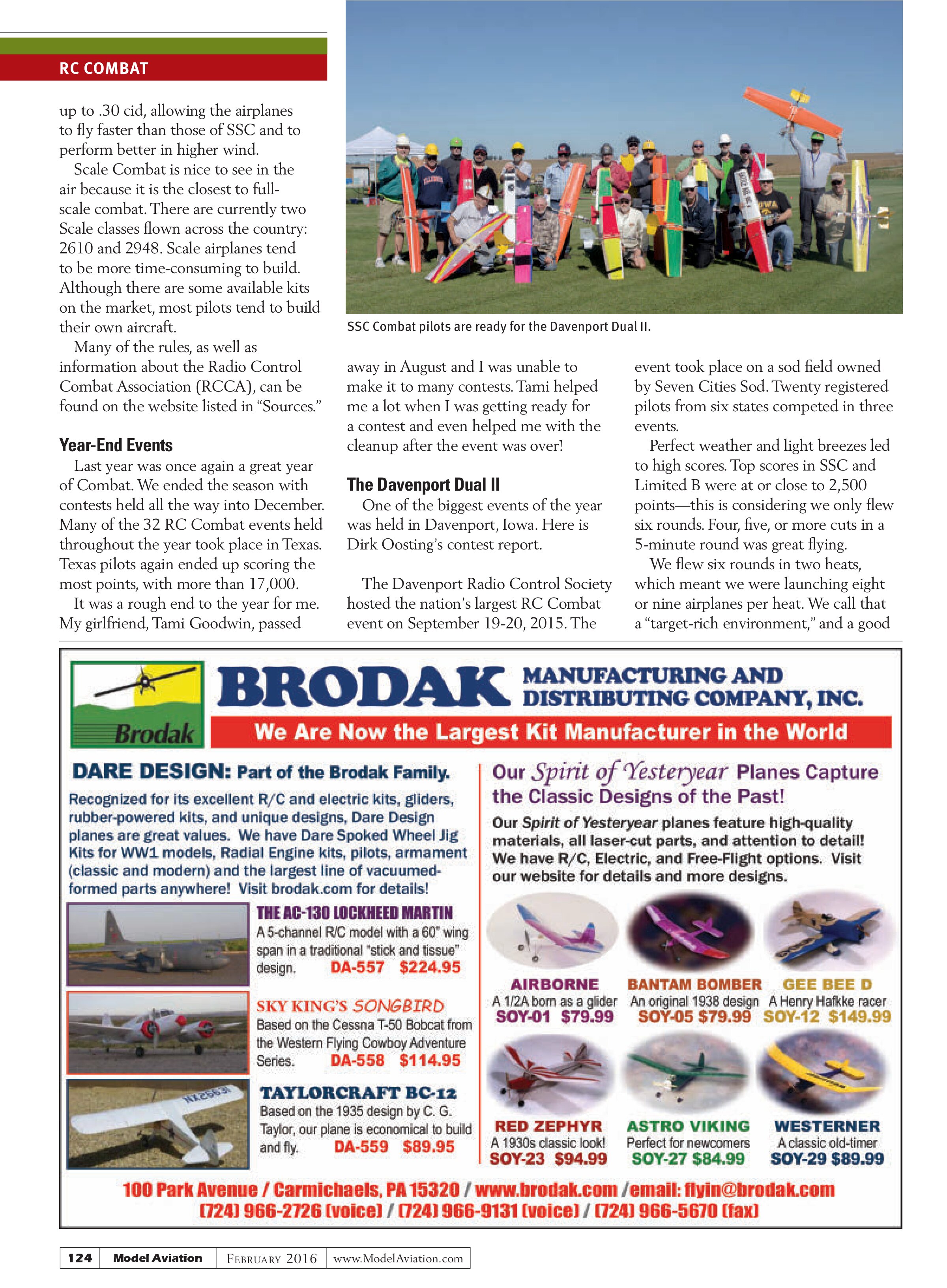
A relatively new Combat class is Gnat Combat. It is a more restricted class because all of the airplanes are the same. Gnat Combat uses a .15 engine, but does not have rpm limits. This class does not use any sticky stuff on the wings, which is nice because you do not end up sticky at the end of the day. Gnat airplanes are all made the same way, making the pilot more important than merely seeing who has the better airplane.
In Open classes, the most commonly flown is Open B. It has been around for many years and is still a favorite for many pilots. Many of the airplane designs flown in SSC can be used in Open B. The main difference is the engine size. Open B employs any engine
up to .30 cid, allowing the airplanes to fly faster than those of SSC and to perform better in higher wind. Scale Combat is nice to see in the air because it is the closest to full-scale combat. There are currently two Scale classes flown across the country: 2610 and 2948. Scale airplanes tend to be more time-consuming to build. Although there are some available kits on the market, most pilots tend to build their own aircraft. Many of the rules, as well as information about the Radio Control Combat Association (RCCA), can be found on the website listed in “Sources.”
Year-End Events
Last year was once again a great year of Combat. We ended the season with contests held all the way into December. Many of the 32 RC Combat events held throughout the year took place in Texas. Texas pilots again ended up scoring the most points, with more than 17,000.
It was a rough end to the year for me. My girlfriend, Tami Goodwin, passed away in August and I was unable to make it to many contests. Tami helped me a lot when I was getting ready for a contest and even helped me with the cleanup after the event was over!
The Davenport Dual II
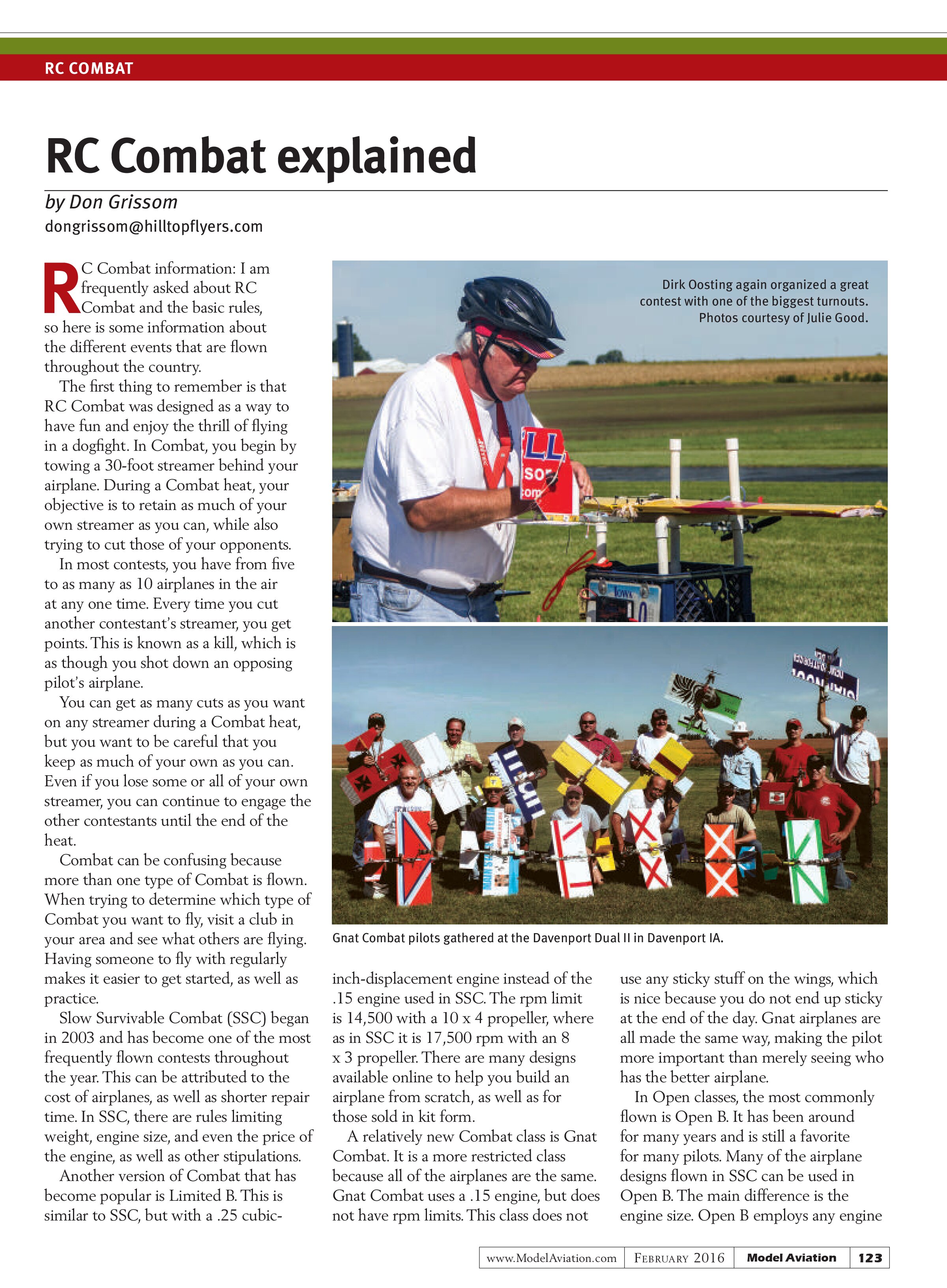
One of the biggest events of the year was held in Davenport, Iowa. Here is Dirk Oosting’s contest report.
The Davenport Radio Control Society hosted the nation’s largest RC Combat event on September 19-20, 2015. The event took place on a sod field owned by Seven Cities Sod. Twenty registered pilots from six states competed in three events.
Perfect weather and light breezes led to high scores. Top scores in SSC and Limited B were at or close to 2,500 points—this is considering we only flew six rounds. Four, five, or more cuts in a 5-minute round was great flying. We flew six rounds in two heats, which meant we were launching eight or nine airplanes per heat. We call that a “target-rich environment,” and a good

The classes flown and top scorers were as follows:
SSC, 17 pilots
- Andy Runte, Dousman, Wisconsin, 2,500 points
- William Drumm III, De Pere, Wisconsin, 2,340 points
- Bill Geipel, Franklin, Wisconsin, 2,008 points
Gnat Combat, 14 pilots (largest group ever)
- Bill Geipel, Franklin, Wisconsin, 2,696 points
- Andy Runte, Dousman, Wisconsin, 2,068 points
- William Drumm III, De Pere, Wisconsin, 1,988 points
Limited B Combat, 18 pilots
- Mark Meyrose, Waterford, Wisconsin, 2,468 points
- (tie) Andy Runte, Dousman, Wisconsin, 2,244 points
- William Drumm III, De Pere, Wisconsin, 2,244 points
This was Mark Meyrose’s first top finish. Note that the pilots from Wisconsin really cleaned up. Gnat Combat is a relatively new event. Gnat airplanes are powered by .015 cubic-inch engines and incorporate a simple design, while being maneuverable.
Sources:
RCCA
www.rccombat.com
Davenport RC Society
www.davenportrc.org
Davenport Dual II
Photos by Julie Good
www.pixgeek.net/albums/sept-2015-davenport-dual-ii