Classic and Vintage events inspire unique aircraft
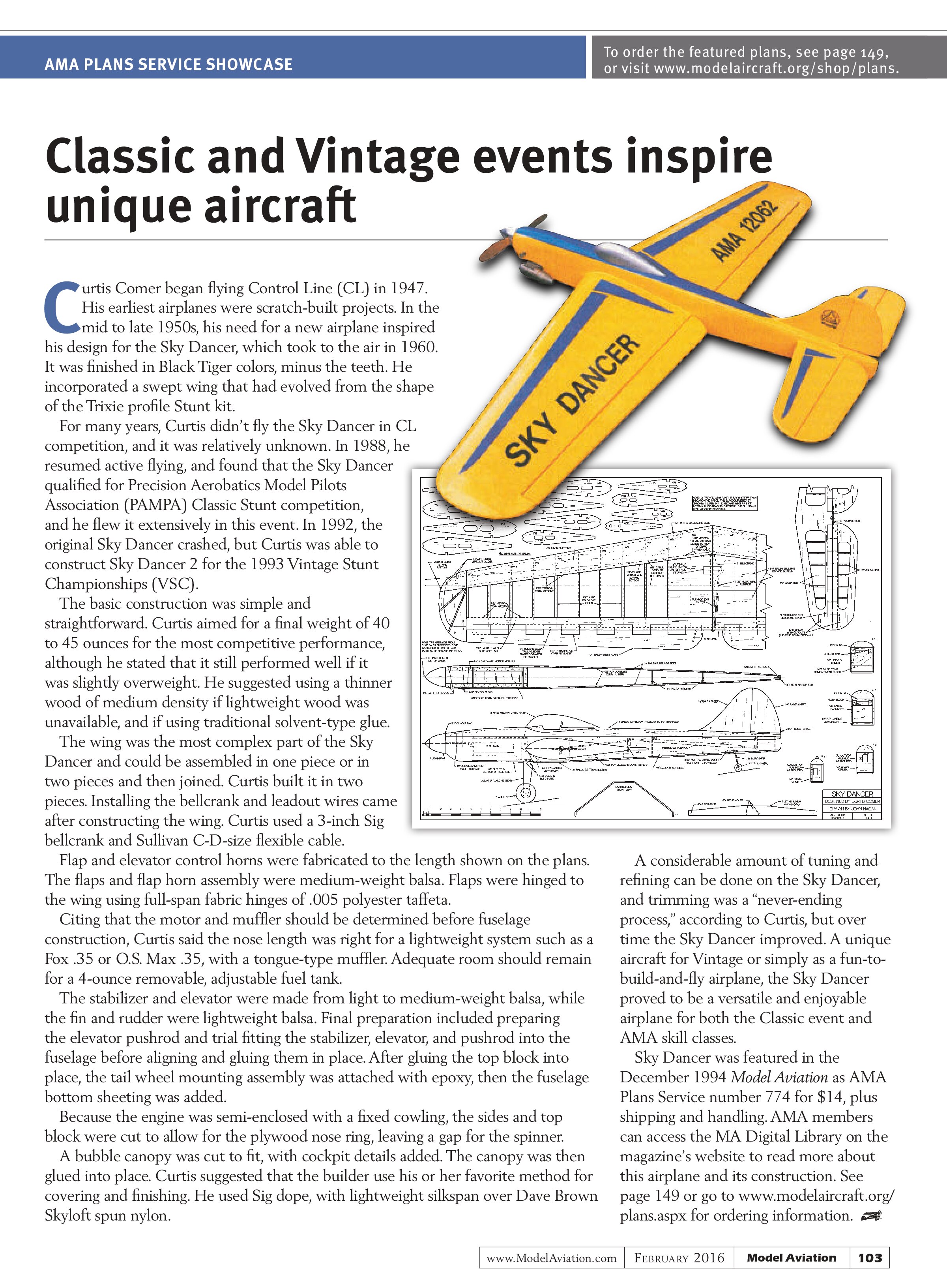
Curtis Comer began flying Control Line (CL) in 1947. His earliest airplanes were scratch-built projects. In the mid to late 1950s, his need for a new airplane inspired his design for the Sky Dancer, which took to the air in 1960. It was finished in Black Tiger colors, minus the teeth. He incorporated a swept wing that had evolved from the shape of the Trixie profile Stunt kit.
For many years, Curtis didn’t fly the Sky Dancer in CL competition, and it was relatively unknown. In 1988, he resumed active flying, and found that the Sky Dancer qualified for Precision Aerobatics Model Pilots Association (PAMPA) Classic Stunt competition, and he flew it extensively in this event. In 1992, the original Sky Dancer crashed, but Curtis was able to construct Sky Dancer 2 for the 1993 Vintage Stunt Championships (VSC).
The basic construction was simple and straightforward. Curtis aimed for a final weight of 40 to 45 ounces for the most competitive performance, although he stated that it still performed well if it was slightly overweight. He suggested using a thinner wood of medium density if lightweight wood was unavailable, and if using traditional solvent-type glue.
The wing was the most complex part of the Sky Dancer and could be assembled in one piece or in two pieces and then joined. Curtis built it in two pieces. Installing the bellcrank and leadout wires came after constructing the wing. Curtis used a 3-inch Sig bellcrank and Sullivan C-D-size flexible cable.


Flap and elevator control horns were fabricated to the length shown on the plans. The flaps and flap horn assembly were medium-weight balsa. Flaps were hinged to the wing using full-span fabric hinges of .005 polyester taffeta.
Citing that the motor and muffler should be determined before fuselage construction, Curtis said the nose length was right for a lightweight system such as a Fox .35 or O.S. Max .35, with a tongue-type muffler. Adequate room should remain for a 4-ounce removable, adjustable fuel tank.
The stabilizer and elevator were made from light to medium-weight balsa, while the fin and rudder were lightweight balsa. Final preparation included preparing the elevator pushrod and trial fitting the stabilizer, elevator, and pushrod into the fuselage before aligning and gluing them in place. After gluing the top block into place, the tail wheel mounting assembly was attached with epoxy, then the fuselage bottom sheeting was added.
Because the engine was semi-enclosed with a fixed cowling, the sides and top block were cut to allow for the plywood nose ring, leaving a gap for the spinner. A bubble canopy was cut to fit, with cockpit details added. The canopy was then glued into place. Curtis suggested that the builder use his or her favorite method for covering and finishing. He used Sig dope, with lightweight silkspan over Dave Brown Skyloft spun nylon.
A considerable amount of tuning and refining can be done on the Sky Dancer, and trimming was a “never-ending process,” according to Curtis, but over time the Sky Dancer improved. A unique aircraft for Vintage or simply as a fun-to-build-and-fly airplane, the Sky Dancer proved to be a versatile and enjoyable airplane for both the Classic event and AMA skill classes.
Sky Dancer was featured in the December 1994 Model Aviation as AMA Plans Service number 774 for $14, plus shipping and handling. AMA members can access the MA Digital Library on the magazine’s website to read more about this airplane and its construction. See page 149 or go to www.modelaircraft.org/plans.aspx for ordering information.