Rules, rules, rules!
Bob Angel
samrcflier@verizon.net

Some Free Flight (FF) organizations have relaxed their Builder-of-the-Model (BOM) rules. This started among fliers who saw no sense in tearing apart a good model left behind by a deceased member just to salvage engines, ignition components, etc. These pilots began honoring deceased fellow fliers by retaining the AMA number on the wing, followed by a D. The current owner placed his or her own number below.
Sanctioned contests require AMA rules to be followed for AMA events, but for events deviating from or not described in the rule book, the deviations must be approved, and a Class A, B, or C sanction assigned. There’s no description of Class C in the AMA rule book, but that’s the designation given at most Society of Antique Modeler (SAM) events and others using rules not in the AMA book.
But a Class C designation doesn’t relieve the event from following AMA safety and other rules that fit the category. SAM rules specifically state that AMA safety and other general rules are to be followed. Sometimes a slight conflict appears, but the problem is usually solvable.
For example, AMA rules specifically prohibit proxy flying in RC events. But some handicapped, and/or older fliers would like to see their models flown again. Because SAM has no BOM rule, whoever flies the aircraft can simply become the official competitor. Any awards or placement listings can go to the actual flier. The pilot might then just pass the award to the owner, and the CD might or might not note that the model was flown for the (named) owner.
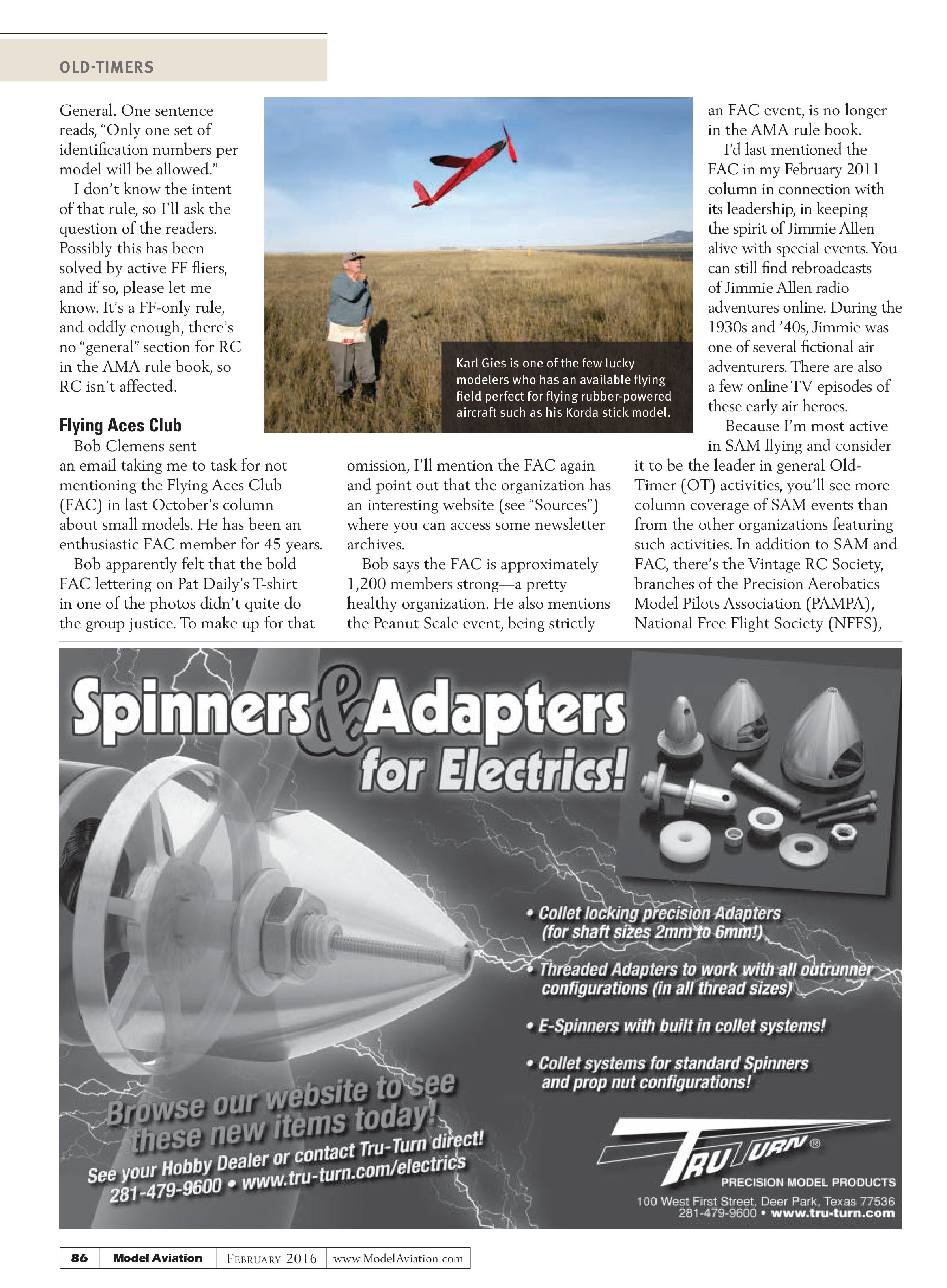
When Steve Moskal couldn’t make it to the last SAM Championships, his friend, Bob Galler, took Steve’s Speed 400 Scale aircraft and flew it for him. The model placed third in the Speed 400 electric RC event and won one of the Concours categories.
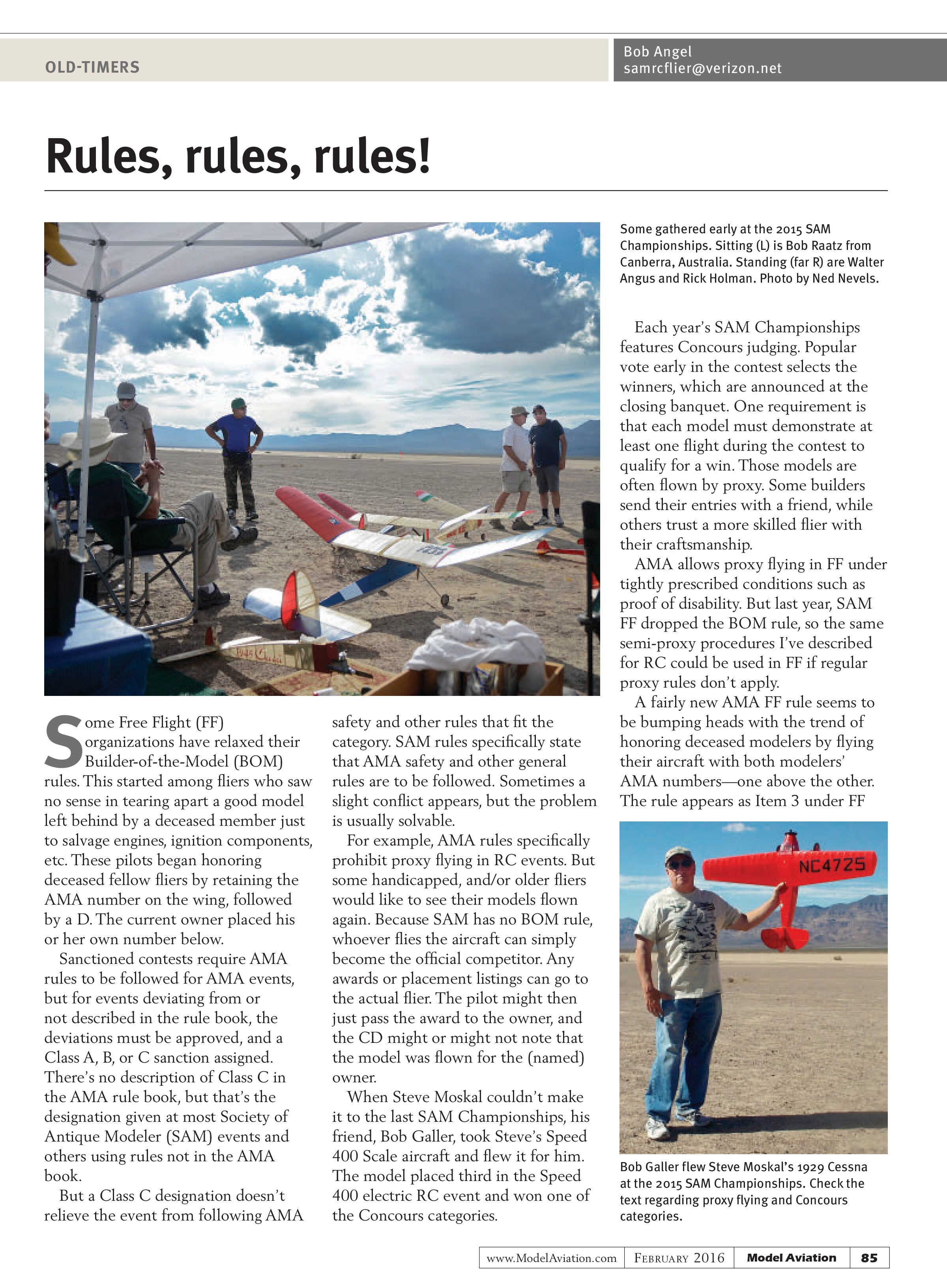
Each year’s SAM Championships features Concours judging. Popular vote early in the contest selects the winners, which are announced at the closing banquet. One requirement is that each model must demonstrate at least one flight during the contest to qualify for a win. Those models are often flown by proxy. Some builders send their entries with a friend, while others trust a more skilled flier with their craftsmanship.
AMA allows proxy flying in FF under tightly prescribed conditions such as proof of disability. But last year, SAM FF dropped the BOM rule, so the same semi-proxy procedures I’ve described for RC could be used in FF if regular proxy rules don’t apply.
A fairly new AMA FF rule seems to be bumping heads with the trend of honoring deceased modelers by flying their aircraft with both modelers’ AMA numbers—one above the other. The rule appears as Item 3 under FF

General. One sentence reads, “Only one set of identification numbers per model will be allowed.” I don’t know the intent of that rule, so I’ll ask the question of the readers. Possibly this has been solved by active FF fliers, and if so, please let me know. It’s a FF-only rule, and oddly enough, there’s no “general” section for RC in the AMA rule book, so RC isn’t affected.
Flying Aces Club
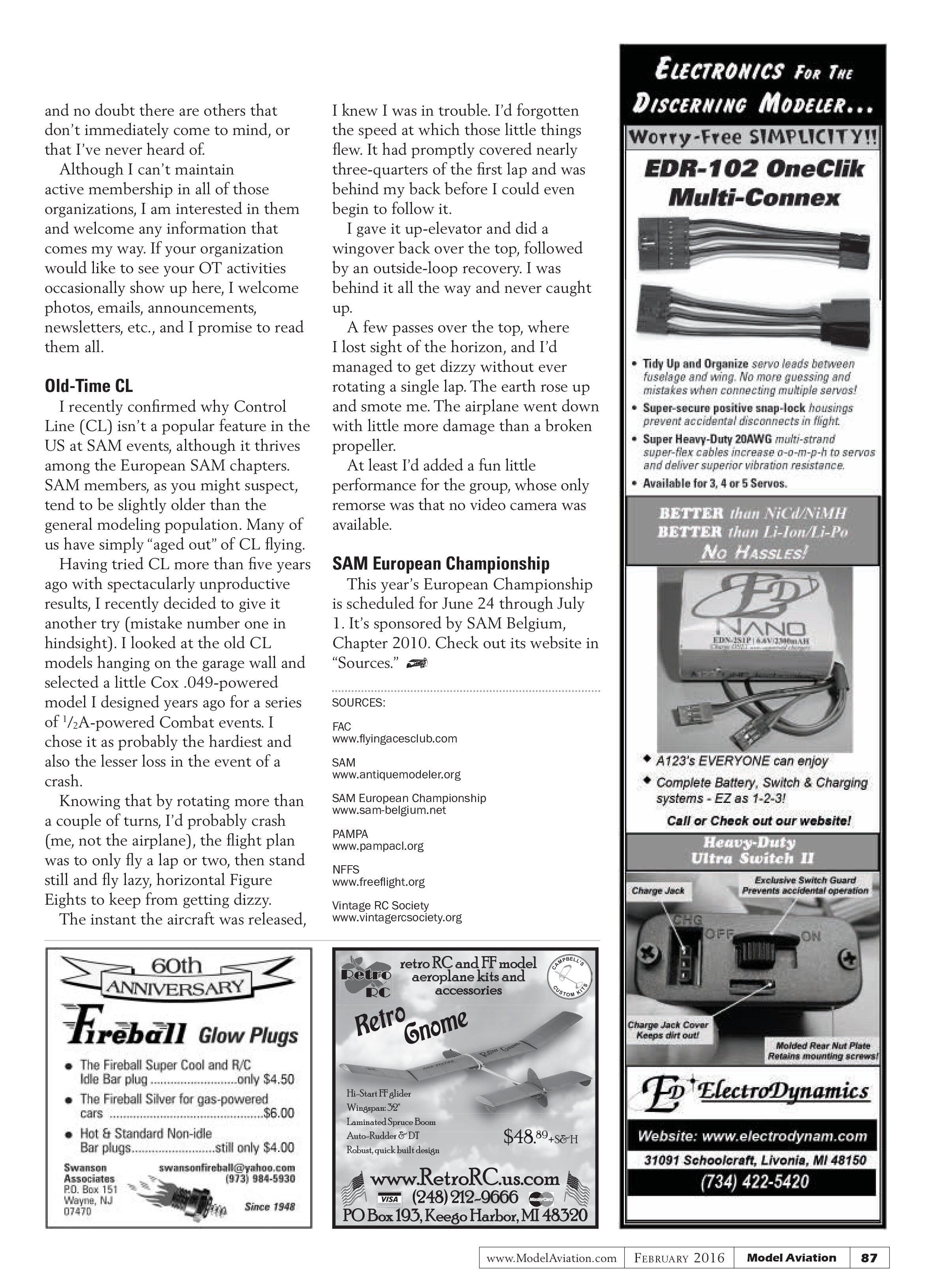
Bob Clemens sent an email taking me to task for not mentioning the Flying Aces Club (FAC) in last October’s column about small models. He has been an enthusiastic FAC member for 45 years.
Bob apparently felt that the bold FAC lettering on Pat Daily’s T-shirt in one of the photos didn’t quite do the group justice. To make up for that omission, I’ll mention the FAC again and point out that the organization has an interesting website (see “Sources”) where you can access some newsletter archives.
Bob says the FAC is approximately 1,200 members strong—a pretty healthy organization. He also mentions the Peanut Scale event, being strictly an FAC event, is no longer in the AMA rule book.

I’d last mentioned the FAC in my February 2011 column in connection with its leadership, in keeping the spirit of Jimmie Allen alive with special events. You can still find rebroadcasts of Jimmie Allen radio adventures online. During the 1930s and ’40s, Jimmie was one of several fictional air adventurers. There are also a few online TV episodes of these early air heroes.
Because I’m most active in SAM flying and consider it to be the leader in general Old-Timer (OT) activities, you’ll see more column coverage of SAM events than from the other organizations featuring such activities. In addition to SAM and FAC, there’s the Vintage RC Society, branches of the Precision Aerobatics Model Pilots Association (PAMPA), National Free Flight Society (NFFS), and no doubt there are others that don’t immediately come to mind, or that I’ve never heard of.
Although I can’t maintain active membership in all of those organizations, I am interested in them and welcome any information that comes my way. If your organization would like to see your OT activities occasionally show up here, I welcome photos, emails, announcements, newsletters, etc., and I promise to read them all.
Old-Time CL
I recently confirmed why Control Line (CL) isn’t a popular feature in the US at SAM events, although it thrives among the European SAM chapters. SAM members, as you might suspect, tend to be slightly older than the general modeling population. Many of us have simply “aged out” of CL flying.
Having tried CL more than five years ago with spectacularly unproductive results, I recently decided to give it another try (mistake number one in hindsight). I looked at the old CL models hanging on the garage wall and selected a little Cox .049-powered model I designed years ago for a series of 1/2A-powered Combat events. I chose it as probably the hardest and also the lesser loss in the event of a crash.
Knowing that by rotating more than a couple of turns, I’d probably crash (me, not the airplane), the flight plan was to only fly a lap or two, then stand still and fly lazy, horizontal Figure Eights to keep from getting dizzy.
The instant the aircraft was released, I knew I was in trouble. I’d forgotten the speed at which those little things flew. It had promptly covered nearly three-quarters of the first lap and was behind my back before I could even begin to follow it.
I gave it up-elevator and did a wingover back over the top, followed by an outside-loop recovery. I was behind it all the way and never caught up.
A few passes over the top, where I lost sight of the horizon, and I’d managed to get dizzy without ever rotating a single lap. The earth rose up and smote me. The airplane went down with little more damage than a broken propeller.
At least I’d added a fun little performance for the group, whose only remorse was that no video camera was available.
SAM European Championship
This year’s European Championship is scheduled for June 24 through July 1. It’s sponsored by SAM Belgium, Chapter 2010. Check out its website in “Sources.”
SOURCES:
SAM European Championship
www.sam-belgium.net
PAMPA
www.pampacl.org
Vintage RC Society
www.vintagercsociety.org