HORIZON HOBBY E-FLITE PULSE 15E BNF BASIC
John Kauk
The popular sport model now comes in a foam version

Horizon Hobby’s series of Pulse sport models, originally designed by Mike McConville, has been around for a while. One of my club members has owned several of them, and they’ve all been well built and fun for him to fly. When I was given the opportunity to take a look at the new Pulse 15e BNF model, I knew it was an airplane that I would enjoy.
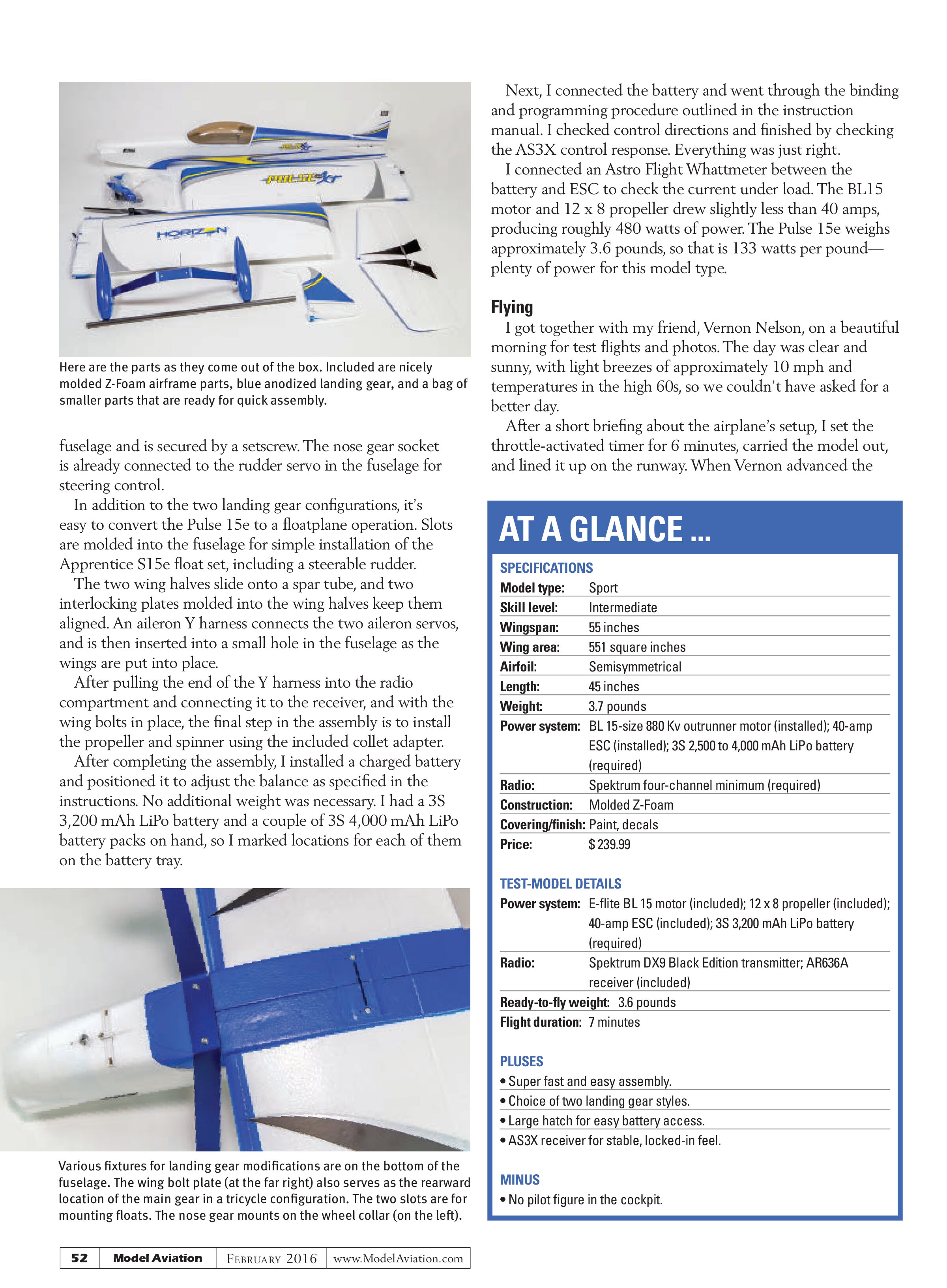
Delivered to my house double-boxed, with all parts sealed in plastic bags and securely fastened inside of a Styrofoam inner container, the Pulse arrived in perfect shape. A quick glance through the box contents revealed a nicely painted, molded Z-Foam airframe with all of the power and radio components installed, blue anodized main gear with wheels and wheel pants installed, and a bag with the rest of the parts required for completion.
Assembly
Assembly begins with the installation of the stabilizer and prehinged elevators. This part is slipped into a slot molded into the fuselage. After connecting the elevator control rod to the control horn, two screws are used to secure the stabilizer. Next, the rudder control rod is connected to the control horn and the rudder hinges are glued into slots in the tail with medium CA glue. A post on the bottom of the rudder fits into a plate under the fuselage tail.
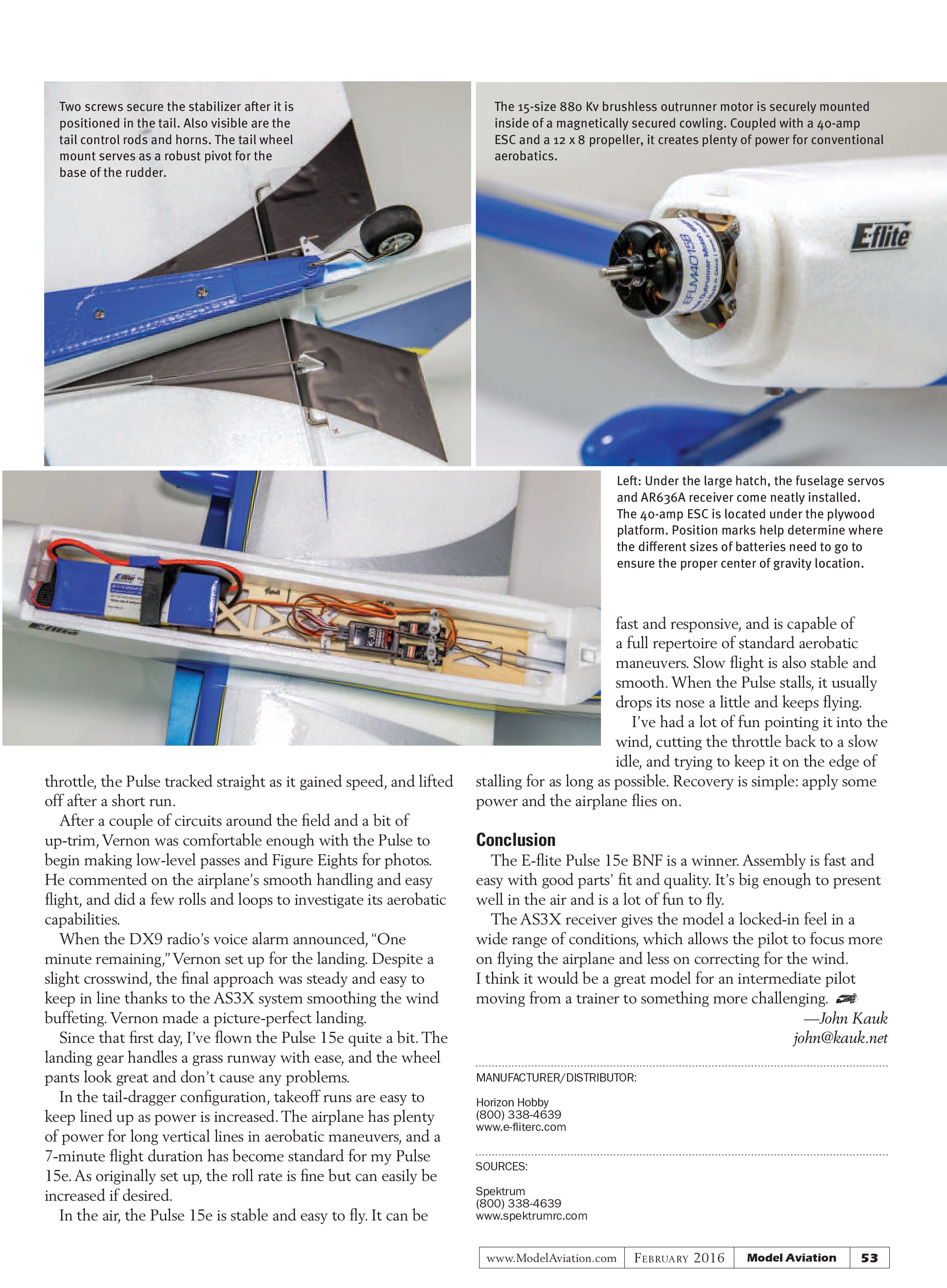
I installed the landing gear next. E-flite includes all of the necessary parts for tail-dragger and tricycle-gear configurations, so the builder has to make a choice. But even after the initial decision is made, it’s easy to switch between the two because all of the parts and control linkages are installed and ready to use.
I decided to go with a conventional tail-dragger arrangement, so I bolted the main gear to the plate slightly forward of the wing. The tail wheel slips into the rudder post and is secured by a setscrew. For a tricycle-gear setup, the main gear is bolted into place with wing bolts aft of the wing’s spar tube. The nose gear then slips into a socket in the forward

Here are the parts as they come out of the box. Included are nicely molded Z-Foam airframe parts, blue anodized landing gear, and a bag of smaller parts that are ready for quick assembly.
fuselage and is secured by a setscrew. The nose gear socket is already connected to the rudder servo in the fuselage for steering control.
In addition to the two landing gear configurations, it’s easy to convert the Pulse 15e to a floatplane operation. Slots are molded into the fuselage for simple installation of the Apprentice S15e float set, including a steerable rudder.
The two wing halves slide onto a spar tube, and two interlocking plates molded into the wing halves keep them aligned. An aileron Y harness connects the two aileron servos, and is then inserted into a small hole in the fuselage as the wings are put into place.
After pulling the end of the Y harness into the radio compartment and connecting it to the receiver, and with the wing bolts in place, the final step in the assembly is to install the propeller and spinner using the included collet adapter.
After completing the assembly, I installed a charged battery and positioned it to adjust the balance as specified in the instructions. No additional weight was necessary. I had a 3S 3,200 mAh LiPo battery and a couple of 3S 4,000 mAh LiPo battery packs on hand, so I marked locations for each of them on the battery tray.

Various fixtures for landing gear modifications are on the bottom of the fuselage. The wing bolt plate (at the far right) also serves as the rearward location of the main gear in a tricycle configuration. The two slots are for mounting floats. The nose gear mounts on the wheel collar (on the left).
Next, I connected the battery and went through the binding and programming procedure outlined in the instruction manual. I checked control directions and finished by checking the AS3X control response. Everything was just right.
I connected an Astro Flight Wattmeter between the battery and ESC to check the current under load. The BL15 motor and 12 x 8 propeller drew slightly less than 40 amps, producing roughly 480 watts of power. The Pulse 15e weighs approximately 3.6 pounds, so that is 133 watts per pound—plenty of power for this model type.
Flying
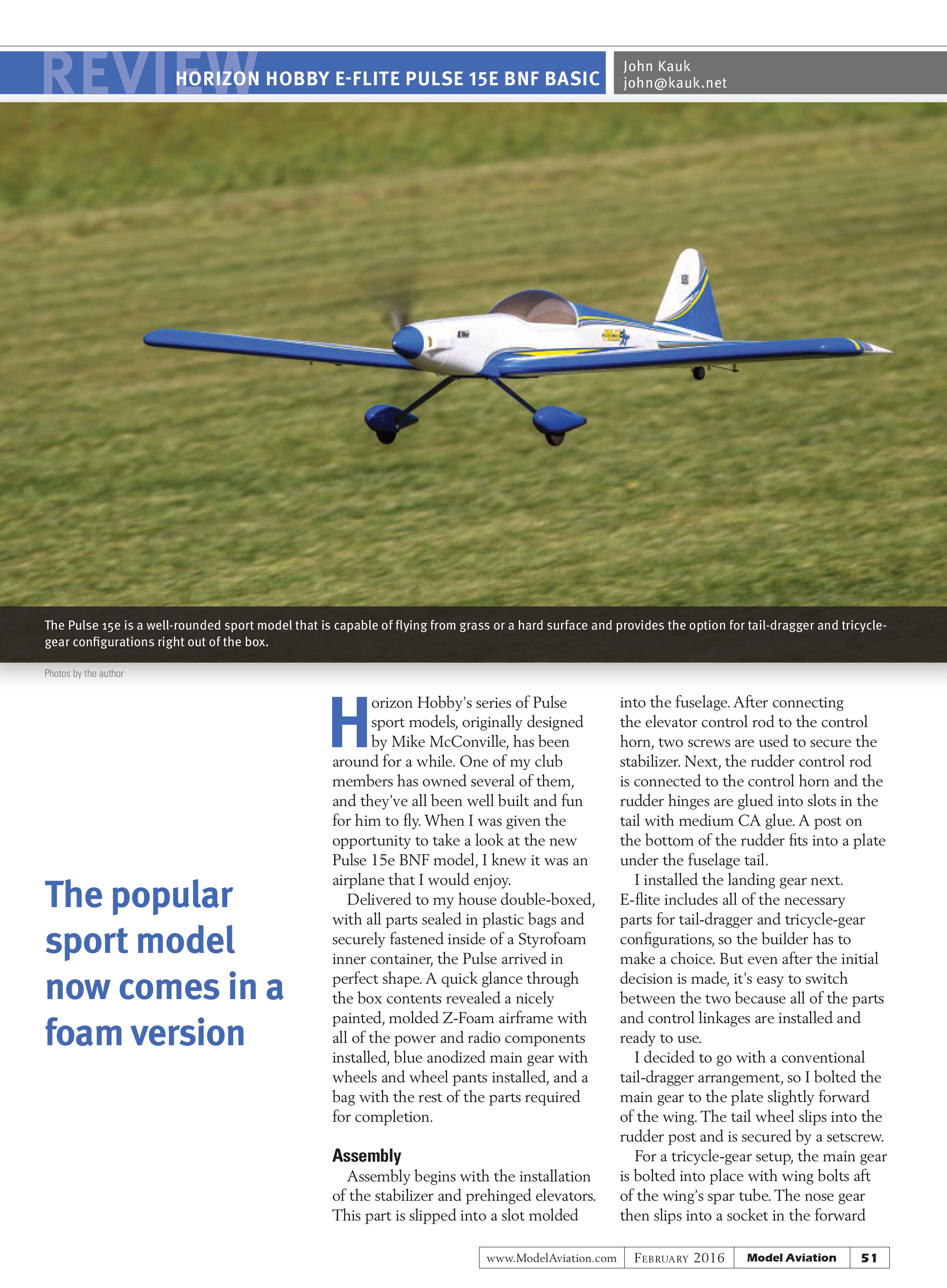
I got together with my friend, Vernon Nelson, on a beautiful morning for test flights and photos. The day was clear and sunny, with light breezes of approximately 10 mph and temperatures in the high 60s, so we couldn’t have asked for a better day.
After a short briefing about the airplane’s setup, I set the throttle-activated timer for 6 minutes, carried the model out, and lined it up on the runway. When Vernon advanced the


throttle, the Pulse tracked straight as it gained speed, and lifted off after a short run.
After a couple of circuits around the field and a bit of up-trim, Vernon was comfortable enough with the Pulse to begin making low-level passes and Figure Eights for photos. He commented on the airplane’s smooth handling and easy flight, and did a few rolls and loops to investigate its aerobatic capabilities.
When the DX9 radio’s voice alarm announced, “One minute remaining,” Vernon set up for the landing. Despite a slight crosswind, the final approach was steady and easy to keep in line thanks to the AS3X system smoothing the wind buffeting. Vernon made a picture-perfect landing.
Since that first day, I’ve flown the Pulse 15e quite a bit. The landing gear handles a grass runway with ease, and the wheel pants look great and don’t cause any problems.
In the tail-dragger configuration, takeoff runs are easy to keep lined up as power is increased. The airplane has plenty of power for long vertical lines in aerobatic maneuvers, and a 7-minute flight duration has become standard for my Pulse 15e. As originally set up, the roll rate is fine but can easily be increased if desired.
In the air, the Pulse 15e is stable and easy to fly. It can be
fast and responsive, and is capable of a full repertoire of standard aerobatic maneuvers. Slow flight is also stable and smooth. When the Pulse stalls, it usually drops its nose a little and keeps flying.
I’ve had a lot of fun pointing it into the wind, cutting the throttle back to a slow idle, and trying to keep it on the edge of stalling for as long as possible. Recovery is simple: apply some power and the airplane flies on.
Conclusion
The E-flite Pulse 15e BNF is a winner. Assembly is fast and easy with good parts’ fit and quality. It’s big enough to present well in the air and is a lot of fun to fly.
The AS3X receiver gives the model a locked-in feel in a wide range of conditions, which allows the pilot to focus more on flying the airplane and less on correcting for the wind. I think it would be a great model for an intermediate pilot moving from a trainer to something more challenging.
—John Kauk
john@kauk.net
MANUFACTURER/DISTRIBUTOR:
Horizon Hobby
(800) 338-4639
www.e-fliterc.com
SOURCES:
Spektrum
(800) 338-4639
www.spektrumrc.com