GREAT PLANES F-1 ROCKET EVO GP/EP ARF
Tom Sullivan

A sport scale model designed to go fast
I like to think of myself as somewhat knowledgeable about nearly any airplane that’s ever been flown—that was until I was asked about reviewing the F-1 Rocket Evo. Having just reviewed a Radial Rocket, I first thought it was a similar design; however, this kit from Great Planes is quite different.
This kit is a semiscale model of the full-scale homebuilt aircraft manufactured by the Team Rocket Aircraft Co. Its all-metal airframe was designed to deliver extremely high performance with a 3,500-feet-per-minute climb rate and a 230-plus-mph cruising speed.
Obviously, the review kit won’t quite hit these speeds, but let’s build it, get it up in the air, and see how well it does in delivering the same “F-16-like” performance promised from the full-scale aircraft.
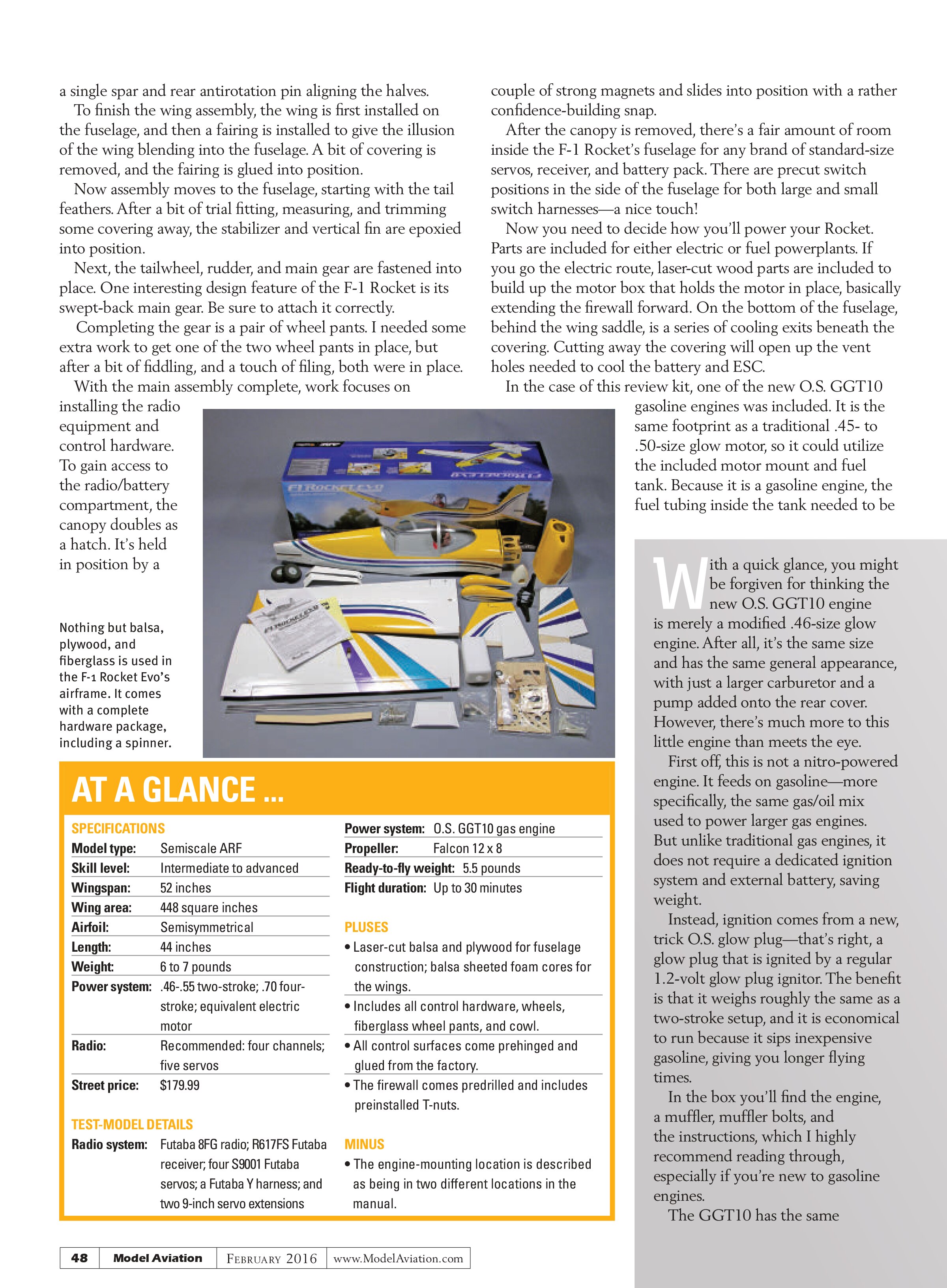
My reviews start with opening the package and inspecting all of the parts as I arrange them for the mandatory parts shot. A few things caught my eye.
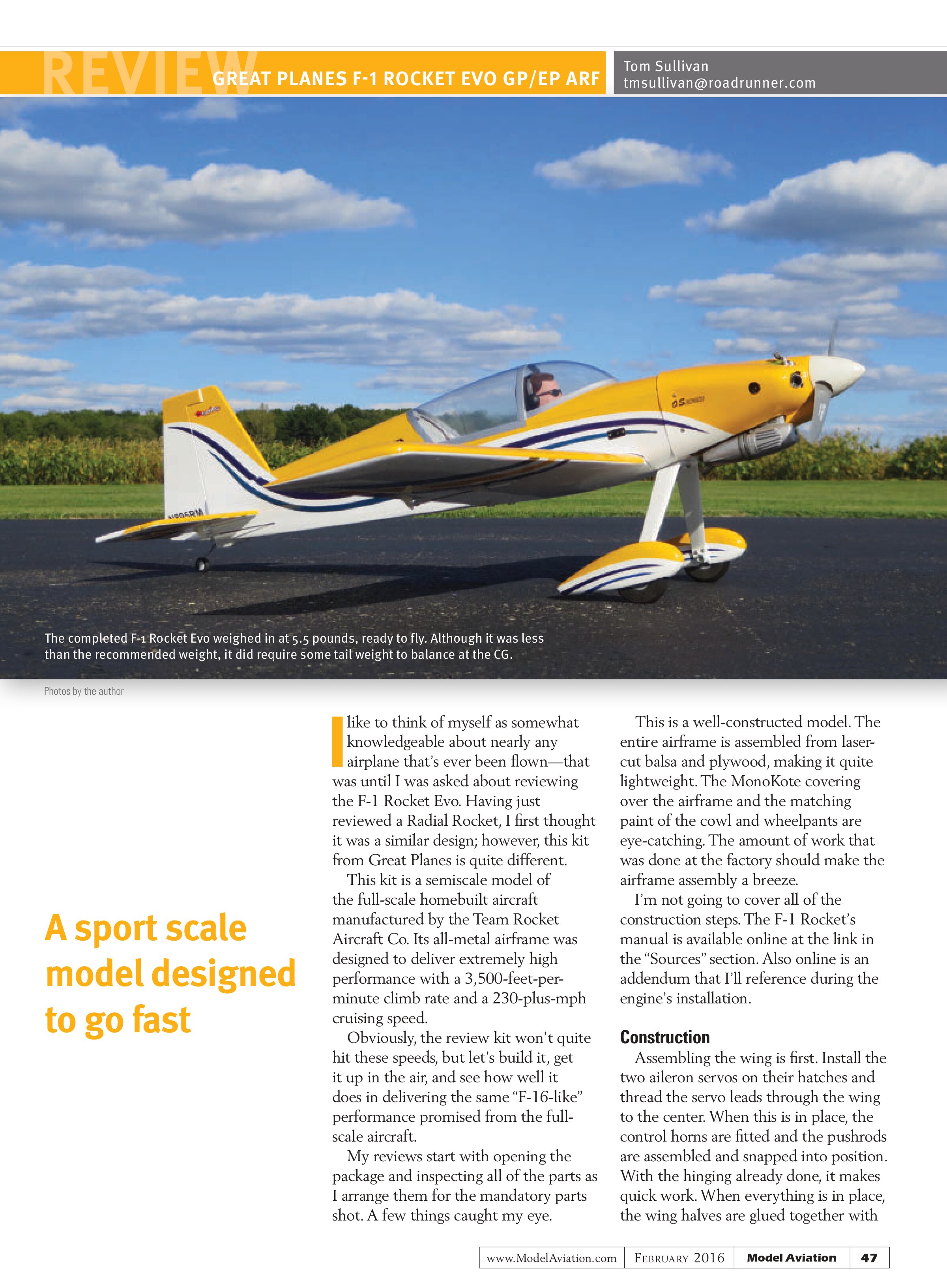
This is a well-constructed model. The entire airframe is assembled from laser-cut balsa and plywood, making it quite lightweight. The MonoKote covering over the airframe and the matching paint of the cowl and wheelpants are eye-catching. The amount of work that was done at the factory should make the airframe assembly a breeze.
I’m not going to cover all of the construction steps. The F-1 Rocket’s manual is available online at the link in the “Sources” section. Also online is an addendum that I’ll reference during the engine’s installation.
Construction
Assembling the wing is first. Install the two aileron servos on their hatches and thread the servo leads through the wing to the center. When this is in place, the control horns are fitted and the pushrods are assembled and snapped into position. With the hinging already done, it makes quick work. When everything is in place, the wing halves are glued together with
a single spar and rear antirotation pin aligning the halves.
To finish the wing assembly, the wing is first installed on the fuselage, and then a fairing is installed to give the illusion of the wing blending into the fuselage. A bit of covering is removed, and the fairing is glued into position.
Now assembly moves to the fuselage, starting with the tail feathers. After a bit of trial fitting, measuring, and trimming some covering away, the stabilizer and vertical fin are epoxied into position.
Next, the tailwheel, rudder, and main gear are fastened into place. One interesting design feature of the F-1 Rocket is its swept-back main gear. Be sure to attach it correctly.
Completing the gear is a pair of wheel pants. I needed some extra work to get one of the two wheel pants in place, but after a bit of fiddling, and a touch of filing, both were in place.
With the main assembly complete, work focuses on installing the radio equipment and control hardware. To gain access to the radio/battery compartment, the canopy doubles as a hatch. It’s held in position by a couple of strong magnets and slides into position with a rather confidence-building snap.
After the canopy is removed, there’s a fair amount of room inside the F-1 Rocket’s fuselage for any brand of standard-size servos, receiver, and battery pack. There are precut switch positions in the side of the fuselage for both large and small switch harnesses—a nice touch!
Now you need to decide how you’ll power your Rocket. Parts are included for either electric or fuel powerplants. If you go the electric route, laser-cut wood parts are included to build up the motor box that holds the motor in place, basically extending the firewall forward. On the bottom of the fuselage, behind the wing saddle, is a series of cooling exits beneath the covering. Cutting away the covering will open up the vent holes needed to cool the battery and ESC.
In the case of this review kit, one of the new O.S. GGT10 gasoline engines was included. It is the same footprint as a traditional .45- to .50-size glow motor, so it could utilize the included motor mount and fuel tank. Because it is a gasoline engine, the fuel tubing inside the tank needed to be switched from silicone to make it fuel compatible. The engine is side mounted so the muffler is under the fuselage. Holes need to be drilled in the included motor mount to attach it using the predrilled holes in the firewall.
The manual has an error in a drawing specifying the correct engine-mounting position. The accompanying text is correct,

Nothing but balsa, plywood, and fiberglass is used in the F-1 Rocket Evo’s airframe. It comes with a complete hardware package, including a spinner.
At a Glance ...
Specifications
- Model type: Semiscale ARF
- Skill level: Intermediate to advanced
- Wingspan: 52 inches
- Wing area: 448 square inches
- Airfoil: Semisymmetrical
- Length: 44 inches
- Weight: 6 to 7 pounds
- Power system: .46-.55 two-stroke; .70 four-stroke; equivalent electric motor
- Radio: Recommended: four channels; five servos
- Street price: $179.99
- Power system: O.S. GGT10 gas engine
- Propeller: Falcon 12 x 8
- Ready-to-fly weight: 5.5 pounds
- Flight duration: Up to 30 minutes
Test-model details
Radio system: Futaba 8FG radio; R617FS Futaba receiver; four S9001 Futaba servos; a Futaba Y harness; and two 9-inch servo extensions
Pluses
- Laser-cut balsa and plywood for fuselage construction; balsa sheeted foam cores for the wings.
- Includes all control hardware, wheels, fiberglass wheel pants, and cowl.
- All control surfaces come prehinged and glued from the factory.
- The firewall comes predrilled and includes preinstalled T-nuts.
Minus
- The engine-mounting location is described as being in two different locations in the manual.

The hardware package contains all of the needed control hardware, including nylon clevises and control horns. The elevator is a split design and has a separate pushrod for each half.
but Great Planes issued an addendum that covers the error. It can be downloaded from the link I mentioned.
I spent the most time cutting the necessary clearances to mount the cowl over the engine. There’s really no simple way to do this because it’s always a trial-and-error process. Take your time and only make small cuts.

Each of the aileron servos mount to removable hatches on the underside of the wing.
To complete the F-1 Rocket Evo, a sheet of self-adhesive stickers is included. Great Planes gives you the option to add as many or as few as you would like.
After everything is in place, check the center of gravity (CG). Even after moving the receiver battery to the rear of
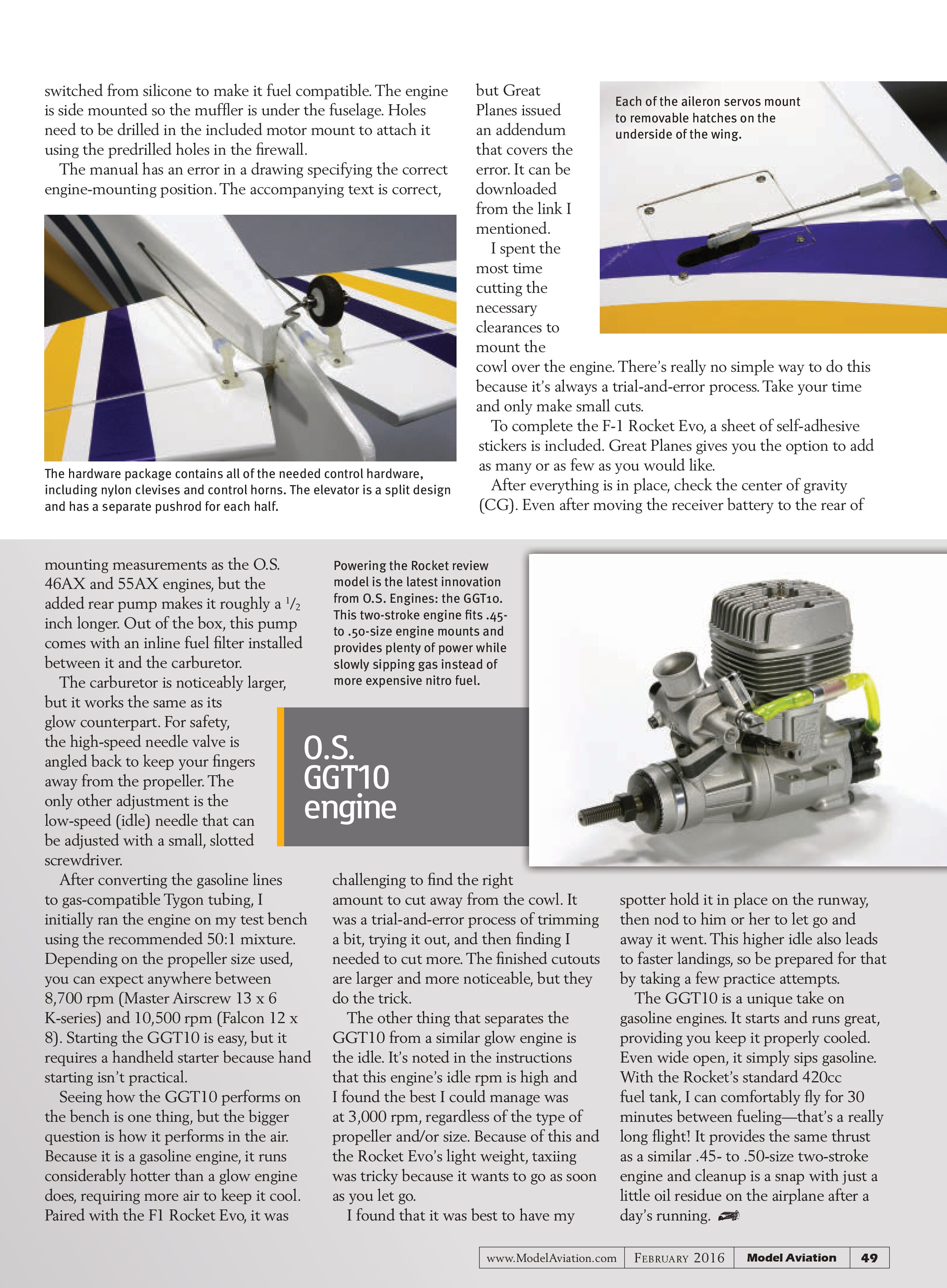
mounting measurements as the O.S. 46AX and 55AX engines, but the added rear pump makes it roughly a ½ inch longer. Out of the box, this pump comes with an inline fuel filter installed between it and the carburetor.
The carburetor is noticeably larger, but it works the same as its glow counterpart. For safety, the high-speed needle valve is angled back to keep your fingers away from the propeller. The only other adjustment is the low-speed (idle) needle that can be adjusted with a small, slotted screwdriver.
After converting the gasoline lines to gas-compatible Tygon tubing, I initially ran the engine on my test bench using the recommended 50:1 mixture. Depending on the propeller size used, you can expect anywhere between 8,700 rpm (Master Airscrew 13 x 6 K-series) and 10,500 rpm (Falcon 12 x 8). Starting the GGT10 is easy, but it requires a handheld starter because hand starting isn’t practical.
Seeing how the GGT10 performs on the bench is one thing, but the bigger question is how it performs in the air. Because it is a gasoline engine, it runs considerably hotter than a glow engine does, requiring more air to keep it cool. Paired with the F1 Rocket Evo, it was
Powering the Rocket review model is the latest innovation from O.S. Engines: the GGT10. This two-stroke engine fits .45- to .50-size engine mounts and provides plenty of power while slowly sipping gas instead of more expensive nitro fuel.

O.S. GGT10 engine
challenging to find the right amount to cut away from the cowl. It was a trial-and-error process of trimming a bit, trying it out, and then finding I needed to cut more. The finished cutouts are larger and more noticeable, but they do the trick.
The other thing that separates the GGT10 from a similar glow engine is the idle. It’s noted in the instructions that this engine’s idle rpm is high and I found the best I could manage was at 3,000 rpm, regardless of the type of propeller and/or size. Because of this and the Rocket Evo’s light weight, taxiing was tricky because it wants to go as soon as you let go.
I found that it was best to have my spotter hold it in place on the runway, then nod to him or her to let go and away it went. This higher idle also leads to faster landings, so be prepared for that by taking a few practice attempts.
The GGT10 is a unique take on gasoline engines. It starts and runs great, providing you keep it properly cooled. Even wide open, it simply sips gasoline. With the Rocket’s standard 420cc fuel tank, I can comfortably fly for 30 minutes between fueling—that’s a really long flight! It provides the same thrust as a similar .45- to .50-size two-stroke engine and cleanup is a snap with just a little oil residue on the airplane after a day’s running.


the cabin area, it still needed 1⅜ ounces of weight back by the tail wheel to balance properly. The completed F-1 Evo Rocket came in at 5½ pounds—½ pound below the manual’s suggested weight!
Flying
When it was time for the maiden flight, and with the GGT10 engine singing along, the Rocket tracked down the runway with a minimal amount of steering input and took off with authority. It took a few passes to get the trim dialed in, and with the photo passes out of the way, it was time to push the F-1 Rocket Evo’s limits.
If you remember in the opening paragraph, I mentioned that the full-scale Rocket claims to have “F-16-like” performance. Well, this review model was spot-on! It flies as though it’s on rails, especially when pushing it at high speeds. Goose-bump-raising low passes are rock solid, even when flying inverted.
But there’s more to flying than high-speed passes, and the F-1 Rocket Evo delivers. It is an aerobatic model and is as happy with simple rolls and loops as it is with violent snaps and spins. Throw anything you want at it and it delivers predictably.
When you’re done tearing up the sky, the Rocket will settle down and cruise with no bad habits or risks of stalling. The controls remain responsive all the way down to landing speed, and that’s reassuring regardless of your skill level.
In Conclusion
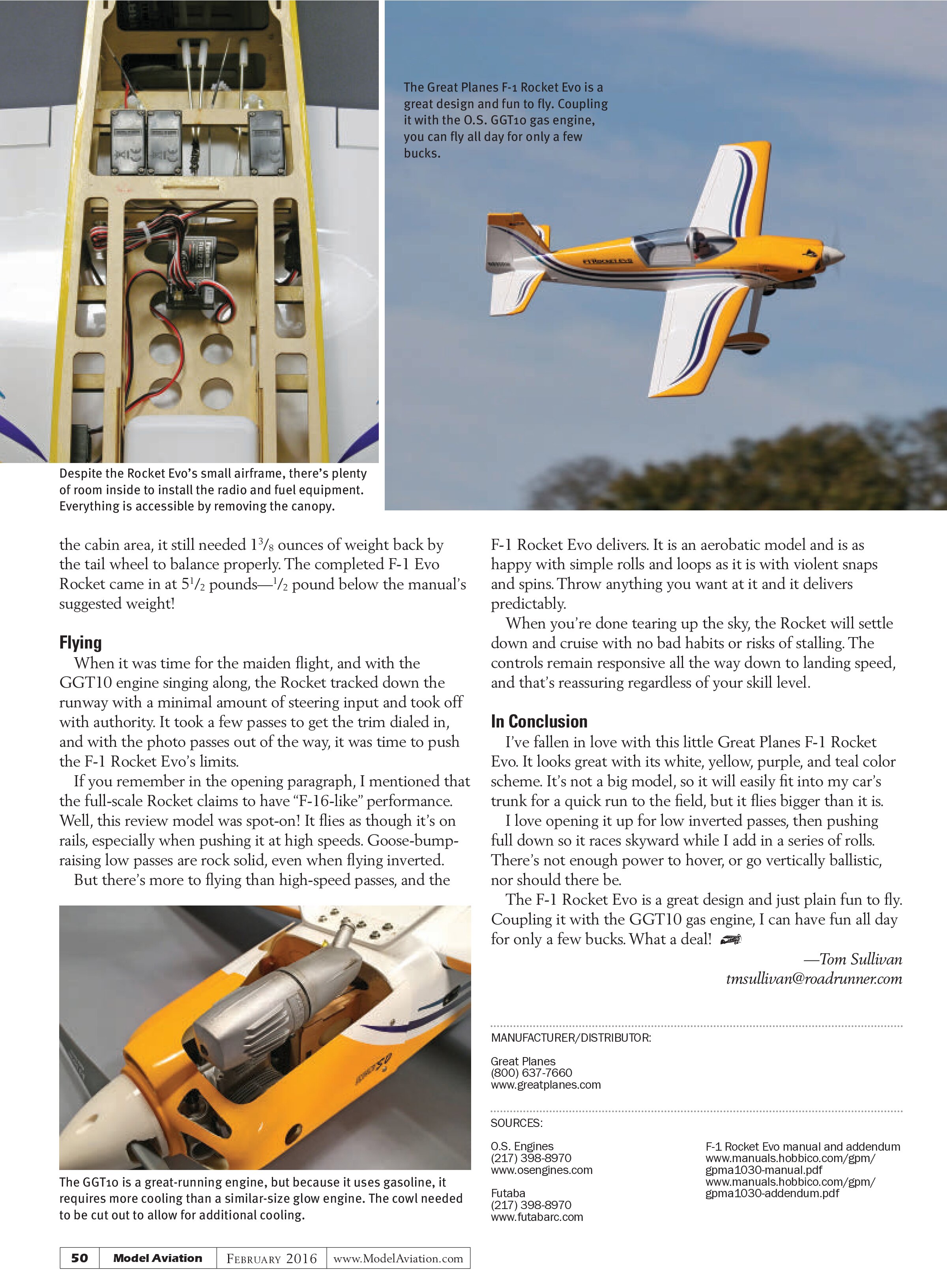
I’ve fallen in love with this little Great Planes F-1 Rocket Evo. It looks great with its white, yellow, purple, and teal color scheme. It’s not a big model, so it will easily fit into my car’s trunk for a quick run to the field, but it flies bigger than it is.
I love opening it up for low inverted passes, then pushing full down so it races skyward while I add in a series of rolls. There’s not enough power to hover, or go vertically ballistic, nor should there be.
The F-1 Rocket Evo is a great design and just plain fun to fly. Coupling it with the GGT10 gas engine, I can have fun all day for only a few bucks. What a deal!
—Tom Sullivan
tmsullivan@roadrunner.com

MANUFACTURER/DISTRIBUTOR:
Great Planes
(800) 637-7660
www.greatplanes.com
SOURCES:
O.S. Engines
(217) 398-8970
www.osengines.com
Futaba
(217) 398-8970
www.futabaRC.com
F-1 Rocket Evo manual and addendum
www.manuals.hobbico.com/gpm/gpma1030-manual.pdf
www.manuals.hobbico.com/gpm/gpma1030-addendum.pdf