Carbon over balsa fuselage
by Louis Joyner
joyner28@comcast.net
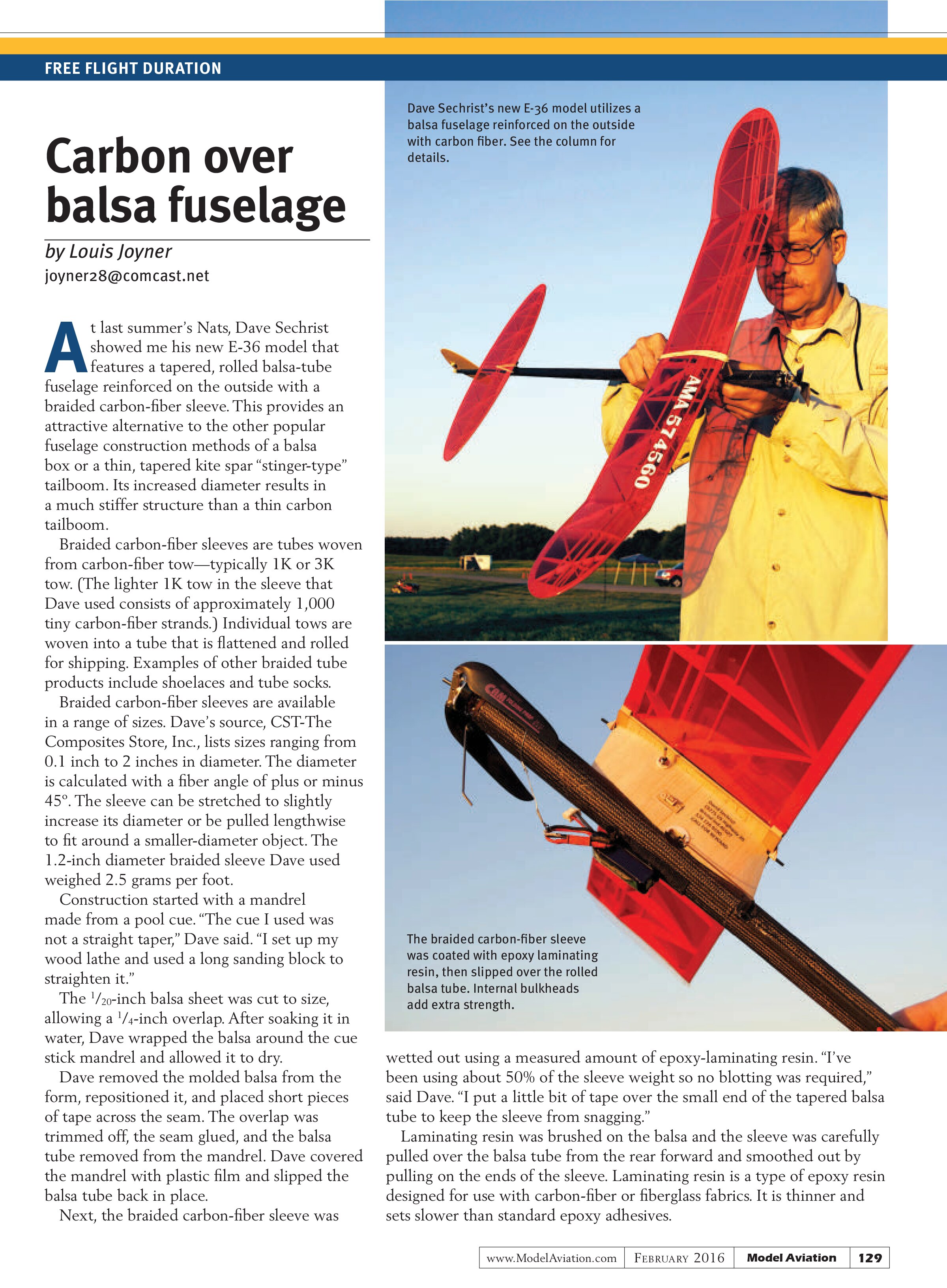
At last summer’s Nats, Dave Sechrist showed me his new E-36 model that features a tapered, rolled balsa-tube fuselage reinforced on the outside with a braided carbon-fiber sleeve. This provides an attractive alternative to the other popular fuselage construction methods of a balsa box or a thin, tapered kite spar “stinger-type” tailboom. Its increased diameter results in a much stiffer structure than a thin carbon tailboom.

Braided carbon-fiber sleeves are tubes woven from carbon-fiber tow—typically 1K or 3K tow. (The lighter 1K tow in the sleeve that Dave used consists of approximately 1,000 tiny carbon-fiber strands.) Individual tows are woven into a tube that is flattened and rolled for shipping. Examples of other braided tube products include shoelaces and tube socks.
Braided carbon-fiber sleeves are available in a range of sizes. Dave’s source, CST-The Composites Store, Inc., lists sizes ranging from 0.1 inch to 2 inches in diameter. The diameter is calculated with a fiber angle of plus or minus 45°. The sleeve can be stretched to slightly increase its diameter or be pulled lengthwise to fit around a smaller-diameter object. The 1.2-inch diameter braided sleeve Dave used weighed 2.5 grams per foot.
Construction started with a mandrel made from a pool cue. “The cue I used was not a straight taper,” Dave said. “I set up my wood lathe and used a long sanding block to straighten it.”
The ¹⁄₂₀-inch balsa sheet was cut to size, allowing a ¹⁄₄-inch overlap. After soaking it in water, Dave wrapped the balsa around the cue stick mandrel and allowed it to dry.
Dave removed the molded balsa from the form, repositioned it, and placed short pieces of tape across the seam. The overlap was trimmed off, the seam glued, and the balsa tube removed from the mandrel. Dave covered the mandrel with plastic film and slipped the balsa tube back in place.
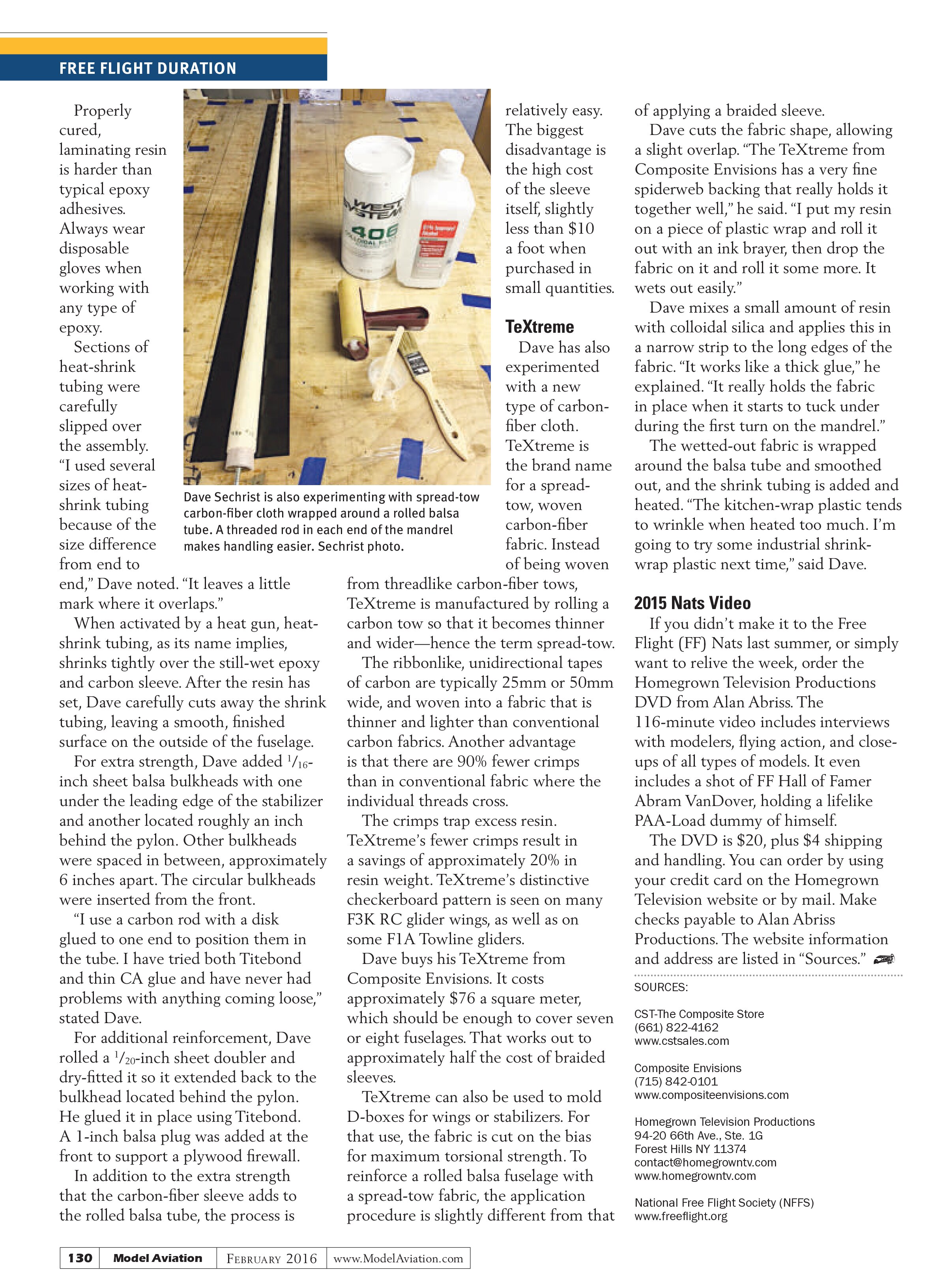
Next, the braided carbon-fiber sleeve was

Laminating resin was brushed on the balsa and the sleeve was carefully pulled over the balsa tube from the rear forward and smoothed out by pulling on the ends of the sleeve. Laminating resin is a type of epoxy resin designed for use with carbon-fiber or fiberglass fabrics. It is thinner and sets slower than standard epoxy adhesives.
Properly cured, laminating resin is harder than typical epoxy adhesives. Always wear disposable gloves when working with any type of epoxy.
Sections of heat-shrink tubing were carefully slipped over the assembly. “I used several sizes of heat-shrink tubing because of the size difference from end to end,” Dave noted. “It leaves a little mark where it overlaps.”
When activated by a heat gun, heat-shrink tubing, as its name implies, shrinks tightly over the still-wet epoxy and carbon sleeve. After the resin has set, Dave carefully cuts away the shrink tubing, leaving a smooth, finished surface on the outside of the fuselage.
For extra strength, Dave added ¹⁄₁₆-inch sheet balsa bulkheads with one under the leading edge of the stabilizer and another located roughly an inch behind the pylon. Other bulkheads were spaced in between, approximately 6 inches apart. The circular bulkheads were inserted from the front.
“I use a carbon rod with a disk glued to one end to position them in the tube. I have tried both Titebond and thin CA glue and have never had problems with anything coming loose,” stated Dave.
For additional reinforcement, Dave rolled a ¹⁄₂₀-inch sheet doubler and dry-fitted it so it extended back to the bulkhead located behind the pylon. He glued it in place using Titebond. A 1-inch balsa plug was added at the front to support a plywood firewall.
In addition to the extra strength that the carbon-fiber sleeve adds to the rolled balsa tube, the process is

Dave Sechrist is also experimenting with spread-tow carbon-fiber cloth wrapped around a rolled balsa tube. A threaded rod in each end of the mandrel makes handling easier. Sechrist photo.
relatively easy. The biggest disadvantage is the high cost of the sleeve itself, slightly less than $10 a foot when purchased in small quantities.
TeXtreme
Dave has also experimented with a new type of carbon-fiber cloth. TeXtreme is the brand name for a spread-tow, woven carbon-fiber fabric. Instead of being woven from threadlike carbon-fiber tows, TeXtreme is manufactured by rolling a carbon tow so that it becomes thinner and wider—hence the term spread-tow.
The ribbonlike, unidirectional tapes of carbon are typically 25mm or 50mm wide, and woven into a fabric that is thinner and lighter than conventional carbon fabrics. Another advantage is that there are 90% fewer crimps than in conventional fabric where the individual threads cross.
The crimps trap excess resin. TeXtreme’s fewer crimps result in a savings of approximately 20% in resin weight. TeXtreme’s distinctive checkerboard pattern is seen on many F3K RC glider wings, as well as on some F1A Towline gliders.
Dave buys his TeXtreme from Composite Envisions. It costs approximately $76 a square meter, which should be enough to cover seven or eight fuselages. That works out to approximately half the cost of braided sleeves.
TeXtreme can also be used to mold D-boxes for wings or stabilizers. For that use, the fabric is cut on the bias for maximum torsional strength. To reinforce a rolled balsa fuselage with a spread-tow fabric, the application procedure is slightly different from that of applying a braided sleeve.
Dave cuts the fabric shape, allowing a slight overlap. “The TeXtreme from Composite Envisions has a very fine spiderweb backing that really holds it together well,” he said. “I put my resin on a piece of plastic wrap and roll it out with an ink brayer, then drop the fabric on it and roll it some more. It wets out easily.”
Dave mixes a small amount of resin with colloidal silica and applies this in a narrow strip to the long edges of the fabric. “It works like a thick glue,” he explained. “It really holds the fabric in place when it starts to tuck under during the first turn on the mandrel.”
The wetted-out fabric is wrapped around the balsa tube and smoothed out, and the shrink tubing is added and heated. “The kitchen-wrap plastic tends to wrinkle when heated too much. I’m going to try some industrial shrink-wrap plastic next time,” said Dave.
2015 Nats Video
If you didn’t make it to the Free Flight (FF) Nats last summer, or simply want to relive the week, order the Homegrown Television Productions DVD from Alan Abriss. The 116-minute video includes interviews with modelers, flying action, and close-ups of all types of models. It even includes a shot of FF Hall of Famer Abram VanDover, holding a lifelike PAA-Load dummy of himself.
The DVD is $20, plus $4 shipping and handling. You can order by using your credit card on the Homegrown Television website or by mail. Make checks payable to Alan Abriss Productions. The website information and address are listed in “Sources.”
SOURCES:
CST-The Composite Store
(661) 822-4162
www.cstsales.com
Composite Envisions
(715) 842-0101
www.compositeenvisions.com
Homegrown Television Productions
94-20 66th Ave., Ste. 1G
Forest Hills NY 11374
contact@homegrowntv.com
www.homegrowntv.com
National Free Flight Society (NFFS)
www.freeflight.org