eWeek 2015—also known as Waterworld
Greg Gimlick
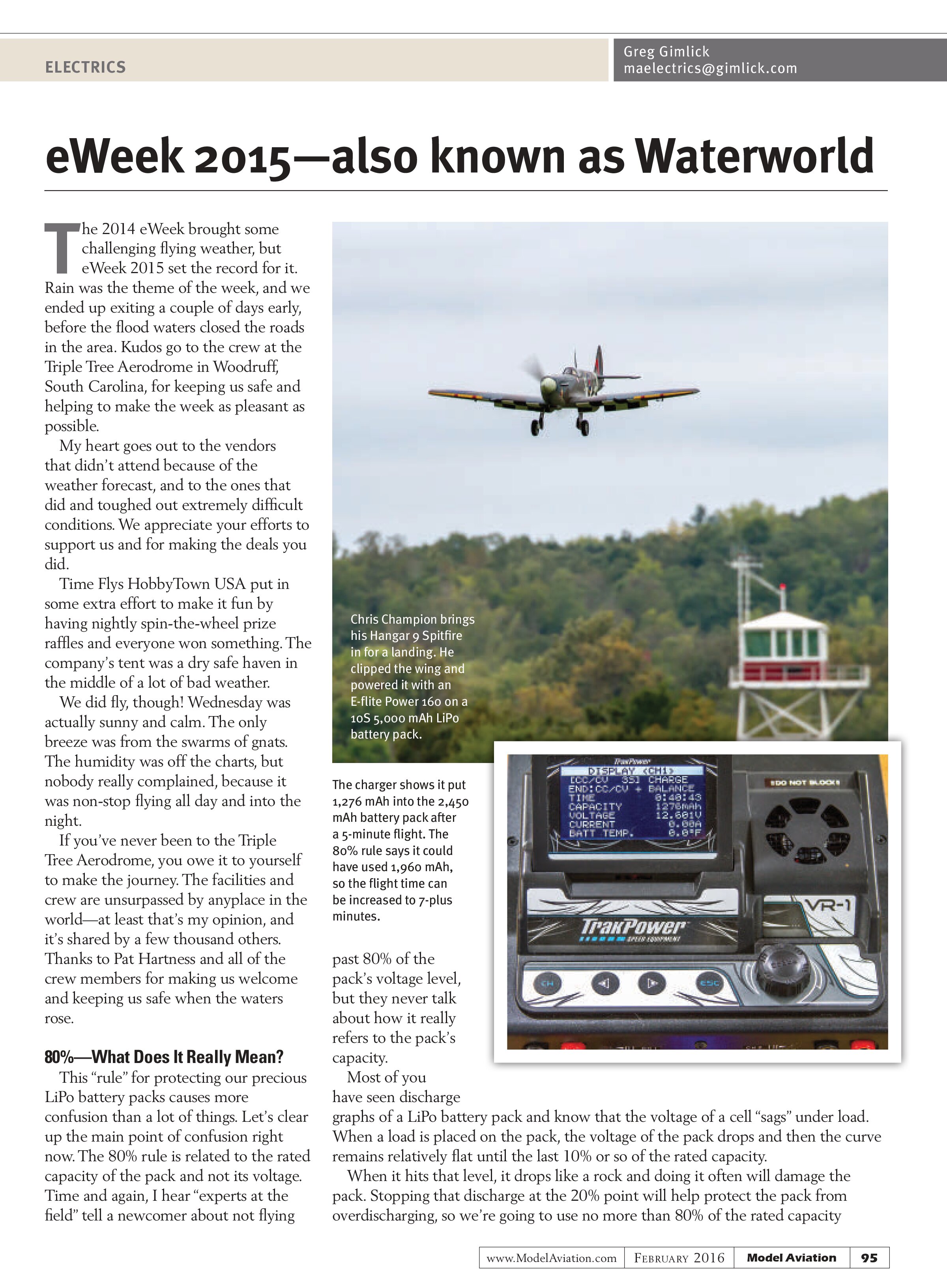
The 2014 eWeek brought some challenging flying weather, but eWeek 2015 set the record for it. Rain was the theme of the week, and we ended up exiting a couple of days early, before the flood waters closed the roads in the area. Kudos go to the crew at the Triple Tree Aerodrome in Woodruff, South Carolina, for keeping us safe and helping to make the week as pleasant as possible.
My heart goes out to the vendors that didn’t attend because of the weather forecast, and to the ones that did and toughed out extremely difficult conditions. We appreciate your efforts to support us and for making the deals you did.
Time Frys HobbyTown USA put in some extra effort to make it fun by having nightly spin-the-wheel prize raffles and everyone won something. The company’s tent was a dry safe haven in the middle of a lot of bad weather.
We did fly, though! Wednesday was actually sunny and calm. The only breeze was from the swarms of gnats. The humidity was off the charts, but nobody really complained, because it was non-stop flying all day and into the night.
If you’ve never been to the Triple Tree Aerodrome, you owe it to yourself to make the journey. The facilities and crew are unsurpassed by anyplace in the world—at least that’s my opinion, and it’s shared by a few thousand others. Thanks to Pat Hartness and all of the crew members for making us welcome and keeping us safe when the waters rose.
80%—What Does It Really Mean?
This “rule” for protecting our precious LiPo battery packs causes more confusion than a lot of things. Let’s clear up the main point of confusion right now. The 80% rule is related to the rated capacity of the pack and not its voltage. Time and again, I hear “experts at the field” tell a newcomer about not flying

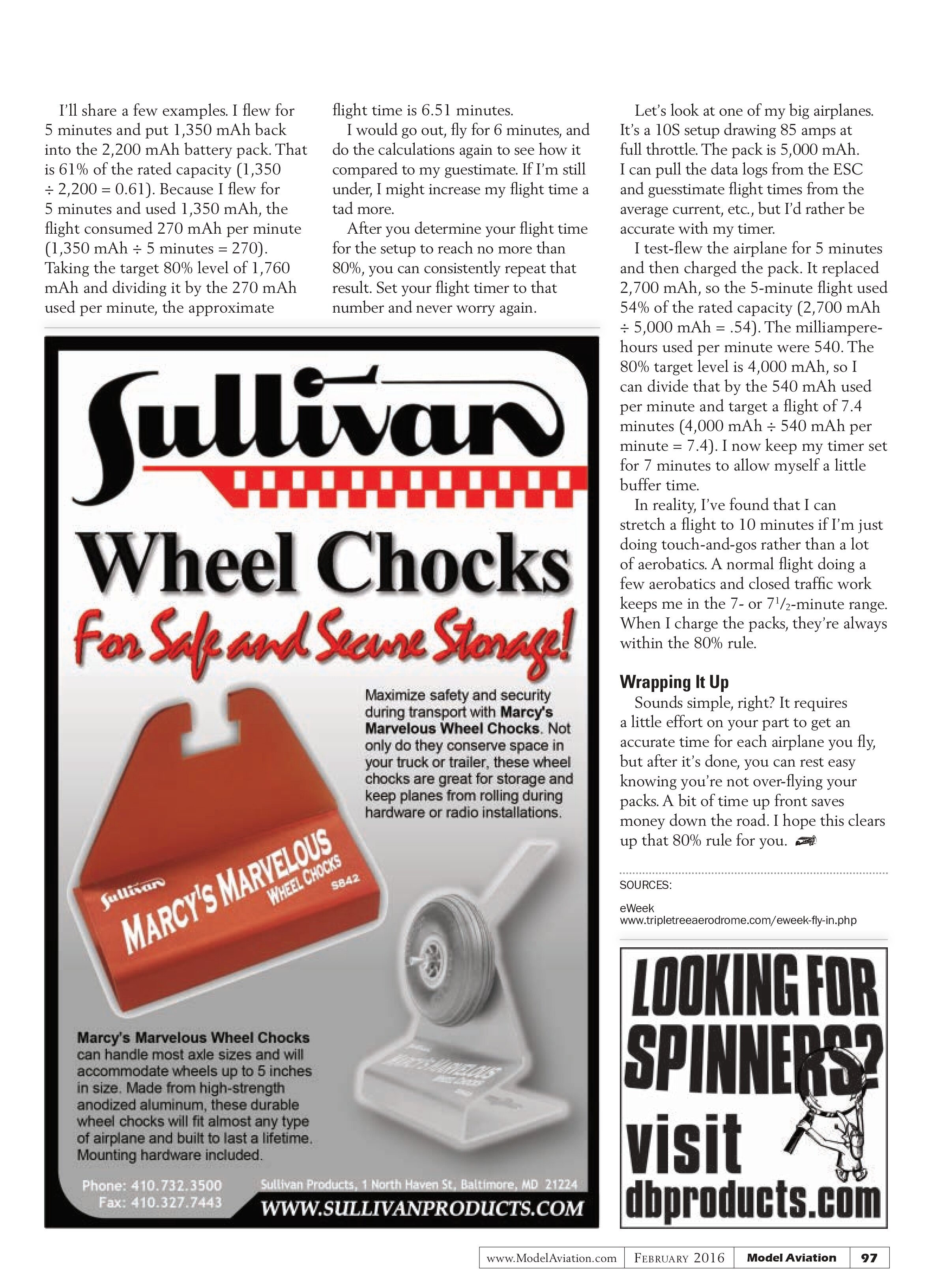
The charger shows it put 1,276 mAh into the 2,450 mAh battery pack after a 5-minute flight. The 80% rule says it could have used 1,960 mAh, so the flight time can be increased to 7-plus minutes.
past 80% of the pack’s voltage level, but they never talk about how it really refers to the pack’s capacity.
Most of you have seen discharge graphs of a LiPo battery pack and know that the voltage of a cell “sags” under load. When a load is placed on the pack, the voltage of the pack drops and then the curve remains relatively flat until the last 10% or so of the rated capacity.
When it hits that level, it drops like a rock and doing it often will damage the pack. Stopping that discharge at the 20% point will help protect the pack from overdischarging, so we’re going to use no more than 80% of the rated capacity

during our flight. Let’s look at what this really means. Using a common 3S 2,200 mAh 30C LiPo battery pack, let’s do some computations to see where the 80% rule lands us. Naturally, there is a formula, but don’t be afraid. It’s an easy one: 80% of pack mAh = pack mAh x 0.8. Using the example pack of 3S 2,200 mAh 30C, we can apply the formula and find the usable capacity is 1,760 mAh (2,200 mAh x 0.8 = 1,760 mAh). That is 80% of the pack’s rated capacity of 2,200 mAh. It also doesn’t matter if it’s a 30C or 60C pack; only the rated capacity matters.

There is only one accurate way to determine how much of the pack’s rated capacity you used during a flight—measure it during the ensuing charge. After you’ve flown the pack for a known time, charge it on a charger that will tell you how many milliampere-hours went back into the pack.
We know we don’t want to put more than 1,760 mAh back into our 2,200 mAh pack or we’ve exceeded the 80% rule. You cannot depend on handheld voltage checkers with little “fuel gauges” because they only measure voltage and guesstimate the rest. It must be measured during a charge cycle.
It’s Just too Complicated and Fiddly
I know; it can be a pain to calculate it at first, but you only need to do it a couple of times with a new airplane or helicopter before you know exactly how long you can fly and stay within your 80% rule.
You might find you can extend your standard 5-minute timer to allow more flying time after you know exactly what the airplane is doing to your pack. Wouldn’t it be great to find you can do 7 minutes instead, and still protect your battery pack?
I’ll share a few examples. I flew for 5 minutes and put 1,350 mAh back into the 2,200 mAh battery pack. That is 61% of the rated capacity (1,350 ÷ 2,200 = 0.61). Because I flew for 5 minutes and used 1,350 mAh, the flight consumed 270 mAh per minute (1,350 mAh ÷ 5 minutes = 270). Taking the target 80% level of 1,760 mAh and dividing it by the 270 mAh used per minute, the approximate flight time is 6.51 minutes.
I would go out, fly for 6 minutes, and do the calculations again to see how it compared to my guesstimate. If I’m still under, I might increase my flight time a tad more.
After you determine your flight time for the setup to reach no more than 80%, you can consistently repeat that result. Set your flight timer to that number and never worry again.
Let’s look at one of my big airplanes. It’s a 10S setup drawing 85 amps at full throttle. The pack is 5,000 mAh. I can pull the data logs from the ESC and guesstimate flight times from the average current, etc., but I’d rather be accurate with my timer.
I test-flew the airplane for 5 minutes and then charged the pack. It replaced 2,700 mAh, so the 5-minute flight used 54% of the rated capacity (2,700 mAh ÷ 5,000 mAh = .54). The milliampere-hours used per minute were 540. The 80% target level is 4,000 mAh, so I can divide that by the 540 mAh used per minute and target a flight of 7.4 minutes (4,000 mAh ÷ 540 mAh per minute = 7.4). I now keep my timer set for 7 minutes to allow myself a little buffer time.
In reality, I’ve found that I can stretch a flight to 10 minutes if I’m just doing touch-and-gos rather than a lot of aerobatics. A normal flight doing a few aerobatics and closed traffic work keeps me in the 7- or 7½-minute range. When I charge the packs, they’re always within the 80% rule.
Wrapping It Up
Sounds simple, right? It requires a little effort on your part to get an accurate time for each airplane you fly, but after it’s done, you can rest easy knowing you’re not over-flying your packs. A bit of time up front saves money down the road. I hope this clears up that 80% rule for you.
SOURCES:
eWeek
www.tripletreeaerodrome.com/eweek-fly-in.php