He’s in stitches, but it’s no joke
Dave Gee
safetycolumn@cs.com
Byron Savage has been flying for 40 years and is a thoughtful man. When he had an unfortunate moment with his big electric RC Cub, Byron decided that sharing his story might save some other pilot from big trouble. He wrote:
“I was fine-tuning the trims on a ¼-scale electric airplane sitting on my table. The transmitter fell over and the throttle went wide open. At that point, I grabbed a wing and it spun around and hit my arm.”
The propeller blade made a deep cut in Byron’s forearm, leaving a serious wound with tendon and muscle damage. Prompt medical treatment led to a full recovery, but Byron decided to take photos of the aftermath. I’m sure he had only the best intentions, but what a pickle he put me in. Should I publish graphic pictures like that or not?
First was a snapshot of his arm, after repairs. A row of stitches on anyone looks awful, and this was no exception. Well, we’ve all seen that kind of thing. No need to print it here.
Then the second photo popped up. This one brought out deep feelings in me. Here was Byron’s big beautiful model airplane, looking jaunty in a blue and white paint scheme. The airplane is on a busy workbench, with typical fun stuff all around. There were tools, humorous wall hangings, and all the accoutrements of model making.
And then I noticed that the wing of the aircraft had blood splatters on it. Wow! Talk about a scary image! Sorry, that picture won’t get printed here, but we all get the point.
Our hobby is about enjoying ourselves and relaxing, yet in the joy of building and flying models, there are hazards lurking. Our attentive care is needed to avoid trouble. If Byron can get caught after 40 years, then that momentary lapse of attention could happen to anyone.


Runaway Throttle Solution
My friend, Bud Matthews, recently showed me a similar, but less severe, injury. It was caused by another bumped throttle lever on an electric model—an all-too-common occurrence. Since that day, Bud has come up with a plan to avoid further trouble. He puts a sturdy rubber band on the transmitter and loops it over the throttle lever to hold it down while he gets ready to fly. Many pilots have thought of this independently, and they all deserve credit for clever thinking. It’s a fine idea and works well. It is not quite as dependable as a programmed feature in the radio itself, but not everyone has a fancy new rig with that option. Transmitters get bumped and sometimes knocked off of tables. Please use one method or another to protect yourself from this situation.
Education at an Air Show
I love air shows. The smaller ones are my favorites because the mood is so friendly, and also because model aircraft
tend to be involved. The EAA put on a great show at the Compton Airport in California this summer. The group even let me help out a little.
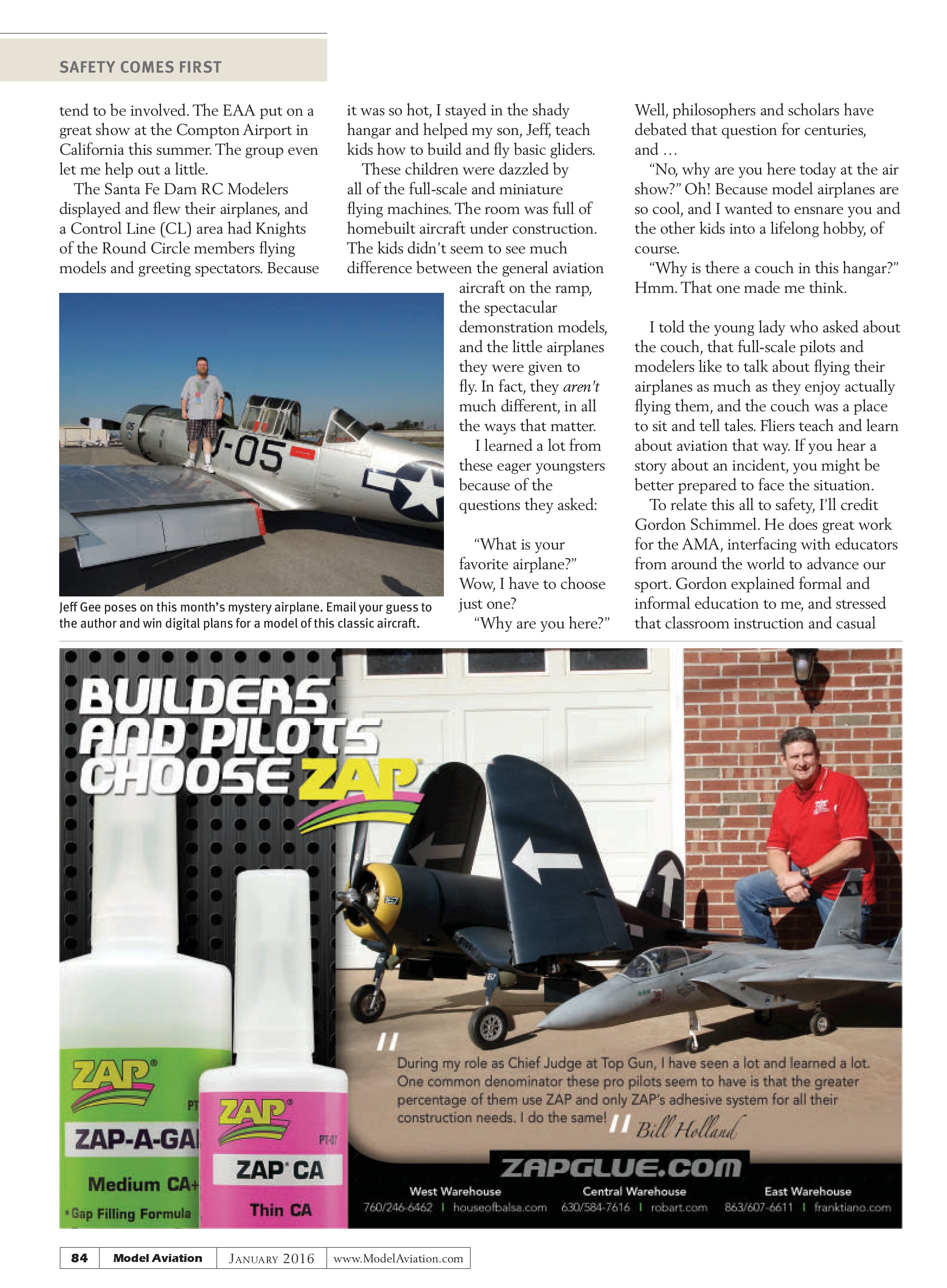
The Santa Fe Dam RC Modelers displayed and flew their airplanes, and a Control Line (CL) area had Knights of the Round Circle members flying models and greeting spectators. Because it was so hot, I stayed in the shady hangar and helped my son, Jeff, teach kids how to build and fly basic gliders.

These children were dazzled by all of the full-scale and miniature flying machines. The room was full of homebuilt aircraft under construction. The kids didn’t seem to see much difference between the general aviation aircraft on the ramp, the spectacular demonstration models, and the little airplanes they were given to fly. In fact, they aren’t much different, in all the ways that matter.
I learned a lot from these eager youngsters because of the questions they asked:
“What is your favorite airplane?”
Wow, I have to choose just one?
“Why are you here?”
Well, philosophers and scholars have debated that question for centuries, and …
“No, why are you here today at the air show?” Oh! Because model airplanes are so cool, and I wanted to ensnare you and the other kids into a lifelong hobby, of course.
“Why is there a couch in this hangar?” Hmm. That one made me think.
I told the young lady who asked about the couch, that full-scale pilots and modelers like to talk about flying their airplanes as much as they enjoy actually flying them, and the couch was a place to sit and tell tales. Fliers teach and learn about aviation that way. If you hear a story about an incident, you might be better prepared to face the situation.
To relate this all to safety, I’ll credit Gordon Schimmel. He does great work for the AMA, interfacing with educators from around the world to advance our sport. Gordon explained formal and informal education to me, and stressed that classroom instruction and casual storytelling are both valuable teaching methods.
Sometimes the best way to learn a safety concept is through hearing about an accident or a near miss. You might read a club newsletter or sit through a briefing about using a spotter when you fly RC at a busy field, but what really brings it home is an old-timer’s yarn about the time he nearly got clobbered and the only thing that saved him was a shouted warning from his spotter. That’s why there is a couch in the hangar—that, and for afternoon naps.
The real teaching at the Compton show was by the flight instructors who gave kids their first chance to operate RC and CL models. You should have seen the look on the kids’ faces when they found out they would be given that chance. “You mean I can fly it?”
There was only one disappointed person in the group of newbies. “Scram, Dave, this is for the kids.”
The Knights were using their amazing electric CL training system again. Perhaps you’ve read about the hybrid CL trainers they designed?
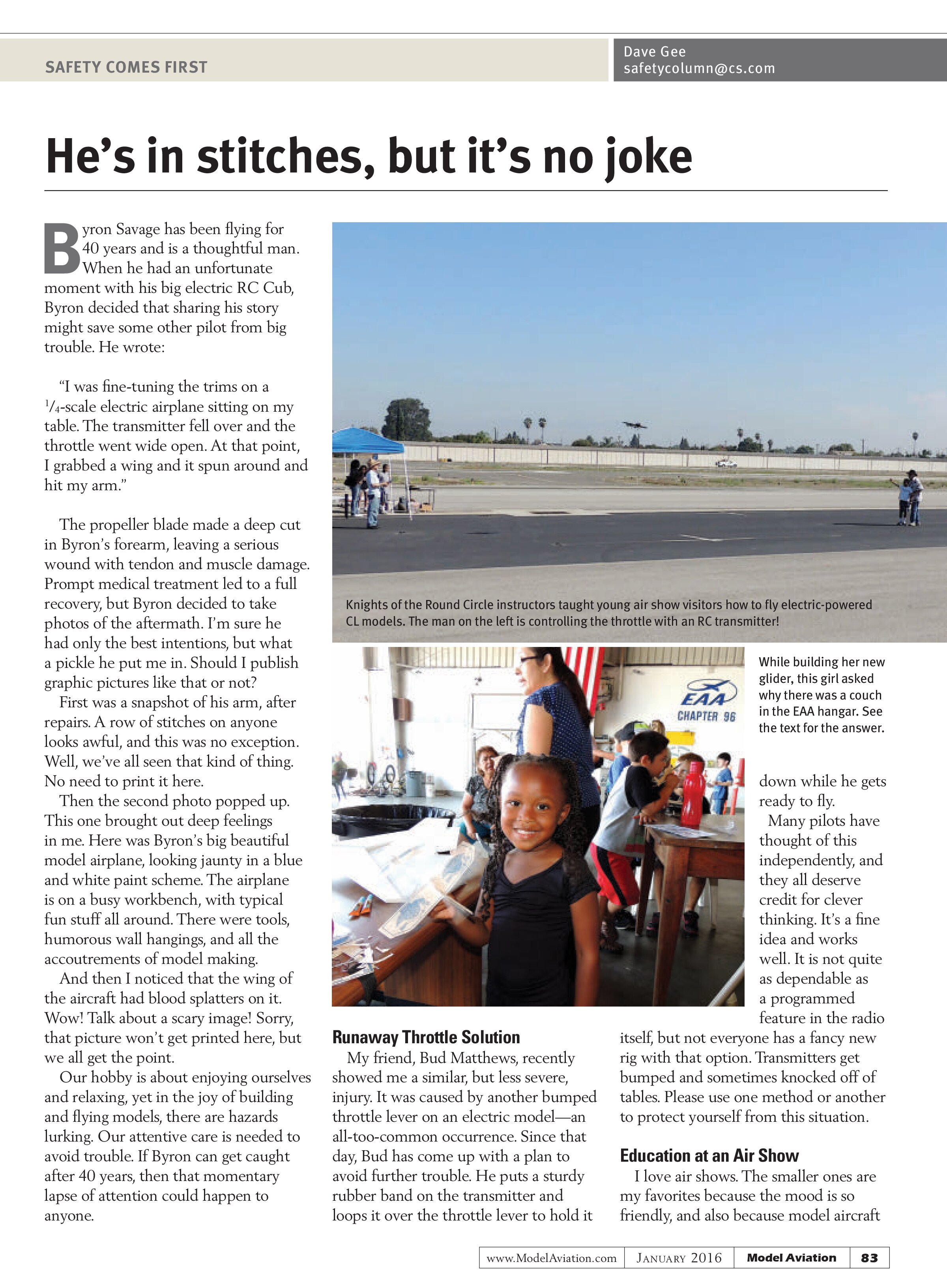
A photo I’ve included shows Larry Renger letting a kid fly a model on the airport ramp, while the man on the left controls the throttle via RC. What fun those young pilots had! And the club members made sure that the safety briefing was part of the enjoyment. Learning and following the right procedures made the trainees feel like they were in the big time. At the end of the show, the tally was zero incidents, maximum fun.
Guess and Get
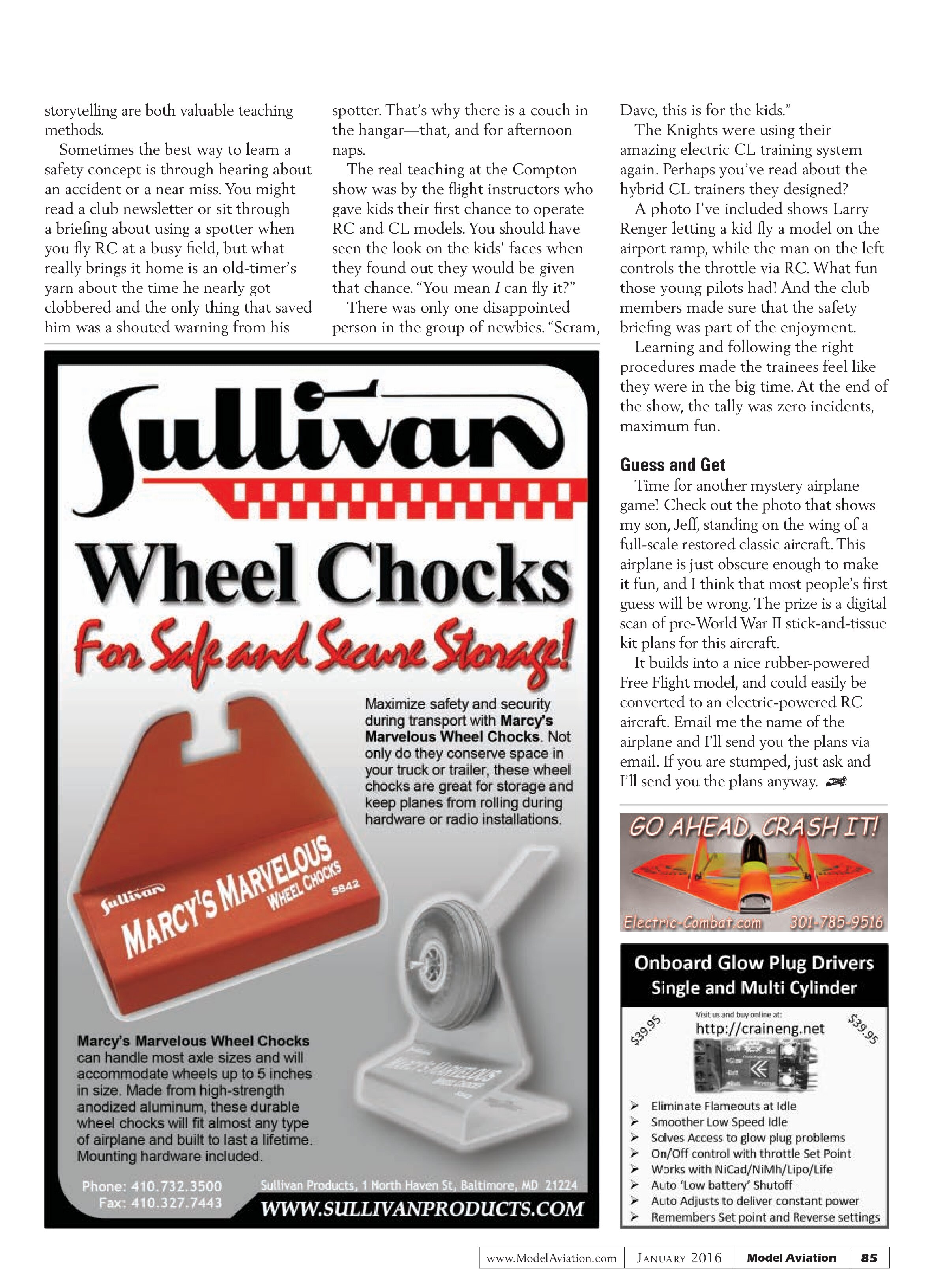
Time for another mystery airplane game! Check out the photo that shows my son, Jeff, standing on the wing of a full-scale restored classic aircraft. This airplane is just obscure enough to make it fun, and I think that most people’s first guess will be wrong. The prize is a digital scan of pre-World War II stick-and-tissue kit plans for this aircraft.
It builds into a nice rubber-powered Free Flight model, and could easily be converted to an electric-powered RC aircraft. Email me the name of the airplane and I’ll send you the plans via email. If you are stumped, just ask and I’ll send you the plans anyway.