Who is the new guy?
by Peter Vogel
vogel.peter@gmail.com

If you’ve been reading this column for a while, as I have, you’ll know that Mike Riggs has done an outstanding job of bringing us the newcomer’s view of the world of RC Aerobatics (Pattern). It’s a lens that I consider ideal for Model Aviation because I think many of our readers have never experienced this discipline of our sport and might be curious as to what it’s all about.
After five years, Mike decided that it was time for someone else to pick up the mantle of responsibility. Although my wife thinks I need my head examined, I offered to continue the “RC Aerobatics” column. I think it is essential for Model Aviation to continue to cover this branch of our hobby from the perspective of “the new guy.”
I built my first airplane, a Sig Kadet Mark II, between 1986 and 1989. I’d always wanted to learn to fly RC and with my first summer at home from college, my girlfriend 600 miles away, and a summer job at Los Alamos National Labs providing a reasonable income, I obtained the kit and

everything I needed to build it from a local hobby shop. Using aliphatic resin glue, the build took quite a while. Changing summer jobs in 1988 meant that I didn’t finish the airplane until 1989, after I’d graduated from college.
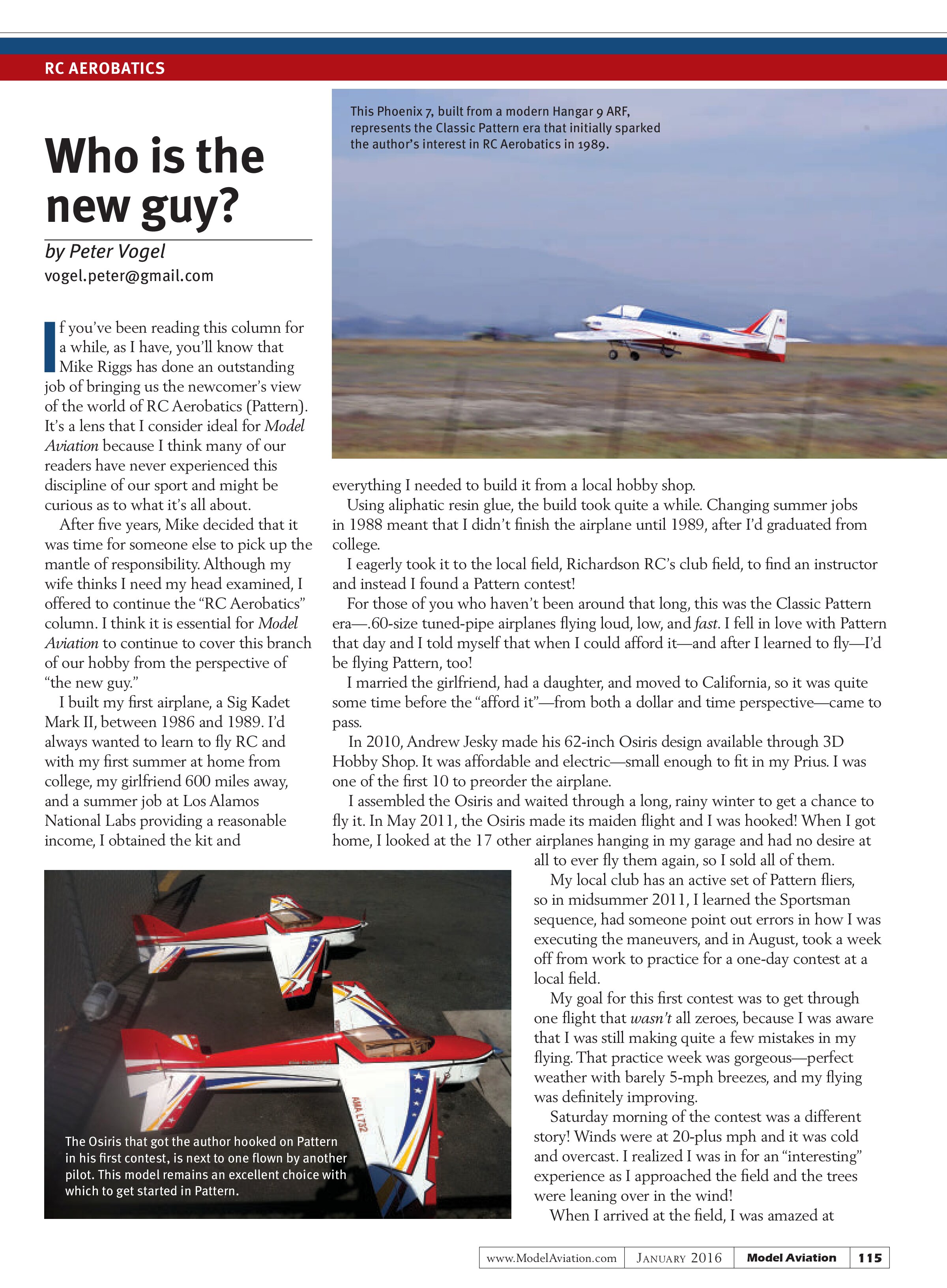
I eagerly took it to the local field, Richardson RC’s club field, to find an instructor and instead I found a Pattern contest!
For those of you who haven’t been around that long, this was the Classic Pattern era—.60-size tuned-pipe airplanes flying loud, low, and fast. I fell in love with Pattern that day and I told myself that when I could afford it—and after I learned to fly—I’d be flying Pattern, too!
I married the girlfriend, had a daughter, and moved to California, so it was quite some time before the “afford it”—from both a dollar and time perspective—came to pass.
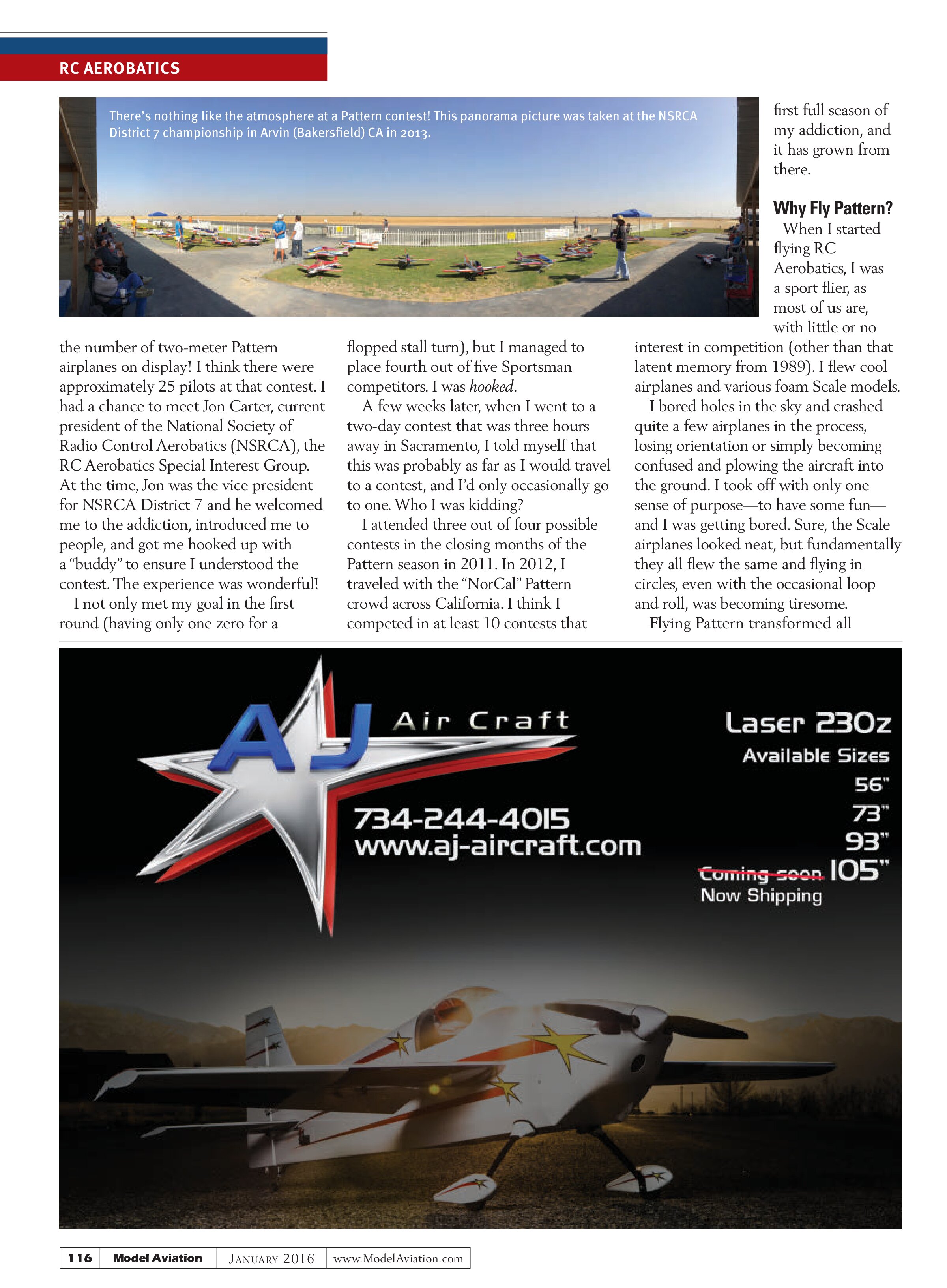
In 2010, Andrew Jesky made his 62-inch Osiris design available through 3D Hobby Shop. It was affordable and electric—small enough to fit in my Prius. I was one of the first 10 to preorder the airplane.
I assembled the Osiris and waited through a long, rainy winter to get a chance to fly it. In May 2011, the Osiris made its maiden flight and I was hooked! When I got home, I looked at the 17 other airplanes hanging in my garage and had no desire at all to ever fly them again, so I sold all of them.
My local club has an active set of Pattern fliers, so in midsummer 2011, I learned the Sportsman sequence, had someone point out errors in how I was executing the maneuvers, and in August, took a week off from work to practice for a one-day contest at a local field.
My goal for this first contest was to get through one flight that wasn’t all zeroes, because I was aware that I was still making quite a few mistakes in my flying. That practice week was gorgeous—perfect weather with barely 5-mph breezes, and my flying was definitely improving.
Saturday morning of the contest was a different story! Winds were at 20-plus mph and it was cold and overcast. I realized I was in for an “interesting” experience as I approached the field and the trees were leaning over in the wind!
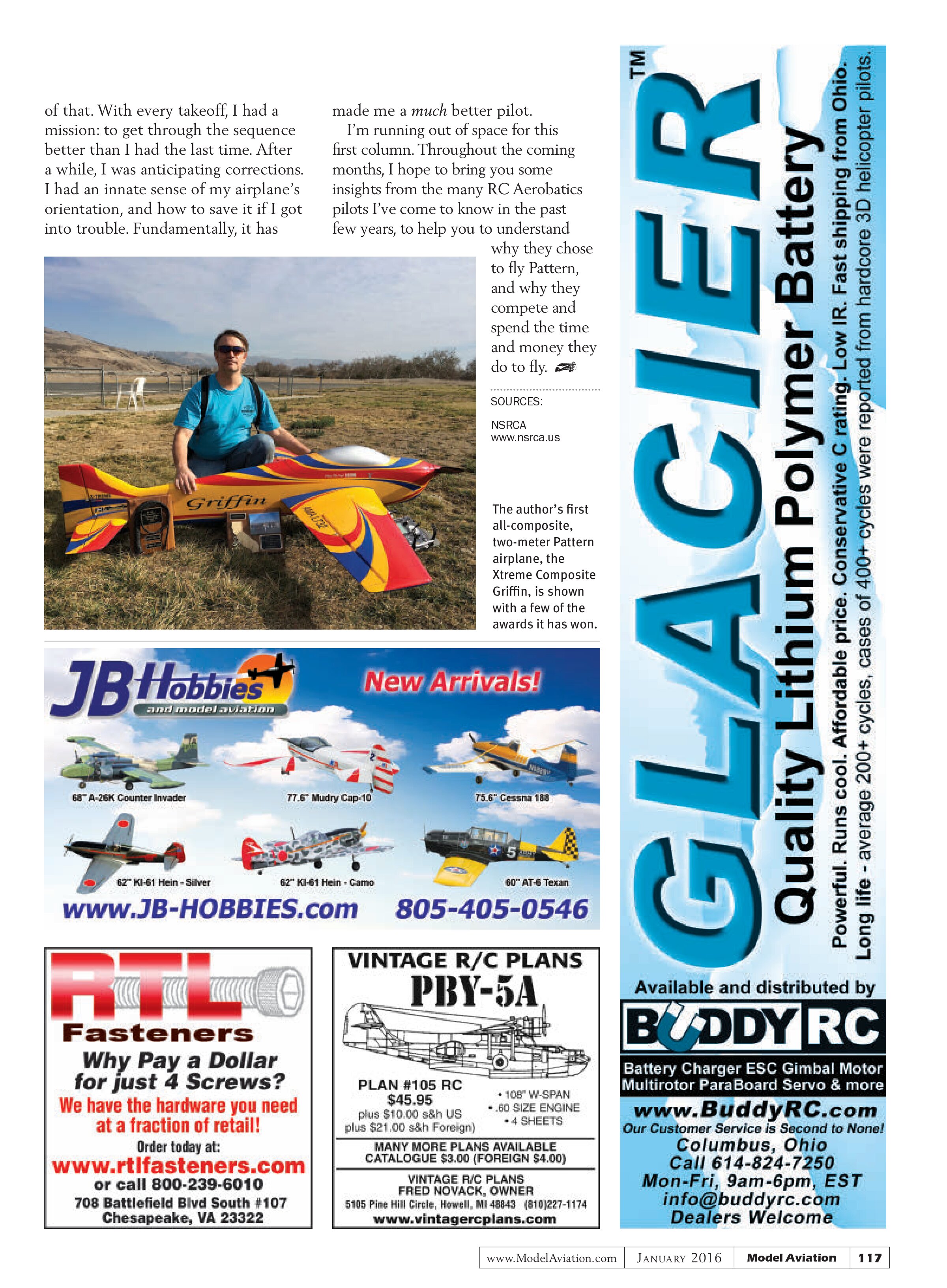
When I arrived at the field, I was amazed at
the number of two-meter Pattern airplanes on display! I think there were approximately 25 pilots at that contest. I had a chance to meet Jon Carter, current president of the National Society of Radio Control Aerobatics (NSRCA), the RC Aerobatics Special Interest Group. At the time, Jon was the vice president for NSRCA District 7 and he welcomed me to the addiction, introduced me to people, and got me hooked up with a “buddy” to ensure I understood the contest. The experience was wonderful!
I not only met my goal in the first round (having only one zero for a flopped stall turn), but I managed to place fourth out of five Sportsman competitors. I was hooked.
A few weeks later, when I went to a two-day contest that was three hours away in Sacramento, I told myself that this was probably as far as I would travel to a contest, and I’d only occasionally go to one. Who I was kidding?
I attended three out of four possible contests in the closing months of the Pattern season in 2011. In 2012, I traveled with the “NorCal” Pattern crowd across California. I think I competed in at least 10 contests that
first full season of my addiction, and it has grown from there.
Why Fly Pattern?
When I started flying RC Aerobatics, I was a sport flier, as most of us are, with little or no interest in competition (other than that latent memory from 1989). I flew cool airplanes and various foam Scale models. I bored holes in the sky and crashed quite a few airplanes in the process, losing orientation or simply becoming confused and plowing the aircraft into the ground. I took off with only one sense of purpose—to have some fun—and I was getting bored. Sure, the Scale airplanes looked neat, but fundamentally they all flew the same and flying in circles, even with the occasional loop and roll, was becoming tiresome. Flying Pattern transformed all

of that. With every takeoff, I had a mission: to get through the sequence better than I had the last time. After a while, I was anticipating corrections. I had an innate sense of my airplane’s orientation, and how to save it if I got into trouble. Fundamentally, it has made me a much better pilot.

I’m running out of space for this first column. Throughout the coming months, I hope to bring you some insights from the many RC Aerobatics pilots I’ve come to know in the past few years, to help you to understand why they chose to fly Pattern, and why they compete and spend the time and money they do to fly.
SOURCES:
NSRCA
www.nsrca.us