Turboprop aircraft perfect for FAC FF Scale
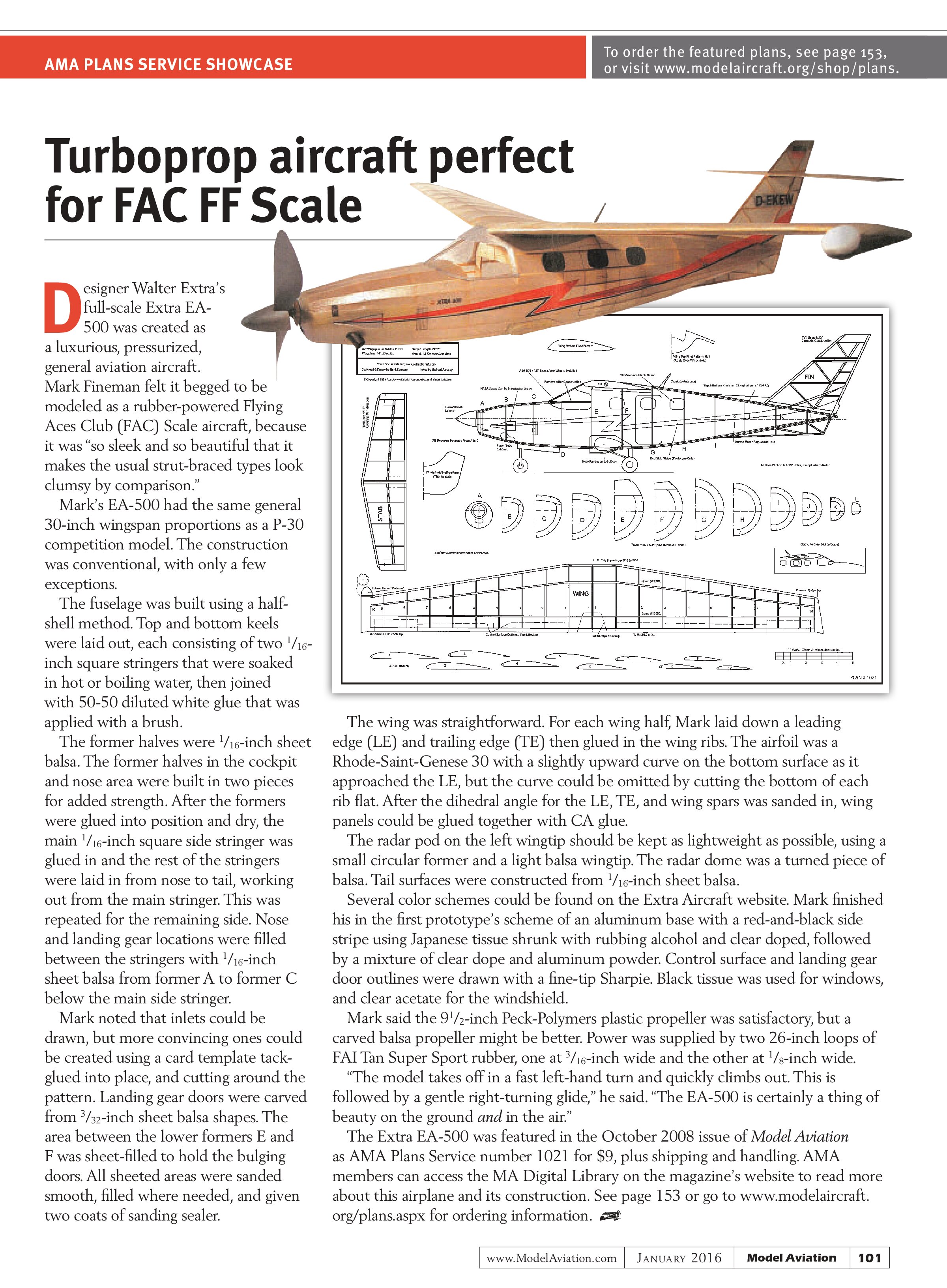
Designer Walter Extra’s full-scale Extra EA-500 was created as a luxurious, pressurized, general aviation aircraft. Mark Fineman felt it begged to be modeled as a rubber-powered Flying Aces Club (FAC) Scale aircraft, because it was “so sleek and so beautiful that it makes the usual strut-braced types look clumsy by comparison.”


Mark’s EA-500 had the same general 30-inch wingspan proportions as a P-30 competition model. The construction was conventional, with only a few exceptions.
The fuselage was built using a half-shell method. Top and bottom keels were laid out, each consisting of two 1/16-inch square stringers that were soaked in hot or boiling water, then joined with 50-50 diluted white glue that was applied with a brush.
The former halves were 1/16-inch sheet balsa. The former halves in the cockpit and nose area were built in two pieces for added strength. After the formers were glued into position and dry, the main 1/16-inch square side stringer was glued in and the rest of the stringers were laid in from nose to tail, working out from the main stringer. This was repeated for the remaining side. Nose and landing gear locations were filled between the stringers with 1/16-inch sheet balsa from former A to former C below the main side stringer.
Mark noted that inlets could be drawn, but more convincing ones could be created using a card template tack-glued into place, and cutting around the pattern. Landing gear doors were carved from 3/32-inch sheet balsa shapes. The area between the lower formers E and F was sheet-filled to hold the bulging doors. All sheeted areas were sanded smooth, filled where needed, and given two coats of sanding sealer.
The wing was straightforward. For each wing half, Mark laid down a leading edge (LE) and trailing edge (TE) then glued in the wing ribs. The airfoil was a Rhode-Saint-Genese 30 with a slightly upward curve on the bottom surface as it approached the LE, but the curve could be omitted by cutting the bottom of each rib flat. After the dihedral angle for the LE, TE, and wing spars was sanded in, wing panels could be glued together with CA glue.
The radar pod on the left wingtip should be kept as lightweight as possible, using a small circular former and a light balsa wingtip. The radar dome was a turned piece of balsa. Tail surfaces were constructed from 1/16-inch sheet balsa.
Several color schemes could be found on the Extra Aircraft website. Mark finished his in the first prototype’s scheme of an aluminum base with a red-and-black side stripe using Japanese tissue shrunk with rubbing alcohol and clear doped, followed by a mixture of clear dope and aluminum powder. Control surface and landing gear door outlines were drawn with a fine-tip Sharpie. Black tissue was used for windows, and clear acetate for the windshield.
Mark said the 9½-inch Peck-Polymers plastic propeller was satisfactory, but a carved balsa propeller might be better. Power was supplied by two 26-inch loops of FAI Tan Super Sport rubber, one at 3/16-inch wide and the other at 1/8-inch wide.
“The model takes off in a fast left-hand turn and quickly climbs out. This is followed by a gentle right-turning glide,” he said. “The EA-500 is certainly a thing of beauty on the ground and in the air.”
The Extra EA-500 was featured in the October 2008 issue of Model Aviation as AMA Plans Service number 1021 for $9, plus shipping and handling. AMA members can access the MA Digital Library on the magazine’s website to read more about this airplane and its construction. See page 153 or go to www.modelaircraft.org/plans.aspx for ordering information.