PAU 50 TO 60CC EDGE 540T
Chris Mulcahy

A capable aerobatic model for 3-D and precision flight
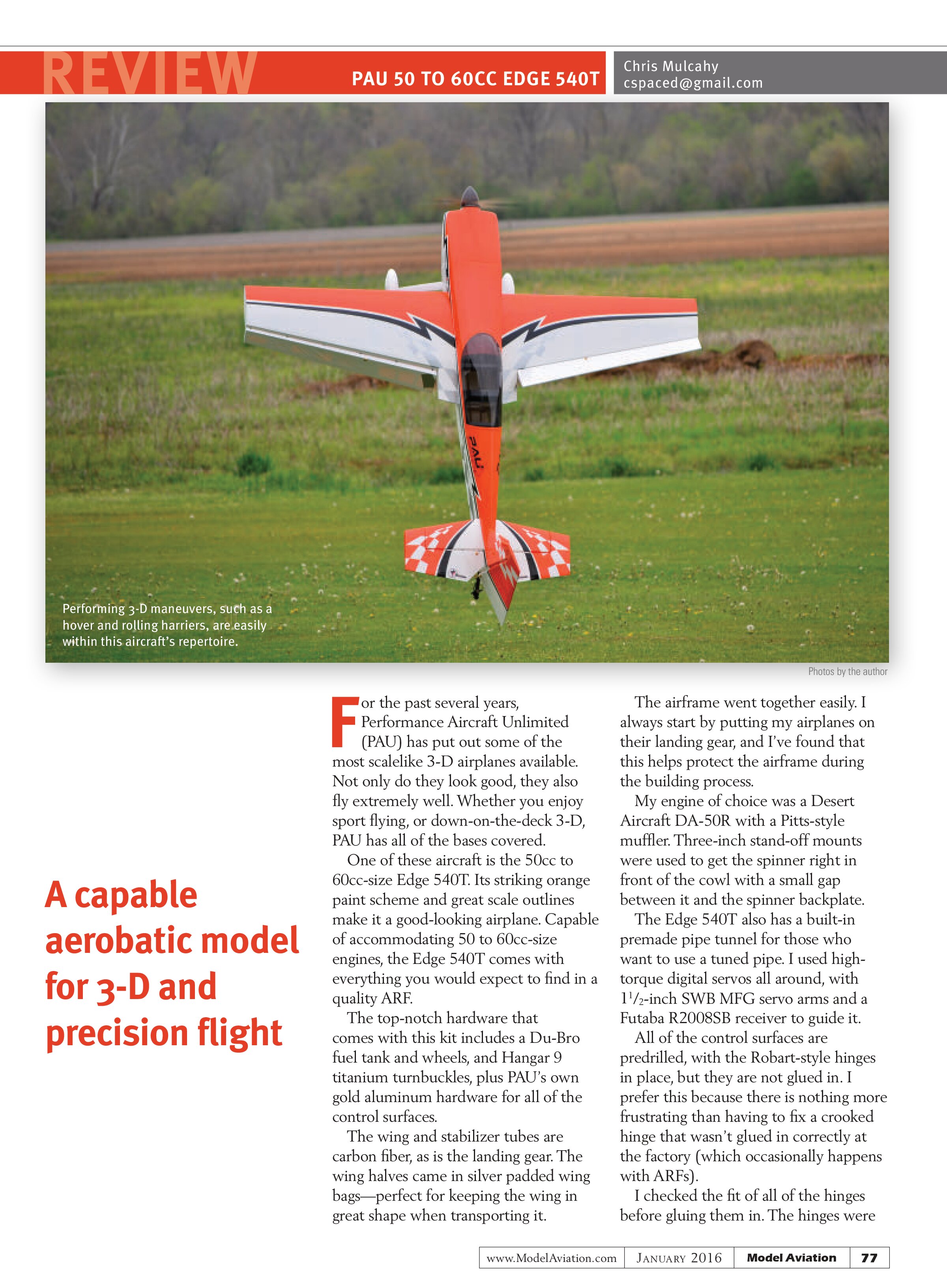
For the past several years, Performance Aircraft Unlimited (PAU) has put out some of the most scalelike 3-D airplanes available. Not only do they look good, they also fly extremely well. Whether you enjoy sport flying, or down-on-the-deck 3-D, PAU has all of the bases covered.
One of these aircraft is the 50cc to 60cc-size Edge 540T. Its striking orange paint scheme and great scale outlines make it a good-looking airplane. Capable of accommodating 50 to 60cc-size engines, the Edge 540T comes with everything you would expect to find in a quality ARF.
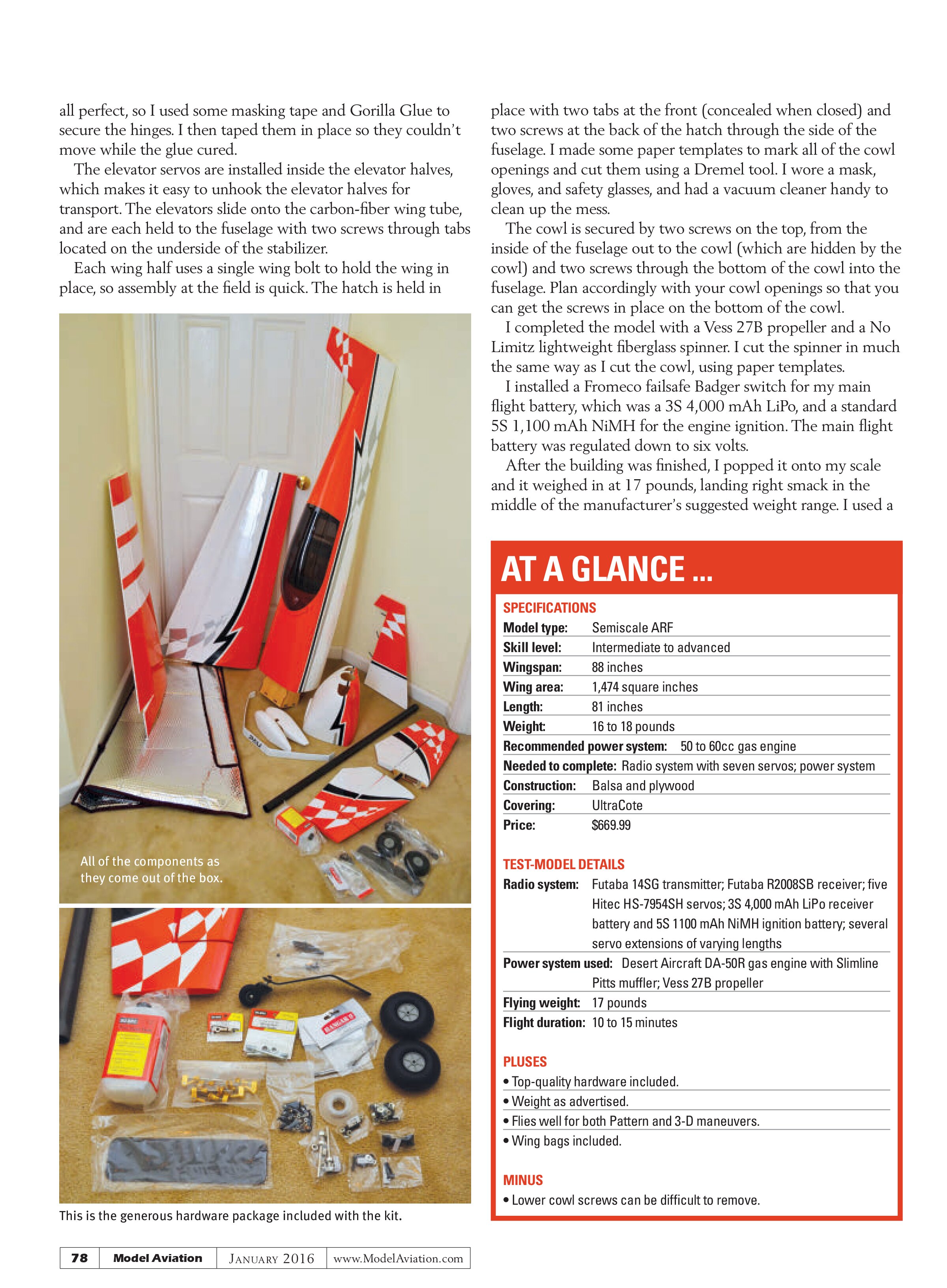
The top-notch hardware that comes with this kit includes a Du-Bro fuel tank and wheels, and Hangar 9 titanium turnbuckles, plus PAU’s own gold aluminum hardware for all of the control surfaces.
The wing and stabilizer tubes are carbon fiber, as is the landing gear. The wing halves came in silver padded wing bags—perfect for keeping the wing in great shape when transporting it.
The airframe went together easily. I always start by putting my airplanes on their landing gear, and I’ve found that this helps protect the airframe during the building process.
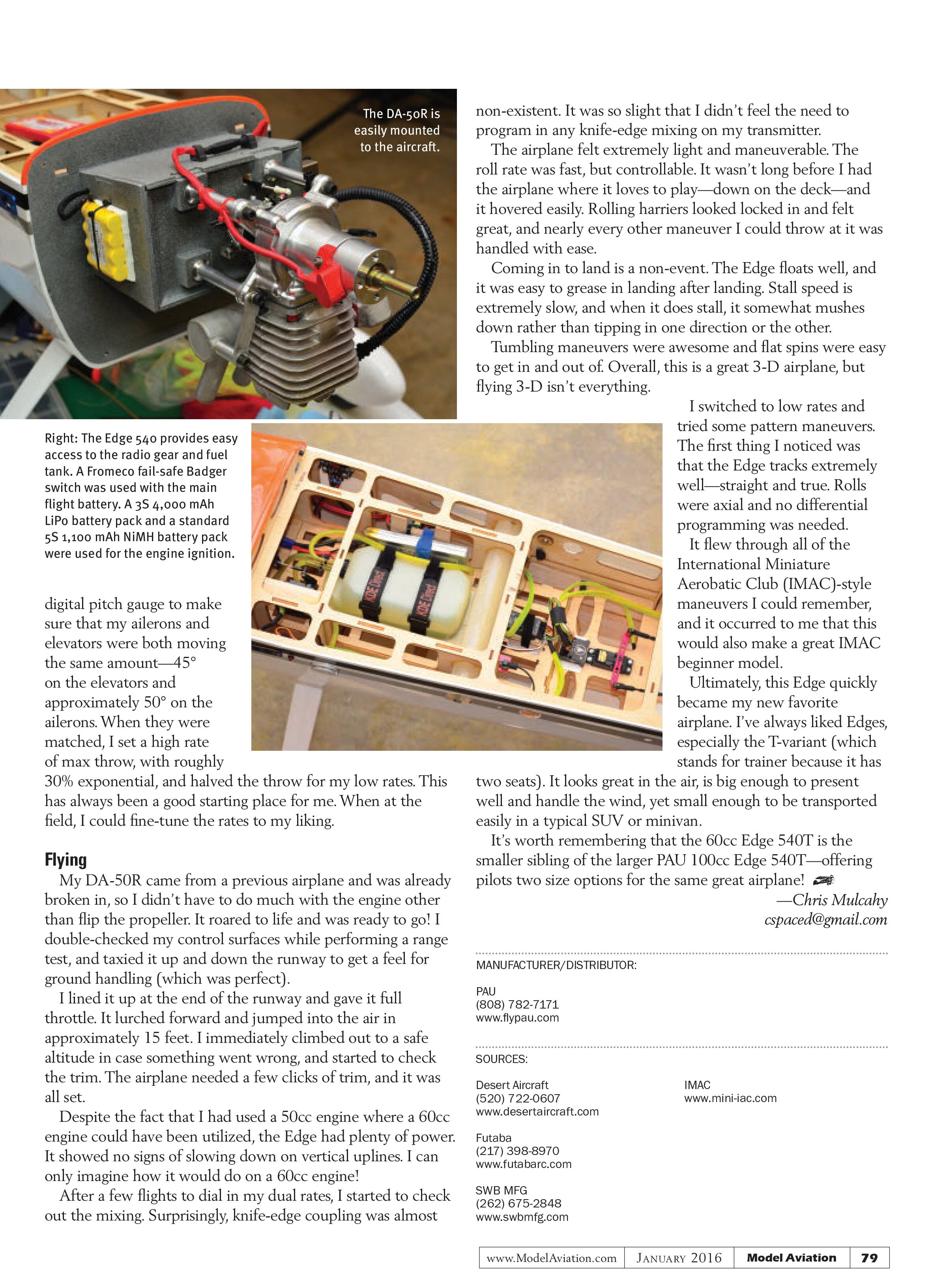
My engine of choice was a Desert Aircraft DA-50R with a Pitts-style muffler. Three-inch stand-off mounts were used to get the spinner right in front of the cowl with a small gap between it and the spinner backplate.
The Edge 540T also has a built-in premade pipe tunnel for those who want to use a tuned pipe. I used high-torque digital servos all around, with 1½-inch SWB MFG servo arms and a Futaba R2008SB receiver to guide it.
All of the control surfaces are predrilled, with the Robart-style hinges in place, but they are not glued in. I prefer this because there is nothing more frustrating than having to fix a crooked hinge that wasn’t glued in correctly at the factory (which occasionally happens with ARFs).
I checked the fit of all of the hinges before gluing them in. The hinges were
all perfect, so I used some masking tape and Gorilla Glue to secure the hinges. I then taped them in place so they couldn’t move while the glue cured.
The elevator servos are installed inside the elevator halves, which makes it easy to unhook the elevator halves for transport. The elevators slide onto the carbon-fiber wing tube, and are each held to the fuselage with two screws through tabs located on the underside of the stabilizer.
Each wing half uses a single wing bolt to hold the wing in place, so assembly at the field is quick. The hatch is held in place with two tabs at the front (concealed when closed) and two screws at the back of the hatch through the side of the fuselage. I made some paper templates to mark all of the cowl openings and cut them using a Dremel tool. I wore a mask, gloves, and safety glasses, and had a vacuum cleaner handy to clean up the mess.
The cowl is secured by two screws on the top, from the inside of the fuselage out to the cowl (which are hidden by the cowl) and two screws through the bottom of the cowl into the fuselage. Plan accordingly with your cowl openings so that you can get the screws in place on the bottom of the cowl.
I completed the model with a Vess 27B propeller and a No Limitz lightweight fiberglass spinner. I cut the spinner in much the same way as I cut the cowl, using paper templates.
I installed a Fromeco failsafe Badger switch for my main flight battery, which was a 3S 4,000 mAh LiPo, and a standard 5S 1,100 mAh NiMH for the engine ignition. The main flight battery was regulated down to six volts.
After the building was finished, I popped it onto my scale and it weighed in at 17 pounds, landing right smack in the middle of the manufacturer’s suggested weight range. I used a


This is the generous hardware package included with the kit.
AT A GLANCE ...
SPECIFICATIONS
Model type: Semiscale ARF
Skill level: Intermediate to advanced
Wingspan: 88 inches
Wing area: 1,474 square inches
Length: 81 inches
Weight: 16 to 18 pounds
Recommended power system: 50 to 60cc gas engine
Needed to complete: Radio system with seven servos; power system
Construction: Balsa and plywood
Covering: UltraCote
Price: $669.99
TEST-MODEL DETAILS
Radio system: Futaba 14SG transmitter; Futaba R2008SB receiver; five Hitec HS-7954SH servos; 3S 4,000 mAh LiPo receiver battery and 5S 1100 mAh NiMH ignition battery; several servo extensions of varying lengths
Power system used: Desert Aircraft DA-50R gas engine with Slimline Pitts muffler; Vess 27B propeller
Flying weight: 17 pounds
Flight duration: 10 to 15 minutes
PLUSES
- Top-quality hardware included.
- Weight as advertised.
- Flies well for both Pattern and 3-D maneuvers.
- Wing bags included.
MINUS
- Lower cowl screws can be difficult to remove.

Right: The Edge 540 provides easy access to the radio gear and fuel tank. A Fromeco fail-safe Badger switch was used with the main flight battery. A 3S 4,000 mAh LiPo battery pack and a standard 5S 1,100 mAh NiMH battery pack were used for the engine ignition.

digital pitch gauge to make sure that my ailerons and elevators were both moving the same amount—45° on the elevators and approximately 50° on the ailerons. When they were matched, I set a high rate of max throw, with roughly 30% exponential, and halved the throw for my low rates. This has always been a good starting place for me. When at the field, I could fine-tune the rates to my liking.
Flying
My DA-50R came from a previous airplane and was already broken in, so I didn’t have to do much with the engine other than flip the propeller. It roared to life and was ready to go! I double-checked my control surfaces while performing a range test, and taxied it up and down the runway to get a feel for ground handling (which was perfect).
I lined it up at the end of the runway and gave it full throttle. It lurched forward and jumped into the air in approximately 15 feet. I immediately climbed out to a safe altitude in case something went wrong, and started to check the trim. The airplane needed a few clicks of trim, and it was all set.
Despite the fact that I had used a 50cc engine where a 60cc engine could have been utilized, the Edge had plenty of power. It showed no signs of slowing down on vertical uplines. I can only imagine how it would do on a 60cc engine!
After a few flights to dial in my dual rates, I started to check out the mixing. Surprisingly, knife-edge coupling was almost non-existent. It was so slight that I didn’t feel the need to program in any knife-edge mixing on my transmitter.
The airplane felt extremely light and maneuverable. The roll rate was fast, but controllable. It wasn’t long before I had the airplane where it loves to play—down on the deck—and it hovered easily. Rolling harriers looked locked in and felt great, and nearly every other maneuver I could throw at it was handled with ease.
Coming in to land is a non-event. The Edge floats well, and it was easy to grease in landing after landing. Stall speed is extremely slow, and when it does stall, it somewhat mushes down rather than tipping in one direction or the other.
Tumbling maneuvers were awesome and flat spins were easy to get in and out of. Overall, this is a great 3-D airplane, but flying 3-D isn’t everything.
I switched to low rates and tried some pattern maneuvers. The first thing I noticed was that the Edge tracks extremely well—straight and true. Rolls were axial and no differential programming was needed.
It flew through all of the International Miniature Aerobatic Club (IMAC)-style maneuvers I could remember, and it occurred to me that this would also make a great IMAC beginner model.
Ultimately, this Edge quickly became my new favorite airplane. I’ve always liked Edges, especially the T-variant (which stands for trainer because it has two seats). It looks great in the air, is big enough to present well and handle the wind, yet small enough to be transported easily in a typical SUV or minivan.
It’s worth remembering that the 60cc Edge 540T is the smaller sibling of the larger PAU 100cc Edge 540T—offering pilots two size options for the same great airplane!
—Chris Mulcahy
cspaced@gmail.com
MANUFACTURER/DISTRIBUTOR:
PAU
(808) 782-7171
www.flypau.com
SOURCES:
Desert Aircraft
(520) 722-0607
www.desertaircraft.com
Futaba
(217) 398-8970
www.futabaRC.com
SWB MFG
(262) 675-2848
www.swbmfg.com
IMAC
www.mini-iac.com